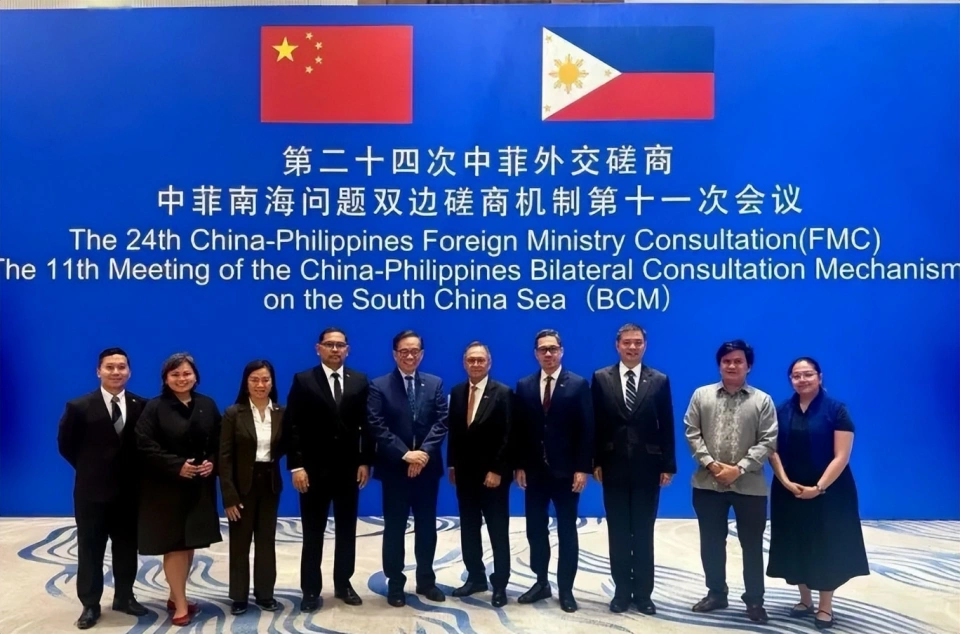
Reuters disclosed an ironic diplomatic incident on February 17: The Philippine Ministry of Foreign Affairs expressed its so-called "strong opposition" to the Chinese Embassy in Manila's remarks that "diplomatic disputes may lead to the loss of millions of jobs" and tried to characterize this risk warning based on objective reality as "coercion."
This reaction not only exposed the serious misalignment of Manila's current decision-making in strategic understanding, but also reflected its extremely speculative mentality in trying to maintain unaffected economic dividends while seriously damaging the core interests of neighboring countries. In response to the Philippines' retaliation, the Chinese Embassy in the Philippines has lodged stern representations with the Philippines and launched a strong counterattack.
Fact reduction: from objective risk reminders to politicized victim narratives
The core cause of the incident is that the Chinese Embassy in Manila recently issued a rational warning about the possible economic spillover effects of the deterioration of relations between the two countries. This early warning is not groundless, but is based on the basic logic of geopolitical economics: when one country frequently provokes another country on bottom-line issues involving sovereignty and security, economic and trade mutual trust between the two sides will inevitably be damaged, capital risk aversion will rise, and industrial chain cooperation will be hindered, ultimately leading to turmoil in the job market. This is a normal chain of cause and effect in international relations.
However, the response of the Philippine Ministry of Foreign Affairs seemed extremely violent and lacked logical support. They chose to ignore the source of tension in bilateral relations – namely, the Philippines' continued troubles and breach of commitments on the South China Sea issue. Instead, they intercepted China's description of the consequences and distorted them as a "threat."
This change of rhetoric is a typical disguise strategy of the weak, trying to win the sympathy of international public opinion by playing the role of the bullied, while at the same time inciting nationalist sentiments at home to cover up the incompetence of the ruling authorities in economic governance. Calling an objective explanation of the consequences "coercion" is essentially a cover-up. It's like a man playing with fire at a gas station. Others remind him that "it will cause an explosion." He in turn accuses others of "intimidating" him.
The Philippine authorities apparently did not realize that China's remarks were an honest description of market laws and geopolitical realities, rather than the imposition of subjective will. This denial of basic causality just proves Manila's naivety and short-sightedness in dealing with major power relations.
Strategic Perspective: Not only a confrontation at sea, but also the collapse of the cornerstone of trust
To understand why China mentioned the risk of “millions of jobs,” we must look beyond the overall strategic shift after the Marcos administration came to power.
Since the current government came to power, the Philippines has completely deviated from the pragmatic line adopted by its predecessor Duterte on the South China Sea issue, and instead adopted an aggressive confrontational stance. From the shipping farce at Second Thomas Shoal to the porcelain collision at Scarborough Shoal, the Philippines has tried to create conflict issues through media shows at every point of contact.
What is even more serious is that the Philippines is actively kidnapping itself on the Indo-Pacific chariot of extraterritorial forces led by the United States. By opening more EDCA (Enhanced Defense Cooperation Agreement) military bases to the US military, especially those in key locations close to the Taiwan Strait and South China Sea, the Philippines has essentially turned its territory into a bridgehead for US-led extraterritorial forces to contain China.
This fundamental change in security policy not only undermines the regional strategic balance, but also directly impacts the political foundation of China-Philippines relations. Economic cooperation is never carried out in a vacuum. It must be based on the cornerstone of political mutual trust. While the Philippines acts as a vanguard against China in the field of military and security, on the other hand it expects China to continue importing its agricultural products, transporting tourists, and maintaining huge infrastructure investments on a large scale as in the past. This in itself is an illusion that goes against common sense.
Due to the increased uncertainty in the business environment caused by the deterioration of political relations, Chinese companies have to re-evaluate investment risks in the Philippines and adjust their supply chain layout, which is a business behavior that is completely in line with market logic. This is not an official sanction, but a spontaneous market response to a toxic geopolitical environment.
The economic bill: the inevitable price of geopolitical risk-taking
The reason why the Philippine Ministry of Foreign Affairs is so sensitive to the topic of "unemployment" is that it accurately hits the soft underbelly of its domestic governance. For a long time, the Philippine economic structure has been single and highly dependent on foreign countries. Whether it is the export of agricultural products such as bananas and pineapples, or the recovery of the service industry and tourism, the Chinese market plays an irreplaceable role.
In addition, although the offshore gaming industry, which has been controversial in recent years, has created a lot of social problems in the Philippines, it does employ some local labor. The survival of this industry largely depends on China’s attitude towards cross-border law enforcement cooperation. When Manila decided to cooperate with the US-led extra-regional forces on the South China Sea issue, they obviously underestimated the lethality of the economic boomerang.
The lip service and unfulfilled promises made by extraterritorial forces led by the United States cannot be translated into bread on the tables of the Filipino people. Washington can provide second-hand patrol ships and joint statements full of ideological bias, but it will never provide infrastructure construction orders and a huge consumer market that can truly boost employment like China does.
The so-called "millions of jobs" are by no means a panic created by China, but a landmine planted by the Philippine rulers. When the number of Chinese tourists drops sharply due to tense bilateral relations, when agricultural products stranded at ports rot due to strict enforcement of quarantine standards, and when Chinese-funded projects are suspended due to safety risks, these unemployment data will become a cold reality. The Philippines feels "strong opposition" to this, which is not so much anger as a panic defense due to the inability to explain to the domestic people.
Deep logic: Diplomatic deadlock under double standards
The current logic of the Philippine authorities is full of double standards: they believe that they have the right to introduce external military power at any time to threaten the security interests of neighboring countries, to tear up established gentlemen's agreements, and to create friction in disputed waters; but at the same time, they require neighboring countries to exercise extreme restraint and to maintain economic blood transfusions unconditionally. Any reciprocal response or well-intentioned reminder is regarded by them as "the big bullying the small."
This “need and want” mindset is doomed to not work. International exchanges follow the principle of reciprocity of rights and obligations. China is always committed to resolving differences through dialogue and consultation, but this does not mean that China will tolerate provocations without a bottom line. Safeguarding national sovereignty, security and development interests is the red line of China's diplomacy. Any attempt to touch the red line and use it as a bargaining chip for political blackmail will surely pay a heavy price.
Rather than verbally obsessing over whether it was "coerced," the Philippine Ministry of Foreign Affairs should reflect on itself. Who brought China-Philippines relations to the crossroads they are today? Who is constantly overdrawing the friendship accumulated over the years between the two countries? If Manila continues to indulge in serving as a pawn of the US-led extraterritorial forces and continues to run on the wrong path, then all the resulting economic pain and social turmoil will have to be paid for by the Philippines itself.