1What is USDT
Since the birth of Bitcoin, the cryptocurrency market has developed to a market value of 400 billion, with more than 1,800 cryptocurrencies issued, and hundreds of cryptocurrency exchanges appearing. However, due to the unclear supervision of local governments, it is difficult for exchanges to obtain support from banks. The connection between legal currency and cryptocurrency has become a big problem, and USDT was born as a result.
USDT is Tether USD (referred to as USDT), a token based on the stable value currency U.S. dollar (USD) launched by Tether. 1 USDT = 1 U.S. dollar.
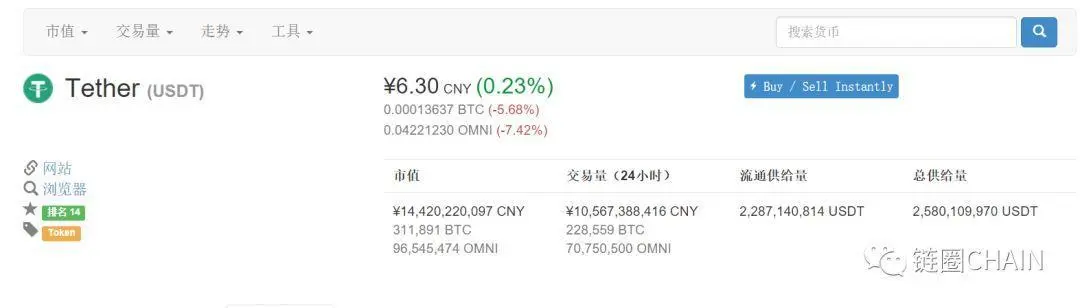
Tether tokens are issued on the Bitcoin network in accordance with the OMNI layer protocol and can be naturally sent on the Bitcoin network. Users can wire USD to a bank account provided by Tether via SWIFT, or exchange for USDT through an exchange. When redeeming USD, just do the reverse operation. Users can also exchange Bitcoin for USDT on the exchange.
Tether is located in Hong Kong. When users deposit legal currency into the company, they can obtain an equivalent amount of tokens issued by the company. The tokens can be used for transfer transactions. Any user holding Tether tokens can exchange the tokens for legal currency at a ratio of 1:1 (minus remittance fees) as long as they complete user authentication at Tether. Currently it supports the US dollar (USDT) and the euro (EURT), which are hosted in different banks, and will also support the Japanese yen in the future.
This model is similar to the issuance of legal currency. Here, the legal currency is the reserve, and the tokens on the chain are the newly issued legal currency. The company Tether acts as the central bank.
In exchanges that have listed Tether tokens, the prices of USDT and USD are basically anchored at 1:1, with little fluctuation. A small amount of fluctuations also exist, often due to the influence of market supply and demand. For example, when the market is hot, USDT, which is a legal currency entry channel, is in short supply on the exchange, causing the price to rise.
USDT Features
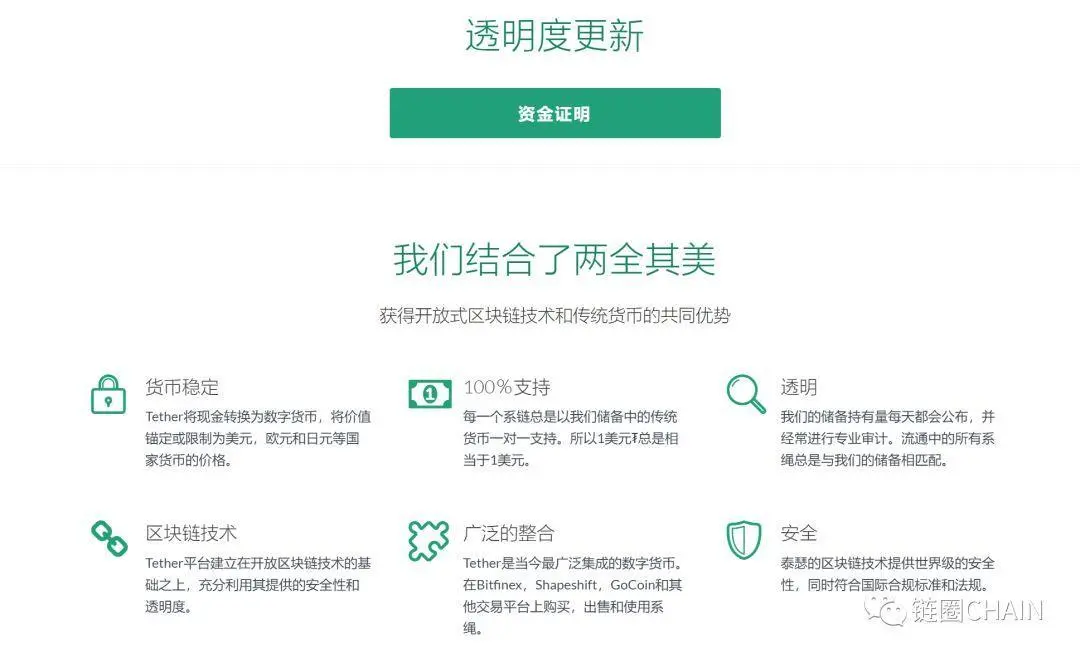
Tether claims to have 100% asset reserves and users can exchange USDT back to US dollars on its platform at a ratio of 1:1. At present, USDT has become the basic anchor currency of mainstream exchanges, with a circulation of 2 billion US dollars, and the price has basically remained stable at 1 US dollar.
2The operating mechanism of stablecoins
1. Centralized legal asset mortgage model
The first is through centralized legal asset mortgage. Such as Tether (USDT) or TrueCoin launched by TrustToken (such as TrueUSD).
USDT is a virtual currency issued by Tether. The former's current market value is approximately US$2.275 billion, accounting for about 90% of the entire stablecoin market share. This is what their white paper says.
“Tethers is a digital currency linked to legal currency. All Tethers are first issued in the form of tokens on the Bitcoin blockchain through the Omni Layer protocol. Each issued Tethers is linked to the US dollar one-to-one, and the corresponding total amount of US dollars is stored in Hong Kong Tether Co., Ltd. (that is, one Tether coin is one US dollar).
With Tether Limited's terms of service, holders can redeem/exchange Tethers with their equivalent fiat currency, or exchange them for Bitcoin. The price of Tether is always linked to the price of legal currency, and the storage amount of its linked currency is always greater than or equal to the amount of currency in circulation.
To put it simply, Tether promises that for every USDT they issue, they guarantee that at least 1 US dollar will be deposited in the bank at the same time, and USDT holders can exchange it for US dollars or Bitcoin at any time. This is to ensure the stability of USDT value.
Tether's method of achieving stable currency value is simple and clear, but it also has obvious drawbacks.
As some critics have pointed out, Tether suffers from the same problem as traditional centralized financial institutions, which is centralization. You need to bear the following risks:
Put aside these capabilities, reserves, policy risks, and moral trust risks. If currency issuance institutions lack supervision, it will be difficult to avoid over-issuance, spam issuance, and black-box operations, and it will also be difficult to avoid gradually becoming opaque driven by huge profits.
Circle CEO Allaire said: "Users now handle fiat currencies through things like Tether, but we see a lot of weaknesses and challenges with Tether."
Generally speaking, the implementation methods of this type of scheme are very simple and can effectively solve the floating risk. There are rarely huge fluctuations, but they bring credit risk. We need to fully trust the institutions behind it, and there will be no over-issuance, spam issuance, misappropriation of funds, or secret operations. If one day the company and the trust behind it collapse, this centralized approach will bring huge systemic risks.
2. Cryptoasset mortgage model
The second common way is to use crypto assets as collateral. Because decentralized crypto assets/tokens themselves run on the blockchain, they naturally solve trust risks and are easy to audit.
Crypto-asset mortgages are usually implemented in this way: for every 1 yuan of stable currency issued, N times (N>1) of other crypto-currency assets are deposited as collateral. The collateral is stored in a smart contract, in which Ethereum can be used to pay off the debt of the stablecoin, or it can be automatically sold by the contract software when the total price of the stablecoin falls below a certain threshold.
These features of a collateral-backed stablecoin make it unnecessary to rely on a centralized institution.

But as mentioned at the beginning of this article, cryptocurrencies themselves are extremely unstable. Therefore, binding cryptocurrencies to achieve value stability solves the trust risk, but it itself has floating risks:
Because the value of collateral will fluctuate, ensure that the unit's stablecoin is adequately collateralized. It's okay if the collateral appreciates, but if the collateral depreciates, the system needs to respond to this. We need to ensure that the collateral value per unit currency is always greater than 1.
Otherwise, once there is a huge fluctuation in the market or a black swan event, and the collateral value is seriously lower than the face value of the corresponding token, the position will be liquidated. Although we have not experienced such a large-scale collapse in the cryptocurrency market so far, it is entirely possible – just like a mortgage on real estate, the collateral depreciates rapidly and the risk of the entire system collapsing increases. This is how the sub-credit crisis of 2008 occurred.

The most terrifying animal in finance, the black swan
Taking DAI launched by MakerDao as an example, when the value of the collateral falls below a certain liquidation value, it will be liquidated. The collateral will be used to repurchase DAI from the market to pay off debt. For example, if 1 USD of DAI uses 3 USD of Ethereum as collateral, but if one day the Ethereum currency suddenly depreciates to 10% and is only worth 0.3 USD, then DAI will lose its value support and the system will be liquidated.
At the same time, assuming that we have to deposit $150 worth of Ethereum in exchange for $100 worth of DAI is a mistake that is simply inefficient. The easier way seems to be to go directly to the exchange and buy $100 worth of DAI for $100, and still have $50 left in your hand…
However, the advantages and benefits of this method of encrypted asset mortgage are also obvious. The first is decentralization, and the second is transparency. Everyone can openly see the fluctuation of the value of the collateral, so if it really collapses, the algorithm itself will be executed mindlessly.
DAI has many application scenarios, such as short-term hedging and trading, because we can see the actual value of the collateral. The short-term risk is very small, but long-term use may cause systemic risks such as black swan events.
3. Algorithmic Banking
Different from the first two operating mechanisms that require collateral, the third way to achieve stable currency is algorithmic banking.
The earliest idea of algorithmic banking came from Seignorage Shares proposed by Robert Sams in 2014. The basic idea is: the supply of tokens is elastic. When the supply exceeds demand, the supply of tokens is reduced. When the supply exceeds demand, the supply of tokens is reduced. When the supply exceeds demand, the supply of tokens is increased, thereby controlling its price.
Is it somewhat similar to how in the real world the central bank maintains the purchasing power of currency by adjusting interest rates, liquidity, and foreign exchange reserves?
Take the more famous base coin as an example. Basecoin realizes the adjustment of circulation through the three-token mechanism. The three tokens are:
**Base currency:** The core token of the system, its role is to anchor the US dollar at a 1:1 ratio, and to maintain this anchoring through the expansion and contraction of its own circulation;
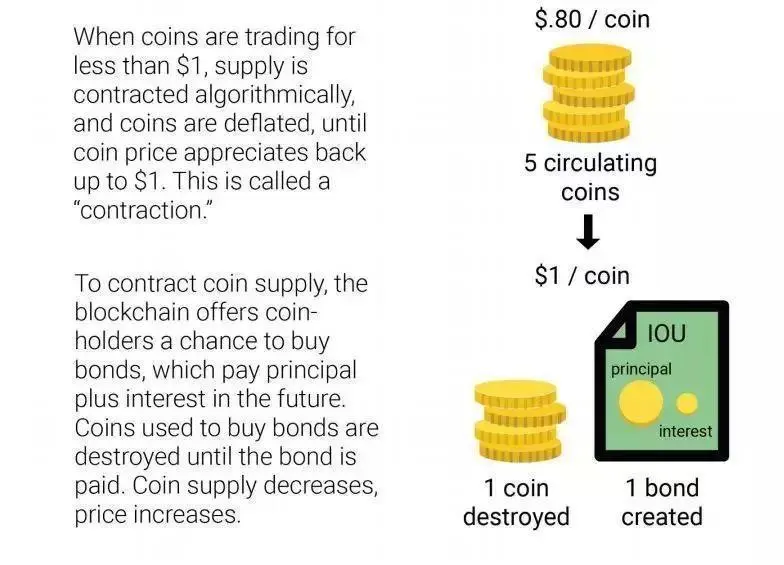
Bond coin: used to regulate the circulation of tokens. When the market price of the base currency is lower than 1 US dollar, the circulation of the base currency must be reduced. At this time, a bond pen auction will be held according to the smart contract system. Bond coins themselves are not anchored to assets. During the auction, the price of bond coins gradually decreases from 1, and the token holder will eventually spend less than 1 unit of base coins to obtain 1 unit of bond coins. The system promises that when new coins are issued in the future, the new tokens will be used to pay off the bond coins 1:1. This price difference will attract token holders to buy.
At the same time, the system destroys or freezes the tokens obtained from the auction, which completes the task of reducing the circulation of tokens.
When the market price is higher than the face value and the circulation of tokens needs to be expanded, the system starts minting coins. The new coins minted are first used to redeem bondholders. As stated above, new coins will be issued at a 1:1 ratio of the face value of the bonds. When bonds are redeemed, they are redeemed sequentially according to the time of bond issuance.
**Equity Coin:** Its quantity is fixed, and the equity itself is not anchored to any asset. The value of the equity comes from the dividend policy when the system issues new tokens.
That is, when executing the token circulation expansion task, if the bonds of all current creditors (bond currency holders) are redeemed and there are still tokens left to be issued, tokens will be issued to equity holders in proportion to their equity currency holdings. In this way, the number of tokens circulating in the market will be increased, which will effectively adjust the token price (pull-down).
It is not difficult to see that through the above mechanism, the contraction and expansion of token circulation can be effectively realized, thereby maintaining the stability of token prices.
However, the problem faced by currencies such as base coin that achieve stability through algorithmic banks is that the market needs to continue to be optimistic about it. Only in this way can it sell the bond coins when it issues them, thus bringing the price of the currency back to $1. Otherwise, we will fall into a terrible death spiral.
In the face of possible trust crises and attacks, Basecoin has designed some mechanisms to allow the system to recover from the death spiral, such as setting the maturity period of the bond. After a certain period of time, the repayment obligation will not be fulfilled (default). However, it is not yet known whether it can withstand the test of time.
The design of a collateral-less stablecoin is ambitious and independent of all other currencies. Even if the dollar collapses, a coin that requires no collateral can survive as a stable store of value. Unlike national central banks, uncollateralized stablecoins do not have perverse incentives to spam money. Its algorithms have only one mission: to achieve stability.
It’s an exciting possibility, and if successful, collateral-free stablecoins could revolutionize the world. But if it fails, it will be extremely catastrophic because there is no collateral to liquidate the tokens back and it will almost certainly collapse to zero.
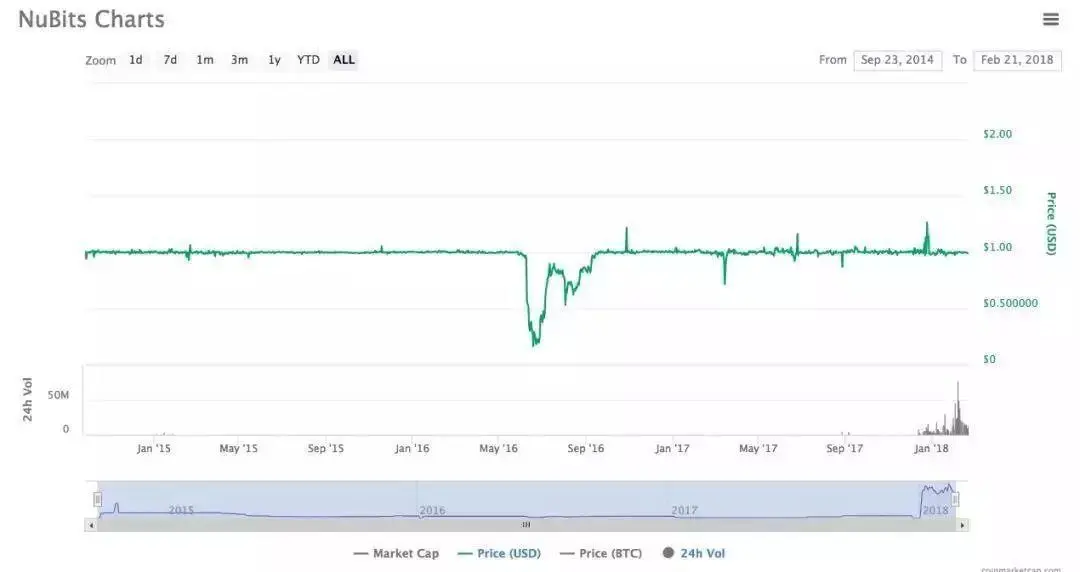
Interestingly, although Robert Sams himself is the proposer of Seignorage Shares, he is not working on this project himself, but is working on other blockchain projects. Previous similar attempts include Peercoins’ Nubits, including the previous BitShares’ bitcny, which also suffered sharp declines and are currently not widely used. It can be seen that the implementation of this solution is indeed not as simple as imagined.
3 Reasons for the “mysterious” existence of USDT
USDT has always been questioned due to non-disclosure of audits, centralization, and alleged over-issuance to manipulate the price of Bitcoin. Some even regard USDT as a Ponzi scheme. Some other stablecoin (anchored currency) alternatives have also appeared on the market, such as TrueUSD supported by the Bittrex exchange and MakerDAO's Dai. Recently, Bitmain led a US$110 million investment in Circle, which announced that it would release a stable currency USD Coin in an attempt to replace USDT.
I will start from the source and analyze the nature of stablecoins, the reasons for the success of USDT, the problems that other stablecoins need to avoid, and how to compete with USDT.
In general, most people misunderstand USDT. Its "mysterious" existence has its own reasons. It is very difficult to replace USDT. Most stablecoin contenders are probably going in the wrong direction.
1. The difference between stablecoins and tokens – why the controversial USDT is successful
First, we need to understand that the stablecoin market is fundamentally different from other cryptocurrency markets (such as Ethereum, EOS, etc.). The stablecoin market is a money market, while other cryptocurrencies are closer to the stock market.
Nobel Prize winner in economics and Swedish economist Bengt Holmström has made a clear comparison between the two. For details, see his paper "Understanding the role of debt in the financial system" (the Wisdom Institute has also analyzed this paper) and his 2017 speech "Debt and Money Markets".
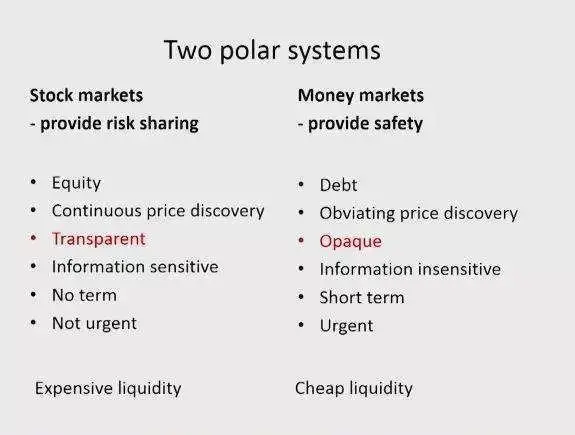
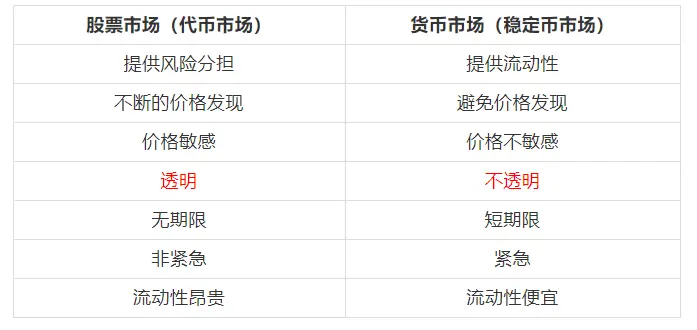
In Bengt's view, the currency market is fundamentally different from the stock market. The stock market is there to provide risk sharing, while the currency market is there to provide liquidity. An important point is that currency markets are inherently opaque, and opacity can provide better liquidity in many cases.
Bengt cited several examples. When diamond group DeBeers wholesales diamonds, it only allows buyers to check whether the correct diamonds have been shipped correctly, but does not allow them to check the details of each diamond. This is because buyers will be picky and try their best to choose the best diamond package, which greatly increases transaction costs and transaction volume. Instead, DeBeers guarantees the quality of its diamonds with its good reputation and collateral. By the same example, the Fed will not announce the specific banks that lend to its discount window because this would create a liquidity premium.
A similar phenomenon can be seen in Taobao stores. Taobao does not require stores to disclose all the details of each product and take photos of each buyer when each transaction occurs. A better approach is to ask merchants to pay a deposit and highlight the role of store reputation and evaluation.
**Opacity can increase liquidity, but that doesn’t mean we don’t need transparency. Providing valid, aggregated information contributes to liquidity more than providing raw information. **This is most vividly reflected in USDT. The official website of Tide Company has a dedicated "transparency" page, which records the asset balance and the issuance quantity of USDT.
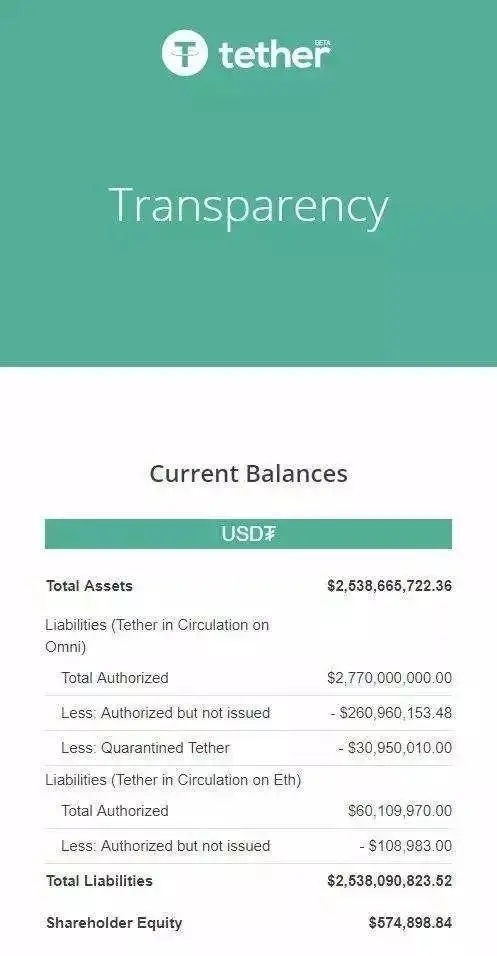
However, since the audit company it cooperated with terminated its cooperation, Tide Company has not provided a detailed audit report (the most recent one was in September last year), nor has it proved whether all assets are in US dollars. This is also one of the reasons why people question the over-issuance of USDT.
*Tether official website description: There are 100% real assets behind all USDT
In fact, this opacity at Ted is actually intentional. Providing only aggregated information is more conducive to the liquidity of USDT. Asset reserve is a vague term. I don't know what the real assets behind USDT represent, but neither does anyone else. "Symmetric ignorance" in the market has reached an equilibrium – no one knows the asset composition behind USDT, but still uses USDT.
2. Complete transparency and 100% USD reserves are not good medicine – the fatal flaw of TrueUSD
Doesn’t Tether’s approach run counter to the spirit of transparency and decentralization pursued by the blockchain? This is indeed the case, and because of this, other US dollar-anchored stablecoins have appeared on the market, trying to replace USDT with a more "blockchain approach."
For example, Bittrex exchange supports anchoring TrueUSD (TUSD), and users can get 1:1 TUSD by depositing US dollars. Unlike USDT, TrueUSD 1. Guarantees full US dollar reserves and provides regular audits. 2. Implement strict standards of KYC/AML verification. 3. Independent hosting, no need to deal with the TrueUSD project team. These three major features seem to be "improvements" to USDT. Will they be advantages in the actual market?
TrueUSD's current market value only accounts for 1/250 of USDT. Of course, this is related to the fact that TrueUSD is still in its early stages, but a recent incident almost caused TrueUSD to be detached from the US dollar. A week ago, Binance, the world's largest exchange, announced that it would launch TrueUSD and open the TUSD/BNB, TUSD/BTC, and TUSD/ETH trading markets.
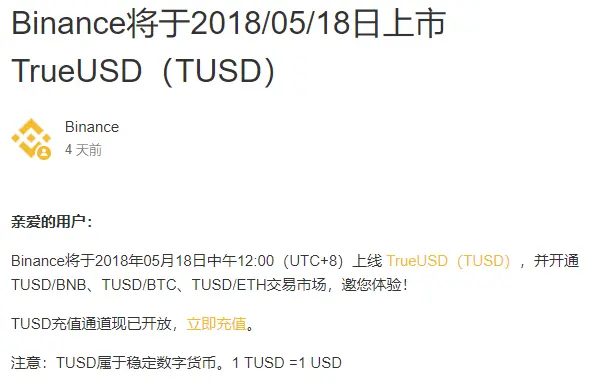
This is originally a good thing for TrueUSD. More people trading and using TUSD will inevitably increase its market share and acceptance. However, the result was massive price fluctuations in TUSD.
The picture below is the TUSD price chart before Binance released the news:
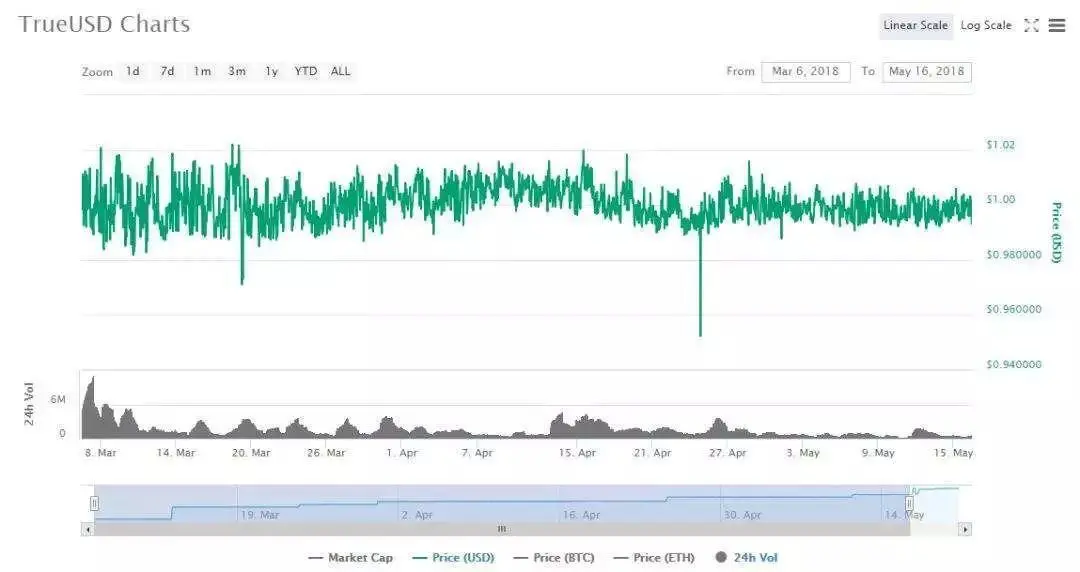
Despite the fluctuations, TUSD has always been able to maintain a price of around $1.
But after Binance announced that it would list TUSD:
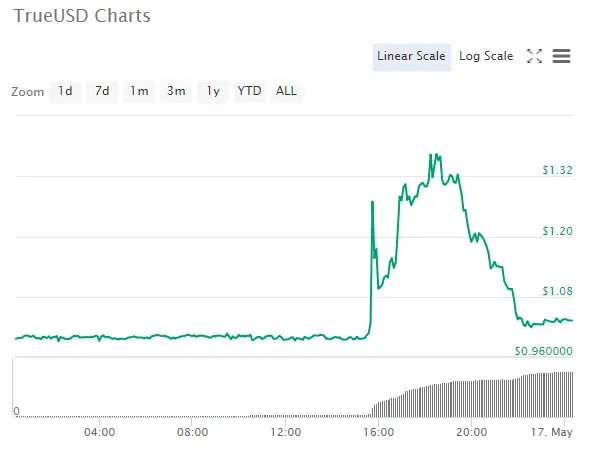
The price of TrueUSD surged on exchanges where it was listed, reaching a maximum of 1.3 TUSD = 1 USD. Many investors regard TUSD as an ordinary token. After discovering the news that Binance will list TUSD, they immediately go to other exchanges to try to "buy the bottom", which causes the price of TrueUSD to skyrocket.
Market participants treat the currency market (information insensitive) where TrueUSD belongs to as the stock market (information sensitive). In fact, in the case of severe information asymmetry, a temporary premium is normal. As long as there is sufficient liquidity, the premium can be eliminated quickly. However, the mechanism of TrueUSD buried its fatal flaw, which also caused it to be decoupled from the US dollar for nearly half a day.
TrueUSD emphasizes strict KYC. Generally, users who want to exchange their US dollars into TUSD at a 1:1 ratio need to fill in a detailed form and wait for more than a few weeks.
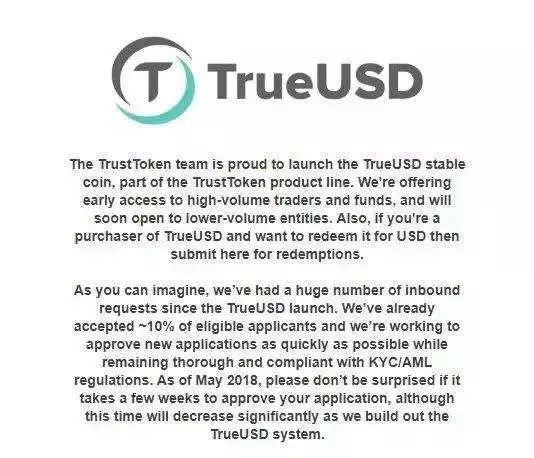
This means that it is difficult for ordinary market participants to act as liquidity providers and smooth out market premiums. At the same time, due to TrueUSD's pursuit of independent custody, the team itself does not have sufficient capital reserves and market-making policies, and is unable to respond to market conditions in a timely manner when a crisis occurs.
The next day, Binance issued a notice that it would delay the listing of TUSD: the TrueUSD team needs sufficient time to meet liquidity.
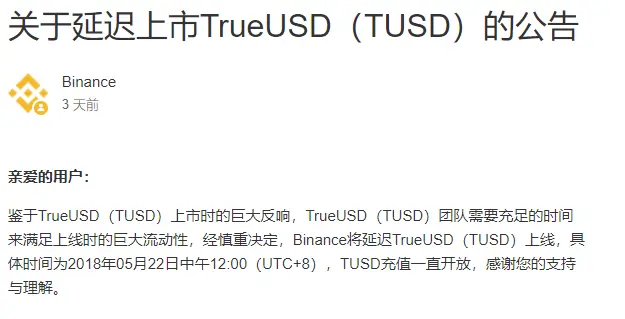
It can be seen that the TrueUSD team is aware of the shortage of liquidity, but the flaws embedded in its mechanism cannot fundamentally solve this problem. Other anchored coin products appear to be following TrueUSD's path. Last week, Bitcoin Continent led a $110 million investment in Circle, which will develop USD Coin and also claims to provide transparent auditing and complete U.S. dollar reserves. As mentioned above, this direction is likely to go against the core of money markets – providing efficient liquidity.
Complete transparency sometimes reduces the efficiency of liquidity. Complete US dollar reserves limit currency-generating assets to fiat currencies, but in reality currency-generating assets are far more than fiat currencies, but include various other debt or asset derivatives. Regarding the money creation of modern banks, it is recommended to read the Bank of England's paper "Money creation in the modern economy (Money creation in the modern economy)"
**3. Alternatives and Breakthrough Points **- Over-collateralization model taking Dai as an example
**Is USDT risk-free? Of course not. As mentioned above, the circulation of USDT is based on the equilibrium reached by people's "symmetric ignorance", but this opacity pushes the risk to the end. **Users and some exchanges regard USDT as a "time bomb" that is used as a last resort. If the banks that Tide cooperates with default, or Tide's reserve assets plummet, or the government bans Tide Company, this black swan event will break the current equilibrium and trigger a domino effect, and the entire cryptocurrency market will face an economic crisis or even collapse.
How to compete for a place in the current equilibrium while providing hedging options for the cryptocurrency market during the USDT crisis?
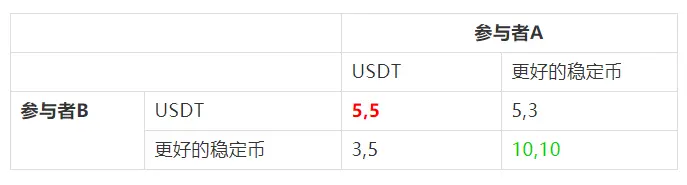
Here is a brief introduction to some basic theories of game theory. **Nash equilibrium is when, given the current reward, market participants have no incentive to move to any other point, so they stay in their current state. **Nash equilibrium does not represent the global optimal equilibrium, but can be a suboptimal equilibrium (there are better options that can benefit the whole world, but people are unwilling to move because any move will not bring higher benefits to individuals). The classic example is the prisoner's dilemma.
The current stable currency market can be said to be in a suboptimal equilibrium: **People realize that USDT may not be the best choice, but individuals have no incentive to try other stable currencies. **Therefore, even if the mechanism becomes better, it will be very difficult for TrueUSD and Circle to challenge or replace USDT in the same field.
Giving market participants new returns and creating another equilibrium paradigm is a more rational (perhaps the only) breakthrough point. This requires that it is fundamentally different from USDT (higher than the level of supervision and auditing) and that it can ensure efficient liquidity.
**Over-collateralization is a feasible and widely used method in financial markets. **The creation of liquidity by over-collateralization is not a new thing. It originated from pawnshops in ancient China. Pawnshops allowed liquidity demanders and providers to quickly obtain liquidity without having to undergo a price discovery process. For example, someone is willing to sell a collection of famous paintings to obtain liquidity, but the accurate valuation of famous paintings is a very costly matter. Instead of bargaining, the pawnshop can give the holder of the famous paintings a loan that is significantly lower than its value, and then both parties agree to pay off the loan and interest within a specified time, and the famous paintings return to their original owners. This ancient but very effective method has continued into the modern financial repo market. (The repo market is an important money market, accounting for nearly $3 trillion in market capitalization).
The most successful project based on this model so far is the MakerDAO project, whose stablecoin Dai is issued through over-collateralized assets. The innovation is that its collateral is on-chain assets such as Ethereum, which can provide liquidity at a low cost based on smart contracts (anyone can obtain liquidity by over-collateralizing Ethereum assets). The issuance model of asset mortgages on the chain encourages people to spontaneously mortgage funds, enriches the sources of liquidity, and eliminates the need for centralized gateways and custody, eliminating people's doubts about central institutions (since the mortgage process is all on the chain, sufficient transparency is provided).
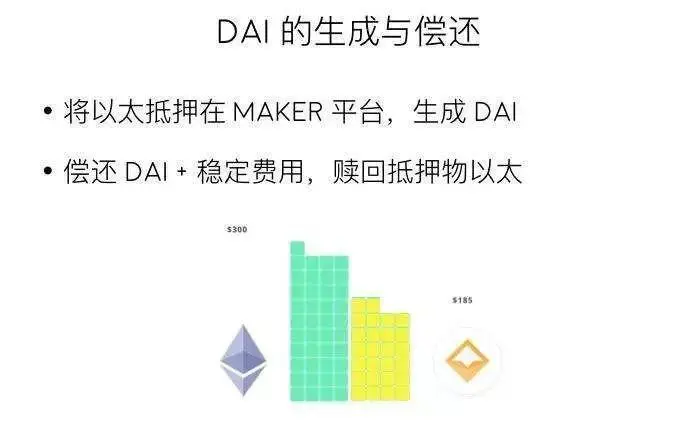
Over-guarantee and automatic liquidation themselves avoid the cost of price discovery and the liquidation of risky debt.
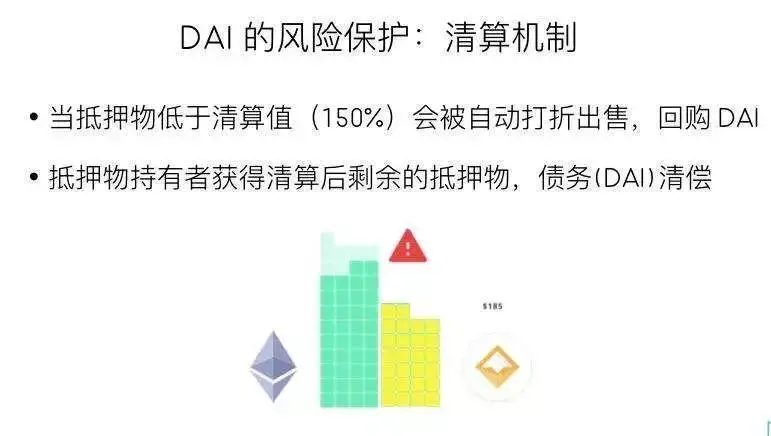
Even if Dai experiences temporary illiquidity, any market participant can generate liquidity by staking at a cost of $1 to even out the premium in the form of arbitrage.
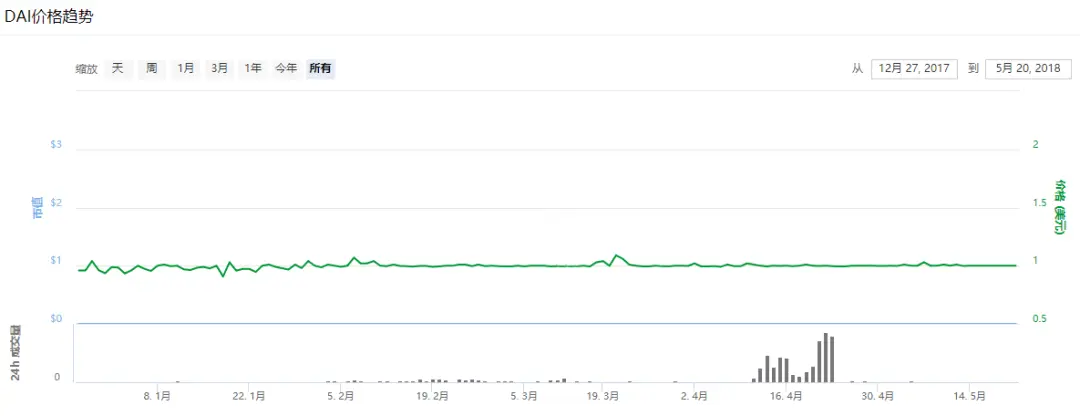
*Since its launch in 2012, the price of Dai has remained basically stable at $1.
Importantly, Dai does not directly compete with USDT for the traditional exchange market. Dai's decentralized issuance and its own ERC20 standard make it the first choice for decentralized exchanges and applications, and serves as the base currency on many decentralized exchanges (even including some traditional exchanges). This creates another equilibrium paradigm (base currency for decentralized exchanges and applications) by giving market participants new rewards (collaterals).
4 words written at the back
This article introduces the nature of stablecoins and people’s misunderstandings when understanding USDT, and analyzes several major stablecoin models and prospects. The development of stablecoins is still in a relatively early stage. It is foreseeable that USDT will still dominate the stablecoin market in the short term, and with the follow-up of supervision, the development of the blockchain itself and the emergence of new technologies, the current situation may change.