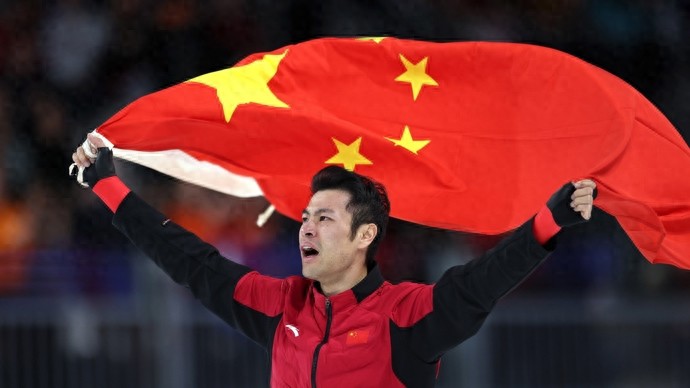

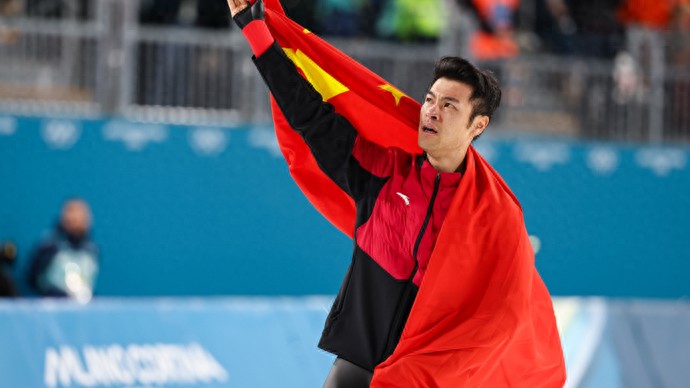
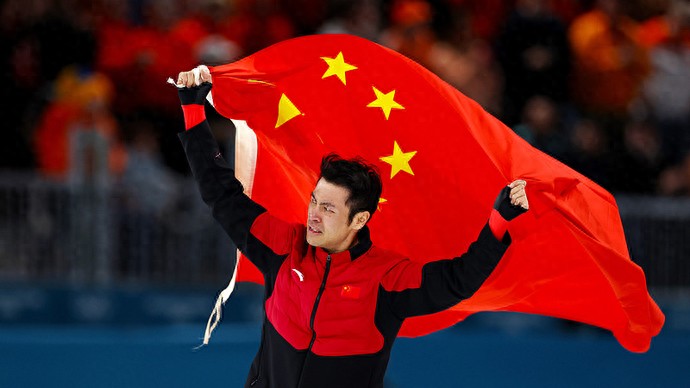
When the timing screen froze at 1 minute, 41 seconds and 98, the audience was stunned for a brief moment, and then was erupted in an even louder noise: This was not only a gold medal, but also a new Olympic record. On the evening of the 19th local time, in the men's 1,500-meter speed skating final at the Milan Winter Olympics, Chinese skater Ning Zhongyan skated the most important lap of his career: He won the championship with an Olympic record and won the Chinese team's first gold medal in the speed skating event at this Winter Olympics. American prodigy Jordan Stoltz won the silver in 1:42.75, and Dutch star and two-time Winter Olympic champion Kjeld Nuys won the bronze in 1:42.82.
This is an absolutely hard-core victory. Stoltz came to this Winter Olympics with two gold medals in the men's 1,000 meters and 500 meters, and both set new Olympic records. Before the game, the outside world generally regarded him as the number one favorite in the 1,500 meters. Nuis is the "veteran ruler" of this event. He has won the two Winter Olympics in Pingchang and Beijing and has maintained the world's top level for a long time.
Ning Zhongyan's victory in such a pinch was not an "upset", but a fulfillment of the past four years of waiting and hard work.
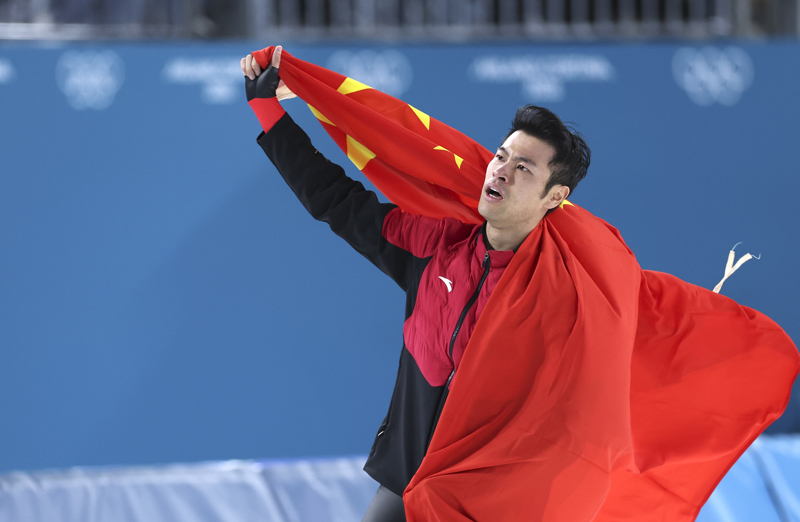
Xinhua News Agency photo, Milan (Italy), February 19, 2026. On February 19, Ning Zhongyan celebrated wearing the national flag after the game. On February 19, local time, the men’s 1,500-meter speed skating final of the Milan-Cortina Winter Olympics was held in Milan, Italy. Chinese player Ning Zhongyan won the championship and set a new Olympic record. Photo by Xinhua News Agency reporter Du Xiaoyi
Win in "the only chance"
The men's 1,500 meters is the most typical middle-distance event in speed skating and the most comprehensive test of overall ability: you must not only dare to start fast, but also know how to pace – if you start half a beat slower, your opponent will take away the rhythm; if you go too fast, you may "lose more than you gain" in the last lap.
Judging from the official segmented data, Ning Zhongyan’s victory this time is a typical example of a strong future and an extremely accurate grasp of key points. He ran the first 300 meters in 22.99 seconds, the 700 meters in 47.86 seconds, and the 1,100 meters in 1 minute, 13.80 seconds to reach the best section of the competition, finally withstanding the pressure of the last lap and crossing the line.
This set of comparisons is particularly eye-catching: rival Nuis in the same group was faster in the first 700 meters – he was first in the competition in both the 300 meters and 700 meters. But between 700 and 1100 meters, Ning Zhongyan completed a "comeback" that determined the outcome and abruptly took the advantage from his opponent.
At the post-race press conference, Nuis took the initiative to give a professional analysis to the reporters present: starting on the outside track at 1,500 meters is usually more advantageous, and it is easier to form a rhythm of sliding and "eating the wind" after the start, and cornering and changing lanes for the first time are more like "hunting"; while Ning Zhongyan started sliding on the inside lane this time, "there are fewer opportunities", and he must make his movements almost perfect in the window of changing lanes from 700 to 1100 meters! "He only had that one chance, he seized it, and then he won." The analysis of this "veteran king" is undoubtedly very weighty.
Ning Zhongyan himself admitted that he was nervous the moment he saw the grouping. "The person sitting next to me is a two-time Olympic champion… I actually want to skate on the outside track." He smiled and said, "Everything is often not as expected." However, he and his coach made the strategy very clear before the game: when starting on the inside track, you must "use all your strength" in the first two laps. As for the last lap, "pray to God." It also reflects the brutality of the project.
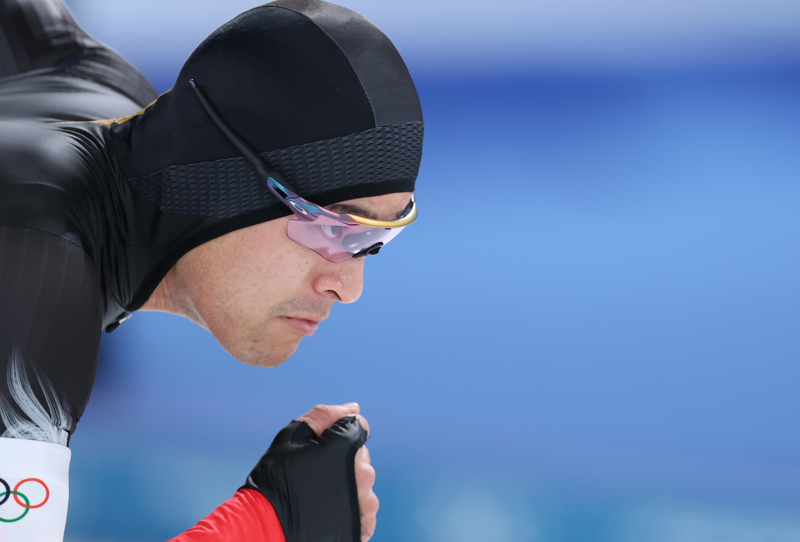
On February 19, Ning Zhongyan was in the game. On February 19, local time, the men’s 1,500-meter speed skating final of the Milan-Cortina Winter Olympics was held in Milan, Italy. Chinese player Ning Zhongyan won the championship and set a new Olympic record. Photo by Xinhua News Agency reporter Du Xiaoyi
“Olympic records are continuously refreshed”: fast ice and the fast era
The 1,500 meters was also like a "slice of the times": the Olympic record was rewritten twice that night – Dutch teenager Joop Winnemars skated first in 1 minute, 43.05 seconds and briefly became the record holder. After the two groups, Ning Zhongyan pushed the record directly to 1 minute, 41.98 seconds. Winnemars ended up fourth, just a short step away from the podium.
"Record rain" is no accident. Before the start of the speed skating competition at this Winter Olympics, some players and coaches expressed concerns about the "softness of the ice"; but soon, records appeared one after another. The event's ice management team gradually adjusted the ice surface and indoor air conditions to allow this temporary venue to continue to skate at high-quality speeds. In just a few days, many Olympic track records were refreshed.
It is worth mentioning that the Milan Speed Skating Arena itself is a "new proposition": it is the first indoor temporary speed skating oval built in a trade exhibition hall in the history of the Winter Olympics. Ice director Mark Messer has brought many years of experience in making ice for the Winter Olympics to "make" the standards of "hard, cold, clean and flat" layer by layer.
Therefore, when someone asked at the press conference "Why has speed skating become faster and faster in the past two years?", Nuis and Stoltz both spread their hands and laughed and said "I don't know." In fact, behind it is a more professional and sophisticated system: ice surface, equipment, training, confrontation intensity…
The answer given by Ning Zhongyan is more from an "athlete's perspective." He first said that he did not dare to evaluate the women's project, but the men's performance has skyrocketed, to some extent because "a talented young man has appeared in the past four years", making the entire project "very timid" – of course he was talking about Stoltz next to him. After saying this, the latter immediately nodded to Ning Zhongyan. The stimulation of a "genius" is also the simplest way to progress in competitive sports.
From "Cashier" to Champion: Four Years of Silence and One Explosion
Ning Zhongyan cried after winning the championship. It was not until the last group of players finished the race and the results were confirmed that he truly believed that the gold medal belonged to him.
At the press conference, he said frankly: "I haven't beaten Jordan in the entire season. I still can't believe that I really won. I finally crossed this mountain."
He also made a joke about himself, "I saw netizens commenting that I am a 'cashier'" because in the past few years, there have been more silver and bronze medals in competitions, but fewer gold medals. There is actually a familiar grievance hidden in the laughter and the relief that the dream has finally come true.
Indeed, he persevered very hard along the way. At the Beijing Winter Olympics, the outside world expected him to become a new breakthrough point for Chinese men's speed skating after Gao Tingyu. However, in his first Winter Olympics, he was seventh in the 1,500 meters and fifth in the 1,000 meters, missing the medal. "At the time, my mind was confused, and I couldn't recover for a long time." he said.
From Beijing to Milan, he chose to "actively seek change": he joined the training system of foreign clubs and absorbed more professional and refined concepts; under the leadership of the famous Dutch coach John de Wit, training ideas, confrontation intensity, and stability were all being reshaped.
Before this Winter Olympics, he had "paved" his status with two bronze medals: the men's 1,000-meter bronze medal and the men's team pursuit bronze medal, allowing the Chinese team to achieve breakthrough results in long-distance team events.
The gold medal in the 1,500-meter race is like paving the way for this series and finally sealing the coffin.
"Heroes cherish each other": a hug and a kind of tolerance
After the game, Ning Zhongyan took the initiative to hug his two opponents. In the past, this event was dominated by European and American players for a long time. Now that an Asian player stands on the top podium, the three medal winners are more like "each other is happy for each other."
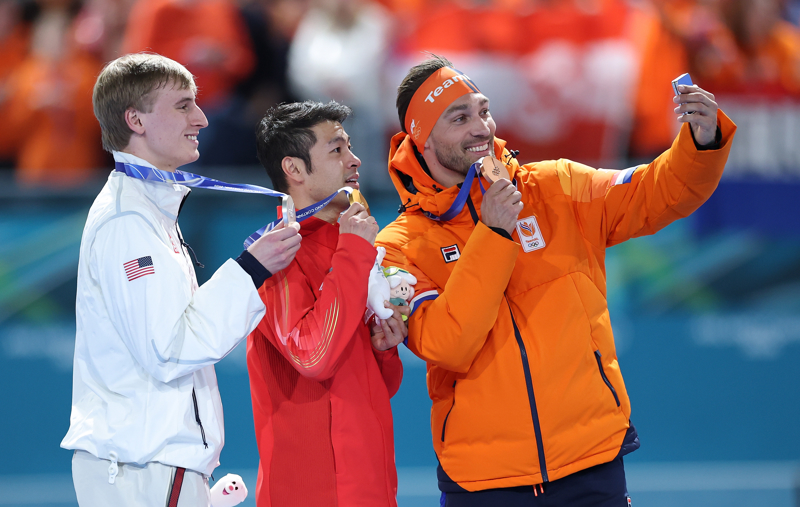
On February 19, champion Chinese player Ning Zhongyan (middle), runner-up American player Jordan Stoltz (left), and third runner-up Kyle Ness of the Netherlands took a selfie at the award ceremony. On February 19, local time, the men’s 1,500-meter speed skating final of the Milan-Cortina Winter Olympics was held in Milan, Italy. Chinese player Ning Zhongyan wins the championship
Stoltz said that when he saw Ning Zhongyan win the championship, he "just felt happy for him" because he was "especially infectious and sincere." Nuis also added: Ning Zhongyan came to him specifically before the game and said, "It's an honor to be in the same group with you and wish you good luck in the last Olympics." This "active respect" is impressive.
In the current sports context, this kind of attitude of "treating opponents as people who jointly complete a work" is particularly rare. You can understand it as personal cultivation, or as a more professional mutual recognition among top athletes: Olympic champions are not determined by "luck". Behind any medal, there is a set of "ledgers" that can withstand disassembly – technology, physical fitness, on-the-spot tactics…
What does this gold medal leave behind for Chinese speed skating?
Ning Zhongyan said very simply at the press conference: "Speed skating is not that influential in our country… but our results are not bad. We have gold medals at the Beijing Winter Olympics and we also have gold medals at the Milan Winter Olympics. I think our speed skating is no worse than any other event. I also hope that our speed skating will get better and better, and we will definitely give everyone more surprises."
This sentence deserves careful consideration. Chinese speed skating used to rely more on short-distance explosions: an "explosion" can make more people aware of the event, but what really determines the height of the event is often the "thickness" of the middle distance. It requires more complex energy distribution, a more stable technical structure, and it also tests the long-term training system. Because of this, the breakthrough of 1,500 meters means not just "one more gold medal" for Chinese speed skating, but more like pushing the competitiveness map to the middle distance.
And this advancement is inseparable from more open and professional training and higher-density international confrontation. DeWitt emphasized in an interview before the Winter Olympics that Ning Zhongyan's most obvious improvement in recent years is "higher stability and faster speed." Chinese and Japanese players promote each other in the same training system, which also makes top competition more routine.
When high-level competition becomes "daily training", it is not surprising that things that were once "dare to be thought of" can now come true.


![[Netherlands] France Turns To The Netherlands To Support Its Military Operations-Lijin Finance](https://www.erbetc.com/wp-content/uploads/2026/03/1773277663261_0.webp)