Black swan incidents in virtual currency exchanges always happen from time to time, and this time it is OKEx’s turn.
OKEx, one of the three major virtual currency trading platforms in China, suddenly issued an announcement today that it would suspend currency withdrawals and said that some of the people in charge of private keys were cooperating with the public security agency’s investigation.
According to a reporter from the Securities Times, Xu Mingxing, the actual controller of OKEx, has been taken away by the police, and OKEx may be suspected of cross-border money laundering, "because large cross-border transfers through virtual currency must be completed through Xu Mingxing's coordinated operation."
OKEx suspended withdrawals, OKB plummeted during the session
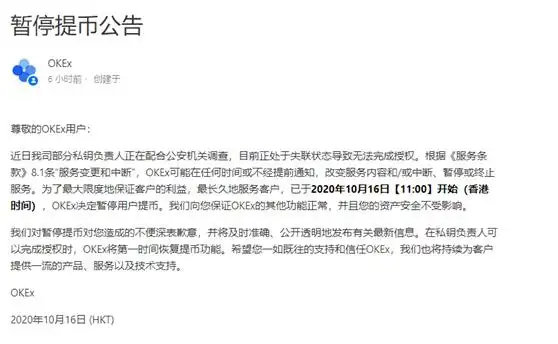
On October 16, OKEx officially announced that because some of the people in charge of OKEx’s private keys are cooperating with the public security agencies in the investigation today, they are currently out of contact and cannot complete the authorization. According to Article 8.1 "Service Changes and Interruptions" of the Terms of Service, OKEx may change the service content and/or interrupt, suspend or terminate the service at any time or without prior notice. In order to maximize the interests of customers and serve customers for the longest time, OKEx has decided to suspend user withdrawals starting from October 16, 2020 [11:00] (Hong Kong time).
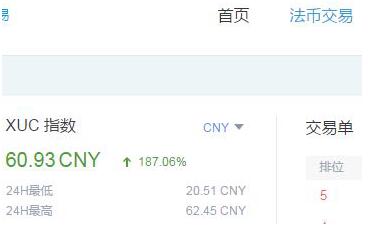
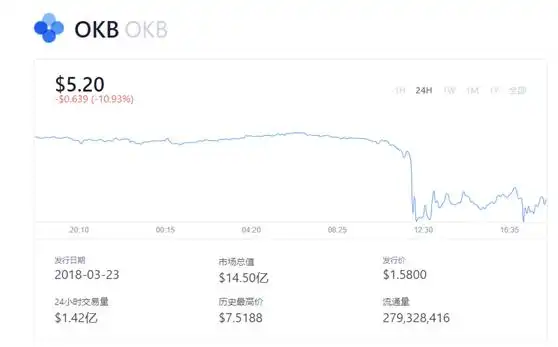
Affected by this, some users began to directly liquidate OTC (over-the-counter), causing the OKB virtual currency to plummet by more than 16% during the session. As of press time, OKB was quoted at US$5.2, a decrease of 10.93%, with a total market value of US$1.45 billion.
The mainstream virtual currency Bitcoin also suffered a sharp short-term decline. Within a few minutes, it dropped $400 from its high point, plummeting 3%. Other mainstream virtual currencies also fell. Data shows that there are currently more than 270,000 BTC (Bitcoin) on OKEx. Based on the current price of Bitcoin at $11,307, the value exceeds $3.052 billion (equivalent to RMB 21.4 billion). Such a huge amount will cause huge fluctuations in the market whether it is liquidated, sold or withdrawn.
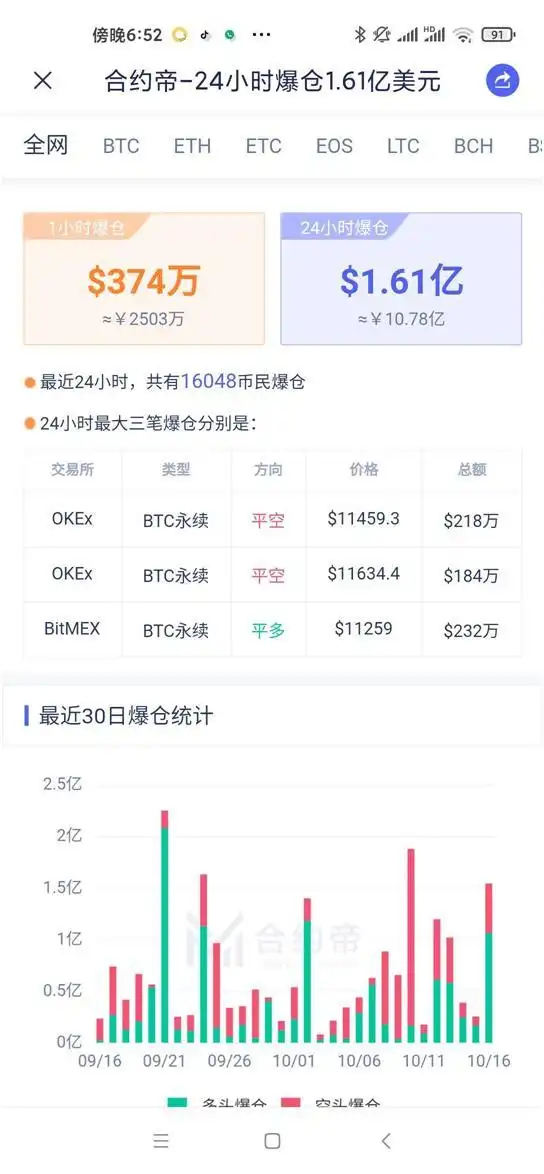
Data from Huishidi shows that the liquidation amount of Binmin in the last hour reached US$3.74 million (equivalent to RMB 25.03 million), and the liquidation amount in 24 hours reached US$161 million (equivalent to RMB 1.078 billion). Among them, the two largest liquidations in the last 24 hours came from the OKEx BTC perpetual contract.
OKEx was established in May 2017. It is a digital asset trading platform that mainly provides spot and derivatives trading services for Bitcoin, Ethereum and various innovative digital assets to global users. However, most users on the OKEx platform are domestic users, so the suspension of currency withdrawals caused an uproar in the domestic encryption industry.
Many domestic currency speculators regard exchange wallet accounts as regular "coin hoarding accounts" to facilitate trading operations. This announcement was sudden, and the digital currencies in the hands of many users may be directly "locked" in the exchange. Therefore, OKEx's suspension of currency withdrawals may have a direct impact on some currency speculators.
OKEx's own ecology also involves various fields such as public chains, wallets, and mining pools. OKEx, formerly known as OKCoin, a well-established exchange, is known as the "Whampoa Military Academy in the Currency Circle" and is one of the earliest exchanges involved in derivatives trading in China.
The actual accuser Xu Mingxing was taken away by the police, was it involved in money laundering?
OKex CEO responded to the previous announcement on the suspension of currency withdrawals on the official Weibo: Please rest assured that the company, business, and platform operations will not be affected. This is a personal issue of the private key manager. The currency withdrawals are temporarily suspended. We will announce the follow-up arrangements to you as soon as possible. Please refer to the announcement information.
From the response of OKEx CEO Jay Hao, we can see that the biggest possibility is the personal problem of the private key manager.
OKEx is not the first company to have problems with exchange private key management. The previous well-known one was the unexpected death of Canadian exchange QuadrigaCX founder Gerald Cotten. However, the exchange's main digital currencies were stored in cold wallets, and the private key of the cold wallet was only known to Gerald Cotten. As a result, approximately US$147 million worth of digital currencies could not be withdrawn.
According to Caixin.com, sources close to OKEx said that OKEx founder Xu Mingxing, who was officially mentioned in the announcement as “cooperating with the public security agency’s investigation,” had been taken away by the police at least a week ago. In this regard, OKEx public relations staff told the Securities Times reporter that they were not sure and everything would be subject to the announcement. However, Andy, a veteran in the currency circle, confirmed the above news to reporters. It was indeed Xu Mingxing who was taken away to cooperate with the investigation, which mainly involved the platform's involvement in cross-border money laundering. "If someone wants to conduct cross-border transactions of virtual currencies through OKEx, especially large funds, they must cooperate with Xu Mingxing."
It is reported that there are currently widespread rumors in the currency circle that OKEx is involved in cross-border money laundering. There are more than 800 accounts involved in this case, the amount is extremely large, and the nature is egregious. As one of the three giants of virtual currency trading platforms, OKEx’s sudden suspension of currency withdrawals really caught users in the currency circle by surprise.
Virtual currency trading becomes an illegal money laundering tool
Due to the non-face-to-face and anonymity of transactions, the wide scope of application, the diversity of capital injection methods, the possibility of obtaining cash, the segmentation of services, the speed and irrevocability of transactions, virtual currency is very difficult to identify the use of virtual currency for money laundering, and the transaction model is complex, it can easily become a tool for money laundering.
In the entire virtual currency money laundering, there are many specialized money launderers who take over the business and use their fund pools, multiple transfers, etc. to help the payers and payees "wash" the information addresses, making it impossible to trace.
Under the new regulatory situation, the central bank's anti-money laundering and other work has been continuously intensified and upgraded. For the first time, the central bank has clearly included third-party payment institutions in its key scope and promoted them to actively fulfill their anti-money laundering obligations. In January this year, the central bank issued a relevant notice. Starting from March 1, the People's Bank of China and its branches will launch on-site anti-money laundering inspections of non-bank payment institutions. The inspected non-bank payment institutions should provide relevant data in accordance with interface specifications.
In March this year, the central bank’s official Weibo released the eighth article in the 315 Financial Consumer Rights Protection Series, reminding financial consumers not to be deceived by virtual currency trading platforms and to be wary of falling into virtual currency traps.
The article points out several "routines" that currently exist in virtual currency exchanges: serious washouts; malicious downtime, forcing leveraged trading to liquidate; money laundering fraud, and reminds investors to avoid falling into the virtual currency trap.