After OKEx suspended currency withdrawals, user assets were temporarily trapped. As a result, a variety of "extrication" channels have appeared on the market. First, there was a mixed bag of OTC transactions, and then there were the "rigid redemptions" of OKU and TRON supported by other exchanges.
Various forces have come on stage one after another, using OKEx's internal transfer function to seemingly "save" OKEx users, but in fact they have their own agenda, creating a trend of "carving up" OKEx user resources and assets.
This well-established platform is not sitting still. On October 21, first, multiple trigger platform risk control accounts were automatically restricted from internal transfer functions. At around 11:00 that day, OKEx announced that it would resume fiat currency trading at 20:00 (Hong Kong time).
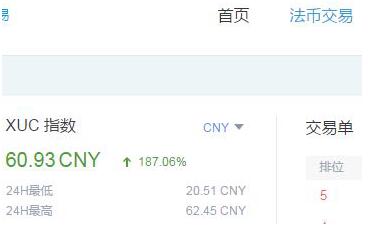
On the OKEx legal currency trading area after the restoration, the selling price range of USDT, the stable currency USDT that is urgently needed by the market, is between 5.01 yuan and 5.71 yuan within 5 minutes, and the selling price is lower than other mainstream platforms. OKB took advantage of the trend and rose sharply in the short term, rising from US$4.81 to US$5 in 10 minutes.
Opening up the exchange channel for fiat currencies and crypto assets is like a counterattack by OKEx, intercepting behaviors that threaten the security of its users and their assets, and more importantly, providing a withdrawal channel for trapped users.
OKEx unblocks fiat currency channels USDT selling price suffers setback
At 8 pm on October 21st, Beijing time, OKEx, which had suspended currency withdrawals for 5 days, first restored the status of the legal currency trading area. Six stable currencies including USDT, 8 mainstream currencies such as BTC, and the platform token OKB are fully open for legal currency trading.
OKEx resumes fiat currency trading
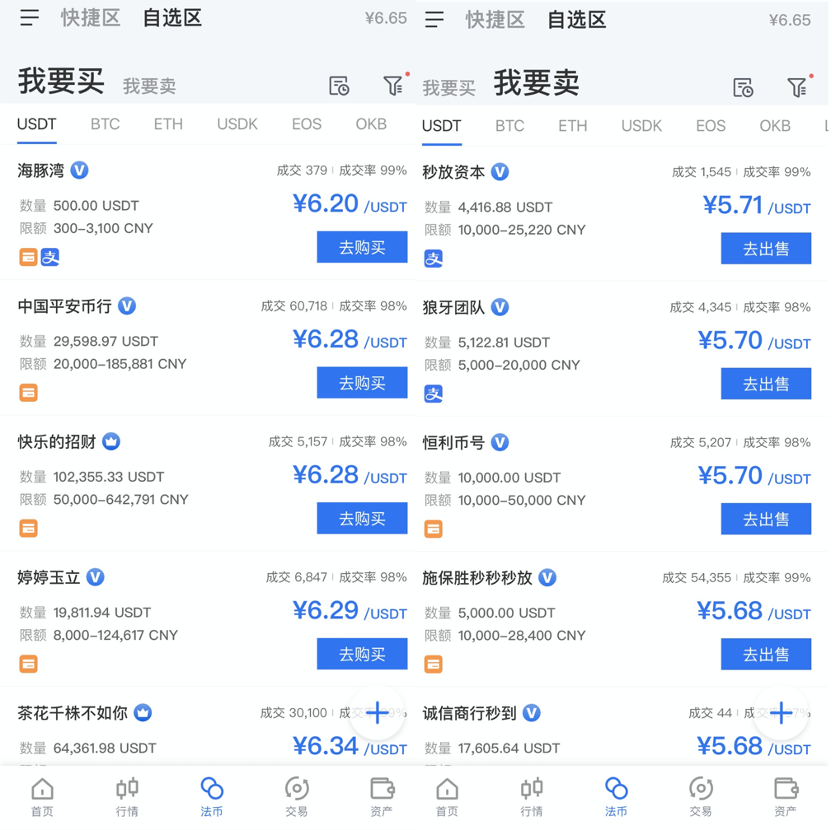
On the afternoon of the 16th, when OKEx "suspended withdrawals", the platform's fiat currency trading area pending order page became blank. Now, this market has finally recovered, but the fiat currency trading prices of various currencies have suffered setbacks.
Taking USDT as an example, at 20:05, the self-selected area of the OKEx legal currency trading area shows that the buying price of USDT listed by the merchant is between 6.2 yuan and 7.99 yuan; the selling price range is between 5.01 yuan and 5.71 yuan. The bid-ask spread ranges from 1.19 yuan to 2.28 yuan.
At the same time, in the Huobi legal currency trading area, the lowest buying price of USDT was above 7.34 yuan, and the selling price was between 5.93 yuan and 6.61 yuan. The lowest buying price and highest selling price of USDT on OKEx are equivalent to a "14% discount" and "16% discount" respectively compared to USDT on Huobi.
This is also as predicted by outside public opinion during the day. Before users' panic about the platform's inability to withdraw coins has dissipated, it is not difficult to imagine the situation where fiat currency trading merchants will collect coins at low prices.
However, the news of the resumption of legal currency transactions has brought benefits to the platform token OKB.
At 11 a.m. on October 20, just after the announcement, OKB jumped from $4.85 and soared to a high of $5.26 within 12 minutes, a rapid increase of 8.45%.
At 20:00 when withdrawals were officially resumed, OKB once again rebounded from US$4.81 after the correction to US$5, an increase of 3% in 10 minutes. As of 1 a.m. on the 22nd, OKB remained near $5.
Each side of the "carving up" has its own agenda, and users pay for their anxiety
Some commentators called OKEx's resumption of fiat currency trading a "smart move." On the one hand, this alleviated users' anxiety caused by being unable to withdraw money and opened up a channel for users to withdraw funds. Some people in the community think, "This is good, at least everyone will not be cheated by some OTC traders."
Indeed, since OKEx suspended currency withdrawals on October 16, advertisements for “collecting OK-USDT” have appeared in various communities, and a dedicated over-the-counter trading group has even been established. The purchase prices appearing in each group range from 30% to 20% off the market price. The way they operate is to allow OKEx users to transfer USDT to the "U recipient" account through on-site transfers, and buyers and sellers settle the tokens through off-site peer-to-peer settlement.
Industry insiders have warned that if users "cash out" at low prices through this method, they may encounter high risks of fraud or money laundering. Today, OKEx has resumed fiat currency trading, which has alleviated the risks for platform users to a certain extent. From a price perspective, although there is a "discount" on the price of USDT in the platform trading area, it is not lower than the off-site purchase price.
More savvy trading platforms have identified the risk and pain points of OTC trading and quickly launched a currency called OKU. On October 20, CoinEX announced that “in order to help OKEx users’ assets circulate better,” it launched OKU with a 1:1 exchange rate with USDT, and supported transactions between OKU and USDT on its platform.
Since OKU went online at 20:00 on October 20, the price has risen from 0.8USDT to 0.99USDT, and the lowest fell to 0.72USDT that day. As of 1:30 a.m. on October 22, OKU quoted 0.91USDT on CoinEX, with the lowest price in 24 hours being 0.81USDT and the highest being 0.92USDT.
Coin-to-crypto transactions endorsed by the trading platform may have lower risks than OTC transactions, but judging from the price of OKU, they are still discounted USDT. One problem is that there is no way to know the total amount of OKU.
CoinEX also stated in the announcement, "If CoinEx's official account on OKEX is frozen or assets are lost due to OKEx's policies or other force majeure factors, the losses caused will be borne by OKU holders, and CoinEx will not bear any responsibility for this." In other words, helping "OKEx users' assets circulate better" does not mean there is no risk, and the specific risks will be borne by users. For the platform, it is a "double harvest" of user resources and transaction fees.
OKEx’s on-site transfer function is not only used by OTC traders and competitors in the industry, but also by the favorite hot spot Justin Sun. Also on October 20, the Tron Foundation announced that TRX on the OKEx platform can be redeemed on a 1:1 basis. Officials will transfer the TRX in the user's designated account on the Tron site to the user's designated TRX mainnet account.
Affected by this, TRX rose by 9.92% in a short period of time, and then quickly fell by 5.48%. As for where TRON’s TRX comes from, and how TRX transferred to designated accounts on OKEx will be handled, the announcement did not explain.
Players in the currency listing circle on Weibo also have mixed reviews of Justin Sun's move. Some praised him for his "quick thinking" and "helping users escape." Others were worried that the TRX concentrated in Tron's OKEx account would create selling pressure, and TRX holders would ultimately pay for it.
When various parties took advantage of OKEx's on-site transfer function to "divide" its users and user assets, OKEx responded in the early morning of the 21st. The official Weibo posted a reminder that "multiple accounts have been automatically restricted from internal transfer functions due to triggering platform risk control measures." In reply to users, OKEx stated that it was working hard to resume currency withdrawals.
Although no timetable has been given for the opening of currency withdrawals, OKEx, which was the first to resume fiat currency trading, finally made a comeback, more or less counterattacking against the fancy "carve-up" actions in the market. At least one channel for users to withdraw funds has been opened.