On March 2, local time, the Mobile World Congress (MWC26) will open in Barcelona, Spain. Observer.com learned from the scene that Huawei will display the latest Atlas 950 SuperPoD and TaiShan 950 SuperPoD and other multiple models of super node products and solutions overseas for the first time, emphasizing its insistence on open source and openness, building a solid computing power base, and providing new choices for the world.
The Atlas 950 super node first appeared at the Huawei Full Connection Conference in 2025.
At that time, Huawei Rotating Chairman Xu Zhijun introduced the Ascend 950DT chip, which focused more on the inference Decode stage and training scenarios. The Atlas 950 super node supports a maximum of 8192 Ascend 950DT cards through the "Lingqu" all-optical interconnection, which will be more than 20 times that of the Ascend 384 super node. Its computing power scale will also be significantly improved, with FP8 computing power reaching 8E FLOPS, FP4 computing power reaching 16E FLOPS, and interconnection bandwidth reaching 16PB/s. This number means that the total interconnection bandwidth of an Atlas 950 product is more than 10 times the peak bandwidth of the global Internet today.
Judging from indicators such as computing power scale and interconnection bandwidth, Atlas 950 will be the world's strongest super node for many years to come. Compared with NVIDIA's NVL144, which will be launched in the second half of 2026, the scale of the Atlas 950 super node card is 56.8 times, the total computing power is 6.7 times, the memory capacity is 15 times, reaching 1152TB, and the interconnection bandwidth is 62 times, reaching 16.3PB/s. Even compared with the NVL576, which NVIDIA plans to launch in 2027, the Atlas 950 super node is still ahead in all aspects.
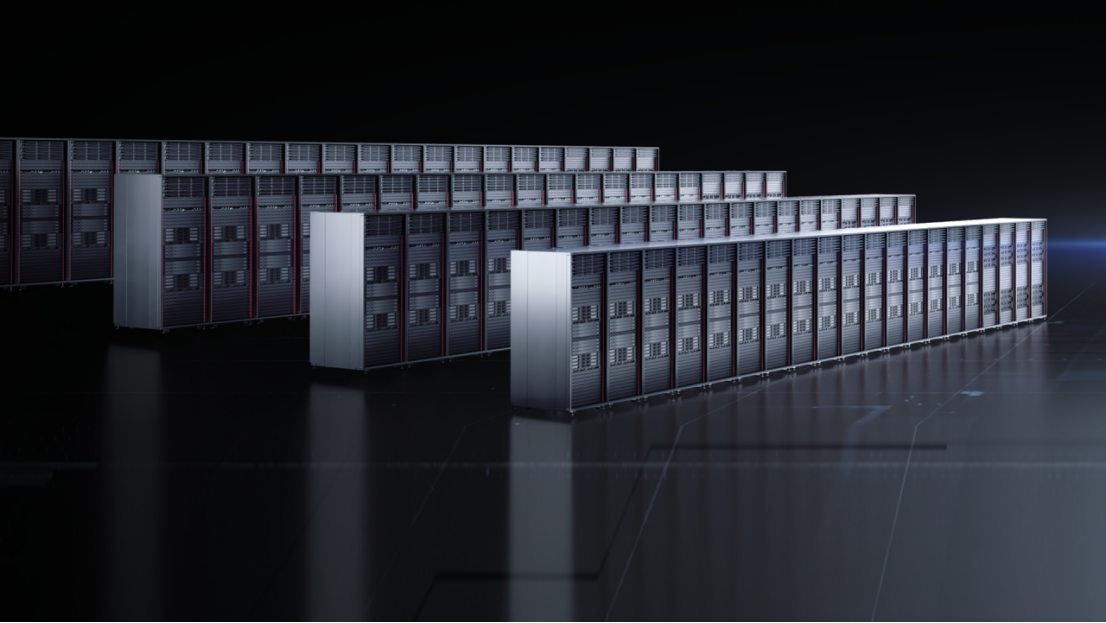
Huawei demonstrates super node at MWC2026
Frankly speaking, Ascend chips are limited by the manufacturing process, and single-card indicators will be in a state of catching up for a long time. So is it as simple as stacking 8192 chips for Atlas 950 to surpass Nvidia? Observer.com has also reported before that stacking cards is a way to increase the scale of domestic computing power, but simply stacking cards roughly does not necessarily have good results. The scale of large model parameters has entered the era of trillions. The traditional server stacking model faces the dilemma of larger cluster size, lower computing power utilization, and more frequent training interruptions.
Super nodes are born to solve the multiple challenges faced by traditional computing clusters. It has changed from a traditional CPU-centered architecture to an all-equal interconnection. Whether it is CPU, NPU or memory unit, they no longer need to go through the CPU, but can be interconnected equally, improving communication efficiency. At the same time, the "highway" connecting the computing units has also changed, with new protocols and bus capabilities supporting the interconnection between devices. A true super node should have key features such as ultra-large bandwidth, ultra-low latency, and unified memory addressing, so that it can learn, think, and work logically like a computer.
Therefore, with the support of the new open interconnection protocol UnifiedBus, Atlas 950 not only increases the computing power scale and memory capacity, but also significantly enhances memory access speed, interconnection bandwidth and other capabilities. Compared with the Ascend 384 super node, the training performance of Atlas 950 is improved by 17 times, reaching 4.91M TPS. By supporting FP4 data format, the inference performance of Atlas 950 is improved by 26.5 times, reaching 19.6M TPS.
According to Observer.com, the Atlas 950 super node is expected to be released in China in the first half of this year and will be available in the fourth quarter. In addition to the Atlas 950, there is also the Atlas 850E super node unveiled in Barcelona this time, but the specific specifications have not yet been announced.
At the same time, Huawei will also showcase TaiShan 950 SuperPoD, as well as TaiShan 500, TaiShan 200 and other new generation general computing servers in Barcelona this time to meet customers' choices of high, medium and low computing power. Among them, TaiShan 950 is the world’s first general computing super node. Xu Zhijun once said that TaiShan 950 plus the distributed GaussDB database can help the financial system solve core problems and will become the terminator of all types of mainframes and minicomputers, completely replacing mainframes and minicomputers in various application scenarios as well as Oracle's Exadata database server.
Super nodes are powerful enough, but they are supported by not only chips, optical modules and other hardware, but also a large number of software ecosystems, such as heterogeneous computing architecture CANN, operating system openEuler, database openGauss, AI framework MindSpore, etc. Huawei stated that it will always adhere to technological innovation, open source and openness, build a solid computing power base, jointly build an open and win-win computing industry ecosystem, and provide new choices for the world.



![[Netherlands] France Turns To The Netherlands To Support Its Military Operations-Lijin Finance](https://www.erbetc.com/wp-content/uploads/2026/03/1773277663261_0.webp)
