On March 2, local time, the 2026 World Mobile Communications Conference (MWC26) kicked off in Barcelona.
The Huawei booth was still crowded with people. Walking into Huawei's operator business exhibition area, you will find that many people are talking about a technology "U6GHz", which is also one of the key words of Huawei's participation in this exhibition. Before the launch, Huawei released a series of U6GHz full-scenario products and solutions, covering a complete matrix of macro stations, small stations, and microwaves.
What is U6GHz and why is it called the "golden frequency band"? Why do communication equipment giants such as Huawei focus on this technology in 2026? Why is U6GHz the key to unlocking the potential of 5G-A networks, and can it also support smooth evolution towards 6G?

Source: Observer.com
To understand these, we have to start with the current development status of communication technology. In 2025, 6G was included in the Chinese government work report for the first time, and our country has also launched the second phase of 6G technology experiments. However, the 6G standard is not expected to be frozen until 2029, and official commercial use may not be until 2030.
Before the official arrival of 6G, 5G-A, known as "5.5G" in the industry, was the mainstream commercial technology for global operators. Especially with the explosive growth of AI applications and terminals, the mobile industry is facing unprecedented opportunities and challenges. AI multi-modal interaction has increased uplink demand by 3-5 times. Real-time decision-making relies on low latency and deterministic guarantees. Ubiquitous agents require more secure and reliable wide-area connections. This makes 5G-A the focus of business innovation and future technology evolution.
At MWC26, Huawei ICT BG CEO Yang Chaobin said that the next five years will be a key window for the explosion of mobile AI business, and it will also be a period of opportunity for the entire industry to create new value. 5G-A has become an inevitable choice. It brings a tenfold increase in uplink and downlink speeds to meet the AI business experience; it also introduces new IoT technologies such as RedCap and Passive-IoT to support the Internet of Everything; at the same time, AI technology has also been introduced into the network to provide diversified network capabilities for businesses to meet the needs brought about by the rapid development of AI.
As of January 2026, 374 operators around the world have completed 5G network deployment. On the basis of wide-area coverage, the commercial implementation of 5G-A technology is accelerating. The current number of global 5G-A users has exceeded the 70 million mark. Currently, in the Chinese market alone, there are more than 135 mobile phone terminal models supporting 5G-A technology, and the cumulative shipment volume has exceeded 170 million units.
Compared with 5G commercialized in 2019, 5G-A has four key features: downlink 10Gbps (10Gbps), uplink gigabit (1Gbps), 100 billion connections, and endogenous intelligence. But if you want to unlock the full potential of 5G-A and allow traffic to run at full speed on this highway, you must widen the "lane", that is, the spectrum.
Yang Chaobin said that 5G-A has achieved large-scale commercial use in more than 300 cities around the world, and its deployment is expanding to all frequency bands, continuing to release technological dividends. The continuous improvement of 5G-A capabilities relies on the introduction of new spectrum and the re-farming of existing spectrum.
This is connected with what Huawei calls "U6G", which is a new spectrum resource.
The full name of U6G is Upper 6GHz, also known as U6GHz. It refers to the upper half of the 6GHz frequency band. The specific frequency range is 6425-7125 MHz, spanning a continuous 700MHz bandwidth. It is also the last 700MHz continuous bandwidth resource in the Sub-6GHz mid-frequency band.
There are many spectrums, high frequency bands have wide bandwidth but poor coverage, and low frequency bands have good coverage but narrow bandwidth.
The reason why U6GHz is called the "golden frequency band" is because it has the dual advantages of wide coverage and large capacity, and has become a key frequency band for 5G-A evolution and commercial use. Not only that, U6GHz, as the n104 frequency band of 5G-A, is also a core candidate frequency band for 6G. It can achieve intergenerational reuse and is the key to operator stock investment protection and smooth connection to 6G.
In other words, U6GHz will unleash the potential of 5G-A, and is also making a forward-looking layout for 6G to protect operators' long-term investments. But the development process of this golden frequency band has not been smooth sailing.
Source: Observer.com
As early as 2022, the world had launched a fierce "spectrum war" around the 6GHz frequency band.
At that time, some countries represented by the United States tended to reserve the entire 6GHz frequency band for Wi-Fi, while Europe, China, the Middle East and other regions advocated using the first half (U6GHz) for 5G and even future 6G cellular mobile communications. In the end, the World Radio Conference (WRC-23) decided to allocate U6GHz for authorized mobile services, clarifying the IMT (International Mobile Communications) positioning of U6GHz under the framework of the International Telecommunications Union (ITU). This is like applying for a property rights certificate for this "golden land", making it clear that it can be used to build public mobile networks.
Although the United States still reserves the entire 6GHz frequency band for Wi-Fi and other unlicensed services, more than 20 countries, including China, the United Arab Emirates, Brazil and many European countries, plan to use the U6G frequency band for IMT (International Mobile Communications). Among them, the United Arab Emirates and Hong Kong, China have released U6G spectrum, and the U6G ecosystem is accelerating.
However, U6GHz must not only meet the requirements of the rapid development of current AI services, but also meet the higher performance requirements of future 6G services, and also faces a number of technical challenges.
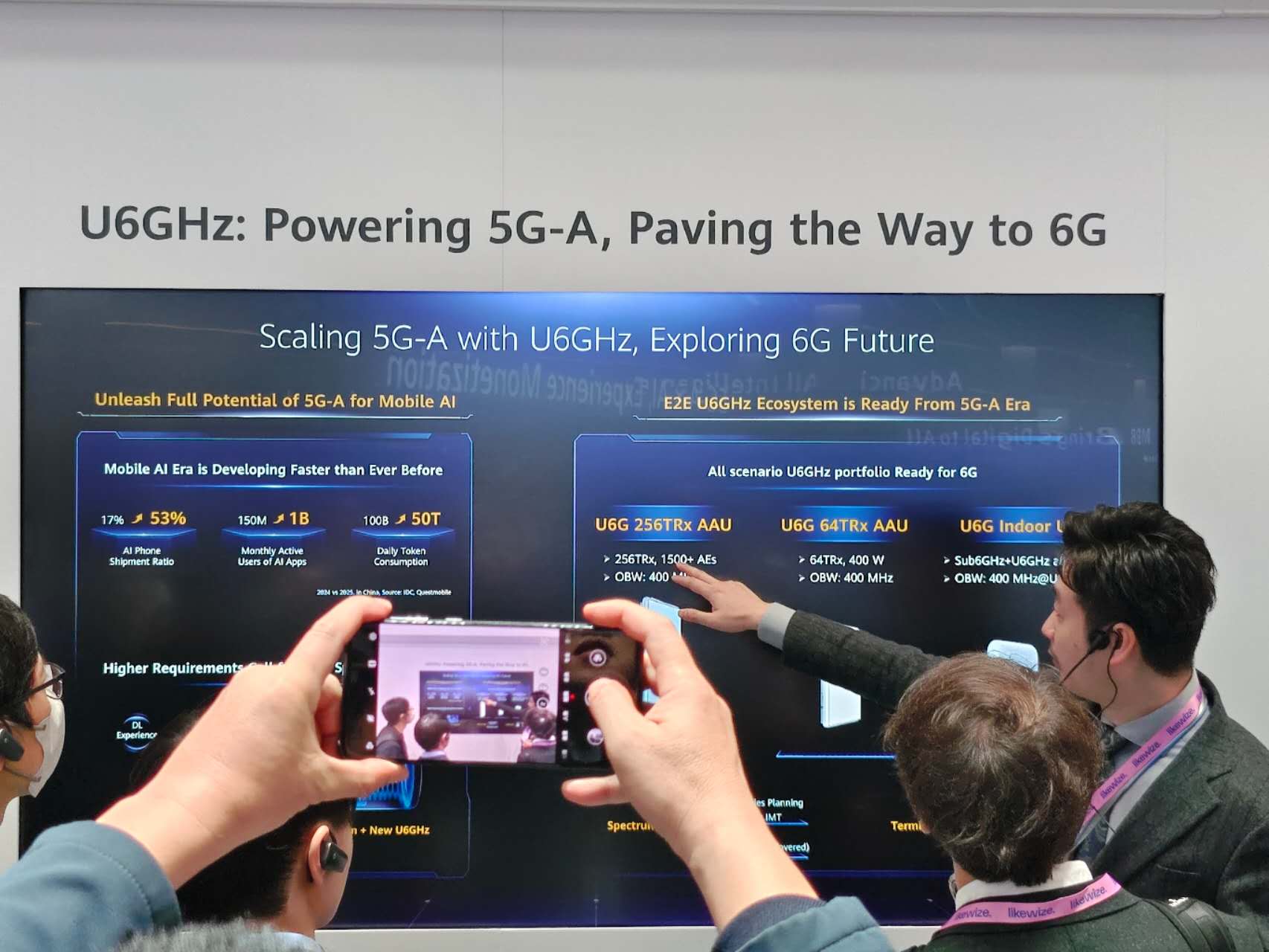
One is the coverage problem. The higher the frequency, the greater the loss. The propagation loss of U6GHz is more than 12dB worse than that of C-Band. If the coverage radius cannot be aligned with existing 5G site sites, operators will need to build sites more densely, and costs will be uncontrollable. The 256T U6GHz AAU exhibited by Huawei this time has achieved double breakthroughs in coverage and experience with its industry-leading 1,500+ antenna arrays: the peak rate of a single user has entered the 10G era, and the entire network capacity can support a total traffic of 100,000 Gigabit in a single cell, and can easily cope with the explosion of large-bandwidth services such as AR/VR and 4K live broadcast.
Second, larger bandwidth and more channels will inevitably lead to a surge in equipment power consumption and weight. If a base station equipment weighs more than 100 kilograms, and the wind resistance is huge, the existing sky surface cannot bear it at all, and the tower can only be rebuilt. Huawei's response strategy is to innovate from the underlying materials, using advanced heat dissipation technologies such as three-dimensional radiator cooling and diamond substrates, combined with the "0bit 0Watt" intelligent shutdown algorithm, to strive to soar in performance while controlling energy consumption and volume within an acceptable range.
At present, the verification of U6GHz by global operators is in full bloom. Through joint innovation with strategic partners such as Huawei, e&UAE has successfully completed live network testing in the U6GHz band, achieving the ultimate 10Gbps experience. In Europe, Vodafone completed Europe's first large-scale U6GHz spectrum test. In Central Asia, Uztelecom of Uzbekistan teamed up with Huawei to innovate U6GHz spectrum technology and demonstrated the latest U6GHz verification results at ICT Week 2025, which can achieve transmission rates of up to 10 Gbps. In Latin America, Brazil's TIM teamed up with Huawei to complete U6GHz technology verification in the Americas. In China, China Mobile has also completed U6GHz innovative testing and verification in Zhejiang, and successfully achieved a stable experience with four-carrier aggregation downlink peak rates exceeding 10Gbps with its industry-leading U6GHz solution.
At the industry chain level, U6GHz CPE terminals have been officially launched, and markets such as the United Arab Emirates have successfully completed end-to-end testing and verification and begun commercial deployment. Mainstream CPE and mobile phones are expected to be commercially launched in 2026. This series of verification results proves that the U6GHz spectrum is a key strategic spectrum for the development of 5G-A technology, paving the way for future technology evolution.
As a core promoter of U6GHz industry development, Huawei has also clarified its long-term technology roadmap this time. In 2026, Huawei will release a 5G-A full-scenario solution including U6GHz, and plans to fully support operators in completing U6GHz large-scale network deployment in 2028.
In 2026, global spectrum allocation has entered a critical window period. U6GHz has become the consensus in the development of 5G-A communications with its perfect balance between coverage and capacity. Global operators are working together to transform U6GHz from vision to reality. By then, you may be at a concert with thousands of people, performing real-time holographic interactions through AR glasses, or driving a smart car on the road. Perhaps what supports all these experiences is the "golden band" technology we are talking about today.