Two people familiar with the matter said that in order to determine Khamenei's whereabouts, Israel's signal intelligence agency Unit 8200, the Israeli Intelligence and Special Missions Directorate (Mossad) and military intelligence have continued to collect information on Tehran for years. Israeli intelligence agencies hacked into almost all road surveillance in Tehran, and the footage captured by the cameras was encrypted and transmitted to a server in Israel.
One of the people familiar with the matter said that on Pasteur Street, where many important government agencies are located in Iran, the angle of a camera is particularly critical. Israeli intelligence agencies can determine where Iranian government personnel park their vehicles and monitor the operations of parts of Pasteur Street.
They revealed that Israel used complex algorithms to construct a "behavioral profile" of Iranian security personnel, including their addresses, duty hours, commuting routes, and those usually responsible for protecting and transporting them. Israel also uses a mathematical method called "social network analysis" to mine Iran's decision-making focus from large amounts of data and identify new surveillance and strike targets.
According to reports, the strike had been planned for months, but after U.S. and Israeli intelligence agencies confirmed that Khamenei and a number of senior Iranian officials would meet on February 28, the two countries adjusted their action plans. Before the operation, Israel used Tehran's road surveillance system and deeply penetrated mobile communication networks to determine that Khamenei and Iranian officials would meet as scheduled.
Another former senior Israeli official added that in order to ensure that the attack was launched on time, Israeli warplanes had taken off several hours in advance and then launched more than 30 precision-guided munitions towards Khamenei's location.
According to people familiar with the matter, Israel also successfully interfered with more than a dozen base stations near Pasteur Street to prevent Khamenei's security personnel from receiving early warning information.
In addition, two people familiar with the matter told the Financial Times that the United States had more specific intelligence through an informant. The CIA declined to comment.
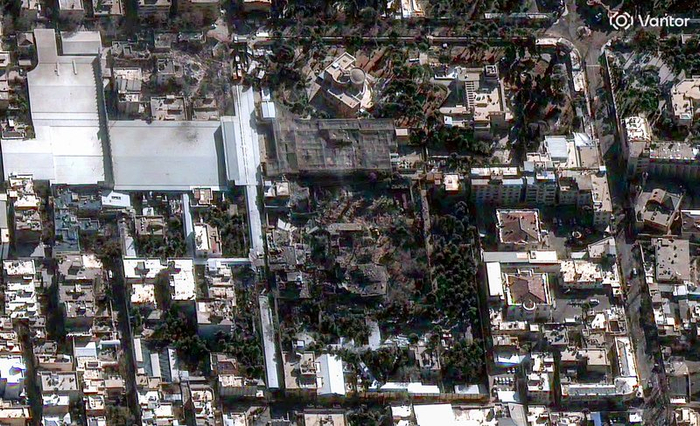
On March 1, Tehran, Iran, satellite images showed damage to the complex of Khamenei’s official residence IC photo
Senior Israeli intelligence officer Itai Shapira said: "In Israeli intelligence culture, target intelligence is the most core tactical issue and is designed to serve the overall strategy. If the decision-maker decides to assassinate someone, the principle is: We will provide the intelligence support needed to achieve this goal."
Another Israeli intelligence official said: "Long before the bombs fell, we were as familiar with Tehran as we were with Jerusalem. When you are as familiar with a place as the streets where you grew up, you can detect even slight differences immediately."
The airstrikes targeting Khamenei were a political decision, according to six current and former Israeli intelligence officials. Both the CIA and Israeli intelligence agencies believe that once the war begins, Iran will immediately take steps to move Khamenei and the Iranian leadership into underground bunkers that can withstand air strikes. Therefore, they regard the February 28 meeting as the best time to take action.
Killing a foreign leader is not only extremely dangerous but also operationally challenging. Over the past few years, Iranian intelligence agencies have also demonstrated considerable capabilities. For example, in 2022, a group related to Iran's security services released data allegedly stolen from the mobile phone of the wife of the Mossad director; in 2025, during the Israel-Iraq conflict, Iran hacked into Jerusalem's surveillance system to determine Israel's losses.
However, former Mossad official Sima Shain said that in recent years, Israeli intelligence agencies have successfully carried out operations such as assassinating Palestinian Islamic resistance leader Ismail Haniyeh and planting explosives in Lebanese Hezbollah pagers. These achievements are tempting in themselves, "Hebrew proverb says, 'Appetite follows food.' In other words, the more you have, the more you want."
However, while Israel was showing off the results of its "decapitation operation", the Financial Times also pointed out that Khamenei had publicly discussed the possibility of his own death, saying that his personal life and death were "insignificant" to the fate of the Islamic Republic of Iran. Some experts on Iran said that Khamenei had expected to die as a "martyr."
After Khamenei's death, Iran has established an interim leadership council composed of President Pezeshizyan, Justice Director Ghulam Hussein Mohseni Ejei and Deputy Chairman of the Guardian Council of the Constitution Alireza Alafi. The Interim Leadership Council temporarily performs the duties of the Supreme Leader until Iran appoints a new Supreme Leader.
Iranian Foreign Minister Araghchi said in an exclusive interview with Qatar's Al Jazeera on the 1st that he expects a meeting of Iranian experts to determine the candidate for the next supreme leader in a "very short time." "Perhaps one to two days later, they will choose a new national leader."
Click to enter the topic:
Pay attention to the situation in Iran