[Introduction] From February 25 to 26, 2026, German Chancellor Mertz visited China for the first time after taking office. The two sides reached a number of practical cooperation in the fields of economy and trade, technology, and artificial intelligence governance. However, less than a year ago, Mertz clearly proposed "strategic de-risking" of China in his first government statement and strengthened the positioning of "systemic confrontation". Is this visit a pragmatic adjustment under the framework of “de-risking”, or is it a realistic manifestation of the contradictions in Germany’s China policy?
German Chancellor Mertz's first visit to China after taking office attracted much attention. On the eve of his visit to China, Mertz elaborated on his "double calibration" diplomatic strategy, advocating that while reducing Germany's excessive security dependence on the United States, it should correct its economic overdependence on China.
Mertz was accompanied on his visit to China by not only cabinet members, but also representatives from the business community, academia and important think tanks, indicating that this visit to China has a dual mission – to strengthen economic ties with China and to deepen strategic understanding of China.
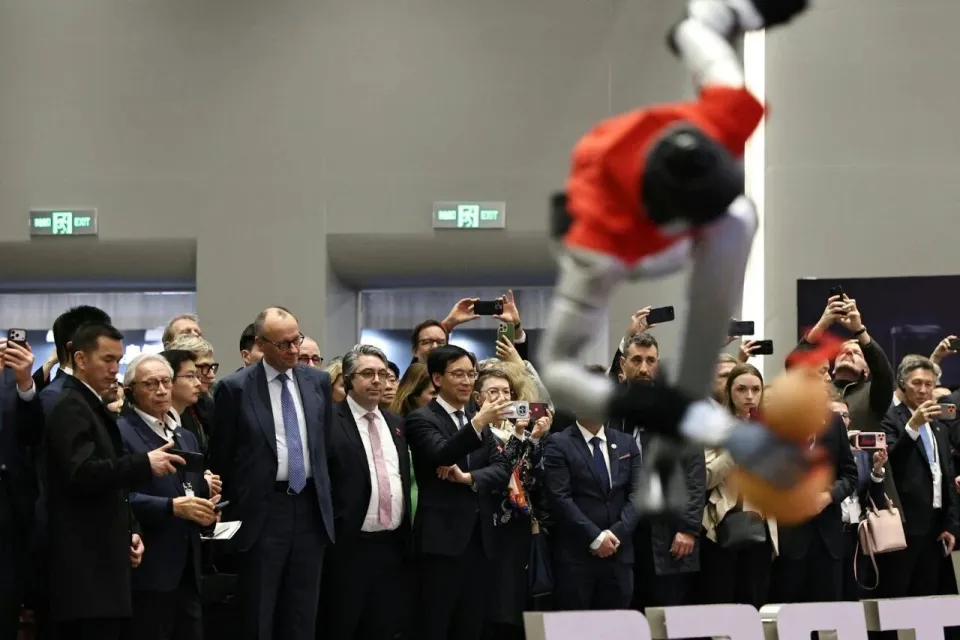
Mertz transferred to Hangzhou to visit Yushu Technology and watched the Spring Festival program "Wu BOT"
▍Get rid of the definition of "systemic rival": the political prerequisite for the stable development of Sino-German relations
The "dual calibration" strategy is essentially a pragmatic response to the intensifying great power competition, the rift in transatlantic relations, and the growing call for European strategic independence.
In recent years, Berlin's China policy has always had the triple premise of partners, competitors, and systemic rivals. The simultaneous effect of these three premises will make people confused, resulting in pragmatic cooperation often being hindered by ideology and group political thinking, biased perceptions of China, and conflicts and swings in China policies.
Positioning China as a "systemic rival" is another historic strategic misjudgment in Germany's China policy. In fact, China firmly upholds multilateralism and the basic norms of international law, and is committed to working with other countries to improve global governance.
The common interests between China and Germany far outweigh their differences, and the space for cooperation far outweighs competitive tensions. If Germany wants to achieve the "balance of values and interests" it pursues, it should not set up exclusive ideological barriers to bilateral relations.
Germany should learn from two strategic misjudgments in its China policy over the past few decades: first, it once believed that China’s system lacked innovation capabilities; second, it once believed that China’s system transformation could be promoted through “promoting change through cooperation.”
Today, China has become one of the major centers of global innovation and competitiveness, and its national institutions are increasingly consolidated. Faced with the failure of these two major misjudgments, Europe and the United States felt frustrated and regarded their previous expectations as "naive". Instead, they became worried about the possible impact of China's system and took precautions – this argument is also popular in German politics.
If Berlin wants to calibrate its China policy, it must first abandon the either-or, zero-sum game view of the political system. This means giving up the ideology-based thinking of group confrontation and abandoning the assumption that institutional differences will inevitably lead to systemic confrontation. It also needs to correct a series of solidified policy perceptions – equating economic complementarity with strategic vulnerability, confusing competition and confrontation, and misinterpreting de-risking as comprehensive decoupling. Chancellor Merz's visit to China provides an important opportunity for Germany to calibrate its understanding of China and rebuild strategic consensus.
▍Pragmatic, win-win and balanced economic cooperation: the cornerstone of the resilience of Sino-German relations
Chancellor Merz led a large business delegation to visit China, which highlighted the deep interest and confidence of German industry in the Chinese market and once again confirmed that pragmatic economic and trade cooperation remains the unshakable cornerstone of Sino-German relations.
The German economy is struggling to cope with sluggish growth, industrial transformation and intensifying external competition, prompting the Mertz government to implement reforms to improve efficiency and revive the economy. China's economy also faces internal and external challenges, but it is opening up with greater intensity and shifting towards high-quality development. New driving forces such as renewable energy, advanced manufacturing, digital economy, and green industry are emerging. Far from weakening, the economic complementarity between the two countries has not weakened, but has presented new intersections due to their respective transformations.
Germany's so-called "over-reliance on the Chinese economy" is essentially the result of market forces and comparative advantages. Artificially cutting off the already formed industrial chain or pursuing "decoupling" will only harm the interests of German companies and weaken Germany's economic competitiveness.
China has been Germany's largest trading partner for many years. Many German flagship companies have invested in China and have taken root in China. They have not only benefited from China's economic growth, but also contributed to China's industrial upgrading and technological progress. This is a natural result of global resource allocation, rather than a "strategic risk" as some people say.
Germany's "de-risking" agenda should focus on practical areas such as supply chain security, fair competition, and intellectual property protection – managing risks through strengthening rules and deepening cooperation, rather than securitizing economic policies, promoting protectionism or market segmentation – which will only create new vulnerabilities. For Germany's export-oriented economy, the integrity of the global market is its core strategic interest, and market fragmentation is the biggest systemic risk.
China and Germany should seize the opportunity of this visit to deepen economic and trade consultations, improve the trade balance mechanism, expand trade scale, and optimize trade structure. It is necessary to upgrade cooperation in traditional fields such as automobiles, machinery, chemicals, and medicine, and to expand cooperation in emerging fields such as renewable energy, hydrogen energy, carbon capture and utilization, industrial Internet, and artificial intelligence. The joint development of third-party markets will open up new cooperation space, growth drivers and cooperation models for the economies of the two countries.
▍Coordination between China and Germany in global governance: a reflection of shared responsibilities
Humanistic care, a sense of history and a shared responsibility for the future are the distinctive common undertones of Chinese and German traditional culture.
The world today is facing a series of global challenges such as climate change, energy crisis, food security, space security, public health and regional conflicts. No country can respond alone. Multilateral cooperation is the only way out.
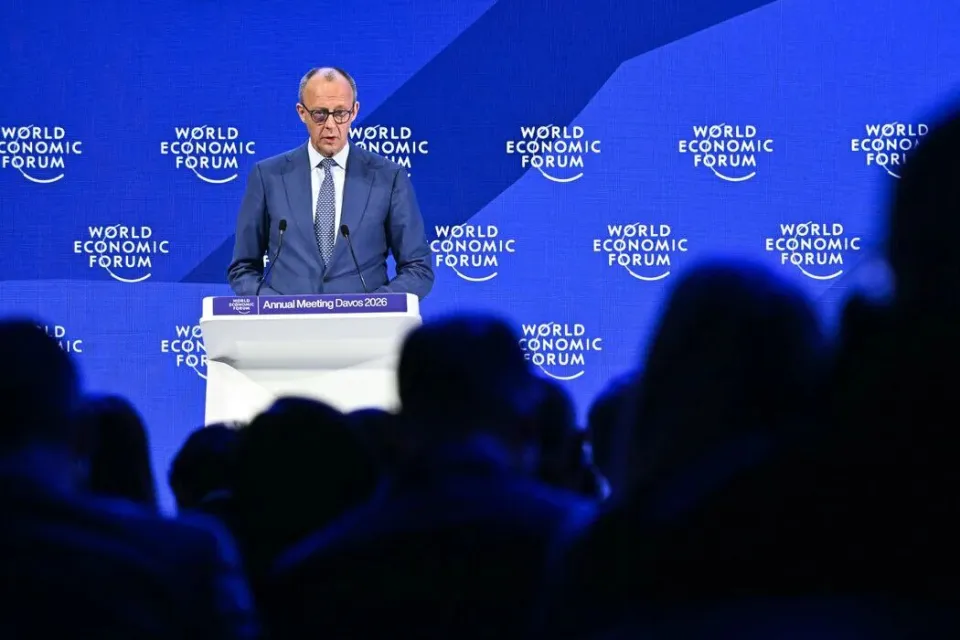
On January 22, Mertz stated at the Davos Forum that the world has entered the "era of great power politics" (Source: Getty Images)
Unfortunately, influenced by arguments such as "risk removal," securitization of economic and trade relations, and "systemic adversaries," the trust foundation of Sino-German bilateral exchanges and cooperation has been weakened, specific cooperation has been reduced, and even academic exchanges between scholars have been censored by national security mechanisms.
It should be recognized that the positioning of a "systemic rival" has not only seriously damaged China-Germany bilateral relations, but also deprived global governance efforts of the sustained momentum that closer cooperation between China and Germany can provide. The collaborative cooperation between China and Germany in global governance not only benefits the societies of the two countries, but also benefits the world, and can provide stability and constructive solutions in an increasingly volatile international situation.
Germany is in a period of major adjustments to its domestic and foreign policies, and the economies of China and Germany are also facing structural transformation and external pressure. Against this background, people from all walks of life have high hopes for Prime Minister Merz's visit to China, hoping that he can work with Chinese leaders to clarify the strategic direction of Sino-German relations, bring much-needed certainty and stability to a divided world, and enable the two countries to play their due strategic roles in global governance.
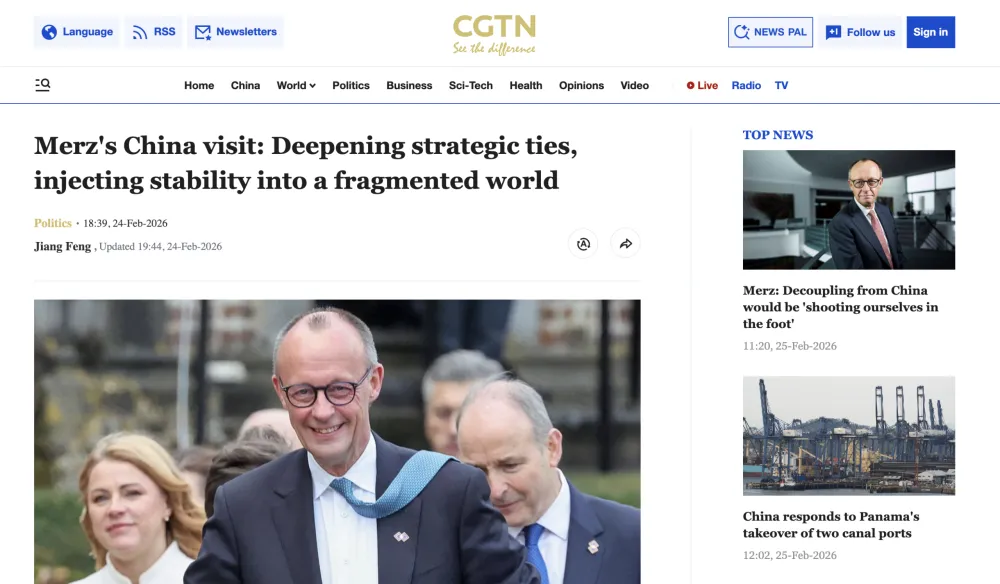
Screenshot of CGTN original English text



![[Netherlands] France Turns To The Netherlands To Support Its Military Operations-Lijin Finance](https://www.erbetc.com/wp-content/uploads/2026/03/1773277663261_0.webp)

