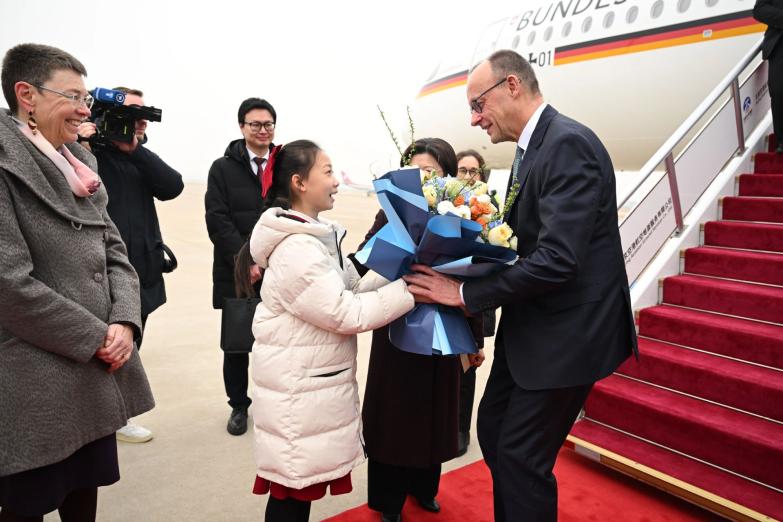
On the morning of February 25, German Chancellor Mertz arrived in Beijing for a two-day official visit to China. (Xinhua News Agency photo)
Peter Bofinger, professor of economics at the University of Würzburg in Germany and former member of the German Economic Expert Committee, wrote an article in China Daily on February 25, pointing out that Sino-German relations have long been based on comparative advantages and division of labor and are an important fulcrum for global economic stability. Facts have shown that new energy, two-way investment and industrial collaboration are not only beneficial to China and Germany, but also help maintain the stability of a multi-polar world and global supply chains.
The article stated that in the complex context of the global economy, the Sino-German partnership is one of the most closely connected bilateral relationships. For decades, this relationship has shown the characteristics of mutual benefit and win-win, confirming the basic views of Adam Smith, the "father of modern economics", on the division of labor and mutual benefit.
The historical success of China-Germany relations stems from complementary advantages. Through direct investment and joint ventures in China, German companies not only bring capital, but also transfer technology and establish high industrial standards. In return, Germany has found the most dynamic growth market in China, allowing German industrial giants and small and medium-sized enterprises to expand their business scale, raise funds for research and development, and lead the world. Today, this tradition continues, for example, the German chemical giant BASF invested 10 billion euros in a new integrated base in Zhanjiang, Guangdong, which is the company's largest single investment project to date. This deep integration shows that when the world's second- and third-largest economies strengthen cooperation, they can bring stabilizing effects to global supply chains.
The most promising areas for future cooperation lie in renewable energy and green technologies. Through strategic and forward-looking industrial policies, China has become a global leader in battery technology, solar energy and electric vehicles. This is not only an economic achievement, but also an important contribution to global climate policy. By reducing the cost of green technology through large-scale production and innovation, China has enabled other countries, including Germany, to smoothly promote energy transition.
Despite the obvious synergies, the shadow of protectionism is growing. In addition to economic costs, explicit or implicit trade barriers will also bring heavy geopolitical costs. Moving towards "decoupling" or aggressive protectionism could fragment the world into competing camps. This bipolar world is inherently unstable and more prone to conflict. Real competitiveness should be built through open competition and cooperation, rather than hiding behind trade barriers.
At this critical moment of geopolitical tension and the impact of a wave of protectionism, China-Germany relations are no longer just about trade balance or corporate profits, but can become the cornerstone of global stability.
(The original English text was published in the "China Daily" Zhixianghui column
https://www.chinadaily.com.cn/a/202602/25/WS699e3462a310d6866eb3a11b.html)



![[Netherlands] France Turns To The Netherlands To Support Its Military Operations-Lijin Finance](https://www.erbetc.com/wp-content/uploads/2026/03/1773277663261_0.webp)
