This is the People's Livelihood Investigation Bureau, investigating changes in people's livelihood where no one has seen it before. Pay attention to what you want to pay attention to and what you haven’t paid attention to, and investigate what you want to see and what you haven’t seen.
China News Service, Beijing, March 15 (Reporter Zhao Fangyuan) I wanted to make a warm beef ball hotpot, but in the "beef balls" I bought, beef was ranked third on the ingredient list, and the first two were chicken and pork. This is not a joke, but the real experience of many consumers.
Recently, some consumers reported to Sino-Singapore Health that they purchased a "beef ball" from Haibawang. When looking at the ingredient list, they found that chicken and pork were listed first, and beef was ranked third. It's called "Beef Balls", but it's actually "Meat Balls".
Reporters logged into multiple e-commerce platforms and saw that the details page of Haibawang Food Flagship Store was marked with slogans such as "Top Ten Chaoshan Beef Ball Enterprises", "Top 20 Chaoshan Beef Balls in China", "Authentic Chaoshan Flavor" and "Three Ancient Chaoshan Craftsmanship". Product promotion is even more focused on "cow".
The reporter further sorted out the ingredient lists of many of the store's products: for a product called "Haibawang Chaoshan Beef Balls", the first two ingredients on the list are chicken and beef.
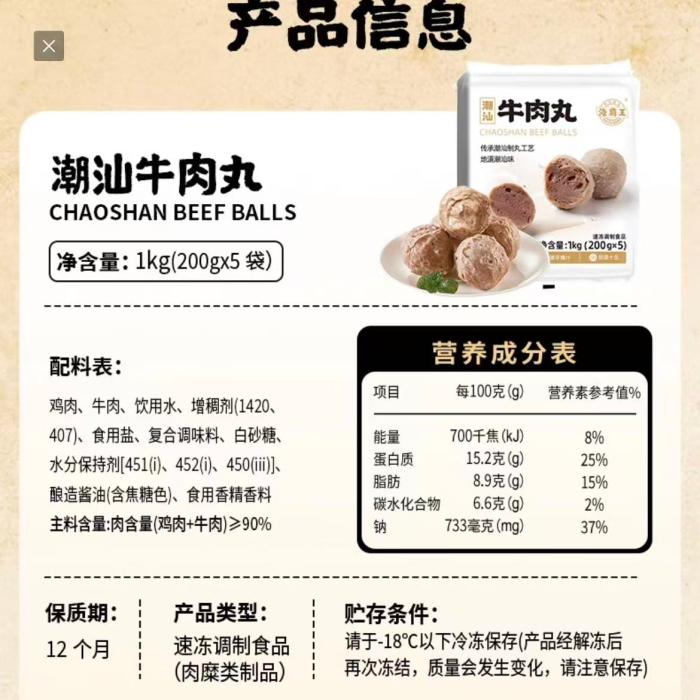
Haibawang Chaoshan Beef Balls details page
The product called "Hai Ba Wang Pissing Beef Balls" has pork, chicken, and beef in its ingredient list.
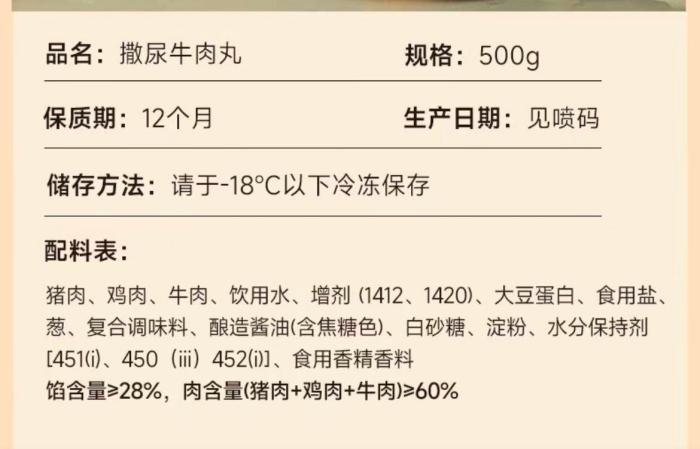
Sea King Pissing Beef Balls
Another product called "Haibawang Chaoshan Beef Tendon Balls" has an ingredient list of beef, pork, chicken, and beef tendon.
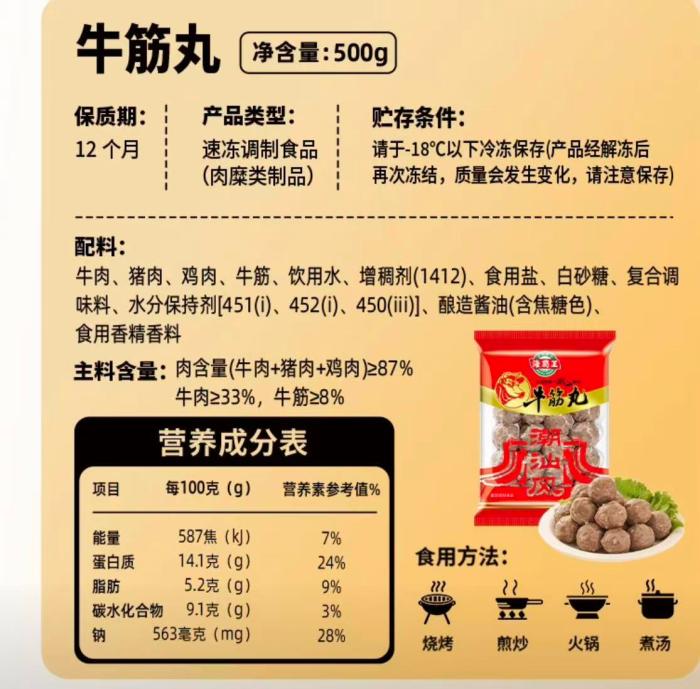
Haibawang Chaoshan Beef Tendon Balls
Subsequently, the reporter asked the customer service of the flagship store as a consumer whether there were pure beef balls, and the other party responded: "Currently there are no pure beef balls in the store, they are all mixed meat balls."
In fact, cost considerations are an important factor why manufacturers mix chicken and pork into beef balls. According to monitoring data from the Market and Information Technology Department of the Ministry of Agriculture and Rural Affairs, in the eighth week of 2026, the average weekly price of beef wholesale markets across the country was 66.20 yuan per kilogram, the average weekly price of white strip chicken wholesale markets was 17.14 yuan per kilogram, and the average weekly price of pork wholesale markets was 18.22 yuan per kilogram. The price of beef is about 3.8 times that of chicken. Substituting poultry meat for beef can significantly reduce raw material costs.
Chaoshan beef balls are a traditional snack from Chaozhou, Shantou and Jieyang. They are famous for their pure meat and crispy texture.
Currently, there are four main enforceable standards for beef ball products: industry standards "Quick Frozen Prepared Food" (SB/T 10379-2012) and "Meat Balls" (SB/T 10610-2011), Guangdong Province local standard "Shantou Beef Balls" (DBS 44/005-2024) and group standard "Chaozhou Beef Balls" (T/CZBXBZ 01-2025).
Different standards have very different requirements for meat content. The industry standard "Quick Frozen Prepared Food" stipulates that the meat content of beef minced meat products only needs to be more than 8%; the "Meatball" standard is divided into special grade, superior grade and ordinary grade according to the meat content, with a minimum meat content of 45%. It also clearly stipulates that if the product name is to be labeled as beef balls, beef must be the first one in the ingredient list.
"Shantou Beef Balls" stipulates that the beef content must be greater than 90% (or the sum of beef and beef tendon content is greater than 90%), and no edible by-products such as cattle viscera, fat, blood, etc. must be added; "Chaozhou Beef Balls" requires that the beef content must be no less than 80%, and must not contain other animal meat and soy protein.
However, the reporter noticed that although Shantou and Chaozhou have issued targeted local standards, the beef ball products from Guangdong on the market are almost all called "Chaoshan beef balls" or "Chaoshan flavored beef balls". Products directly named "Shantou beef balls" or "Chaozhou beef balls" are rare.
Some people in the industry pointed out that "Chaoshan", as a general regional name, currently has no corresponding mandatory product standards. Companies using this name can not only take advantage of the popularity of Chaoshan beef balls, but also avoid the strict constraints of Shantou, Chaozhou and other local laws and standards.
"There is still no detailed standard for regional specialty foods such as beef balls at the national level. The national standard needs to take into account the production level and cost differences across the country, and it is difficult to achieve the ultimate precise segmentation like local standards." Zhu Danpeng, a food industry analyst, pointed out that at present, some manufacturers are taking advantage of the loopholes in the standard and apply the lower threshold ordinary meatball standard (SB/T 10379) to beef ball products. "
"If you don't reach 80%, of course you can't call it beef balls, which creates a big cognitive gap for consumers." Zhu Danpeng believes that as regional specialty products such as Chaoshan beef balls continue to be refined and marketed nationwide, the introduction of national standards is imminent.
It is worth noting that the new version of the "General Principles for Labeling of Prepackaged Foods" that will be implemented in March 2027 has begun to pay attention to this issue. In the future, if other meats are mixed into beef balls, they must be clearly named as "beef and chicken balls" and other compound names, and can no longer be generically named "beef balls". This means that those "meat balls" that use the word "flavor" as a cover will no longer be able to hide in packaging design.
For consumers, when buying beef balls, in addition to reading the product name, they can also pay attention to two details: first, check the standard code of the product, and give priority to products that comply with local standards or group standards; second, directly look at the ingredient list to confirm whether beef is ranked first. After all, "meat content" is not equal to "beef content". This word game can no longer be played. (over)