
Masters Of Ancient Music Gather In Shanghai To Play Bach Classics To Satisfy Music Fans’ Thirst For High-quality Ancient Music
"Tonight, once again witness the legend at the Shanghai Concert Hall
"Tonight, once again witness the legend at the Shanghai Concert Hall
https://github.com/google-gemini/gemini-cli
In order to allow developers to use "human language" to work with AI, Gemini CLI reduces the complexity of traditional programming interfaces and is very easy to use:
You can ask questions, edit files, or run commands directly.
For best results, it's best to describe your needs as specifically as possible.
Enter "/help". More information is also available.
In addition to Gemini CLI, in the field of programming, Google has also deployed tools such as Gemini Code Assist and asynchronous AI assistant Jules.
At the press conference, Google senior software engineer Taylor Mullen said: "Using Gemini CLI, you can use natural language to talk to computers, solve problems, and integrate complex workflows to accomplish things that were impossible in the past."
This is seen as a head-to-head confrontation with OpenAI and Anthropic.
OpenAI and Anthropic have already joined the terminal AI tool track:
OpenAI launches open source Codex CLI;
Anthropic launched Claude Code, etc., which are favored by developers for their lightweight, easy integration, and fast response.
Technically, Gemini CLI has the same origin as the Google AI coding assistant plug-in Gemini Code Assist.
In VS Code, just enable agent mode in the chat window to enter your requirements, and Code Assist will work tirelessly:
Write test cases, fix bugs, develop new features, and even complete code migration...
This means that whether developers are users of the free version, standard version or enterprise version, they can enjoy AI-driven coding functions in VS Code and the terminal environment.
This kind of cross-platform thinking allows developers to avoid the "difficulty of choice".
This time Google has made such a big move that Ai2 scientist Nathan Lambert began to long for: the free premium version of Gemini is just around the corner!
More than just writing code
The functionality of Gemini CLI goes far beyond writing code and supports more common task scenarios.
It is designed to be very versatile and can perform tasks such as generating content, solving problems, and conducting research.
While most users will use Gemini CLI for programming, Google says the tool supports a variety of other uses as well. For example:
Ryan J. Salva, senior director of product at Google, thinks this is how work will be done in the next 10 years.
At the press conference, he said:
We believe that over the next decade these tools will dominate the way developers and creators of all kinds work.
Whether you're a student, hobbyist, freelancer or developer, you should have the same tools.
It seems that this time Google is really here: from programming to video shooting, AI is used to inspire all kinds of creativity!
References:
https://www.bloomberg.com/news/articles/2025-06-25/google-debuts-gemini-ai-coding-tool-in-bid-to-entice-developers
https://x.com/googleaidevs/status/1937861646082515205
https://blog.google/technology/developers/introducing-gemini-cli-open-source-ai-agent/
https://www.developer-tech.com/news/gemini-cli-google-brings-ai-smarts-terminal/
https://techcrunch.com/2025/06/25/google-unveils-gemini-cli-an-open-source-ai-tool-for-terminals/
https://www.linkedin.com/feed/update/urn:li:activity:7343640552640344069/
With the advancement of financial technology and the development of society, financial products and services have become increasingly diversified. Financial chaos such as illegal agent surrender and claim settlement, overseas bank card fraud, and professional debtors have occurred frequently, which has brought many challenges to the protection of financial consumers' rights and interests. On the occasion of the 44th "March 15" International Consumer Rights Day, Postal Savings Bank Beijing Branch launched the 2026 "March 15" financial consumer rights protection education and publicity campaign to help the public improve financial literacy and effectively protect the legitimate rights and interests of consumers; integrate consumer rights protection into services and scenarios, and use original intentions and actions to paint a warm picture of "finance for the people".
Traveling through the streets to protect financial rights and interests
From March 5 to March 18, 2026, Postal Savings Bank Beijing Branch carried out the 2026 "3·15" financial consumer rights protection education and publicity campaign. With the slogan "A clear financial network protects safe consumption", the event closely follows the theme of protecting financial rights and interests, uses positive publicity to establish guidance, builds a line of defense with risk warnings, and strives to create a clear and orderly financial market environment through public welfare publicity. On the one hand, we vigorously promote the financial culture with Chinese characteristics, highlight the positive energy of finance, and demonstrate the Postal Savings Bank's practical examples and highlight measures to solve people's worries, benefit people's livelihood, and warm people's hearts by using digital and technological means to accurately meet the diverse needs of the people; on the other hand, we strengthen consumer protection reminders against financial network chaos to help consumers build a strong defense line for property security.
When arriving at the Beijing Yizhuang Business Department of the Postal Savings Bank of China, the red banner of "Yizhuang Branch Launches 3.15 Financial Consumer Rights Protection Education and Publicity Campaign" came into view. In the business hall, electronic screens and self-service machines are playing grass-green "3·15" event posters, special foldouts are placed in the public education service area, and LCD TVs are playing public service announcements on preventing illegal fund-raising... During the event, Postal Savings Bank Beijing Branch organized more than 500 business outlets within its jurisdiction to layout the halls, hang banners at the outlets, display posters, slogans, foldouts, and play public service announcements. The staff took advantage of the time when customers were waiting for business to carry out financial knowledge lectures, and set up interactive Q&A sessions based on Women's Day characteristics to answer questions about deposit insurance, personal information protection and other aspects, so that consumers could learn financial knowledge during the festival. There is a public education service area in the branch all year round, and the complaint hotline and complaint flow chart are publicized to facilitate consumers to enjoy financial services and effectively protect their right to know and claim for compensation in accordance with the law.
Taking advantage of its extensive business network in urban and rural areas, Postal Savings Bank Beijing Branch deeply integrates professional financial knowledge with traditional culture, daily travel, etc., and takes advantage of festivals such as the Lantern Festival and Women's Day to organize various, rich, and distinctive "Five Entry" outdoor promotional activities, entering communities, campuses, villages, enterprises, and business districts to integrate financial knowledge into consumers' daily lives.
Promote inclusive services to solve people’s livelihood problems
The warmth of inclusive services is often reflected in the corners that are harder to reach. Postal Savings Bank Beijing Branch continues to promote financial services to move downwards, move forward, and extend, helping key groups such as the "old, young, and disabled" to cross the "digital divide" and let the warmth of finance truly enter thousands of households.
In the field of aging-friendly and barrier-free services, the Postal Savings Bank Beijing Branch has been responsible for Beijing’s pension distribution for many years. Its business outlets have not only set up barrier-free passages, installed emergency call bells, equipped with reading glasses, magnifying glasses, wheelchairs and other facilities to assist the elderly and disabled, set up green love windows exclusive for the elderly and disabled people, and also provided rest and rest for the elderly through the "Postal Love Station". Convenient services such as drinking water and charging make it more convenient for the elderly to withdraw pensions from branches every month; for customers with special circumstances such as mobility difficulties and unable to visit branches in person, Postal Savings Bank Beijing Branch supports telephone appointment extension services, and two staff members will come to customers to handle account opening, password reset, information update and other services, turning the "last mile" into "zero distance". Financial services are no longer about waiting across the counter, but about the protection that comes into your home and your heart.
In terms of serving parent-child families, Postal Savings Bank Beijing Branch is equally attentive and affectionate. "Little Banker" experience activities are carried out from time to time in the branches, and children learn to identify RMB and manage pocket money in the game; while in the hall, the staff patiently teach the elderly to adjust the mobile banking to the large-character version to facilitate the elderly's subsequent operations. At the Postal Savings Bank Beijing Wangjing Street Branch, an example of applying for three-generation social security cards for a multinational family has become a vivid footnote of heart-warming service. At the beginning of 2026, an old man brought his granddaughter to the Wangjing Street branch to apply for a third-generation social security card. Because his granddaughter was born abroad and was actually a foreigner, he could not apply for a third-generation social security card online and could only make the card on-site. Faced with this situation, the staff opened a green channel for extended services for customers, remotely connected with the mother whose child was working overseas, and successfully handled the extended service (video verification) business. After verifying that the relevant documents and authorization letter of the child's guardian were correct, the third-generation social security card printing machine produced the card on site and successfully applied for the third-generation social security card for the child to facilitate his subsequent medical treatment.
In the wave of digital transformation, Postal Savings Bank Beijing Branch insists on paralleling traditional services with smart innovation: the mobile banking APP continues to iterate and optimize, launches a large-font interface, increases font icons, and simplifies operation procedures; it also supports voice assistance functions. When the user turns on the narration mode on the phone, key operations such as face recognition, function icons, return and delete can all implement voice prompts, helping the visually impaired to complete online business processing independently. The integration of online and offline services allows different consumers to find a service method that suits them.
From aging-friendly renovations to barrier-free services, from door-to-door financial services to face-to-face promotion of financial knowledge, Postal Savings Bank Beijing Branch has used "micro-initiatives" to meet the "big needs" of the masses. In the future, Postal Savings Bank Beijing Branch will continue to improve the financial consumer rights protection system, promote the in-depth integration of traditional services and intelligent innovation, and let the sunshine of finance illuminate every corner.
At one o'clock in the morning London time, the madness of the market woke Michael Brown from his sleep. His mobile phone is placed beside the bed, and it is buzzing almost constantly with constant news reminders: Brent crude oil exceeded US$100 per barrel; it exceeded US$110; Nasdaq futures fell 2%; the Nikkei index plummeted 5%.
So Brown, a senior strategist at the brokerage firm Pepperstone, got out of bed, turned on his computer and started answering a flood of calls from Asian clients. "There was already some panic going on," he said.
It was Monday, the 10th day of the war with Iran, that investors suddenly realized the extent of the disruption to oil production in the Middle East. Panic once pushed crude oil prices up by more than 30%, and Gerald Gan, chief investment officer of Reed Capital Partners, was also woken up at home in Singapore. Some of Reed's clients had suffered huge stock losses, and company employees were desperate for guidance, calling him again and again before dawn, saying, "We need to protect our portfolio."

An oil tanker caught fire after being attacked in Iraqi waters.
In America's oil fields, veteran commodities trader Dennis Keesler is busy dealing with an entirely different problem. Many of his clients at BOK Financial Securities are executives from shale oil producers who, as they watched crude prices soar in overnight trading, became increasingly eager to lock in those high prices. From the moment he walked into the Oklahoma City office at 6 a.m. Monday, deal orders came pouring in, and Keesler found himself having to answer three phones at once. By noon, his voice was hoarse.
The war in the past two weeks has triggered violent market fluctuations. The South Korean stock market crashed at a record high, European natural gas futures soared 68% in two days, the Indian rupee and the Egyptian pound fell to historical lows, and investors around the world are on edge. Some made fortunes, others suffered heavy losses, and even some of the biggest names in the financial world were left unscathed, including PIMCO, The Castle and ExodusPoint Capital Management.
"Someone's always going to get hurt," Kiesler said. "In a moment like this, if you don't pay attention and do it the wrong way, you can lose a million dollars in two seconds."
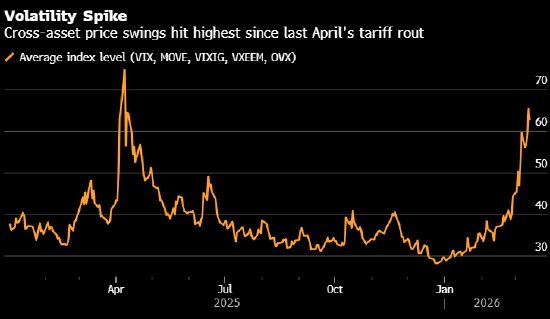
It wasn't just the speed of the moves that shocked traders, but also the dramatic "whiplash effect." Markets can be thrown into turmoil by just one piece of news, even if it's wrong, such as when U.S. Energy Secretary Chris Wright posted on Tuesday that the Navy had escorted an oil tanker through the Strait of Hormuz.
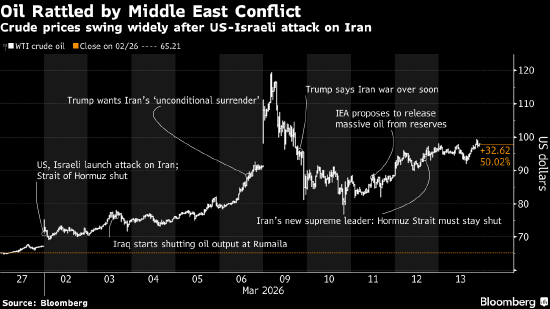
Just the day before, U.S. WTI crude oil futures gave up almost all of their 31% gains after Trump suggested that the war may be nearing an end. This was the largest intraday reversal in at least four decades. The S&P 500 surged in the final hour, notching its biggest gain in a month.
Things have eased slightly over the past few days, however, unlike the brief crash triggered by Trump's reciprocal tariff announcement a year ago, many in the market expect this extraordinary volatility to continue for weeks, if not months. They point out that a real war would be more unpredictable and harder to cool down than a trade war. "I tell all the stakeholders, be careful," Gerald Gan said.
One of the most puzzling features of the sell-off is that traditional safe havens, with the exception of the U.S. dollar, appear to be failing. From gold to the yen, the Swiss franc and U.S. Treasuries, assets typically seen as safe havens in times of crisis are falling as soaring energy prices reignite inflation fears and push interest rates higher.

The trading floor in Seoul this week.
Raymond Lee, chief investment officer of Torica Capital in Sydney, had originally hoped to hedge risks by investing in U.S. Treasury bonds. When he saw oil surge early Monday and Treasuries fall again, he decided to cut his losses, ordering traders to sell their holdings of two-year Treasury futures contracts.
He concluded that the U.S. Treasury market had become almost an extension of the oil market, with yields rising and falling with crude prices, and he wanted no part of it until things stabilized. "Trading interest rates is like trading oil, and I'm not an oil expert," Lee said.
But Keesler knew oil.
As BOK's head of energy trading, he spent decades in the trading pool of the Chicago Mercantile Exchange. He had experienced the surge in oil prices caused by the Gulf War in 1990 and the Iraq War ten years later, and the market shock waves at that time are still fresh in his mind.
Keesler has traded through all the oil shocks over the years: the 2008 financial crisis, the coronavirus pandemic, the Russia-Ukraine conflict. No time has produced such a steady flow of customer orders as Monday morning, he said.
Oil prices rose about 30% in the first week after the United States and Israel began bombing Iran, but investor anxiety quickly built ahead of Monday's opening as reports over the weekend began to show more fully the decline in crude production in the region. In just a few minutes after the market opened, WTI rose by more than 10%.
With the Strait of Hormuz all but closed, the International Energy Agency estimates that about 8 million barrels of oil per day will disappear from the market this month. The agency called it the "largest supply disruption" the market has ever seen.
Kiesler reminded his traders that for now, they must always be fully staffed. One of his tips for moments like this: drink less coffee and water, which will reduce the number of trips to the bathroom. "You can never take your eyes off the screen."
Back in Singapore, Gerald Gan followed a similar rhythm at Reed Capital. He went online at 6 a.m. and stared at the screen until about 2 a.m. the next morning.
The region relies heavily on oil and gas imports from the Middle East to drive its economy, and many of the worst market crashes have occurred in Asia. Every surge in crude oil prices will quickly push up inflation expectations, lower economic growth prospects, squeeze the finances of various countries, and put the market under greater pressure.
Along with India, currencies in Indonesia and the Philippines have fallen to record lows. Five of the 10 worst-performing stock markets in the world this month are from Asia. Few fell more sharply than the KOSPI. The index fell more than 7% on March 3 and hit a record loss of 12% the next day before recouping some of its losses in several rounds of wildly volatile trading.
The rout in South Korea's stock market took a "hard hit" to Gan's portfolio, but he said he made a fortune for his clients by buying large amounts of oil at around $60 a barrel a few weeks ago.
Gan said it was like riding a "roller coaster." He was ready for the coming weeks. "This is not over yet."
Brown, a strategist at Pepperstone in London, shares the same concerns. "One minute you think, 'Maybe we're out of this, maybe there's progress,'" he said. "Then the next minute the news completely reverses and you lose money on all your positions. You're back to square one."
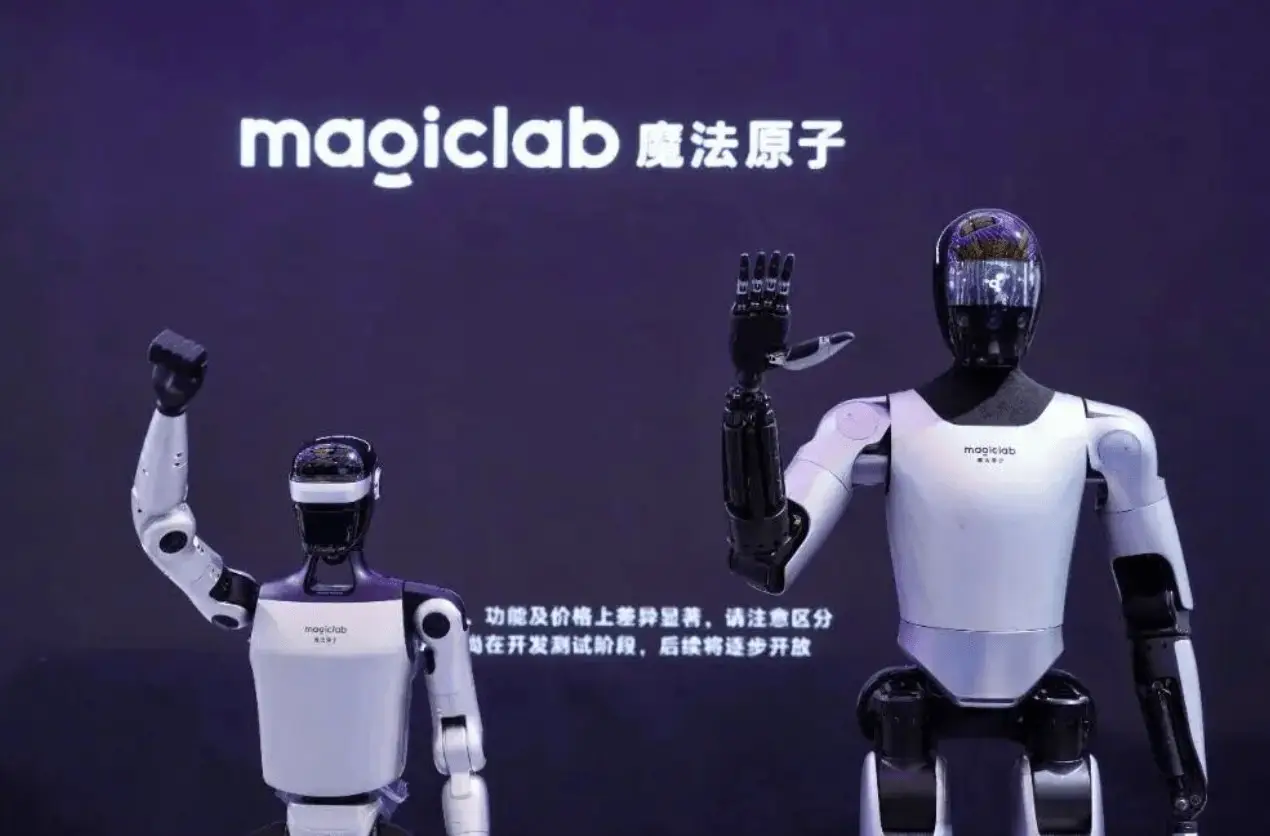
On March 9, a signal worth pondering came from the embodied intelligence track. Magic Atom announced the completion of a new round of financing of 500 million yuan. Among the investors, there are a number of industrial capitals with manufacturing foundation and scene resources such as Tuopu Group, Jiechuang Intelligent, and ASD. SkyWorks Venture Capital Fund, Jinyu Bogor, etc. also participated.
It is worth noting that there is also an industrial ecological fund with a scale of tens of billions, focusing on the key links in the upstream and downstream of the industrial chain, and the overall capital scale exceeds 10.5 billion yuan.
For a long time in the past, early financing in the embodied intelligence track was often characterized by a single-point breakthrough. Because the single-point route is more focused, it is easy for startups to label technology in the short term, thereby further gaining favor from the capital market.
Now, the wind direction is shifting. Public data shows that global humanoid robot shipments have reached 18,000 units in 2025, and their technical capabilities are moving from "prototype verification" to "scale availability."
Capital is also paying more and more attention to whether a company is an all-rounder and whether it can continue to build system capabilities among ontology, models, data, and scenarios along a complete path. Magic Atom’s capital dynamics of exceeding 10 billion this time just reflect this logical evolution.
Behind the battle between software and hardware, the industry begins to bid farewell to the "partial science competition"
The current embodied intelligence track has shown clear path divisions.
Some companies choose to start with models and "brains", trying to take the lead in breakthroughs in understanding, planning, and generalization capabilities; others start with the ontology and hardware, giving priority to establishing motion performance, structural capabilities, and engineering thresholds. Behind the different paths are different judgments by enterprises on the key bottlenecks of the industry, which also correspond to different aspects of the embodied intelligence industry.
The discussion within the industry on the battle between software and hardware has never stopped. Musk has admitted that the team is still struggling with the final design of Optimus hardware, but he is confident in achieving natural human-computer interaction based on large language models. Wang Xingxing, the founder of Yushu Technology, has the complete opposite view of somatosensory. He believes that the existing hardware is sufficient in a sense. The real desert lies in the difficulty of AI in accurately controlling the complex mechanical components of the robot.
The completely different somatosensory does not represent opposing views, but reveals the current dilemma of robots - the lack of deep integration of software and hardware.
As the industry enters the implementation verification period, a consensus has become increasingly clear. Embodied intelligence is not a track that can be won by relying on a single point. The real real competition is turning to "whether software and hardware can form a closed-loop system."
The integrated strategy of software and hardware has once again become the way to break the situation.
IDC pointed out that China's embodied intelligence market has entered a critical inflection point in 2026. Breakthroughs in single-point technology are no longer scarce resources. In the next two to three years, the differences in hardware parameters will gradually narrow, components such as body structure, computing power, and sensors will become standardized, and manufacturers' software and hardware system capabilities will become a watershed.
In this context, Magic Atom takes "embodied intelligence + The "1" on the bottom represents a capability base that integrates software and hardware and continues to evolve. The "2" represents the two core product lines of humanoid and four-legged. It is extended by N ecological touch points. Starting from modular products, it gradually grows into a collaborative, multi-form intelligent ecological space.
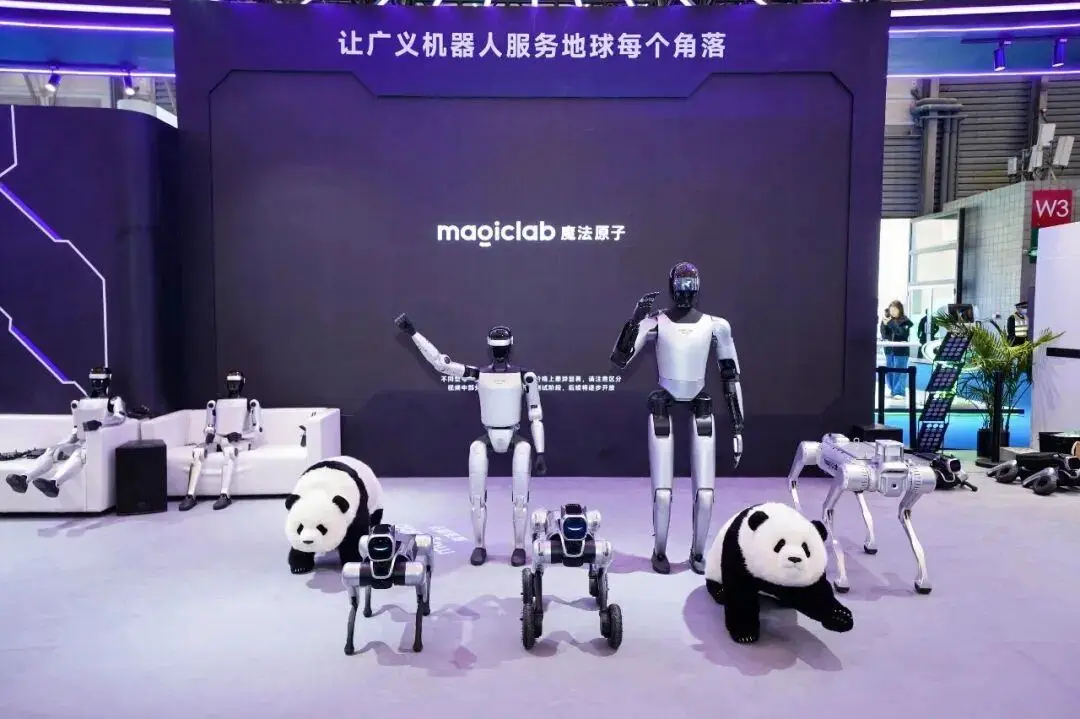
The significance of this strategic structure lies not in the enrichment of product lines, but in the fact that different products and different scenarios are not separated from each other, but share a technical chassis.
Because in the real world, without ontology, the model has no execution carrier; without the model, the ontology is difficult to generalize across tasks; without data, the model and control cannot be continuously iterated; without scenarios, it is difficult for data to form a closed loop; without productization and engineering capabilities, it is difficult to achieve stable delivery.
The real barrier is not a certain ability itself, but whether a stable and difficult-to-dismantle interlocking relationship can be formed between these abilities. Optimize the model through data feedback from the real environment, and then use the iterated model to improve the generalization ability of the hardware. This advantage that relies on time, scale, and task density is extremely difficult for latecomers to directly eliminate through short-term capital investment.
The moat of embodied intelligence is shifting from parameters to systems
What kind of robot can be considered as a large-scale application?
A robot that lifts a 20-kilogram weight in a stable environment only completes primary engineering indicators; but a robot that can stably pick up metal castings with an offset center of gravity for 24 hours in a factory environment with slight ground vibrations can be called a commercial product.
This is the difference between heavy parameters and heavy systems. Commercial competition has never been about showing off parameter "muscle", but testing systematization capabilities.
Therefore, Magic Atom chose to self-develop key components and independently developed joint modules covering a variety of actuators such as planetary deceleration, harmonic deceleration and linear actuators, with a maximum explosive force of 525N·m. The accompanying dexterous hand MagicHand S01, while providing 11 degrees of freedom, can lift the maximum load for specific tasks to more than 20 kilograms. This heavy investment in core components and overall machine structure has an extremely long cycle, but it is deeply bound to subsequent model training and task execution.
In terms of model technology, Magic Atom has self-developed large-scale embodied intelligent models that integrate visual language understanding, task planning and motion control capabilities to promote the evolution of robots from single task execution to cross-scenario task capabilities. From life service scenarios where robots "catch noodles" during the Spring Festival Gala to industrial manufacturing scenarios, the capabilities of the Magic Atomic Model have been verified in real industrial scenarios, with a loading and unloading accuracy rate of up to over 90%.

But if robots want to truly enter large-scale applications, only ontology and models are not enough. Data training based on real scenarios is also required. This is a prerequisite for the system to traverse complex environments and improve robustness.
The data of the robot naturally depends on the body shape, control method, task process and scene feedback. Although laboratory simulation data can help the model converge quickly, it can also easily push the system to "overfitting": it performs well in an ideal environment, but frequently fails once it arrives on site. The real world is far more complex than the laboratory. The position of parts on the assembly line may only shift by a few millimeters. The light in the workshop will alternate between light and dark as the time changes, disrupting the original spatial coordinates.
This is also the reason why more and more head manufacturers are beginning to pay attention to real scene data. For example, in order for Tesla's Optimus to achieve stable sorting in the factory, the amount of measured data required reaches millions of hours.
In this regard, Magic Atom built its own data mining factory to open up a complete link from data collection, model training, simulation evaluation, model deployment, and application feedback. And it is deployed in the production front-line scenarios of a group of the most demanding head KAs (key customers) as a "whetstone" for product iterations. Every time the robot enters a more complex scene, it gets not only orders, but also higher-quality data and more realistic problem sets.
From the perspective of scenario distribution, this system capability is also tested in different types of environments.
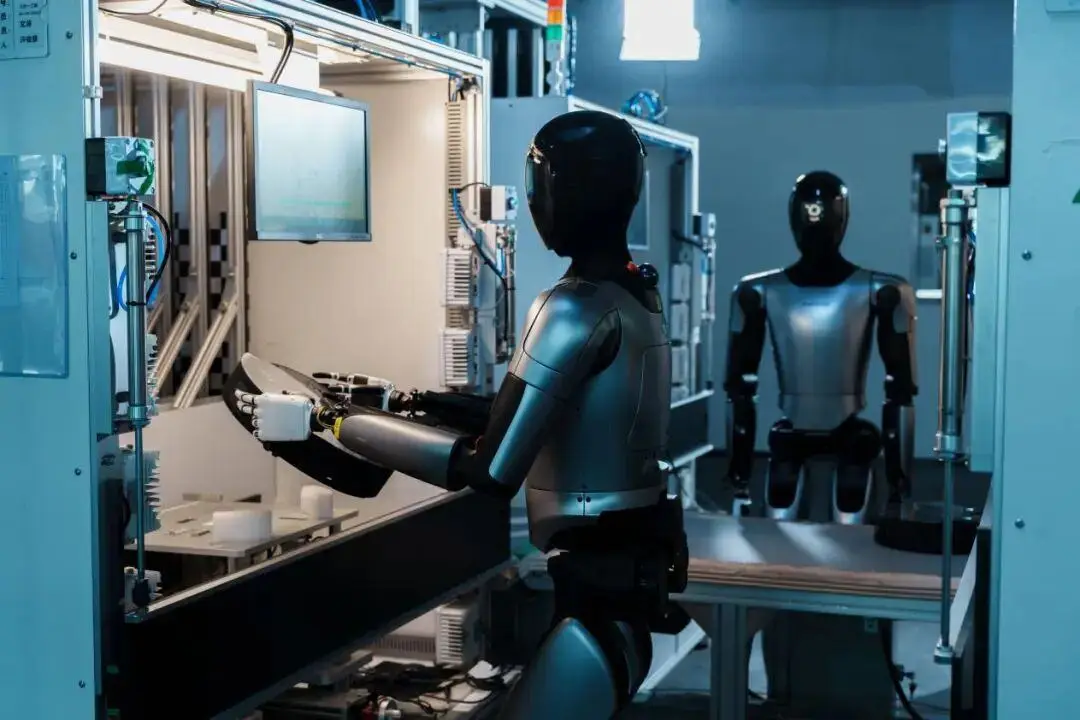
Industrial scenarios are relatively structured scenarios in reality, and the first thing to verify is execution capabilities. In the factory, Magic Atom's Magic Bot Gen1 is no longer just a demonstration prototype, but has begun to be used in specific tasks such as loading and unloading on the production line, precision inspection of parts, cargo sorting, handling and palletizing.
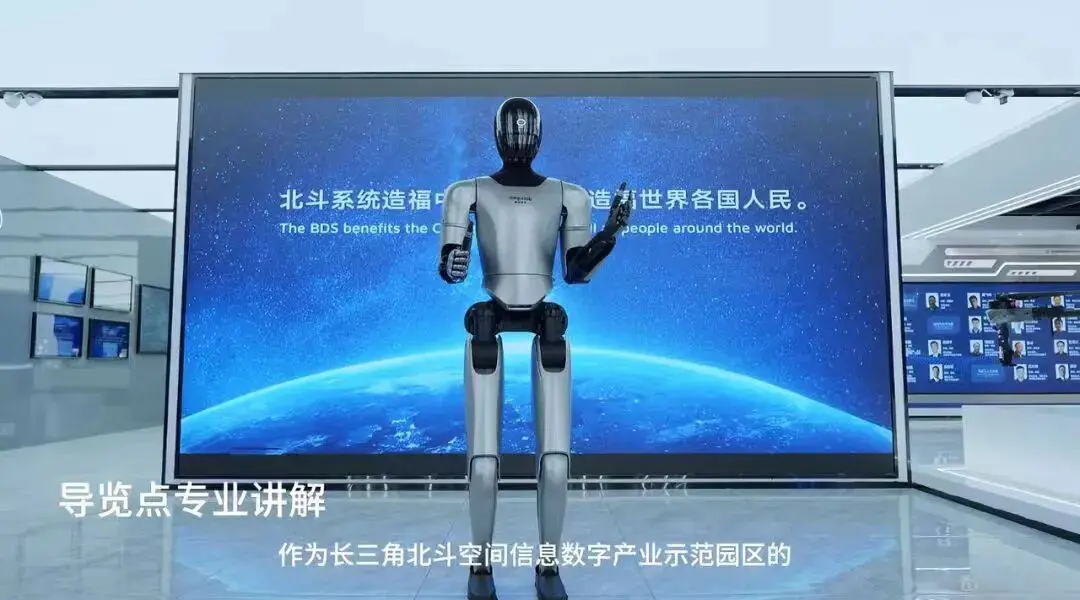
Commercial service scenarios are semi-structured scenarios that require human-computer interaction, environmental adaptation, and long-term stable operation in scenarios such as tour guides and shopping guides. Magic Atom's tour and shopping guide solutions have been implemented in many projects such as the Wuxi Yangtze River Delta Beidou Space Information Digital Industry Demonstration Park and the Wuxi Low-altitude Economic Operation Exhibition Center; the unmanned store solution has also been implemented on a regular basis in Wuxi Airport, Plaza 66, Huishan Ancient Town, and Shenzhen Gankeng Ancient Town.
Special scenarios further push the system capabilities to the limit and are its ultimate tests. High-risk environments such as mining prospecting, power inspection, and chemical monitoring put forward more stringent requirements for all-terrain adaptation, high load capacity, and stable operation capabilities in dangerous environments. Here, any shortcomings between ontology, control, perception and execution are magnified. The quadruped robot Magic Dog Y1 can replace humans to complete data collection in dangerous environments, freeing humans from high-risk operations.
Industrial, commercial, special and other scenarios use seemingly scattered scenarios, but ultimately serve the same thing: increasing scene density, accumulating real data, and improving system reusability.
Why is Magic Atom revalued by capital?
Observing the current industry climate of China's embodied intelligence is more like revisiting the early development of the autonomous driving track from 2015 to 2019. Initially, capital was keen on the grand narrative of the industry. Just as concepts such as L4 and Robotaxi were pursued back then, hot money initially also flocked to single-point technological breakthroughs. Because a single technological breakthrough can amplify industry optimism.
However, as it truly advances towards commercialization, industry rules emerge: the path of autonomous driving that has been fully experienced by "algorithm breakthroughs igniting expectations - parallel competition among multiple routes - hot money chasing head narratives - commercialization forcing technological convergence", embodied intelligence is going through again.
The investment logic quickly moves from the conceptual level to the closed-loop scenario. Investors are no longer satisfied with demo code, but are beginning to ask about the cost of a single machine, the success rate of real deployment, and the number of complete machines delivered.
At the stage of commercialization, software and hardware collaboration, system integration, responsibility boundaries, supply chain cooperation and scenario closed loop have become new sticking points.
At this time, the tens of billions-level industrial ecological fund and 500 million yuan in financing settled by Magic Atom happened to be in line with the pace of industry revaluation.
If ontologies, models, data, and scenarios are scattered among different vendors, commercial delivery will face extremely high communication losses. A robot made a grasping error in the workshop, resulting in a decline in yield, and the customer was unable to identify the root cause. Enterprises cannot open the underlying interfaces without reservation, which directly locks the upper limit of system capabilities.
In order to break the fragmented state of the industry in its early stages, Magic Atomic chose capital links to integrate the industrial chain, and settled tens of billions of ecological funds in Wuxi. Through the "Venus Plan" of "investment + incubation", it clearly invested funds in upstream and downstream links such as algorithms, computing power, core components and end execution tools.
The financing promoted at the same time is essentially reserving strategic ammunition for the subsequent large-scale mass production. Looking at the list of Magic Atom’s investors in this round: SkyWorks Venture Capital Fund, Top Group, Golden Rain Bogor, Suda Tiangong, Jiechuang Intelligent, Aistar, Liang Venture Capital... it shows a clear demand for industrial synergy.
From this point of view, the next stage of competition in embodied intelligence is not necessarily about who can achieve the ultimate in a certain ability first, but who can first truly turn ontology, models, data, and scenarios into a self-reinforcing system.
A single breakthrough can bring a temporary lead, but it is the system's capabilities that determine long-term value. After the robots enter the real scene, the competition is not only parameters and demonstration effects, but also stability, collaboration and continuous iteration capabilities.
In this sense, Magic Atom’s dual-line financing and fundraising is not just a capital event, but more like the market’s early bet on the “complete path school”. This bet is not on the explosion of a single point of capability, but on the closed-loop capability of the system. This is a path that is heavier, slower, but also harder to copy.
The real watershed of embodied intelligence may begin here.
At the "Belt and Road" Science and Technology Exchange Conference held in Chongqing, my country proposed the "International Science and Technology Cooperation Initiative" for the first time, advocating and practicing the concept of international science and technology cooperation that is open, fair, just and non-discriminatory, adhering to the principle that "science knows no borders and benefits all mankind", and jointly builds a global science and technology community.
China for the first time proposed an international science and technology cooperation initiative at the Belt and Road Conference on Science and Technology Exchange in southwest China's Chongqing Municipality. The initiative calls for advocating and practicing the concept of open, fair, just and non-discriminatory international cooperation in science and technology, adhering to the principle that "science has no borders and benefits all mankind," and joining hands to build a global community of science and technology.
A corner of the venue of the first "Belt and Road" Science and Technology Exchange Conference taken on November 6, 2023. Image source: Xinhua News Agency
【Knowledge Points】
At present, the world is undergoing major changes unseen in a century and is accelerating. Human development is facing more and more major challenges. Human society needs international cooperation and open sharing more than ever before. Through scientific and technological innovation cooperation, we can explore and solve global problems, jointly respond to the challenges of the times, and promote peaceful development. Scientific and technological cooperation is an important part of cooperation in jointly building the "Belt and Road". Over the years, the Ministry of Science and Technology of China has worked with partners from various countries to consolidate and deepen bilateral and multilateral scientific and technological cooperation between governments, continue to expand exchanges and exchanges in the scientific and technological community, continuously improve the level of joint research and development, vigorously promote technology demonstration, promotion and application, jointly support innovation and entrepreneurship, and contribute positively to enhancing the scientific and technological capabilities of various countries, serving the economic and social development of various countries, and deepening friendship between countries.
The "International Science and Technology Cooperation Initiative" includes six specific contents including adhering to advocating science, innovative development, open cooperation, equality and inclusiveness, solidarity and collaboration, and universal benefit and win-win, such as improving global science and technology governance and strengthening intellectual property protection; strengthening global science and technology innovation collaboration to jointly build a global innovation network; adhering to scientific and technological innovation personnel and resources flow freely around the world, strengthen talent exchanges and cooperation; advocate all countries and scientific research entities to participate in international scientific and technological cooperation on an equal footing; strengthen in-depth collaboration and mutual learning among scientific and technological innovation entities; explore mutually beneficial and win-win new models of global scientific and technological innovation cooperation, and promote mutual benefit and mutual sharing of scientific and technological innovation achievements, etc.
【Important speech】
We deeply realize that only win-win cooperation can accomplish things, do good things, and do great things. As long as all countries have the desire to cooperate and coordinate actions, natural chasms can be opened up, "land-locked countries" can become "land-linked countries", and lowlands of development can become highlands of prosperity.
We have learned that win-win cooperation is the sure way to success in launching major initiatives that benefit all. When countries embrace cooperation and act in concert, a deep chasm can be turned into a thoroughfare, land-locked countries can become land-linked, and a place of underdevelopment can be transformed into a land of prosperity.
——On October 18, 2023, Xi Jinping’s important speech at the opening ceremony of the 3rd “Belt and Road” International Cooperation Summit Forum
【Congratulatory message】
At present, a new round of scientific and technological revolution and industrial transformation are developing in depth. To solve the problem of common development, mankind needs international cooperation and open sharing more than ever before.
As a new round of sci-tech revolution and industrial transformation continues to evolve, mankind needs international cooperation, openness and sharing more than ever in order to address common development problems.
——On May 25, 2023, Xi Jinping’s congratulatory letter to the 2023 Zhongguancun Forum
【Related vocabulary】
Global Science and Technology Innovation Collaboration
global collaboration on technological innovation
Global Technology Governance
global science and technology governance
global science and technology community
global scientific and technological community
china daily website english commentary studio
(This article was first published on the "Study Powerful Nation" learning platform)
Municipal Economic Development Zone accelerates the construction of the park
Promote the continuous agglomeration of industries
Achieve continuous improvement in development quality and efficiency——
Build a large platform for the park to achieve new breakthroughs in development
Build the main economic battlefield
Make the strongest sound in industry
In midsummer, industries gather in China (Bengbu) Sensing Valley, and the entire smart sensor industry chain industry system is accelerated;
Lingang Industrial Park rises from the ground, and a brand-new picture from scratch, from desolation to prosperity is slowly unfolding...
Walking through the various parks in the Municipal Economic and Technological Development Zone, key enterprises are developing at full capacity, and major project construction is in full swing. The vibrant scenes inside and outside the park make people deeply feel the power of progress and the pulse of development.
Aerial photography of China (Bengbu) Sensor Valley
Build a park and build a platform
Improve supporting facilities and optimize development environment
Under the scorching sun, on the construction site of the first phase of the China (Bengbu) Sensor Valley Central Innovation Park project, there are many tower cranes, machinery roaring, and workers working intensively at their respective posts, creating a bustling and busy scene.
China (Bengbu) Sensing Valley
"China (Bengbu) Sensor Valley is a special industrial park built by the Municipal Economic Development Zone. It is committed to building a domestic first-class and internationally renowned smart sensor industry cluster that is dominated by smart sensors and the Internet of Things industry and integrates R&D, design, manufacturing, packaging, testing and application in the sensor industry." Ge Duolei, deputy general manager of the Economic Investment Group, said that the park coordinates the industrial spatial layout in accordance with the "one valley and three parks" →→→
"One Valley"
China (Bengbu) Sensing Valley
"Three Gardens"
MEMS core device industrial park, science and technology incubation park, and central innovation park.
At present, the MEMS core device industrial park and science and technology incubator park have been put into operation, and the Central Innovation Park has been fully constructed. It has gathered 23 key enterprises such as the 214th Institute of Ordnance, Xindong Lianke, CMC Technology, Yuxin Semiconductor, and Jinggu Perimeter.
At the construction site of the first phase of the China (Bengbu) Sensing Valley Central Innovation Park, project leader Deng Bin told reporters that the project started in late April this year. It is expected that the main structure of the first phase factory building of approximately 110,000 square meters will be completed by the end of October this year, and will be equipped with water, electricity, gas, greening, roads, etc., making it easier for companies to move in and install production equipment as soon as possible, so as to achieve early production results.
"This is the province's largest single project after Anhui implemented the separate assessment and bidding model. The factory building can reach up to eight floors and is equipped with complete apartments and supporting facilities, which can meet all aspects of enterprise development needs." Ge Duolei said that after the first phase of the factory is completed, it can provide production sites for more than 10 high-tech enterprises.
Build parks and promote development
↓↓↓
In recent years, the Municipal Economic Development Zone has focused on park construction, actively built industrial platforms, provided park supporting facilities, and accelerated the professionalization of the Sensing Valley Central Innovation Park Phase I, Medical Device Industrial Park, Ningbo (Bengbu) New Materials Industrial Park, Science and Technology Innovation Industrial Park, Lingang Intelligent Manufacturing Industrial Park, Lingang Equipment Manufacturing Industrial Park, etc. In the construction of industrial undertaking platforms, infrastructure projects such as Fengyang East Road, Simazhuang Road, Zhihuai East Road, Comprehensive Pipe Gallery, and Wei 5 Road in Lingang Industrial Park have been fully accelerated, and supporting facilities such as resettlement housing and schools have been promoted simultaneously. Large-scale projects such as industrial platforms and park supporting facilities for water supply have supported the continued growth of fixed asset investment.
Under the favorable park environment, a number of key enterprises and projects have gathered in the park, injecting inexhaustible impetus into the development of the Economic Development Zone. Wang Jian, deputy director of the District Economic and Trade Development Bureau, told reporters that in the first half of this year, the regional GDP of the Municipal Economic Development Zone increased by 9.9% year-on-year, of which the secondary industry increased by 48.6% year-on-year, the added value of industries above designated size increased by 495.5% year-on-year, the output value of strategic emerging industries increased by 390.6%, and the added value of high-tech industries increased by 513.1%, ranking first in the city in terms of growth rate.
Employees of Bengbu Xici Technology Co., Ltd. check the operation status of the equipment
Grasping investment and extending the chain
“Business-based investment promotion” promotes industrial agglomeration
Xici Technology
CMC Technology is a magnetic sensor IDM company that masters the core capabilities of the entire industrial chain of magnetic sensor chip design, material preparation, wafer manufacturing, chip testing, and magnetic sensor module design and production. It has completely independent R&D, design and production capabilities in all core links. Its products are widely used in new energy electric vehicles, new energy power generation and other fields.
In 2018, companies were recruited from Ningbo to Bengbu. Zhao Qianyang, the person in charge of the company's general manager office, said that the reason why the company settled in the Economic Development Zone was because at the most critical moment for the company's development, the Economic Development Zone took the initiative and helped CMC Technology complete the acquisition of a world-renowned magnetoresistive sensor company in Germany, thus filling the shortcomings of the company's development, improving its core competitiveness, and realizing the company's layout in the global market.
Since settling in the Economic Development Zone, CMC Technology's annual sales revenue has increased exponentially, from 50 million yuan in 2019 to 150 million yuan in 2021. In the first five months of this year, the company's sales revenue has reached about 140 million yuan, and it is expected to achieve about 300 million yuan this year.
"From investment promotion to implementation, from factory location selection to environmental assessment approval, from policy implementation to difficulty assistance, the Economic Development Zone provides us with full-process services. As long as we have needs, they will solve them as soon as possible." Zhao Qianyang said that it is based on the Municipal Economic Development Zone In view of the good development environment in the district, CMC Technology, which was originally headquartered in Ningbo, completed the industrial and commercial change registration last year, changed Bengbu CMC Technology Co., Ltd. to its headquarters, gradually transferred the industry to Bengbu, and invited upstream and downstream enterprises to come to Bengbu for joint development. At present, the upstream company Zhongke Jiuheng Technology Co., Ltd. has been attracted by CMC Technology to Bengbu to jointly develop the sensor industry in the Economic Development Zone. At the same time, CMC Technology has also implemented a new production expansion project in the Sensing Valley and launched a science and technology innovation version listing plan, preparing to attract more upstream and downstream companies to gather in the Sensing Valley to support the development of Bengbu.
Using the park as a platform
Taking the industrial chain as the starting point
Guaranteed by quality service
The Municipal Economic Development Zone has attracted a large number of high-quality projects to settle in
According to Xiang Dinghui from the District Investment Promotion Bureau, in June this year alone, the Municipal Economic Development Zone signed eight new projects, including the new energy power battery Bengbu warehousing center, new energy power battery Bengbu intelligent logistics center, display panel driver chip COF process packaging and testing, Xianmi Intelligent Manufacturing New Intelligent Power Module (IPM) R&D and production base, Lingang Science and Technology Innovation Industrial Park, Economic Innovation Wanbei Maker Space, Lingang Intelligent Manufacturing Industrial Park, and high-efficiency source-network-load-storage-charging integration.
In the first half of this year, the district signed 23 new projects worth over 100 million yuan, with an agreed investment of 12.13 billion yuan.
BYD New Energy Power Battery Production Base Project
Excellent service emphasis
Everyone is a "waiter" and "propaganda"
"What should the enterprise's foreign technical personnel or temporary external personnel do if their residence period is about to expire? How should enterprise employees solve household registration and legal issues?" Jiang Zerui and Lan Changliang, members of the "Three Gangs" team of the Municipal Economic Development Zone, discovered during their visits to enterprises that since there are many migrant workers in the park, they often encounter various problems related to household registration and identity, which consumes a lot of energy from enterprises. After in-depth thinking, the district's "Three Gangs" team decided to innovate the way of assistance, actively connect with relevant departments and enterprises, and form a WeChat service group of "Three Gangs" personnel + enterprises + public security departments. When enterprises encounter problems, they only need to "shout" in the WeChat group, and personnel will respond immediately. They are guaranteed to handle the problems immediately, on-site, and to ensure satisfaction, and to support the development of the enterprise around the clock.
Meticulous service
Give the company a full sense of gain
In the circle of friends of the staff of the Municipal Economic Development Zone, you can often see various information about recruiting employees for enterprises. As long as companies have needs, the entire district is "waiters" and "propagandaists." This kind of multi-departmental linkage service for enterprises and the behavior of all employees to solve problems for enterprises has become the autonomous consciousness and daily habits of most staff in the Economic Development Zone.
Nian Fubin from the Science, Technology, Economic and Information Technology Bureau of the Municipal Economic Development Zone said that in the process of serving enterprises, the district strictly implements the guarantee mechanism, visits enterprises regularly, and promptly helps enterprises solve their needs in financing, technology, employment, sales and other aspects, so that enterprises can see the hope of starting a business. At the same time, we actively help enterprises apply for various honors such as Little Giant Enterprises and Individual Champion Enterprises, strive to allow enterprises to obtain more "brands", guide enterprises to develop in new directions of specialization, and allow enterprises to find their development direction. In addition, we proactively apply for various reward and subsidy policies for qualified enterprises, and implement the reward and subsidy funds as soon as possible, so that enterprises can taste the benefits of the policy, and use good services to help enterprises grow healthily.
On the one hand, provide good service
On the one hand, strengthen scheduling
The Municipal Economic Development Zone adheres to top-level scheduling. The management committee schedules investment promotion, project construction, economic operations and other work on a monthly basis, and supervises and supervises the completion of project construction progress, timely resolution of corporate problems, improvement of weak indicators of economic operation, start-up rate, warehousing rate, entry rate of newly introduced projects, etc., to ensure that all projects are completed, developed well, and achieve results.
at present
The first and second batches of the Municipal Economic Development Zone
Those who participated in the provincial centralized construction
China (Bengbu) Sensor Valley Central Innovation Park Phase I
Xici Technology Industrial Park Phase I
China (Bengbu) Sensor Valley Public Demonstration Platform and Demonstration Line
Waiting for 9 projects
All construction has started
Completed investment of 2.25 billion yuan
Accounting for 72.55% of the annual plan
In view of the current complex situation of the epidemic
The Municipal Economic Development Zone has also specially formulated
Emergency plan for epidemic prevention and control in the park
Efficiently coordinate epidemic prevention and control and economic and social development
Leading cadres at all levels are required to provide "one-to-one" protection for key industrial enterprises, guide and urge enterprises to promptly improve epidemic prevention and control plans, and implement prevention and control measures such as detailed temperature measurement and code checking, visitor registration, and disinfection protection, so as to strengthen the enterprise's epidemic prevention and control lines.
At the same time, the supervision work is refined, and in accordance with the requirements of "three questions, three inspections, and three clarifications", we implement one order per enterprise, supervision according to the order, and cancellation of the order, forming a closed-loop working mechanism of "guarantee-supervision-supervision-rectification-verification" to ensure that there are no dead ends in on-site inspections and there are no exceptions to immediate changes.
At present, the Municipal Economic and Technological Development Zone has printed clear sheets on epidemic prevention and control for enterprises and the "Notice on Further Strengthening Epidemic Prevention and Control Work" to remind enterprises to do daily health monitoring, setting up isolation observation sites, and management of outsiders, and further urge enterprises to strictly implement epidemic prevention and control measures and strive to create a safe and stable production environment.
The person in charge of the Municipal Economic Development Zone said
In the next step, the Municipal Economic Development Zone will conscientiously implement the important instructions and requirements of "preventing the epidemic, stabilizing the economy, and ensuring safe development", and in accordance with the relevant work requirements of the Municipal Party Committee and Municipal Government, continue to focus on the construction and development of the park, continuously strengthen services and dispatch, strive to introduce more enterprises, promote the speed and efficiency of existing projects, and provide strong support for the sustained, stable and healthy development of the city's economy.
 Under Continued U.S. Sanctions, Venezuela Relies On Increasing Productivity To Stabilize Prices And Demand2026-02-27Comments(0)
 The Bride Responded To Her Father’s Return Of 188,000 Yuan In Gift Money At The Wedding, And The Reason Behind It Was Touching.2026-03-04Comments(0)
 Ning Zhongyan Set A Record By Winning The 1,500 Meters At The Milan Winter Olympics, Defeating A Strong Opponent And Fulfilling Four Years Of Hard Work2026-02-27Comments(0)
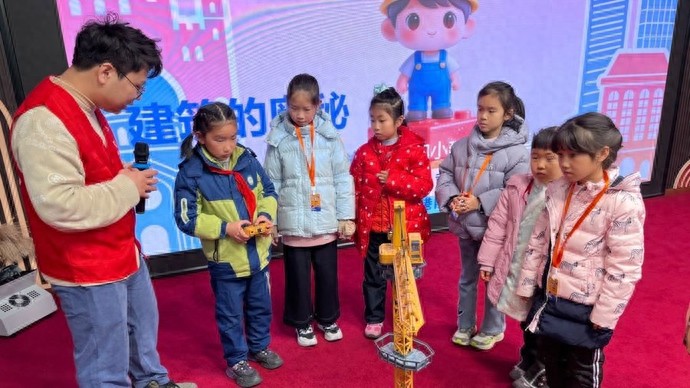 The Shanghai Branch Of China Construction Second Engineering Bureau Visited Primary School Kindergartens And Brought Popular Construction Science Classes2026-02-13Comments(0)