
How Much Do You Know About The History Of Anhui University Of Finance And Economics?
Anhui University of Finance & Economics official website address: http://www.aufe.edu
Anhui University of Finance & Economics official website address: http://www.aufe.edu
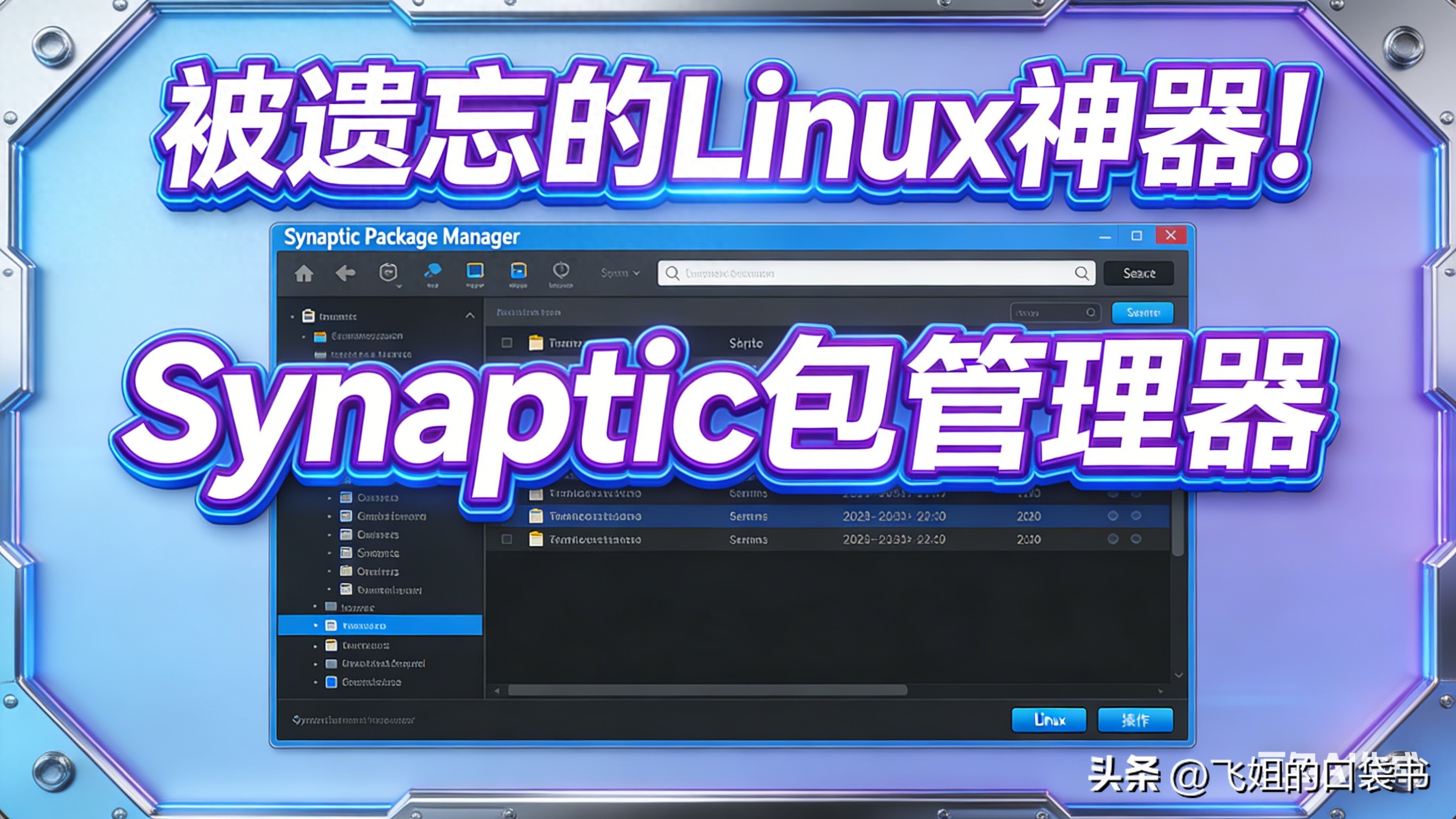
1. After using Linux for many years, you may have been using the wrong package manager.
Everyone who plays Debian Linux cannot escape the apt command in the terminal. sudo apt install xxx, sudo apt remove xxx, these instructions are like required introductory courses, accompanying countless people from Linux novices to advanced users. It is undeniable that the apt command is simple and efficient, and can meet the needs of most software installation and uninstallation. It is one of the core tools of the Linux system.
But few people know that there is a tool that can maximize the functions of apt and solve all the pain points of apt - it can visually manage all software packages, repair dependency errors with one click, completely delete software residues, and even lock software versions to avoid accidental updates. It is Synaptic Package Manager, an artifact that was once the default graphical package manager for Debian Linux, but is now forgotten by most people.
Many people insist on using the terminal to type commands, thinking that this is the embodiment of "understanding Linux", but ignore the time and energy this tool can save; some people are attracted by the gorgeous interface of the modern software center and have no idea of the strength of this "old antique". Why bother with terminal commands when you can solve the problem with one click? You can clearly see the status of all packages in the system, so why do you have to guess around in the limited feedback from apt?
Detailed explanation of key technologies: Free and open source, superior to similar tools
Synaptic is a graphical front-end tool based on the APT package management system. It is specially designed for Debian Linux distributions, including Ubuntu, Kali, Linux Mint, Parrot OS, etc. It can be perfectly adapted. Its biggest advantage is that it is "open source and free". There are no advertisements or paid functions in the whole process. Anyone can download, use and modify its source code for free.
As a classic open source tool, Synaptic has high popularity on GitHub, with thousands of stars. It has accumulated maintenance and optimization by countless developers around the world, and its stability and compatibility have been tested by the market for more than 20 years. It does not pursue a gorgeous interface, but takes "practicality" to the extreme. All functions that apt can achieve can be completed through graphical operations. It also adds visual management and control capabilities that apt does not have, making complex package management simple and easy to understand.
2. Core dismantling: Complete Synaptic in one article, even novices can get started
The power of Synaptic lies in the fact that it can not only meet the "visual operation" needs of novices, but also take into account the "fine management and control" needs of advanced users, transforming complex package management logic into simple mouse click operations. The following will explain the core functions of Synaptic thoroughly from four aspects: definition, installation, use, and practical skills. You can easily master it by following the operation.
What is Synaptic Package Manager
Synaptic is essentially a "graphical shell" for APT. It does not change the core working logic of APT, but solves the "unintuitive" problem of APT terminal operations. Different from the simple application store that comes with Linux, it can display all software packages in the system - including underlying libraries and dependent components, not just the "applications" we usually see.
The core functions it can implement include: installing software, completely deleting software, repairing damaged dependencies, locking software versions, viewing software details, and visually browsing all software packages. Whether you are a security researcher, developer, or a novice who wants to intuitively control the system, you can use its core value.
How to install Synaptic (steps + code)
Synaptic supports all Debian Linux distributions. The installation steps are simple. The whole process only requires two terminal commands. Novices can easily complete it. The specific operations are as follows:
# 第一步:更新系统软件包缓存(确保能下载到最新版本的Synaptic)
sudo apt update
# 第二步:安装Synaptic包管理器
sudo apt install synaptic
After the installation is complete, there are two startup methods:
1. Terminal startup: Enter the following command. Note that root privileges must be used, otherwise all functions will not be able to operate normally.
sudo synaptic2. Graphical startup: Open the system application menu, search for "Synaptic", and click the icon to start (you will be prompted to enter a password to obtain root permissions during startup).
Synaptic step-by-step tutorial (a must-read for newbies)
Synaptic's interface is simple and clear. The core operation only has three steps: "Search-Mark-Apply". Taking the installation of nmap software as an example, the detailed steps are as follows:
Step 1: Search for packages
After opening Synaptic, click the "Search" button on the top toolbar, enter the software package name (such as nmap) in the pop-up search box, and click "Search" again. The system will automatically filter out all nmap-related software packages.
Step 2: Mark for installation
In the search results, find the software package that needs to be installed (usually the item whose name exactly matches the search keyword), right-click the software package and select "Mark for Installation". A dependency prompt will pop up. Click "Mark" to confirm the installation of the required dependency packages.
Step 3: Apply changes
After the marking is completed, click the "Apply" button on the top toolbar. In the pop-up confirmation window, click "Apply" again. The system will automatically start installing the software and related dependencies. Wait for the progress bar to complete and the installation will be successful.
Synaptic Practical Tips (Essential for Improving Efficiency)
In addition to basic installation and uninstallation, Synaptic also has three super practical tips that can solve the common pain points of Linux users. It is recommended to collect them:
Tip 1: Filter packages by status
On the left panel of Synaptic, there are four commonly used filtering options: installed, upgradeable, not installed, and damaged. Click the corresponding option to quickly filter out the software packages in the corresponding status, which is suitable for system auditing and cleaning up useless software.
Tip 2: View detailed properties of the software package
Double-click any software package, and a properties window will pop up, which contains detailed information such as software description, installed files, dependencies, maintainers, versions, etc. It can not only help novices understand the software functions, but also allow advanced users to troubleshoot dependency issues.
Tip 3: Clean up residual configuration files
After using apt remove to delete software, configuration files are often left behind, and long-term accumulation will occupy system space. Select "Installed (residual configuration)" in the filter bar on the left side of Synaptic, right-click the corresponding software package, select "Mark for Complete Removal", and click "Apply" to completely remove the software and all remaining configurations.
3. Dialectical analysis: Although Synaptic is powerful, it is not suitable for everyone.
It is undeniable that Synaptic is a powerful package management tool. It solves the pain points of unintuitive APT terminal operation, troublesome dependency repair, and incomplete software deletion, making Linux package management simpler and more transparent. For users who need a refined management and control system, its value is irreplaceable and can even increase work efficiency several times.
But Synaptic also has its own limitations, and not all Linux users need it. Its interface is relatively old and does not have the thumbnails, ratings, comments and other functions of modern software centers. For novices who only need to occasionally install a few commonly used software, it may feel "too complicated"; and its running speed is slightly slower than APT terminal commands. For advanced users who pursue ultimate efficiency and are familiar with terminal operations, APT may still be the first choice.
What’s more worth thinking about is that Synaptic’s “decline” was not due to its own lack of strength, but the inevitable development of the times. With the rise of modern graphical package managers such as GNOME "Software" and KDE "Discover", they have occupied the mainstream market with their more beautiful interfaces and simpler operations. However, Synaptic was gradually forgotten because it did not update the interface in time to adapt to new user habits. But this does not mean that its functions are lagging behind. On the contrary, in many scenarios, its practicality still exceeds that of modern software centers - such as locking software versions and fixing dependency errors. These functions are still difficult to achieve in modern software centers.
So the question is, for Linux users, should they choose Synaptic or APT? Should we stick to the efficiency of terminal commands, or embrace the convenience of graphical tools? In fact, the answer is simple: what suits you is the best.
4. Practical significance: The forgotten artifact still has irreplaceable value
In today's Linux ecosystem, although Synaptic is no longer mainstream, it still has irreplaceable practical significance, especially for certain groups of people, its value is even irreplaceable.
For security researchers and penetration testers, Synaptic can help them quickly manage a large number of tool kits, lock tool versions to avoid functional abnormalities caused by upgrades, completely delete useless tools and residual configurations, and keep the system clean and stable. This is crucial for people who rely on Kali and Parrot OS for work.
For developers, Synaptic can visually display the dependencies of software, help them troubleshoot dependency conflicts during the development process, view the installation path and detailed information of the software, save time in troubleshooting, and improve development efficiency.
For those new to Linux, Synaptic is an excellent tool for understanding the logic of system package management. Through the visual interface, novices can clearly see the entire process of software installation and uninstallation, understand the importance of dependencies, and gradually understand the underlying structure of the Linux system, laying the foundation for subsequent learning of terminal operations. Compared with directly memorizing apt commands by rote, this "visual learning" method is more efficient and easier to understand.
What is even more impressive is that Synaptic, as a classic tool for more than 20 years, has always insisted on being open source and free, without any commercial elements, and silently contributes to the Linux ecosystem. It does not pursue traffic and popularity, but uses its strength to prove that "practicality is the last word." This original intention is particularly valuable in today's software market that pursues appearance and traffic.
Its decline reminds us: the success of a software requires not only powerful functions, but also the need to keep up with changes in user habits; but the value of a software will not disappear because the popularity subsides. As long as users need it, it still has the meaning of existence.
5. Interactive topic: Have you used Synaptic? Tell me about your Linux package management experience
Seeing this, I believe many Linux users will suddenly realize that there is such a useful package management tool, and they have been using apt in vain for so many years; some old users will also sigh: Someone finally mentioned Synaptic, which was my main tool back then.
In fact, this is the charm of Linux - there are countless classic tools like Synaptic, which are not ostentatious or fancy, but can solve practical problems. Maybe you have been typing apt commands in the terminal, maybe you have given up on Synaptic a long time ago, or maybe this is the first time you have heard of this tool.
Let’s chat in the comment area: Have you ever used Synaptic package manager? What useful tips have you encountered while using it? Do you usually prefer to use apt terminal or graphical package manager? What do you think is the fundamental reason why Synaptic has been forgotten?
"Chill 1994", the first prequel in the "Cold War" series, held a press conference today (18/3). New cast members Liu Junqian, Tse Junhao, Wang Danni, and director Liang Leming were all present. One of the protagonists of the series, Tony Leung Ka Fai, also made his final appearance. In addition, Ji Zhao also announced the 12 important actors in the film. In addition to the 4 present, the others include Chow Yun-fat, Aaron Kwok, Louis Koo, Daniel Wu, Tse Kwan-ho, Wu Kangren, Liu Ziyu, Dani Wang, and two British heavyweight actors, Aidan Gillen from "Game of Thrones" and Hugh Bonneville from "Downton Abbey", who will play important members of the colonial government.
(Photo by Chen Shunzhen)
Director Liang Leman said frankly that he would like to thank Boss Jiang for making his dream come true: "The boss asked me to come up with a good lineup, and he will try his best to cooperate with me." (Photo by Chen Shunzhen)
Regarding the new work having such a shocking cast, director Liang Lok Man said frankly that he would like to thank Boss Jiang for making his dream come true: "Thank you boss first. I am responsible for the creation. During the preparations, the boss asked me to come up with a good lineup. He will try his best to cooperate with me." As for finding Louis Koo to play the role of the chief executive, The directors all expressed their gratitude: "When everyone sees the feature film, you will feel as if you will know that we write tight roles. I told Gu Sheng that since you are playing the biggest man in Hong Kong, you should know a little bit about acting. He trusts us so much that he can let us change our hair, add some beards, and change glasses."
Tse Kwan-ho, who played the role of the richest man in a prominent Hong Kong family, revealed that he spent three hours a day on makeup for his role. (Photo by Chen Shunzhen)
Tse Junhao said that this old makeup requires a total of 11 accessories. "It feels like wearing a mask." ("Cold War 1994" character poster)
As for Tse Kwan-ho, who played the role of the richest man in a prominent Hong Kong family in the film, he revealed that he spent three hours a day putting on aging makeup for his role. "There were a total of 11 accessories required for the scene. It felt like wearing a mask. I didn't get used to it at first and couldn't get the expressions I wanted, but after one or two days of filming I got used to it. The director said that you finally got the job done." Another challenge for Brother Junhao is to work with Hugh Bonneville Bonneville), who spoke English: "It's actually only two sentences, but I practiced very patiently and found an English teacher to teach me, so I passed the test by luck."
Wang Danni, who plays the club's new talker in the film, described the filming of "Cold War 1994" as having many firsts. "You have to fight with a lot of people, for many days in a row, and there are gun scenes, so you need to receive firearms training beforehand." In order to play the role of the club's big sister, the director asked Dani to be calmer: "Stop emotional ups and downs, and be more powerful!"
Wang Danni, who played the club's new talker in "Cold War 1994", said there were many firsts during the filming. (Photo by Chen Shunzhen)
On February 28, 2026 (Saturday), the overnight market review released by the world's major financial media recorded a clear trading fact: During the trading session this past Friday (February 27), the world's two largest cryptocurrencies by market capitalization - Bitcoin (BTC) and Ethereum (ETH) - both experienced significant declines. Among them, the price of Bitcoin fell by about 3%, which marked its fifth consecutive monthly decline since October 2025. Meanwhile, the price of Ethereum plunged more than 5% in a single day on Friday and fell below the key psychological round number of $2,000.
According to real-time quotations released by multiple market data platforms on the morning of February 28, this fact of decline has been confirmed by specific data. As of 06:04 on February 28, 2026, Beijing time, the unified global spot price of Bitcoin was approximately US$65,500 per coin. Its 24-hour price drop was 2.82%, and the maximum intraday retracement exceeded 4.5%.
At the same time, the price of Ethereum was around $1,983.18, down about 0.89% in 24 hours. It should be noted that since the cryptocurrency market trades 24 hours a day, there are slight differences in quotations at different time points, but the core downward trend is consistent. Other data shows that during the pre-market trading session of US stocks on Friday, the price of Bitcoin was reported at approximately US$66,137.95, a decrease of 2%; Ethereum fell by more than 3.5% to US$1,954.94, clearly falling below US$2,000.
This drop is not an isolated incident, but a continuation of Bitcoin’s long-term trend of weakness. Market analysts pointed out that Bitcoin is facing its fifth consecutive monthly decline. As of February 27, Bitcoin’s single-month decline in February had reached approximately 14%. If viewed from a longer period, the maximum correction of Bitcoin price is close to 50% compared with its historical high of approximately US$126,000 in October 2025, basically erasing all the gains in the second half of 2025. Since the beginning of 2026, Bitcoin has fallen by approximately 24.73%, which is considered by the market to be one of its weakest starts to the year on record.
Historical data shows that the last time there were five consecutive negative months was back in the depths of the bear market at the end of 2018.
Ethereum's performance has also been weak, with its losses exceeding Bitcoin's multiple times in recent times. In the trading on February 27, Ethereum not only fell even more, but also fell below the $2,000 round number mark that has a significant impact on market sentiment. Technical analysis shows that Ethereum's technical picture is even weaker. After falling below $2,000, its short-term core support level has moved down to the $1,850-1,860 area.
This decline occurred against a specific macro market backdrop. On February 27, the United States released its producer price index (PPI) for January, and the data reignited market concerns about inflation. At the same time, global risk aversion has increased significantly, with funds withdrawing from high-risk assets such as Bitcoin and pouring into traditional safe-haven assets such as gold and silver. Spot gold rose by 1.8% during the same period, approaching US$5,300, rising for the seventh consecutive month; silver rose by more than 6%, rising for the tenth consecutive month. This apparent asset rotation highlights the pressure that cryptocurrencies are under as a riskier asset at a time of increased macro uncertainty.
From the perspective of capital flows, U.S. spot Bitcoin exchange-traded funds (ETFs), which are the core channel for institutional funds to enter the crypto market, have continued to face pressure from capital outflows recently. Although there was a short-lived optimistic signal of a single-day net inflow of US$506.6 million on February 26, the cumulative net outflow so far this year has still reached approximately US$1.7 billion, and the direction of capital flows has diverged. This cautious attitude of institutional funds is also an important factor in suppressing market prices.
Sentiment indicators across the cryptocurrency market also reflect the current pessimistic atmosphere. The market's fear and greed index once fell to the extreme fear range, showing that investor confidence has been severely damaged. During the decline, highly leveraged trading positions encountered centralized liquidation, further exacerbating market volatility. In the past 24 hours, the total liquidation amount of global cryptocurrency contracts reached US$275 million, and more than 100,000 people were liquidated, with long positions accounting for the majority.
The Cloud Visitor app is a smart traffic boosting tool specially designed for QQ users. It can help users quickly increase the popularity of QQ space. This software is simple and convenient to operate. Just enter the target QQ number and click the start button, and the system will automatically generate a large amount of traffic for your space. Whether individual users want to increase their social influence or merchants need to increase their exposure, the Cloud Visitor app can meet your needs. We strongly recommend this practical and efficient space access software. Friends in need are welcome to download and experience it!
Introduction to Cloud Guest Software
The qq cloud visitor app is a comprehensive cloud visitor management system. It not only supports free brushing of QQ space visits, but also intelligently counts visitor data to help users better understand changes in space popularity. The software uses advanced cloud computing technology to ensure that the brushing process is stable and efficient, and all functions are permanently open for free, so users do not need to worry about additional costs. Whether it is daily use or special needs, qq cloud guest app can provide professional and reliable solutions.
How to use
Using the qq cloud guest app is very simple and only takes a few steps to complete the operation. First download and install the qq cloud guest app, open the software and enter the QQ account number you want to increase the number of visits. Then click the "Start" button, and the system will automatically brush the traffic for you. When the number of visitors reaches your desired number, click the "Stop" button to end the operation. Finally, you will find that the number of visitors to QQ Space has been successfully increased. The entire process does not require complicated settings and can easily increase the popularity.
Software features
The qq cloud visitor app has a number of unique features: it provides a QQ space visit brushing service completely free of charge, without any hidden charges; it supports custom brushing quantities, allowing you to accurately control the popularity of the space; it uses intelligent algorithms to simulate real visits to ensure data security and reliability; it can also help users increase the number of fans and enhance their social influence in an all-round way. These special features make QQ Cloud Guest App stand out among similar software and become the first choice tool for users.
Update content
The latest version of the QQ Cloud Visitor app has made a number of optimizations and improvements based on user feedback: it has fixed the problem of unstable brush volume caused by the failure of some IPs, and improved the compatibility of the system; optimized the algorithm efficiency to make the brush volume faster; and added data statistics functions to allow users to understand the changes in visit volume more intuitively. We will continue to update and maintain to provide users with a better service experience.
Package name: com.youinnov.evisitor
MD5: E3085F97BF1A365C0924649B79E0528B

Recently, the "Forty Forum on Chinese Political Economy·2026" was held at the Shanghai Academy of Social Sciences. Experts and scholars from universities and academic institutions across the country gathered together to share the latest insights into contemporary Chinese political economics from multiple perspectives.
The "Forty People Forum on Chinese Political Economy" was established in 2018 and has been successfully held for seven sessions so far. This forum is co-sponsored by the Institute of Economics of the Shanghai Academy of Social Sciences and the China Political Economics Annual Conference, and hosted by the Political Economics Research Office of the Institute of Economics of the Shanghai Academy of Social Sciences.
"Shenzhen Bao'an to Shanghai Hongqiao is likely to become the busiest route this year." Based on a case study of industrial cooperation between the Yangtze River Delta and the Greater Bay Area, Tang Jie, a professor at the Chinese University of Hong Kong (Shenzhen), found that the cross-regional industrial logic has shifted from "final product sales" to "intermediate product division of labor and collaboration," forming an inter-embedded "R&D-manufacturing" network. He took BYD as an example. This car company founded in Shenzhen has made full use of the industrial chain advantages of the Pearl River Delta and the Yangtze River Delta, connecting the industrial chain and innovation chain collaboration of many cities and companies. While promoting the improvement of the Yangtze River Delta's new energy vehicle manufacturing capabilities, it has accelerated Shenzhen's more specialized production and research and development, and has achieved world leadership in the research and development and application of core components represented by electric drives, batteries and electronic controls, as well as intelligent driving technology. "Building a unified national market not only requires unblocking logistics, eliminating barriers, and reducing trade costs, but also improving regional specialization efficiency to cross the threshold of division of labor. In the future, we should rely on standard co-construction and platform diffusion to promote the industry from 'selling to the whole country' to 'chain to the whole country,' and achieve a win-win situation in the deep division of labor." Tang Jie said.
Olympic Doge coin is an innovative digital currency that combines the Olympic spirit and Dogecoin culture. It is inspired by the popular Shiba Inu emoticon package Doge on the Internet and the global influence of the Olympic movement. It was launched in 2024 by an anonymous development team to build a digital asset ecosystem that is both interesting and practical through blockchain technology. As a branch of meme currency, Olympic Doge currency inherits the community genes of Dogecoin, and takes sports competition as the core of the narrative. The total issuance is set at 994,693.33 billion coins, and a decentralized mechanism is used to ensure fairness. Its iconic design combines the image of the Shiba Inu with the five Olympic rings, forming a unique visual symbol in the cryptocurrency field. Although the initial circulation is zero, the project team plans to gradually release liquidity through exchange listings and community incentives. This scarcity design provides potential support for its market value.
olympicdoge coin demonstrates a differentiated competitive strategy. The project team clearly proposed to create vertical field applications of sports + blockchain and expand physical scenarios through sponsoring sports events and linking sports brands. Unlike meme coins that rely solely on market hype, its roadmap includes smart contract development plans and plans to implement functions such as event betting and NFT trading of sports equipment. Although the current price is only $6.82754E-12, community activity continues to rise. The official Twitter account has accumulated tens of thousands of fans and regularly releases Olympic-themed interactive activities. This currency has not yet been listed on mainstream exchanges. If a breakthrough in trading channels is achieved in the future, it may trigger a liquidity premium. Industry analysts believe that the key to whether it can replicate the success of Dogecoin lies in its ability to transform cultural symbols into practical application scenarios.
The market advantages are concentrated in the two dimensions of low threshold and emotional resonance. As a cryptocurrency for the public, the price of a single Olympic Doge coin is extremely low, allowing users to participate in investment at a small cost. This feature attracts a large number of young people. At the technical level, an energy-saving consensus mechanism is adopted, and the transaction confirmation speed is significantly faster than that of Bitcoin, making it suitable for small-amount and high-frequency payment scenarios. It cleverly combines two global cultural symbols - the universal value of the Olympic Games and the humorous gene of Doge coins. This cross-border fusion creates a unique emotional connection. Community members can not only share the passion for sports competition, but also experience the entertainment of meme culture. The dual attributes give it viral potential in social media communication. Some early supporters even view it as a social currency for sports fans, and this identity is forming a unique community economic model.
The usage scenario design highlights the innovative ideas of online and offline integration. For the online part, the project team has developed a dedicated wallet application that integrates functions such as live event rewards and sports community points exchange; offline, it is trying to cooperate with gyms and sporting goods stores to establish payment channels. During the 2024 Paris Olympics, a volunteer organization launched a charity event to use Olympic Doge coins to sponsor athletes from developing countries. Although the scale was limited, it received positive response from the community. Future plans include an AR treasure hunt game based on geographical location, where users can mine digital assets through movement trajectories. These attempts break through the single payment of traditional cryptocurrencies and build a closed-loop ecological cycle of sports incentives-token acquisition-consumption. However, there are still few actual implementation scenarios, and most applications are in the proof-of-concept stage, requiring more business partners to join in order to achieve scale effects.
 Chen Xiaojing From Yongjia Source Village: Restore The Boat And Fire Tourism To Create A Zero-pollution Demonstration Village2026-03-15Comments(0)