Log In And Everyone Is A Product Manager To Get The Following Benefits:
In 2025, the field of AI crawlers will usher in new changes.
In 2025, the field of AI crawlers will usher in new changes.
After living in Japan for five years, many people will come to an extremely pessimistic conclusion: this country has no future. However, this view often only sees the silence of the surface, but ignores the unfathomable resilience of the underlying layer. When we want to discuss a country's future, we cannot rely on intuition; we must see through its cold and hard-core data.
First of all, please put away your misconceptions about Japan’s “poverty”. Even after experiencing the so-called "lost thirty years", Japan's per capita nominal GDP still remains at US$35,000. If you include the huge income from overseas assets (GNP), this number is actually US$38,000. More importantly, Japan is an extremely "average" country, with the median annual income of ordinary people ranging from 150,000 to 200,000 yuan. Among all G7 countries, Japan's tax system does not encourage sudden wealth. It is more like a "socialist country" disguised as capitalism. Although this system has stifled the enthusiasm of a very small number of geniuses, it has built an extremely thick anti-risk cushion for the entire society.

Let’s talk about the automobile industry, which everyone loves to pessimize. Yes, the rise of China's electric vehicles is indeed unstoppable, but has Japan really lost? The profits of Toyota alone exceed the combined profits of all new energy vehicle manufacturers in China. In terms of stability and quality control of internal combustion engines, Japan still holds absolute hegemony. New energy is a big gamble, and Japan has chosen to bet long on hybrid, hydrogen and traditional energy. This kind of "conservatism" seemed outdated in the era of fanaticism, but when the energy crisis broke out, it became the most stable safe haven.
What is even more terrifying is Japan’s “invisible hegemony”. In the fields of semiconductor upstream materials, high-precision equipment and robots, Japan has already deeply embedded itself in the marrow of the global industrial chain. It does not seek to compete with the United States in terms of originality from 0 to 1, but in terms of ultimate craftsmanship from 1 to 100, it is the "gatekeeper" of the global industry. Looking at Japan's five major trading companies, they account for 20% of Japan's output value. In the past thirty years, they have used extremely cheap Japanese yen financing to harvest minerals, farmland and core assets around the world, recreating an "invisible Japan" overseas.
Of course, Japan's terminal illness lies not in external competition, but in its internal "rigid paradox." Its aging has penetrated deep into its bones, and more than 30,000 century-old companies are facing the dilemma of having no successors. Last year, hundreds of companies were forced to close down simply because they could not recruit workers. An extremely absurd logic emerges here: Japan's economy is desperate for foreign labor and global talent, but Japanese society is permeated by an extremely narrow-minded xenophobic sentiment. This tear between demand and cognition is Japan’s real fatal wound.
But we cannot conclude that Japan has no future. Japan is experiencing a "deep precipitation" similar to Thailand. Thailand seemed to be stagnant after the 1998 financial crisis, but it has developed world-class standards in the fields of cultural creativity, design and advertising. The same is true for Japan. It still has strong defense capabilities in terms of hardware support and cultural industry output in the AI era.
Therefore, Japan is not "dying", it is just transforming from an "expansionary empire" to a "defensive fortress." It has a profound heritage, a very high social lower limit, and an irreplaceable industrial status. Its future may no longer see turbulent growth, but it has more “dry food” reserves in the dark than most countries. Looking at the bottom of data and logic, Japan's current situation and structure tell us: you can laugh at its slowness, but you absolutely cannot underestimate its ability.

Thanks to the IT House netizen who is very homely and afraid of strangers for submitting clues!
IT House reported on March 17 that ASUS Fearless 16 notebook 2026 notebook has now opened new product reservations on JD.com, with optional Ryzen 7 8845H / Intel Core Ultra 9 285H processors, priced from 4,199 yuan.
IT Home attaches the details of each new product as follows:
Fearless 16 Ryzen Edition 2026 144Hz:
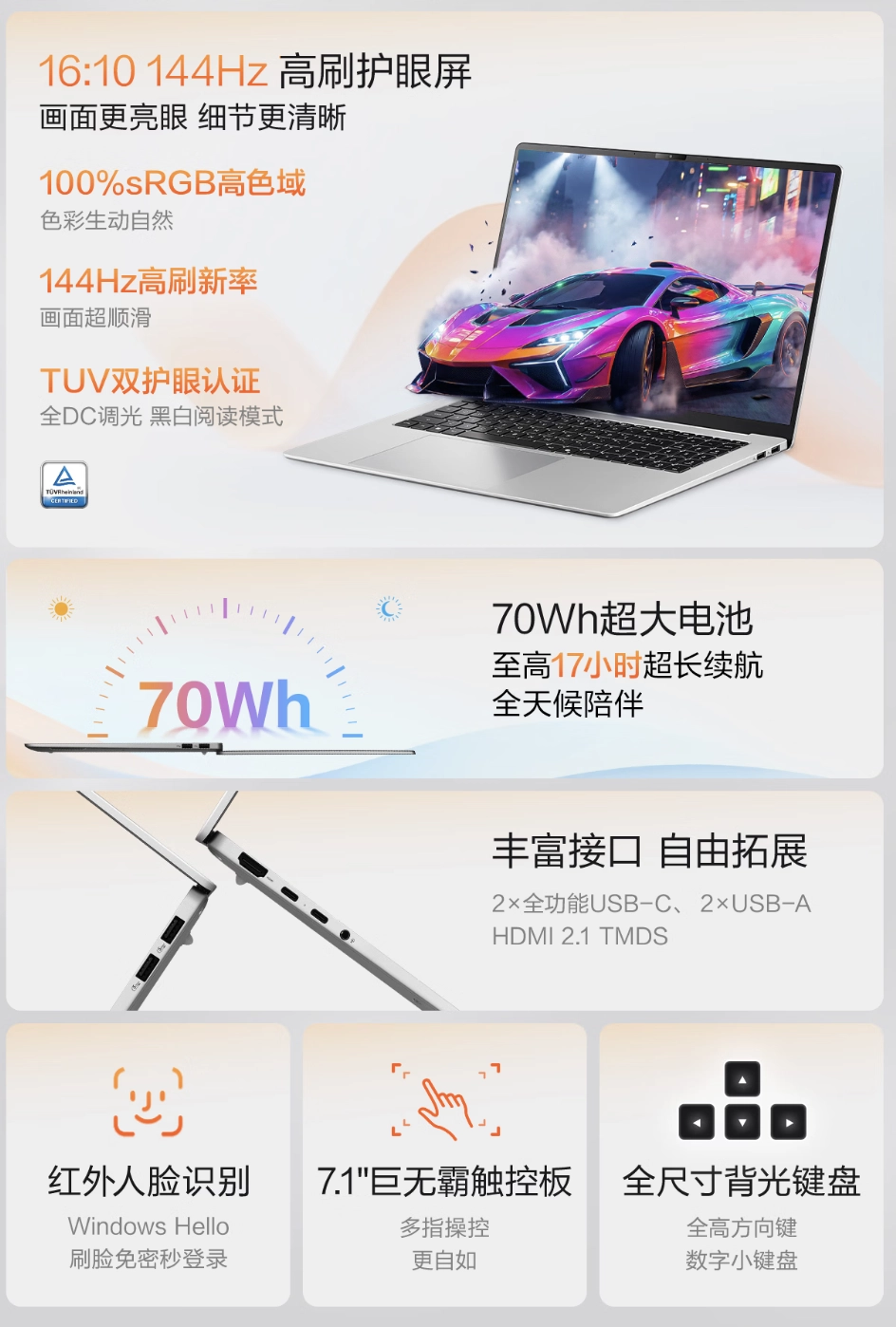
This notebook is equipped with AMD Ryzen 7 8845H second-generation AI processor, with 8-core 16-thread design, built-in Radeon 780M integrated display, body thickness of 15.9mm, weight of 1.65kg, performance release up to 45W, AI computing power up to 38TOPS, maximum acceleration frequency up to 5.1GHz, built-in 16GB LPDDR5X memory, 512GB PCIe 4.0 The solid-state drive uses dual M.2 slots and supports expansion up to 4TB.

In addition, the notebook is equipped with a 70Wh large-capacity battery, supports USB-C charging, has a full-size backlit keyboard, is equipped with a 16:10 144Hz high refresh screen, covers 100% sRGB color gamut, supports Windows Hello infrared face recognition login, and is priced at 4,199 yuan.


JD.com Asus Dreadnought 16 Ryzen Edition 4199 Yuan direct link to Dreadnought 16 Ryzen Edition 2026 2.5K 144Hz:
This notebook is also equipped with AMD Ryzen 7 8845H processor, 16GB of memory, 1TB PCIe 4.0 solid-state drive, dual M.2 slot design, 45W performance release, support for adjusting three-speed heat dissipation mode, all-metal body design, equipped with 2.5K 144Hz screen, covering 100% sRGB color gamut, maximum brightness of 400nit, and supports USB-C charging.


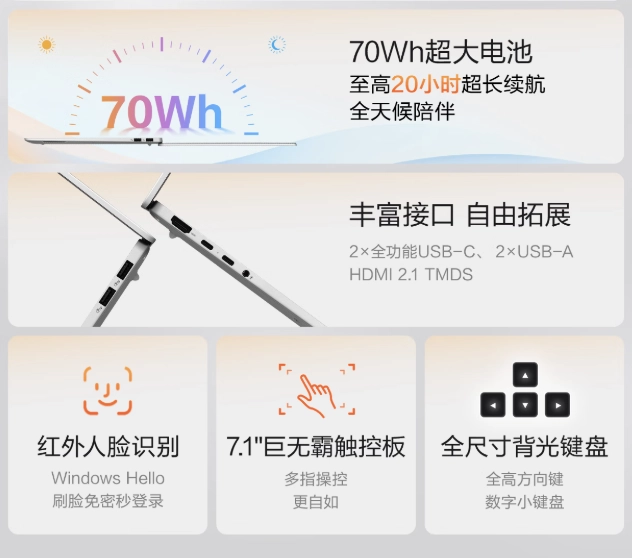
In addition, the machine is equipped with dual USB-A 3.2, dual USB-C 3.2 and HDMI 2.1 interfaces and a 3.5mm audio interface. It is equipped with a full-size backlit keyboard, a 7.1-inch Big Mac touch version, and is priced at 4,999 yuan.

JD.com ASUS Dreadnought 16 Ryzen Edition (standard pressure R7 16G 1T) 4999 yuan direct link to Dreadnought 16 second generation Core Ultra9:
This notebook is equipped with Intel Core Ultra 9 285H standard voltage processor, with a 16-core 16-thread design, a turbo frequency of up to 5.4GHz, an AI computing power of up to 99TOPS, a built-in 8Xe high-power core display, a built-in 16GB onboard memory that can be added up to 48GB, and a 1TB PCIe 4.0 solid-state drive.

In addition, the machine is equipped with a 2.5K 144Hz gaming-grade screen, covering 100% sRGB color gamut, with a maximum brightness of 400 nits. It has a new generation ergonomic keyboard, the direction keys are half-height design, and is equipped with a 6.1-inch large-size touch panel with a thickness of 1.69cm. It has two full-function USB-C, two USB-A and an HDMI interface. It is priced at 5,999 yuan.


JD ASUS Dreadnought 16 Second Generation Core Ultra9 5999 Yuan direct link
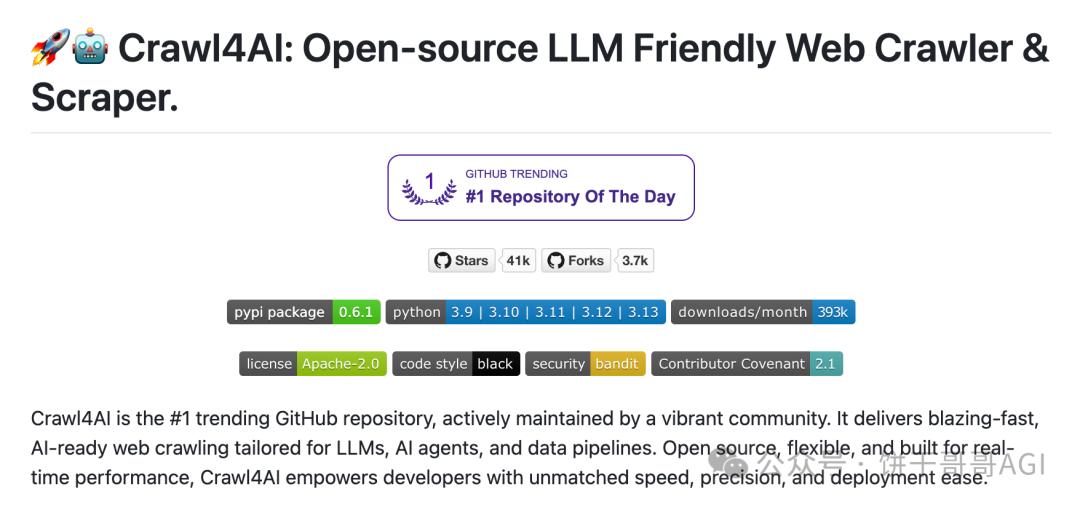
In 2025, the field of AI crawlers will usher in new changes. This article focuses on the best practices of AI crawlers in 2025, and provides an in-depth practical demonstration of how to use the three major tool combinations of Deepseek, Crawl4ai, and Playwright MCP to achieve efficient and intelligent crawler operations. From environment construction to code practice, to dynamic loading and data extraction, it fully demonstrates the charm and potential of AI crawlers, allowing you to easily master cutting-edge crawler technology.
Let’s do a practical exercise today: use Crawl4ai to make an AI crawler and see what it looks like.

Test your skills
First install it according to the official code:
#Install the package
pip install -U crawl4ai
# Run post-installation setup
crawl4ai-setup
#Verify your installation
crawl4ai-doctor
Finally, when you see the picture below, it proves that the installation and initialization were successful.
Next, let’s test the official example.
import asyncio
from crawl4ai import *
async def main:
async with AsyncWebCrawler as crawler:
result = await crawler.arun(
url=”https://www.nbcnews.com/business”,
print(result.markdown)
if __name__ == “__main__”:
asyncio.run(main)
The official test is a news website
Create a new py file, paste the code into it, and run it directly. The results show that it can indeed be crawled normally.
Extract form
The latest version of Crawl4ai has a new function: after crawling the tables on the website, parse them into pandas DataFrame format.
To put it simply, before we needed to manually clean and structure the downloaded data, then convert it into DataFrame format for analysis.
Now you can do it in one step.
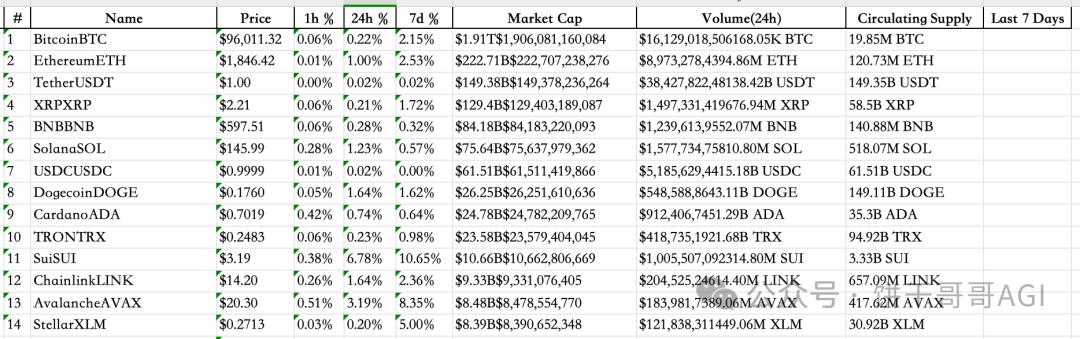
Let's take a look at this official example for a virtual currency website. We need to crawl down the table in the picture below and convert it into a python table, which can be directly used for the next step of analysis.
But there is a problem here: the official example cannot be used, as shown in the picture, it is incomplete, all are red wavy lines, and an error will be reported when running directly. My coding ability is poor and I can’t change it. What should I do?
It's very simple, just let AI change it. Go directly to Cursor.
But then there is a new problem: because this is a new function of crawl4ai, some AI should not have learned.
At this time, you can use the context7MCP we introduced before to let the AI learn the latest documents by itself and then complete the code. Red and warm! Cursor writes random code again? Install Context7 MCP in 1 minute to enjoy real-time document retrieval service
Prompt words I use:
The file code is the official example of crawl4ai. The effect is to capture the website table data as shown in the picture and save it in pandas dataframe format. However, this code is incomplete. You need to use context7 mcp to find the latest crawl4ai document and complete the code to ensure that it can be used normally.
After the AI operates for a while, the code it gets can be run directly. We see that the form from the previous website has been successfully downloaded into DF.
It went quite smoothly. I opened Excel to see it more completely, and then I could use the data for analysis.
dynamic loading
Today's websites are rarely static. Most of them are dynamically loaded, which means they need to be scrolled continuously to load new content. It would be too troublesome to handle this process by yourself.
Fortunately, Crawl4ai has built-in javascript support. We can directly write a js code to load all the content in one scroll of the page. result = await crawler.arun( url="https://dynamic content site.com", js_code="window.scrollTo(0,
document.body.scrollHeight);", wait_for="document.querySelector('.loaded')")
OK, so far, we have run through the official crawler sample code provided by Crawl4ai. But AI has not been used yet.
You know, the reason why we use these frameworks is to let AI help us solve the problems in crawling.
So let’s take a look at how to use AI to make crawlers in Crawl4ai? Advanced: Dynamically load large models to crawl e-commerce reviews
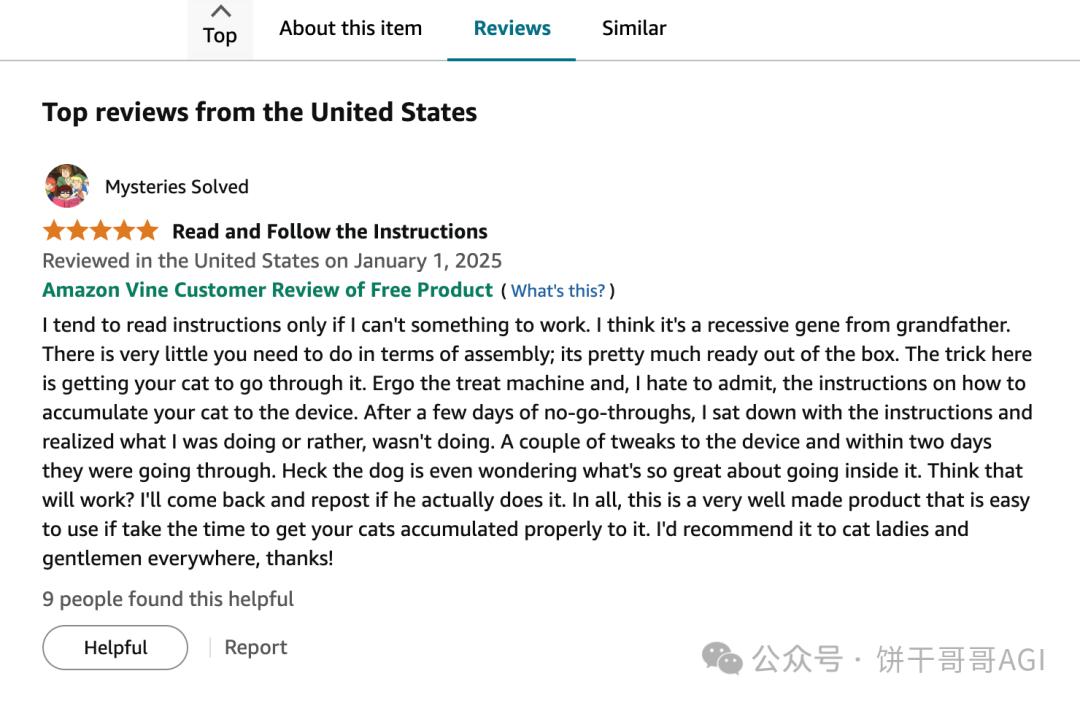
The business scenario comes first. I chose a high-frequency scenario: crawling e-commerce product reviews. (The comment data that is subsequently crawled can also be subjected to text analysis to unearth information of commercial value)
The URL is:
https://www.amazon.com/PawSwing-AutoComb-Automatic-Surround-biomimetic/dp/B0DMSVNTC1
Scroll down to see the list of comments:
Utilizing playwright MCP initialization script
In the original Cursor window, let AI help us write the code first: Now you need to write a Crawl4ai script to grab the comments under this Amazon product: customer name, title, country, time, comment content, etc. You can use playwright mcp to check the website first, and then modify it.
I didn’t find it. I didn’t let AI write the code directly. Instead, I asked it to take a look at what the website looked like and then write the code.
Because the loading process, speed, and structure of each website are different, if you rush to write a general code, it may not work.
As for the introduction and installation of Playwright MCP, I have said it before. You can jump directly to this article to learn: Use Playwright MCP to let AI change the shit mountain code it wrote.
Having said that, we can already see the AI Called MCP tool automatically opening the Amazon website and `get_visible_html`, that is, taking a look.
The obtained code is as follows. It is very long overall. I have cut out some key parts, including suggestions, and put them in comments:
1. Define the data model for Amazon reviews
classAmazonReview(BaseModel):
customer_name:
review_title:
country_and_date:
review_body:
image_urls:
rating:
# 2. Use LLMConfig to configure the AI model
llm_config = LLMConfig(
provider=provider,
api_token=api_token,
base_url=base_url
# 3. Set the strategy for AI crawling data. The key is the prompt word.
strategy = LLMExtractionStrategy(
llm_config=llm_config,
schema=AmazonReview.model_json_schema,
extraction_type=”schema”,
instruction=f”””
Extract Amazon product review information from the provided HTML content.
Reviews are usually contained in a hook with the 'data-hook="review"' attribute
element.
Please extract the following information for each comment and construct it into a list of JSON objects:
1. `customer_name`: The name of the reviewer, usually within or near a span element with 'data-hook="genome-widget"'.
2. `review_title`: The title of the review, usually within a span or a element with 'data-hook="review-title"', which may be bold text.
3. `country_and_date`: The country and date of the review, usually within a span element with 'data-hook="review-date"', in a format similar to "Reviewed in on".
4. `review_body`: The body content of the review, usually within a span element with 'data-hook="review-body"'.
5. `image_urls`: List of image URLs uploaded by users in comments. Pictures are usually
tag, its parent element may have a 'review-image-tile' or similar class. Please extract
The 'src' attribute of the tag. If there are no images, this field is null or an empty list.
6. `rating`: The star rating of the review, usually near the review title or at the beginning of the review body.
Make sure to extract as many reviews as possible. Ignore content in non-comment areas on the page.
""",
chunk_token_threshold=8000, # Change back to a reasonable chunking threshold
apply_chunking=True, #Chunk large pages
input_format="html",
verbose=True# Enable detailed logs of LLM policy
# 4. Browser settings must be set, especially for websites with strong anti-crawling capabilities.
browser_config = BrowserConfig(
headless=False, # can be set to True to run in the background
java_script_enabled=True, # Ensure JavaScript loads comments
# You can add proxy, user-agent and other configurations to simulate real users and reduce the risk of being blocked.
# user_agent=”Mozilla/5.0 (Windows NT 10.0; Win64; x64) AppleWebKit/537.36 (KHTML, like Gecko) Chrome/91.0.4472.124 Safari/537.36″
viewport={“width”: 1280, “height”: 800},
verbose=True# Enable detailed logs of browser configuration
# 5. Crawler configuration
crawler_config = CrawlerRunConfig(
cache_mode=CacheMode.BYPASS,
page_timeout=90000, # Increase the page loading timeout, Amazon pages may be slow
extraction_strategy=strategy,
# Increase the waiting time to ensure that dynamically loaded comment content appears
# Note: crawl4ai currently does not have a direct wait_for_selector or a fine-grained waiting mechanism similar to playwright
# You can control the waiting time indirectly through page_timeout, or consider using playwright to operate directly later.
verbose=True# Enable detailed logs of crawler operations
# 6. Start crawling
result = await crawler.arun(
url=self.url,
config=self.crawler_config,
js_code="window.scrollTo(0, document.body.scrollHeight);",
wait_for="document.querySelector('.loaded')"
Complete crawling

Look at the result, it’s pretty good
In particular, image_url can directly organize image addresses.
The logic of Crawl4ai is that it will first throw all the HTML to AI and then let AI come up with a parsing strategy, and then split it into multiple modules and give them to AI to parse the data one by one.
Here’s a key point: When choosing a model, pay attention to one that supports “big context”
The deepseek v3 I chose at the beginning was too small, so I couldn’t read the entire HTML at first and reported an error.
Later, I switched to gemini-2.5-pro-exp-03-25 and succeeded.
It’s a waste of tokens. You can feel it. I grabbed 24 comments and how much was consumed:
Total consumption: 992,830 (Prompt) + 6,348 (Completion) = 999,178 tokens
if
Calculating the cost of gemini-2.5-pro-preview-03-25, it is about 1.3 US dollars (Gemini helped me calculate it. Fortunately, I am using the free version.)
Summarize
To be honest, RPA is much more effective when it comes to crawlers, but RPA seems to be a false proposition. You need to set up processes, capture elements, design capture logic, etc. A codeless tool will make novices confused and have to learn from scratch.
The more feasible solution for AI crawlers now is based on Cursor and paired with Playwright MCP to develop Crawl4ai scripts.
Although it is not very easy to use now, it may be a very smooth AI crawler experience in the near future.
"After working hard, China Eastern Airlines has arranged a flight (MU7294) from Muscat, the capital of Oman, to Beijing. It is scheduled to take off back to China at 21:55 local time on March 7, Oman. There are still tickets available."
This is an emergency notice issued by the Consular Protection Center of the Ministry of Foreign Affairs on March 7. It was released simultaneously with the notice, as well as ticket purchase channels and the embassy’s consular protection and assistance phone number.
When the US-Israeli coalition launched a surprise attack on Iraq, the Middle East aviation hubs represented by the United Arab Emirates and Qatar were still operating normally. Moreover, the Middle East is an important transit point for European and Asian routes. A large number of passengers transfer from the Middle East to and from Europe and China every day. Therefore, after the sudden outbreak of war and the suspension of flights, a large number of Chinese tourists were stranded in the Middle East, mainly in the United Arab Emirates and Qatar.
In the current round of the US-Israel war, Iran clearly listed the Gulf countries that provide military bases to the United States as targets for attack. The United Arab Emirates and Qatar, which were originally safe zones in previous conflicts in the Middle East, have also become targets of attack. Although Iran's counterattacks are relatively restrained, they are limited to US military bases in the two countries, have high attack accuracy, and do not attack civilian targets. However, the location of the wreckage of the interceptor shot down from the incoming missile was completely random. This also made these two busy Middle Eastern aviation hubs feel the threat of war for the first time.
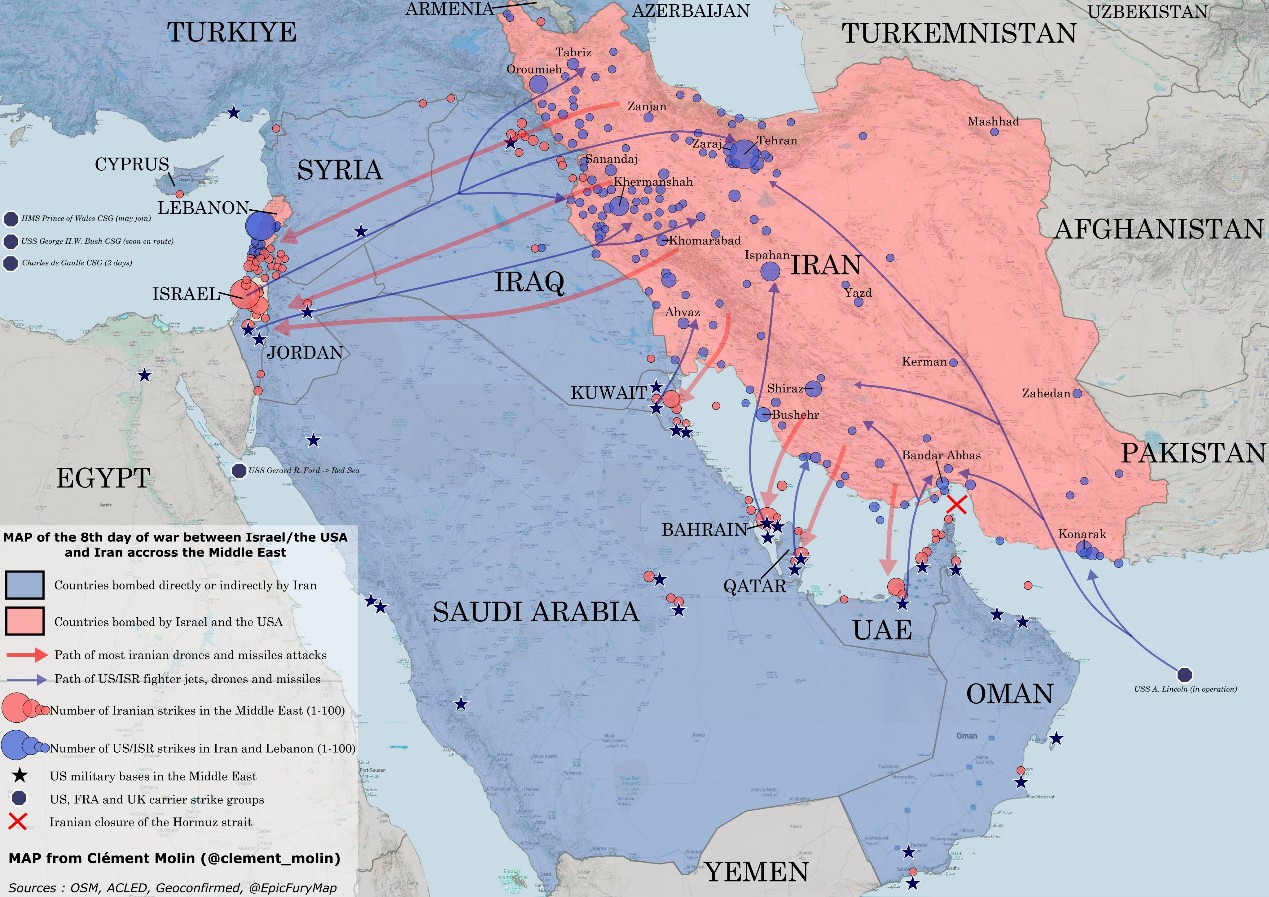
A schematic diagram of the attacks by both sides in this round of the US-Israel-Iraq war. It can be seen that Qatar, the United Arab Emirates, has rarely become the target of Iranian attacks.
For the large number of stranded Chinese tourists, on the one hand there is an urgent need to return home (many of them are forced to stay in transit), and on the other hand there is the real threat of war. For this reason, the local Chinese Embassy also began emergency coordination, and began the evacuation operation after the intensity of the war dropped significantly. Therefore, there was an emergency notice from the Consular Protection Center of the Ministry of Foreign Affairs at the beginning.
Why should we seize the window period to evacuate?
In this Middle East evacuation operation, the air evacuation rhythms in different regions are also different, and the situation is highly complex. Therefore, after starting the evacuation work, the Ministry of Foreign Affairs immediately issued a reminder to take advantage of the short flight recovery window to seize the time to take flights to evacuate. The Ministry of Foreign Affairs' warning is not alarmist, because the reality is that there are many crises.
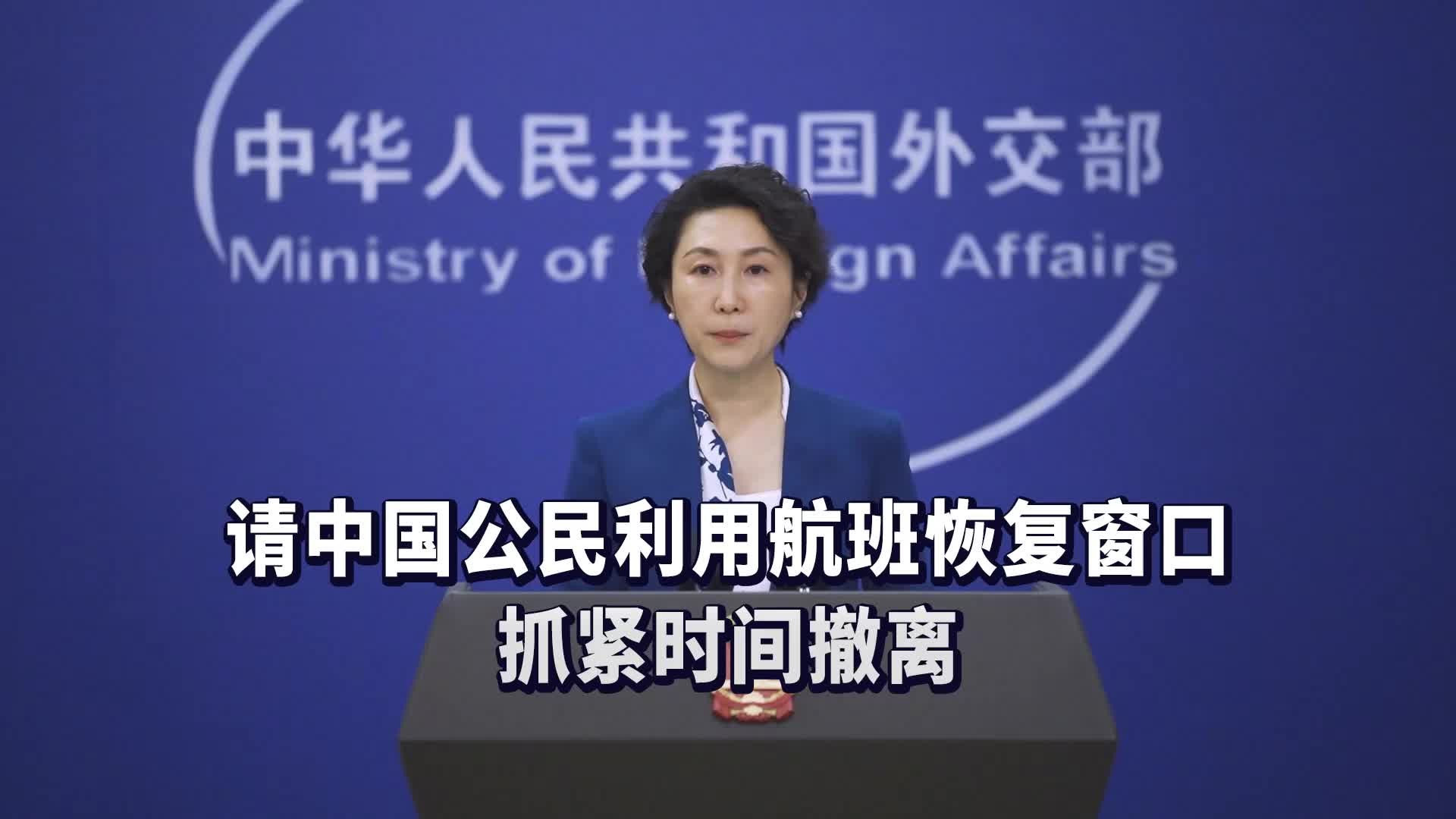
Saudi Arabia was the first to initiate evacuation operations. On March 2, Hainan Airlines' flight HU7913 from Haikou to Jeddah, Saudi Arabia, successfully landed in Saudi Arabia and flew back to China on the same day, completing the evacuation of the first batch of stranded passengers. Due to its large land area and multiple airports, Saudi Arabia was less affected by Iran's attack, so it was the first to resume air routes and evacuate stranded passengers.
However, the United Arab Emirates and Qatar were the top targets of Iran's attacks on U.S. overseas bases in the early stages of this war, making the situation more complicated.
The UAE and Qatar themselves have a large number of advanced weapons and air defense equipment, and Iran ranks first in missiles and drones launched by these two countries, making the air defense war particularly fierce. According to Zelensky, in the first three days of the war, more than 800 Patriot anti-aircraft missiles were fired in the Middle East. The air defense forces of Qatar and the United Arab Emirates have not experienced actual combat tests. Once there is a passenger plane in the combat airspace when firing to intercept, there is a high probability of accidental damage.
Therefore, the time window for evacuation flights requires a high degree of coordination with all parties to execute flights at designated times, airspace, and routes. Due to the high degree of uncertainty in the war situation, the airport that was operating one hour ago may have an air defense warning and have to be closed, which makes the time window even more precious.
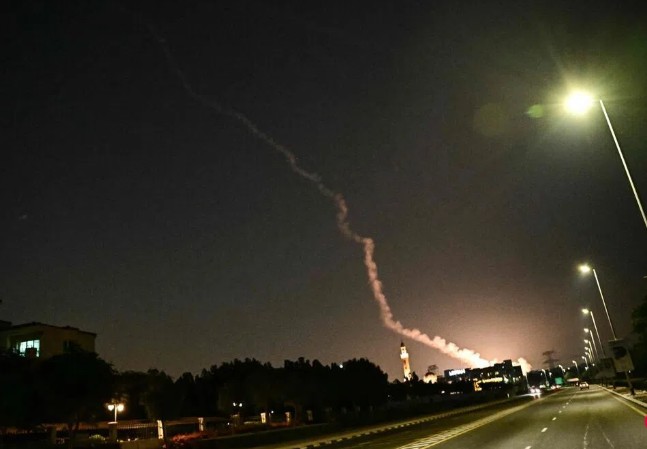
UAE military launches anti-aircraft missiles to intercept
Take the evacuation charter flight of Air France as an example. The aircraft encountered a dangerous situation while performing the evacuation mission of French citizens from the United Arab Emirates, and happened to encounter a large-scale missile attack in the airspace. The evacuation charter flight that was already loaded with passengers had to return to the United Arab Emirates and find another opportunity to fly back to France. This also illustrates the instability of the situation in the Middle East and the complexity and uncertainty of evacuation operations.
Moreover, the limitations of transportation capacity determine that it cannot meet the immediate needs of all stranded people. After the war broke out, all countries were rushing to transport their own citizens, but due to the impact of the war, transportation capacity was extremely limited. Although China's civil aviation urgently allocates aircraft types and resumes routes, the number of flights is limited due to restrictions on airspace approval, safety assessment, aircraft type allocation, etc., and priority must be given to special groups such as the elderly, the weak, the sick and disabled, women and children.
More importantly, the uncertainty of war and the absolute requirement for safety have further reduced the evacuation space. It can be said that the so-called "designated flights" are scarce resources obtained by the embassy through coordination and efforts. Missing one may mean a longer wait or even greater security risks.
Evacuation operations under fire
Technically speaking, it is extremely difficult to formulate a flight plan for such a war zone evacuation flight. On the one hand, we must consider using uncommon routes to fly around. On the other hand, the war zone is extremely variable, and it is very likely that we will need to hover and wait in the air for a long time, or even make an alternate landing due to force majeure. Therefore, it is not only necessary to have a large amount of reserve fuel, but also for pilots to take unfamiliar routes and be prepared to make alternate landings at unfamiliar airports. We will even encounter special situations such as missile attacks, contact loss, GNSS interference, shootings, etc. This not only tests the quality of the crew, but also tests the support capabilities and even the overall national strength behind it.
The evacuation operations of the United Arab Emirates, Qatar and Saudi Arabia were generally smooth and orderly. As of March 10, tens of thousands of Chinese citizens have been successfully evacuated, and this is inseparable from the efforts of the Chinese embassy and consulates and China Civil Aviation.
Taking Qatar as an example, air routes have never been restored due to its small size and constant threats. This leaves people stranded in Qatar to evacuate by land to relatively safe countries such as Saudi Arabia or Oman, and then return home by plane. During the land transfer process, the Chinese embassy and consulates formed special teams, mobilized a large number of resources and coordinated all parties to complete this complicated transfer process and send the stranded Chinese citizens home.
But this land route was not as easy to walk as imagined. Due to the complex and tense relationship between Saudi Arabia and Qatar, it is not easy to enter Saudi Arabia from Qatar for evacuation by land, and it is also full of unknown risks. It takes eight hours to charter a bus from Doha to Riyadh, Saudi Arabia, and pass through a five-kilometer isolation zone between Qatar and Saudi customs. You must have the assistance of a guarantor holding both Saudi and Qatari visas to pass. Some compatriots were temporarily intercepted by military checkpoints during the transfer, and it took several hours of coordination before they could continue. The evacuation could not be completed without the help of the embassy and people from all walks of life.
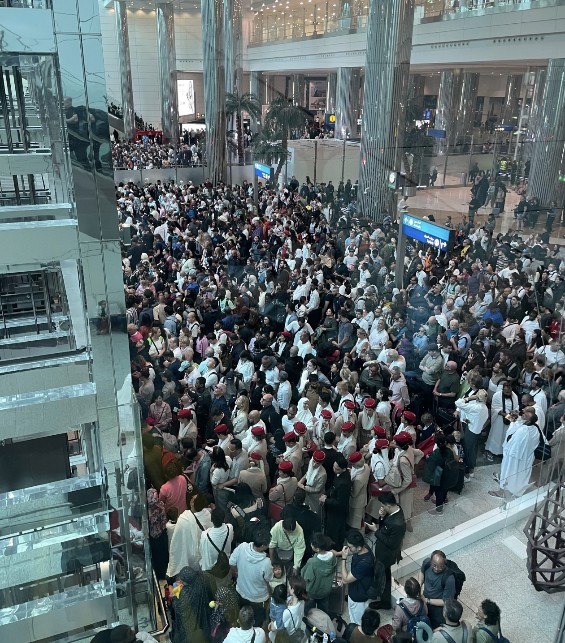
A large number of passengers were stranded at Dubai Airport, and Emirates flight crews could also be seen among them.
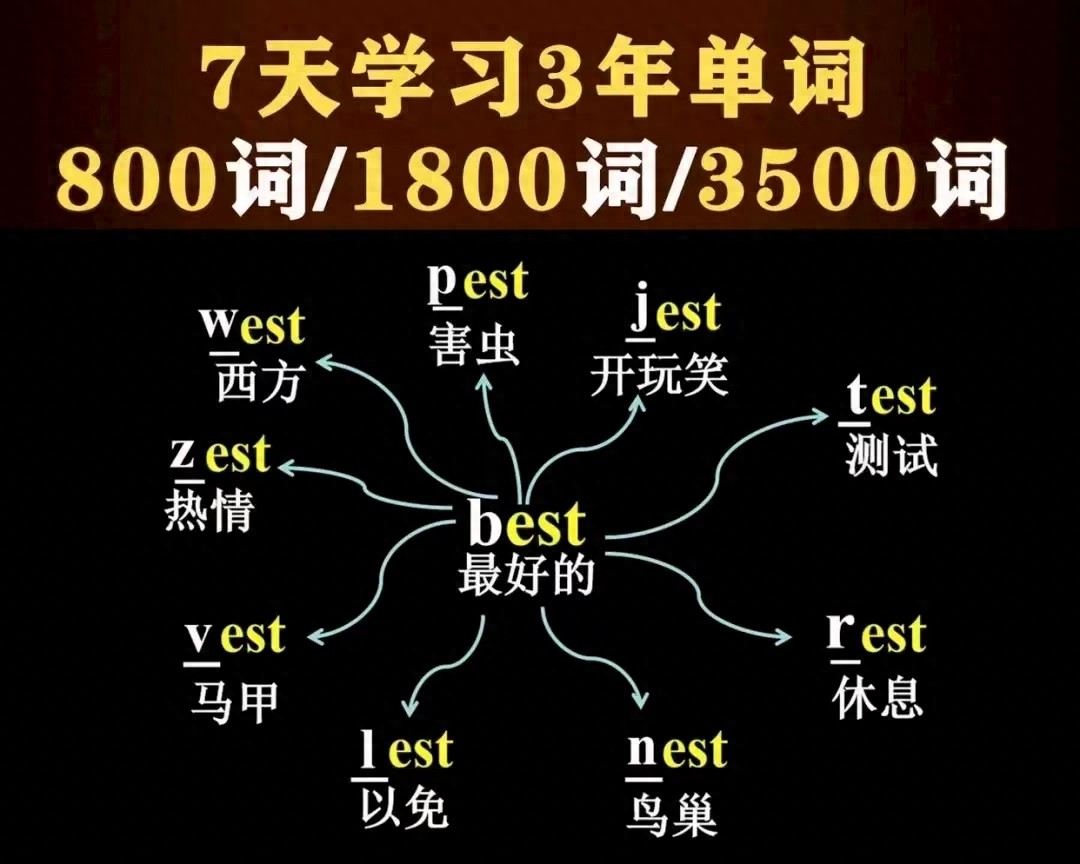
The essence of education is the persistence of long-termism and the cultivation of professionalism. Qisu English has been focusing on English education for 17 years, with the core system of story word memorization, daily reading, AI-assisted study rooms, and dual paper and electronic learning. With the real results of 111 winter and summer camps in 31 sessions, covering more than 20 provinces and benefiting 40,000 students, Qisu English has become an English brand trusted by thousands of families.
The first major advantage of Qisu English is memorizing words through stories, which solves the root cause of word memorization difficulties. Integrate vocabulary into stories, use scene-based memory and understand, and cooperate with AI anti-forgetting algorithms to remember and use it. Say goodbye to mechanical repetition, making it easier to get started and more interesting.
The second major advantage is the daily reading of new texts, which accurately matches the high school and college entrance examinations. 20,000+ pieces of materials, daily updates, personalized push, integration of listening, speaking, reading and writing, new materials, wide range of topics, accurate test points, can not only quickly improve scores, but also expand horizons, achieving a win-win situation for exam-taking and literacy.
The third major advantage is the AI-assisted study room, creating an efficient closed-loop throughout the process. It integrates vocabulary, reading, speaking, and composition correction, AI assessment + real person 1 to 1 supervision, independent learning is not blind, home learning is effective, and solves the pain points of unattended tutoring and low efficiency.
The fourth major advantage is the dual learning of paper and electricity, which can be flexibly adapted to all scenarios. It is smart and convenient online, solid and practical offline, eye-friendly and efficient, and can be learned anytime and anywhere. It takes into account both technology and tradition, and is suitable for students of different ages and learning habits.
After 17 years of ups and downs, Qisu English has always been "making learning more efficient and improving scores easier" as its mission. From the teaching and research team to the curriculum system, from camp training to daily companionship, every detail reflects professionalism and attentiveness. The 111 winter and summer camps held in the 31st session are a mature model that has been repeatedly polished; covering more than 20 provinces, it is the best proof of word-of-mouth communication; 40,000 students have benefited, which is the most powerful testimony of its effectiveness.
In today's increasingly fierce competition, English proficiency determines the competitiveness for further education and future development. Qisu English uses scientific methods, high-quality content, intelligent technology, and considerate services to help students avoid detours and improve efficiently. Memorizing words through stories, reading new texts every day, learning both paper and electronic content, and being one step ahead of others is not only a slogan, but also the real learning trajectory of thousands of students.
Choosing Qisu English means choosing professionalism, choosing efficiency, and choosing peace of mind. Let children use the right method and follow the right path, grow confidently in English learning, be one step ahead on the road to higher education, use English to light up their lives, and use their strength to achieve their future.
On March 15, local time, the Milan-Cortina Winter Paralympics concluded in Milan, Italy. At this Winter Paralympic Games, the Chinese sports delegation worked hard, worked together, and strived bravely. With 15 gold medals, 13 silver medals, and 16 bronze medals, a total of 44 medals, it ranked first in both the gold medal list and the medal list. It created the best results in the history of overseas participation in the Winter Paralympics and wrote a new chapter in winter sports for Chinese disabled people.
“Since the opening of this Winter Paralympic Games, the Chinese sports delegation has always kept in mind the entrustment of the Party and the people, shouldered the lofty mission of fighting for the country and bringing glory to the country, vigorously promoted the Chinese sports spirit, the Beijing Winter Olympics spirit, and the Paralympic spirit, fought tenaciously, surpassed themselves, and fully demonstrated the spirit of China’s disabled people in the new era. Chang Zheng, member of the Party Leadership Group of the China Disabled Persons' Federation, Vice Chairman, and Deputy Head of the Chinese Sports Delegation, said that while achieving great results, the Chinese delegation always insisted on "taking the gold medal for morality, the gold medal for style, and the gold medal for cleanliness", and achieved both sports performance and spiritual civilization.
This Winter Paralympics is the seventh time that my country has participated in the Winter Paralympics. It is also the time that my country has participated in the most events and the largest number of athletes in the Winter Paralympics overseas. The number of athletes ranks first among all delegations in this Winter Paralympic Games. "From the first Winter Paralympic Games in 2002, when only 4 athletes participated in 2 major events and 8 minor events, to this year, 70 athletes have qualified to participate in 6 major events and 73 minor events. Such changes reflect the vigorous development of ice and snow sports for people with disabilities in my country." Chang Zheng said.
On the evening of March 15, the closing ceremony of the Milan-Cortina Winter Paralympics was held at the Cortina Olympic Curling Hall. Paralympic cross-country skiing and biathlon athlete Cai Jiayun, who won three gold medals at this Winter Paralympic Games, and wheelchair curler Wang Meng, who won the first wheelchair curling mixed doubles gold medal in the history of the Winter Paralympics, served as the flag bearers of the Chinese sports delegation at the closing ceremony, holding the national flag high.
The closing ceremony used a performance that integrated sports, art, culture and music to celebrate the Paralympic athletes who fought hard on the field and expressed gratitude to the volunteers who worked hard.
At the end of the closing ceremony, the Winter Paralympic flame was extinguished and the flag was handed over to France, the host of the next Winter Paralympic Games.
It is understood that the next Winter Paralympics will be held in the French Alps in March 2030. The last time France hosted the Winter Paralympics was in 1992.
(Guangming Daily, Milan, March 16)
"Guangming Daily" (Page 9, March 17, 2026)
 The Story Of The Willow Boat: A Sweet Ancient Puppet Drama About The Sinister Prince And The Amnesiac Woman.2026-02-26Comments(0)
 Henan University Of Finance, Economics And Law, One Of Only Two Universities Of Finance, Economics And Law In The Country!2026-02-27Comments(0)