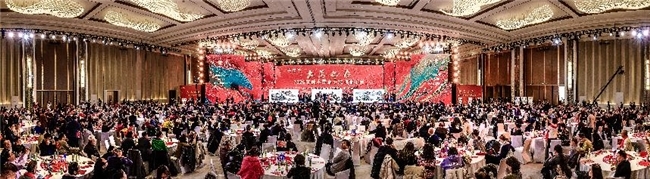
The 2026 Fine Arts Spring Festival Symphony Concert Kicked Off Grandly At The National Convention Center
Spring of Great Beauty - 2026 Art Circle Spring Festival Symphony Concert was grandly held at the National Convention Center
Spring of Great Beauty - 2026 Art Circle Spring Festival Symphony Concert was grandly held at the National Convention Center
Professor, doctoral supervisor, PhD in economics
Director, Taxation and Public Policy Research Center, Central University of Finance and Economics
Central University of Finance and Economics, Shahe Higher Education Park, Changping District, Beijing
Postal code: 102206
Mobile:13681592777
Email: cdoer@163.com
Educational experience:
Bachelor of Economics, Department of Finance and Taxation, Central South University of Finance and Economics (1999)
Master of Economics, School of Finance, Renmin University of China (2004)
PhD in Economics, School of Finance, Renmin University of China (2008)
Visiting Scholar, School of Environment and Public Affairs, Indiana University, USA (2013)
Main research areas:
Fiscal and taxation theory, system and policy; economic system model and application; econometric model and application
Courses taught:
Taxation (undergraduate students), Tax Law (undergraduate students), Chinese tax system (undergraduate students), Comparative Taxation System (master students), "Foreign Fiscal Theory and Practice" (master students), Frontiers of Fiscal Theory (doctoral students), Taxation Theory and Policy (doctoral students), "Foreign Fiscal and Taxation Theory" (doctoral students)
Main papers:
Wang Hao, 2025, Inter-regional transfer of value-added tax: mechanism and scale, Economic Research, Issue 6.
Wang Hao, 2025, Re-understanding of the division of direct taxes and indirect taxes and optimization of tax system structure, Taxation Research, Issue 5.
Lou Feng, Wang Hao, Xu Jing, 2025, China's corporate income tax revenue distribution effect - based on general equilibrium theory and model, Quantitative Economics and Technology Economics Research, Issue 8.
Guo Yuqing, Nie Song, Chen Chuanglian, Wang Hao, 2025, How to have both your cake and eat it too: Research on risk management of financing platforms under the pressure of statutory debt, Finance and Trade Economics, Issue 8.
Guo Jing, Wang Hao, 2024, Tax Burden of Urban and Rural Residents - Fiscal Income Analysis, Economic Research, Issue 5.
Wang Hao, 2023, China's labor and capital tax burden and distribution effects, Economic Research, Issue 4.
Wang Hao, Guo Yuqing, and Lu Yi, 2022, China's value-added tax pass-through, fate and tax reduction effect - general equilibrium analysis, Economic Research, Issue 2.
Guo Yuqing, Jiang Xiaoni, Mao Jie, Wang Hao, 2022, Risk governance effects of creditor credit constraints: Based on the signaling perspective, World Economy, Issue 9.
Wang Hao and Lou Feng, 2017, Estimating the effect of fiscal redistribution in China, Economic Research, Issue 1.
Wang Hao and Lou Feng, 2017, The fate of indirect taxes in China: Functional mechanism and tax burden calculation, World Economy, Issue 9.
Ma Haitao, Wang Hao, 2017, The impact of finance on income distribution and reform suggestions, China Taxation, Issue 4.
Li Yongbin, Wang Hao, 2017, Comparison of double taxation avoidance agreements between my country and countries along the “Belt and Road”, Taxation Research, Issue 2.
Wang Hao, 2016, Income distribution effects of business tax to tax increase and reduction, Fiscal Research, Issue 10.
Wang Hao and Fan Tianqin, 2016, Comparative study on the tax policies of non-profit organizations in China and the United States, Taxation Research, Issue 2.
Wang Jun, Wang Hao, et al., 2016, Economic governance modernization and “13th Five-Year Plan” tax system reform, Regional Economic Review, Issue 7.
Wang Chaocai, Xu Jun, Wang Hao, 2012, Discussing my country's value-added tax expansion options from the perspective of its impact on economic efficiency, Fiscal Research, Issue 7.
Wang Hao, 2011, Thoughts on improving my country’s capital market tax system, Investment Research, Issue 4.
Wang Hao, 2010, Thoughts on the construction of my country's medium and long-term tax system, Taxation Research, Issue 10.
Wang Hao, 2010, Economic structural regulation calls for fiscal and taxation system reform, China Finance, Issue 7.
Wang Hao, 2009, Analysis of my country's fiscal and taxation policies from the perspective of supply and demand management, Taxation Research, Issue 9.
Wang Hao, 2009, Thoughts on my country’s tax policy in response to the economic crisis, Fiscal Research, Issue 8.
Wang Hao, 2009, Russia’s fiscal and taxation policies and lessons learned in response to the financial crisis, Foreign Taxation, Issue 7.
Wang Hao, 2009, Characteristics and Enlightenment of the British Tax Policy in Response to the Financial Crisis, Foreign Taxation, Issue 5.
Wang Hao, 2009, Taxation Systems between China and France: Comparison and Enlightenment, in "Research on China-EU Tax Agreements and Comparison of China-EU Taxation Systems", China Taxation Press.
Wang Hao and Xu Jun, 2007, Characteristics and Enlightenments of U.S. Personal Income Tax Collection and Administration, Foreign Taxation, Issue 12.
Wang Hao, 2007, Changes, Causes and Countermeasures of my country’s Excessive Tax Burden, Finance and Trade Economics, Issue 5. (Reprinted in English by "China Economist")
Wang Hao, 2007, The impact of land value-added tax liquidation on after-tax profits of real estate companies, Finance and Accounting, Issue 5.
Wang Hao, 2007, The impact of land transfer fee accounting on taxation cannot be ignored, Finance and Accounting, Issue 8.
Wang Hao, 2007, Land transfer, how shareholders can obtain maximum returns, Finance and Accounting, Issue 11.
Wang Hao, 2007, Comparison and improvement of new corporate income tax returns, Tax Collection, Issue 3.
monograph:
Lou Feng, Wang Hao, Liu Yu, 2024, Computable General Equilibrium (CGE) Model: Theory and GAMS Programming, Tsinghua University Press.
Wang Hao, 2016, Research on tax policy reform of Chinese non-profit organizations, Economic Science Press.
Wang Hao, 2013, Research on Economic Structural Adjustment and Tax System Reform, China Taxation Press.
Wang Hao, 2009, Research on Tax Regulation of Real Estate Market - Analysis Based on China's Current Situation, China Taxation Press.
Topic research:
He has presided over many projects such as major projects of the National Social Science Fund, general projects of the National Natural Science Foundation, youth projects of the National Social Science Fund, general projects of the Humanities and Social Sciences Fund of the Ministry of Education, projects of the Ministry of Finance, and outstanding scientific research and innovation team projects of the Central University of Finance and Economics.
Rewards received:
First Prize of Central University of Finance and Economics Hongji Shiye Outstanding Academic Paper Award (2023)
First Prize of Central University of Finance and Economics’ Outstanding Achievements Transformation Award (2023)
Expert with Outstanding Contributions from the Ministry of Finance Expert Studio (2021)
Annual Outstanding Paper Award of the Society of International Economic Relations (2017)
First Prize for Excellent Paper of China Annual Conference on Quantitative Economics (2015)
Central University of Finance and Economics Yongjin Academic Award (2012)
Outstanding Doctoral Thesis Award of Renmin University of China (2009)
Academic part-time job:
Reviewer for journals such as "Economic Research", "Management World", "World Economy", "Economics (Quarterly)", "Nankai Economic Research" and other journals
Expert in the macroeconomic talent pool of the Ministry of Finance
Expert from Ministry of Finance Expert Studio
Member of China Systems Engineering Society
Vice Chairman of China Social and Economic Systems Engineering Professional Committee
Director of the China Taxation Society Young and Middle-aged Taxation Research Association
Director of China Society of International Economic Relations
Director of China Input-Output Society
Zhitong Finance APP learned that the U.S. encryption industry ushered in a major victory on Thursday. The House of Representatives passed a landmark bill with a vote of 308 in favor and 122 against to formulate regulatory rules for "stable coins." This marks that digital assets are gradually entering the mainstream financial system.
The bill, called the Genius Act, was passed by the Senate as early as June, and the White House said on Thursday that President Trump is expected to sign the bill into law on Friday.
The bill has been a core target of years of lobbying by stablecoin issuer Circle (CRCL) and crypto trading platform Coinbase (COIN.US). The passage of the bill is the epitome of the crypto industry’s years of political mobilization and donations to support lawmakers with pro-crypto stances.
Crypto supporters generally believe that this bill and several other crypto legislation being considered by Congress will open up broader development space for the industry, especially attracting more institutional investors.
News of the bill comes as Bitcoin prices have been essentially flat over the past 24 hours, trading around $119,400. However, most other mainstream cryptocurrencies rose, with Ethereum rising by 1.5% and Ripple rising by 9.4%. Dogecoin gained 2%, while Solana was flat. In the past seven days, ETH and XRP have gained 23% and 33% respectively, while Bitcoin has also gained 6.4%.
Although the "Genius Act" is expected to be implemented soon, the encryption industry still has many unfinished ambitions. In particular, market structure legislation for crypto exchanges, brokers and tokens is the focus of the industry in the next stage.
It is worth noting that the House of Representatives also passed a broader “Market Structure Act” (CLARITY Act) on Thursday by a vote of 294 to 134 to establish complete regulatory rules for the crypto market. Among them, 78 Democratic congressmen voted in favor, exceeding the number of Democrats who supported a similar bill last year (71), showing that support is rising.
However, unlike the stablecoin bill, the market structure bill has not yet been voted on in the Senate. Analysts say the Senate is still some way off from assembling the bipartisan coalition needed to break through the filibuster.
TD Cowen analyst Jaret Seiberg wrote in a research note this week: "The passage of the bill is very important in a symbolic sense, but the real key is what kind of language the Senate will ultimately pass it." He does not expect the Senate to have a clearer draft bill before the end of this year or even early next year.
There are two reasons for the slow progress in the Senate. The first is the issue of consensus. While some senators have been pushing legislation for years, the Senate as a whole lags far behind the House in building consensus. Former Senate Banking Committee Chairman and Democrat Sherrod Brown has long been skeptical of encryption and has repeatedly blocked related bills from advancing.
The second is substantive differences. Several Democratic senators, including Elizabeth Warren, worry that the bill will undermine existing investor protection mechanisms and hand enforcement responsibilities to the Commodity Futures Trading Commission (CFTC), which is severely understaffed and inexperienced. They believe that existing securities regulations are sufficient to regulate the industry.
Additionally, Trump’s own involvement in the crypto industry casts a shadow over the legislation. The stablecoin bill was nearly stalled in the Senate because some Democratic lawmakers were concerned that the bill failed to prohibit the president or other government officials from profiting from it. According to ethics disclosure documents, the Trump family holds shares in crypto company World Liberty Financial, which has brought it more than $57 million in revenue from token sales and launched its own stablecoin this year. In the future, some Democratic lawmakers may push for additional restrictions in the new bill to prohibit the president and his relatives from benefiting from it.
The new chairman of the Senate Banking Committee, Republican Tim Scott, began holding hearings on the relevant legislation last week, but it is expected to take several months to write a bill that can win the support of at least seven Democratic lawmakers and thereby bypass the obstruction process.
At the same time, the U.S. House of Representatives also passed another important bill, the “Anti-CBDC Anti-Surveillance State Act.” The bill seeks to prevent the Federal Reserve from issuing or testing a central bank digital currency without congressional approval. The final vote was 219 votes in favor and 217 votes against.
Central bank digital currency is different from decentralized cryptocurrencies such as Bitcoin. It is directly issued and managed by the central bank and is programmable and highly controllable. Some critics worry that it will become a means for the government to strengthen currency and citizen privacy control.
Other news pointed out that Trump is preparing to open the US$9 trillion US retirement market to cryptocurrency investment, gold and private equity. This move will stimulate a fundamental change in the way Americans manage their savings.
Trump is expected to sign an executive order this week to open up 401k plans to alternative investments beyond traditional stocks and bonds, three people familiar with the president's plans said. The investments will span a wide range of asset classes, from digital assets to metals, as well as funds focused on corporate buyouts, private loans and infrastructure deals. The executive order will direct Washington regulators to investigate remaining obstacles needed to allow such alternative investments to be included in professionally managed funds used by 401k savers, people familiar with the matter said.
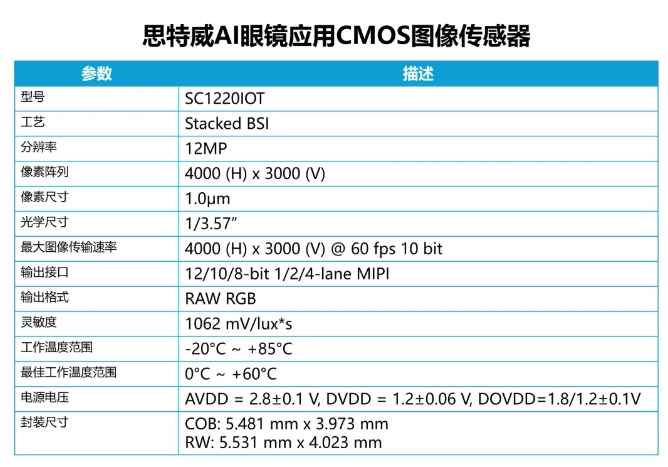
IT House reported on March 12 that domestic supply chain manufacturer Smartway announced today the launch of a new 12-megapixel CMOS image sensor for AI glasses application - SC1220IOT.
According to reports, this new product is equipped with the Always-On low-power normally-on function. In Always-On mode, SC1220IOT can maintain ultra-low power consumption and always-on operation at a lower frame rate, which can meet the needs of all-weather standby visual detection such as smart AI glasses camera environment detection and gesture recognition. In this mode, the power consumption of SC1220IOT can be as low as 1mW, which can fully guarantee the battery life of the whole machine.

SC1220IOT is equipped with SmartSmart ColGain HDR® technology, which can achieve a high dynamic range effect of up to 75dB through single-frame exposure multi-gain image synthesis, helping AI glasses cameras retain more details of bright and dark parts in complex light environments with strong contrast between light and dark, significantly improving the light and shadow effects of video shooting.
Moreover, AI glasses, as smart wearable devices, often need to be taken while the user is moving. SmartSign's ColGain HDR® technology can effectively suppress the generation of motion artifacts, helping AI glasses cameras easily cope with shooting sports scenes, and capture high-quality video images that are clear and smooth, without motion smearing, and with vivid light and shadow.
In addition, SC1220IOT can support 12MP full-size 60fps high frame rate video shooting in normal mode (double the frame rate compared to the previous generation product), and 4k 30fps high dynamic range video shooting in ColGain HDR® mode.
SC1220IOT is equipped with SmartSite's advanced SFCPixel®-2 technology, which achieves higher sensitivity while significantly reducing noise through the SF center. Thanks to this, the reading noise of SC1220IOT can be as low as 0.8e-, which can make the imaging picture clearer and cleaner in dark light environments such as evening and night.
As a 12-megapixel 1/3.57-inch CMOS image sensor, SC1220IOT is built on SmartClarity®-XL technology platform and adopts full-process domestic Stacked BSI advanced process technology. Its package size is only about 5.48mm x 3.97mm, and it can be flexibly applied to micro camera modules for a variety of smart wearable devices such as AI glasses and AR/VR devices.
Currently, SC1220IOT has accepted samples and will be mass-produced in Q2 2026.
IT Home’s product parameters are as follows:
IT House reported on September 5 that the Washington Post published a blog post yesterday (September 4), stating that judging from the initial feedback from 10,000 users, although the SearchGPT search engine from OpenAI, regarded by many as the "Google killer", has many bright features, it still has a long way to go before it can shake up Google's search status.
Some features are excellent
Note from IT House: SearchGPT does not simplify the user's search experience by providing concise and organized answers instead of a list of search results.
SearchGPT compiles answers using data from Bing and other sources, which OpenAI views as a comprehensive resource for information users search for.
SearchGPT's initial user feedback has been mixed. In terms of specific queries such as planning activities, programming, and summarizing information, SearchGPT performed relatively well.
insufficient
Ananay Arora, a software engineer, believes that SearchGPT does not pose a threat to Google at this stage. It performs well in searching for local restaurants, but the search image results are poor, and the way of labeling the source is confusing.
Technology expert Daniel Lemire thinks it's better than Google's AI Overviews but not as impressive as Perplexity.
Artificial intelligence enthusiast Matt Berman posted a video on YouTube, saying that SearchGPT performed better than Google in event planning and programming, but there was an "illusion" problem and the speaker information given was incorrect.

Spring of Great Beauty - 2026 Art Circle Spring Festival Symphony Concert Live
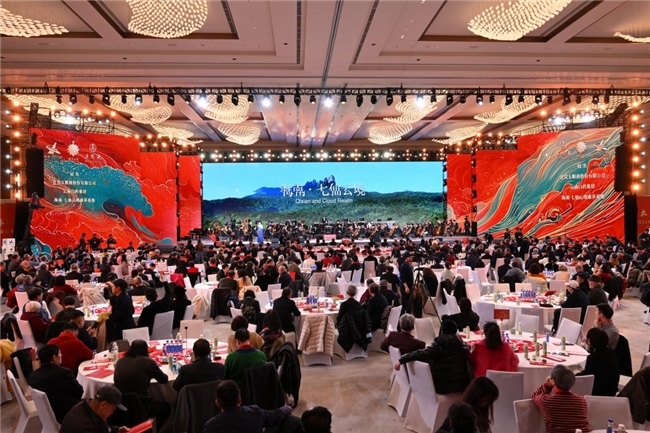
The paintings capture the charm of the times, and the horses gallop through the prosperous spring. On February 2, the "Spring of Great Beauty - 2026 Art Circle Spring Festival Symphony Concert", co-sponsored by the Painting and Calligraphy Channel, the China National Academy of Painting, and the Chinese Art Archives Society, and co-sponsored by Yibin Wuliangye Co., Ltd., Yunnan Baiyao Group, and Hainan Qixian Yunjing Health Care Base, kicked off at the majestic National Convention Center. This art festival, which carries the accumulation of thirteen years, unfolds a magnificent picture of the art cause in the new era with grandeur, and plays a majestic movement of cultural self-confidence and self-improvement on the new journey. More than a thousand people from the Ministry of Culture and Tourism, the China Federation of Literary and Art Circles, the Chinese Artists Association, the Chinese Calligraphers Association, major art schools, the Chinese Calligraphy and Painting Art Research Institute of the Calligraphy and Painting Channel, Wuliangye Group, Yunnan Baiyao Group, Hainan Qixian Yunjing Health Care Base, and major leaders and artist representatives from art institutions in all provinces, cities, autonomous regions and municipalities across the country gathered together to show the high-spirited style of the Chinese art world that has maintained the true trend for thousands of years and opened up a new era.
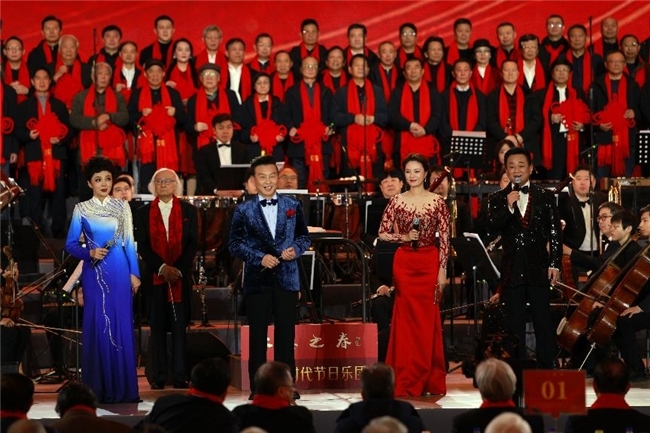
From left to right: host Yajuan, Zhang Zequn, Liu Fangfei, Zhu Jun
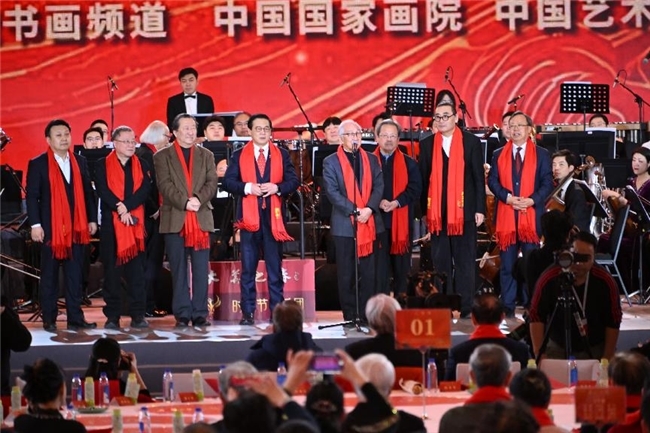
From left to right: Pan Yikui, Zhang Xian, Yang Xiaoyang, Xu Li, Jin Shangyi, Feng Yuan, Liu Wanming, and Wang Ping send their sincere New Year greetings to the national audience.
Jin Shangyi, Honorary Chairman of the Chinese Artists Association, Feng Yuan, Honorary Chairman of the Chinese Artists Association, Liu Wanming, President of the China National Academy of Painting, Xu Li, former Party Secretary and Resident Vice Chairman of the Chinese Artists Association, Yang Xiaoyang, Chairman of the China Association for Cultural Development and Art Promotion, Pan Yikui, Director of the National Art Museum of China, Zhang Xian, President of the China Art Archives Society, and Wang Ping, Chairman of the Board of Directors of the Calligraphy and Painting Channel, sent their sincere New Year greetings to the national audience, conveying the deep love of art workers for the times, the people, and the cause of art.
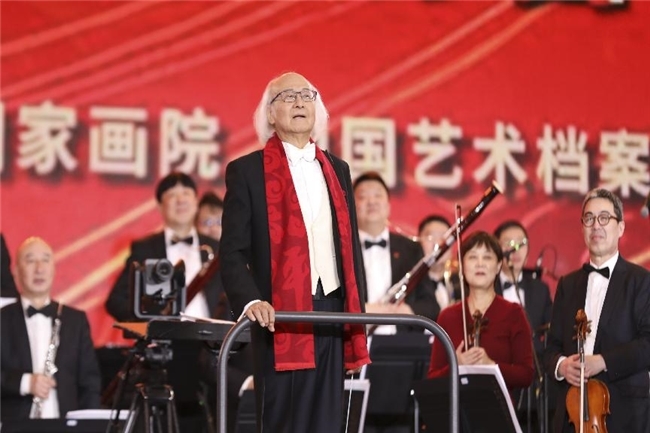
Famous conductor Chen Xieyang
The party was ambitious and cleverly conceived. Under the majestic and affectionate conductor of the famous conductor Mr. Chen Xieyang, the melody of the symphony "Spring Festival Overture" was like spring breeze and rain, instantly activating the atmosphere of the entire venue.
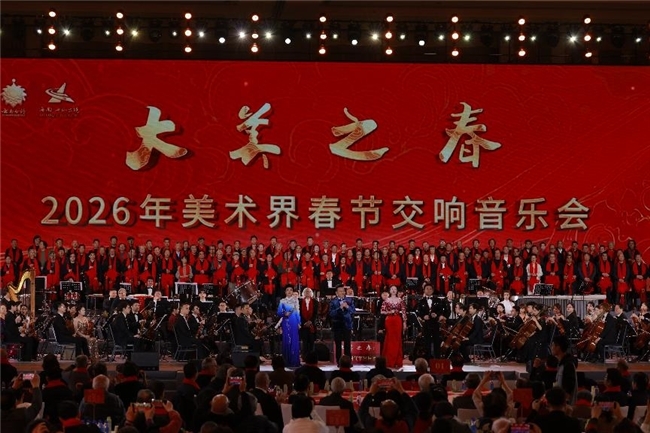
Two hundred representatives of calligraphy and painting artists from all over the country sent blessings to colleagues and audiences across the country
Two hundred representatives of calligraphy and painting artists from all over the country held auspicious Chinese knots and sent blessings to colleagues and audiences across the country. The word "blessing" gathered in the audience and the blessings on the stage were profound and meaningful, instantly sketching a moving picture of the art community uniting as one and celebrating spring together.
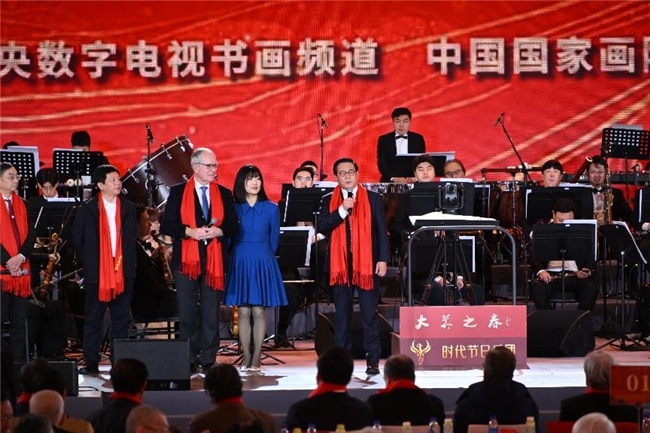
The Calligraphy and Painting Channel leads artists on their European tour to present on-site narration sessions
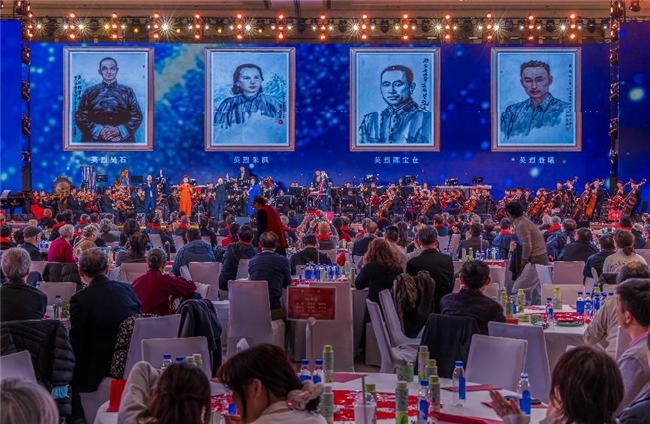
Cast statues and biographies of the four archetypal heroes in the TV series "Silent Glory"
In the atmosphere of celebration, many artists took the stage to share their thoughts: under the leadership of the Calligraphy and Painting Channel, they went to the "European House" in Paris to hold an exhibition to spread the charm of Chinese culture; they devoted themselves to creation and cast portraits of the four prototype heroes in the TV series "Silent Glory". Artists dedicated themselves to practice, conveying the deep feelings of family and country through pen and ink paintings, and writing the immortal national spirit.
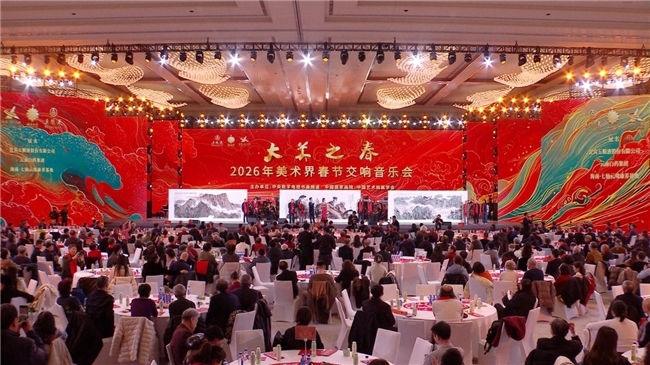
Three six-foot-long paintings appear on stage
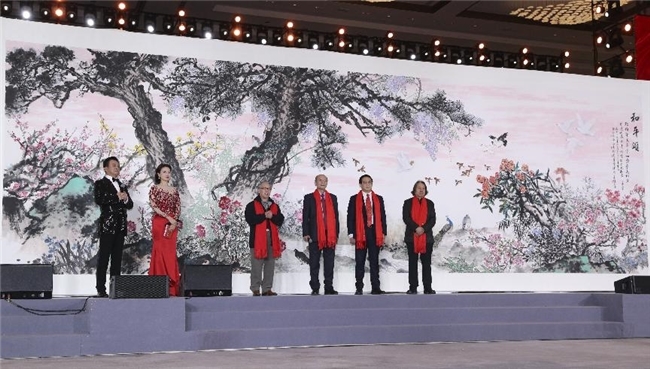
Guo Yisi, Guo Shifu, Xu Li, Jia Guangjian, and Liu Wanming jointly created an 11-meter large painting
"Ode to Peace"
At the party, several calligraphy and painting works were shockingly unveiled. Three six-foot-long paintings collectively created by the artists praised the mountains and rivers of the motherland with full ink. The 11-meter-long and 3.3-meter-wide giant painting "Ode to Peace" intertwined a harmonious and magnificent atmosphere.
Liquor culture, medical wisdom and health care originate from the deep soil of Chinese civilization. Yibin Wuliangye Co., Ltd., Yunnan Baiyao Group, and Hainan Qixian Yunjing Health Care Base, as like-minded inheritors and staunch practitioners of outstanding Chinese culture, deeply participated in the evening presentation. With their own contemporary practices, they vividly responded to the profound call of the millennium context.
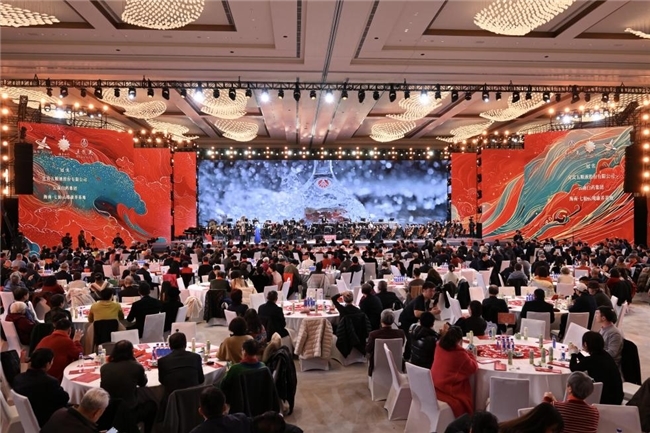
Yibin Wuliangye Co., Ltd. sponsored this party
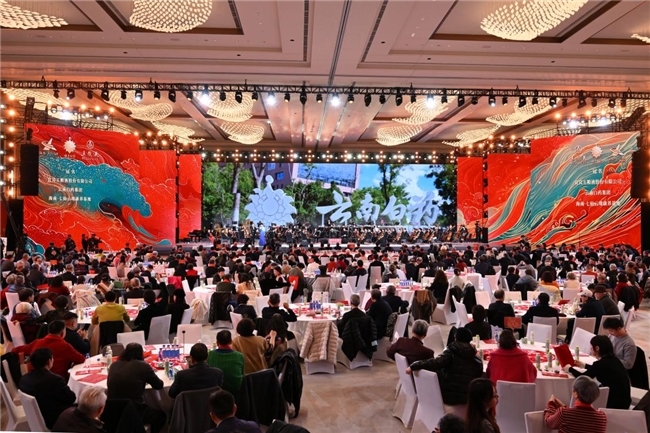
Yunnan Baiyao Group sponsored this party
Hainan Qixian Yunjing Health Care Base sponsored this party
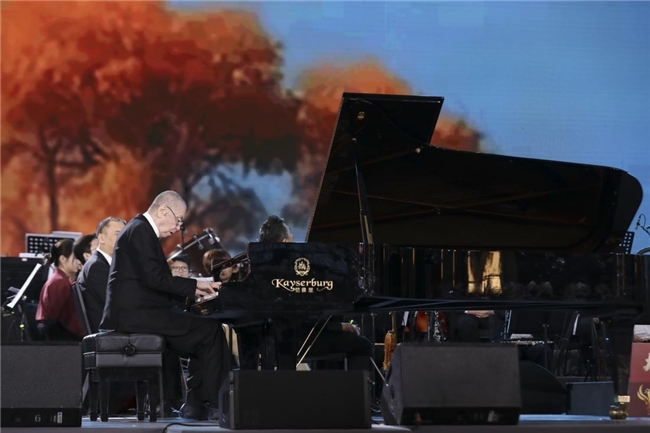
China's leading pianist and music educator Liu Shikun's piano solo "My Motherland"
The emotion of the party reached its peak in the melody of "My Motherland" played affectionately by piano master Liu Shikun. As an annual event in the art world, the cultural ripples stirred up by the "Spring of Great Beauty" are constantly expanding towards a bright future. This grand event is not only an art ceremony, but also a collective oath and a new start for art workers across the country towards the goal of building a cultural power in 2035. At the beginning of the "15th Five-Year Plan", the majority of art workers will be deeply engaged in creation with the spirit of Longma. In the artistic practice of serving the people and contributing to the times, they will continue to draw a magnificent picture of the prosperity of socialist culture with Chinese characteristics, and contribute surging and eternal artistic power to the great rejuvenation of the Chinese nation.

Spring of Great Beauty—Group photo of guests of the 2026 Fine Arts Spring Festival Symphony Concert
At the beginning of 2025, TikTok experienced a dramatic shutdown and restart in the United States, and every move it made attracted global attention. This regulatory tug-of-war across the Pacific not only highlights the severe challenges TikTok faces in overseas markets, but also reveals its difficulty in surviving in the international environment.
Although regulatory pressure from Europe and the United States continues to increase, TikTok's global popularity continues to rise, and downloads have grown rapidly, demonstrating its strong market appeal and user base.
KJ123 learned that the latest data from AppFigures showed that in January 2025, TikTok took first place in the global application download rankings, ending Instagram’s dominance for more than a year. Among them, the explosive growth of the Southeast Asian market has become a key engine, especially Indonesia, which contributed the largest share of TikTok's new global downloads in a single month.
As the largest economy in Southeast Asia, the importance of the Indonesian market to TikTok is self-evident. Official data shows that by continuing to increase investment in localization, TikTok has provided total advertising credit to Indonesian government agencies, state-owned enterprises, and small, medium and micro enterprises in 2024. It has reached 15.3 billion Indonesian rupiah (approximately US$940,000), an increase of 6 times from the initial stage.
What is more critical is its layout in the e-commerce field. After experiencing policy fluctuations, TikTok invested in the acquisition of local e-commerce giant Tokopedia. It not only successfully resolved the regulatory crisis in Indonesia that prohibited direct transactions on social platforms, but also relied on Tokopedia's mature logistics network and user base to deeply integrate live streaming e-commerce with the traditional shelf model, further consolidating its market position.
In addition to Indonesia, TikTok e-commerce also performed well in the Thai market. Data shows that from January to August 2024, TikTok Shop's product purchase volume increased threefold, and the amount of cooperation between brands and creators increased fourfold, driving more than 3 million local users to earn income through content creation.
With the vigorous development of Southeast Asia's digital economy, the e-commerce industry is facing unprecedented opportunities for transformation and growth. According to the "2024 Southeast Asia Digital Economy Report" jointly released by Google, Temasek and Bain, the scale of Southeast Asia's digital economy is expected to reach US$263 billion in 2024, a year-on-year increase of 15%. Among them, short videos and live broadcasts have become important driving forces for the growth of e-commerce. More than 40% of Southeast Asian online shoppers rely on video content when making purchasing decisions.
With the right time, place and people, TikTok Shop successfully seized the opportunity of social e-commerce and quickly emerged as a force that cannot be ignored in the Southeast Asian e-commerce market. Surveys show that TikTok Shop has become one of the most popular shopping channels in Southeast Asia, thanks to the strong appeal of short videos and live broadcasts. It is expected that TikTok Shop’s e-commerce market share in Southeast Asia will reach 15% by 2024, an increase of 5% from 2023.
According to KJ123, TikTok Shop’s global site layout has expanded to 6 regions, among which Vietnam, Thailand, Philippines, Malaysia, Singapore and Indonesia in Southeast Asia have become the first key markets for TikTok e-commerce.
In order to take advantage of the e-commerce boom in Southeast Asia, TikTok is accelerating its e-commerce layout and launching a series of innovative measures. For example, the "refund without return" function has been effective since January 8, and the "Resumption of Work and Production Task Competition" launched last year for the Southeast Asian market.
According to the official announcement of TikTok Shop Southeast Asia, this "Resumption of Work and Production Task Competition" will cover the five major markets of Malaysia, Thailand, Philippines, Vietnam and Singapore. In order to motivate platform merchants, TikTok Shop has launched a number of support policies, including a GMV growth incentive plan from January 1 to March 31, a Spring Festival resumption support plan, and advertising investment growth incentives, aiming to help merchants achieve business growth at the beginning of the new year.
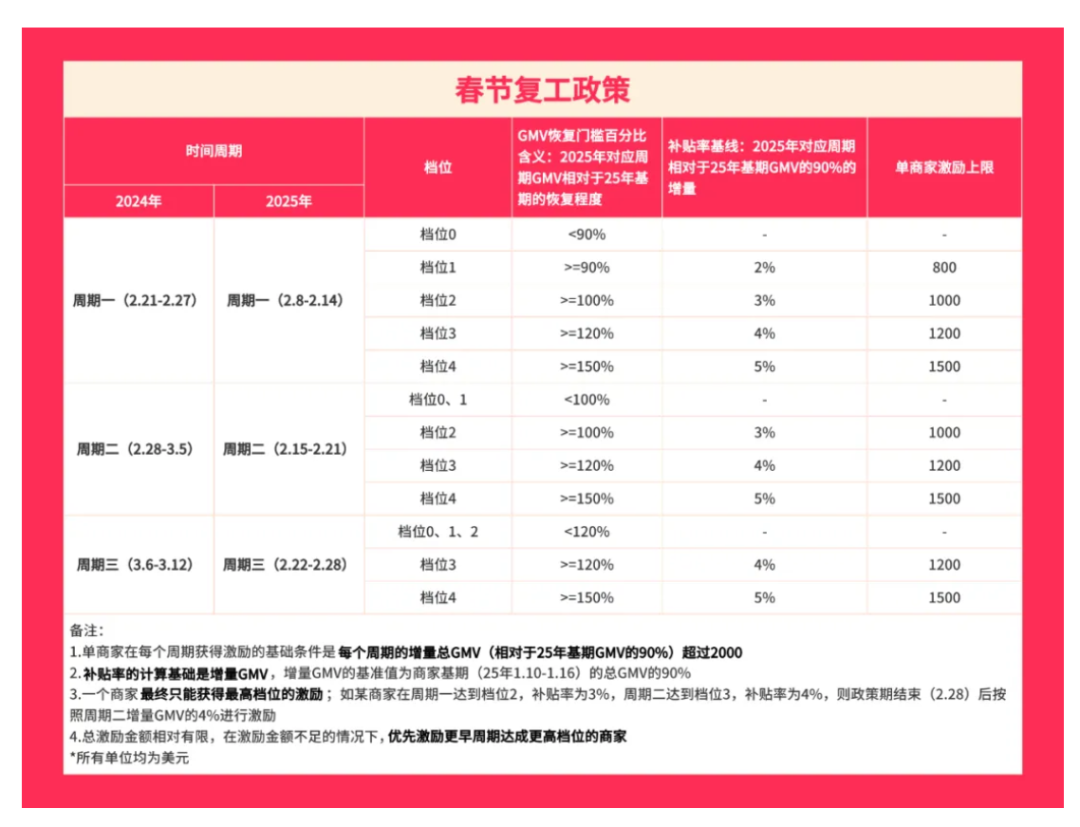
However, it is worth noting that TikTok’s development in the e-commerce field in Southeast Asia has not been smooth sailing, and it still faces multiple challenges.
In order to protect local enterprises, Southeast Asian countries have strengthened their supervision of the e-commerce market, especially the supervision of cross-border enterprises. For example, the Vietnamese government has tightened regulations on taxation and counterfeit products. Recently, Thailand’s Ministry of Commerce has united 16 government agencies and major e-commerce platforms to jointly crack down on the online sales of substandard and illegal products. According to a statement from Thailand’s Ministry of Commerce, they have implemented a “removal from shelves at notice” policy. Once goods are deemed substandard, they will be removed immediately to ensure that consumers are protected from low-quality products.
In addition to the challenges of government regulation, TikTok also needs to deal with fierce competition from established e-commerce giants such as Shopee and Lazada. These platforms not only have a huge user base and mature operating systems, but are also actively exploring new areas of social e-commerce to enhance their competitiveness. Taking the Shopee Malaysia site as an example, during the Spring Festival this year, Shopee live shopping experienced explosive growth. The number of buyers on Shopee Live surged 116% year-on-year, holiday food searches increased by more than 3,000%, and orders from local merchants increased by 240%.
In addition, TikTok also faces challenges from other platforms in the field of social e-commerce that TikTok is good at. For example, YouTube has partnered with Shopee to launch YouTube Shopping services in Indonesia, Thailand and Vietnam. Since YouTube has a deep user base in Southeast Asia, this will undoubtedly bring greater competitive pressure to TikTok.
Although the road ahead is full of challenges, TikTok has shown momentum to compete with e-commerce giant Shopee in the Southeast Asian market. Although its fate in the United States is still unresolved, in Southeast Asia, the future development of TikTok e-commerce is worth looking forward to. In the future, we will wait and see whether TikTok can further enhance its status in the Southeast Asian market.
-------- END --------
 Nexperia Launches Small Batch Mass Production Of 12-inch Wafer Bipolar Discrete Devices With Significant Advantages2026-03-17Comments(0)