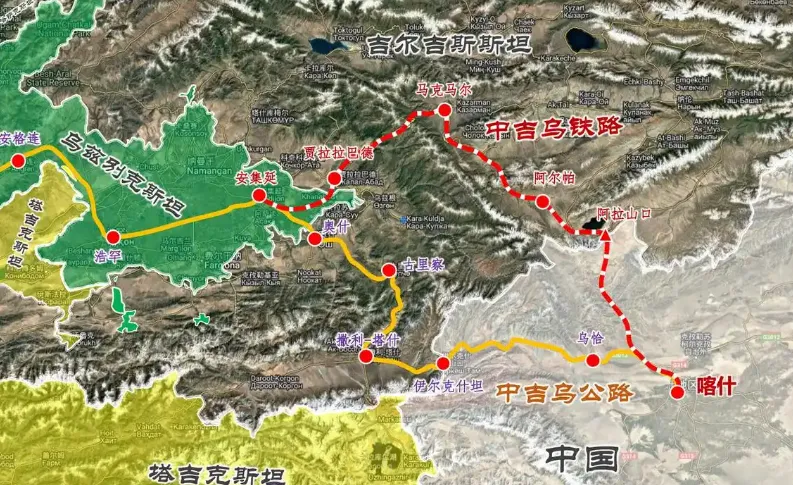
The Process Of Proposing And Promoting The China-Kyrgyzstan-Uzbekistan Railway Plan Has Encountered Setbacks And Key Issues
DOI: 10.13568/j.cnki.issn1000-2820.2025.06
DOI: 10.13568/j.cnki.issn1000-2820.2025.06

The man took sick leave many times due to back pain and foot pain, but the company discovered that he had taken more than 16,000 steps on WeChat on the day he had foot pain. The company suspected that he was taking sick leave and fired him for absenteeism. The two parties went to court. Xiao Chen is a spring coiler in a company in Jiangsu

The audio source of Mooney's third special album "Money III: The Noble" is released for the first time! Behind-the-scenes planning, Whale Xianghai reveals the secrets of the "drama-chasing" announcement
Our newspaper (chinatimes.net.cn) reporter Hu Jinhua from Shanghai reported that A-shares have been receiving frequent favorable policies recently, but under the market conditions, the index was suppressed even if it "rised" slightly.
Want to know a summary of the list of very professional Cambridge English KET/PET training institutions in Shenzhen? Go to Shenzhen Global Education Cambridge English to provide you with relevant course tuition fees, class opening times and discount information. Professional teachers teach and tailor-made courses are easy to understand and you can learn wherever you go.
Financial News Agency, February 27 (Editor Shi Zhengcheng) Last night and this morning, as Nvidia, the world's most valuable listed company, once again experienced a "habitual decline" after releasing its financial report, the technology sector was collectively dragged down, causing the Nasdaq to fall by more than 1%. until close

Graduation certificates for self-study examinations are produced uniformly by the National Examination Committee and are electronically registered on the Ministry of Education Examination Center network. Samples of self-study undergraduate certificates over the years have the seals of the Provincial Self-Study Committee and the examiner’s institution.
Xinshi District Educational Science Edition Primary School Science Volume 2 Review Questions for Grade 5 1. Fill in the blanks: 1. When you press down the foam on the water surface with your hands, you will feel an upward force. This force is buoyancy. The sinking and floating of an object in water is related to the amount of water it displaces.
Science and Technology Daily reporter Lu Chengkuan learned from the National Astronomical Observatory of the Chinese Academy of Sciences on the 25th that scientific research teams from the National Astronomical Observatory of the Chinese Academy of Sciences, the University of Chinese Academy of Sciences and other units have successfully developed an artificial intelligence model called SpecCLIP.
The list of the top 10 recommended Cambridge KET/PET English training institutions in Shenzhen was announced today. Shenzhen Shennan Foreign Language is a professional international language training institution, providing you with French, Spanish, Japanese, French, English, French, Russian, Korean, Thai, Cantonese
Usage of Polygon command:
After entering the Polygon command in the command bar, set the number of sides of the polygon, then specify the center point of the polygon and enter the radius of the polygon. Select the desired handover mode. That's it.
Definition and usage:
The polygon polygon command creates an equilateral closed polyline. You can specify various parameters of the polygon, including the number of sides. It shows the difference between inscribed and circumscribed options. You can also create polygon segments using edges.

Polygon command usage examples:
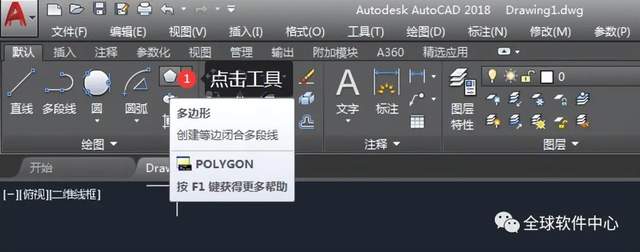
1. Open the CAD2018 software, click the polygon tool on the drawing panel, or enter the POLYGON command, or enter the abbreviation POL command.
2. POLYGON input the number of sides. That is the number of sides of the polygon. Space for next step.
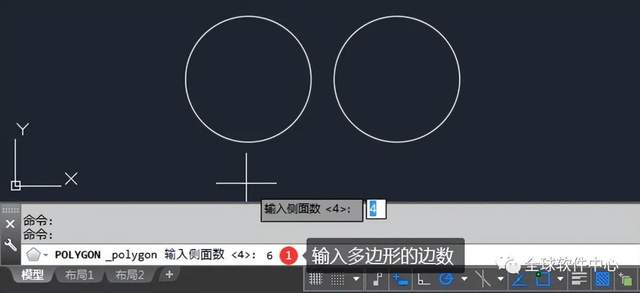
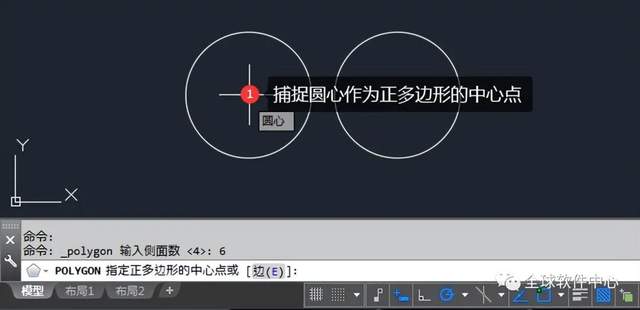
3. POLYGON specifies the center point of the regular polygon, and can capture the center point of the circle as the reference center point. Go to the next step.
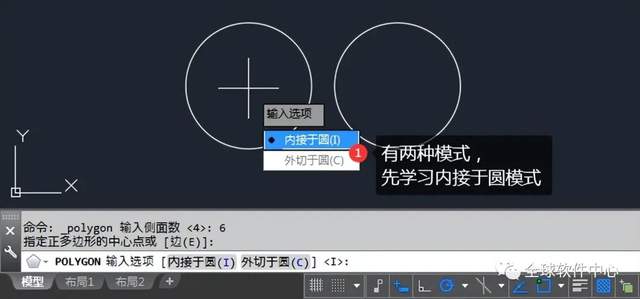
4. POLYGON input options. There are two modes: inscribed in a circle and circumscribed in a circle. Select Inscribed in Circle to proceed to the next step.
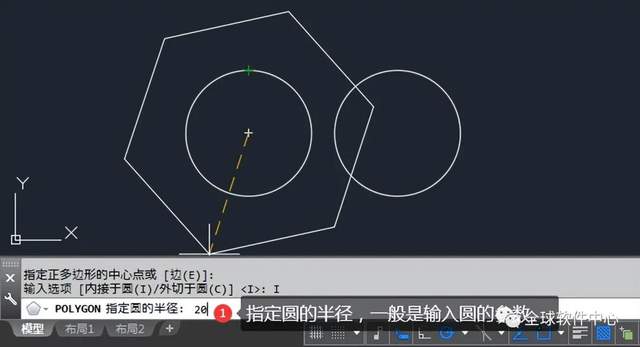
5. POLYGON specifies the radius of the circle, which is inscribed in the circle radius. The parameters here are referenced to the radius of the circle 20. The space is complete.
6. In the same way, enter the POLYGON command and enter the number of sides as 6. The effect is as follows:
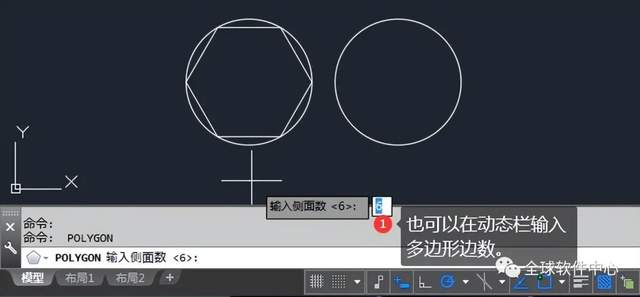
7. Also capture the center point of the circle as the center point of the polygon side. Go to the next step.
8. Enter the options, here select circumscribed in the circle as the reference mode. You can also enter C space to proceed to the next step.
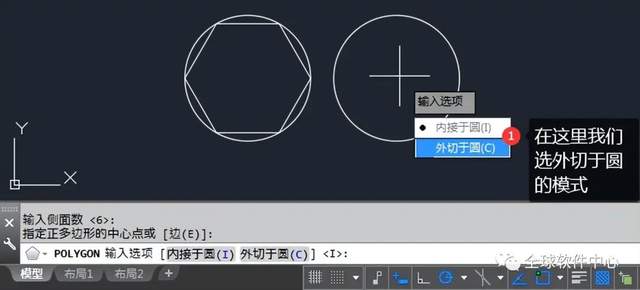
9. Enter the radius parameter of the circle circumscribed to the circle. For example, if the radius of the circle is 20, leave a space to enter the next step.
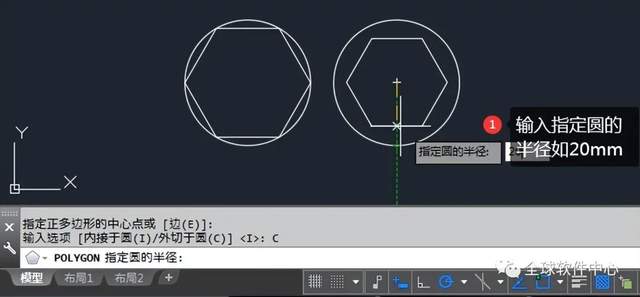
10. In this way, we can distinguish the effects of being inscribed in a circle and circumscribed in a circle.
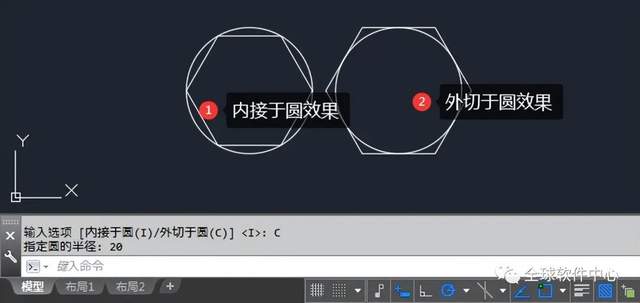
11. Another way to learn is to set the number of polygon sides.
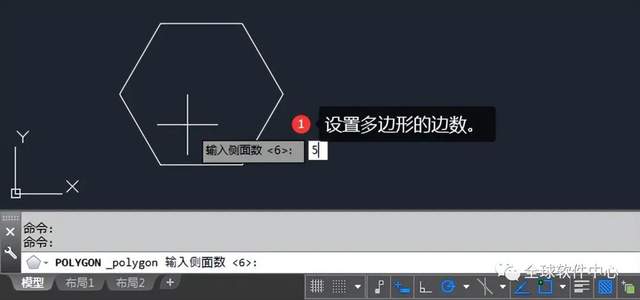
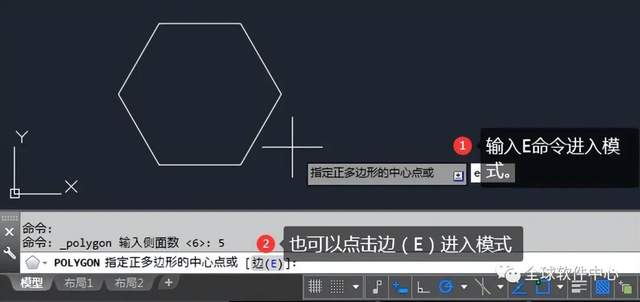
12. Click the edge (E) or enter E to enter the edge drawing mode.
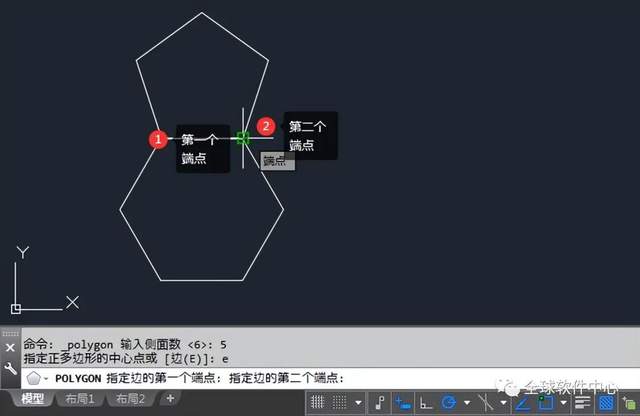
13. Click on the first and second endpoints of the polygon. That's it.
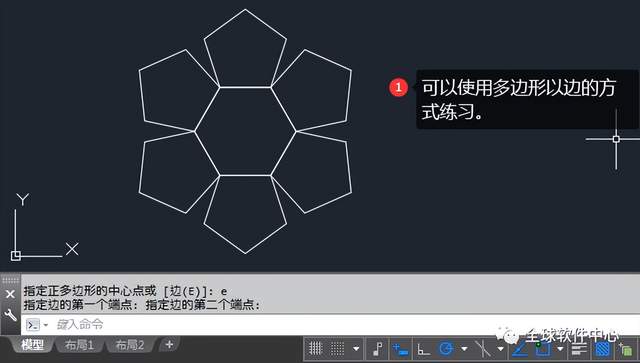
14. You can use this method to complete the following graphics.
On the afternoon of June 7, the second session of the first International Urban Development Forum was held again at Guangfo New World Manor. Lang Xianping, a well-known economist and professor of finance at the School of Business Administration of the Chinese University of Hong Kong, visited the "Heart of Guangfo" exhibition hall and gave a wonderful speech to the guests on the theme of China's macroeconomic status quo and future industrial opportunities in Greater Guangzhou. More than a thousand entrepreneurs and celebrities from all walks of life actively participated in the event.
Lang Xianping: The industrial reshuffle represents new opportunities for enterprises
Professor Lang Xianping made a shocking statement at the forum, believing that China has entered the era of "Great Depression". The "Great Depression" is not a bad thing, but it means that a major industrial upgrading forced by the economic situation is coming. This is an industrial reshuffle, which will be a major crisis for complacent companies and industries with low industry value; however, it will be a new opportunity for high-tech knowledge industries and powerful companies. "Seize the opportunity, don't be eliminated now, and you can succeed in the future." Professor Lang Xianping said.
However, a major industrial reshuffle requires a huge space for the "Great Shift of the World". Guangzhou cannot provide this space, nor can Foshan provide it. Only by combining Guangzhou, Foshan, Hong Kong and Macao to form a greater Guangzhou metropolitan area can sufficient space be provided. The industrial reshuffle will gradually eliminate enterprises and industries that cannot keep up with the development pace of the metropolitan area, creating opportunities for forward-looking and knowledgeable new entrepreneurs and sunrise industries with strong vitality. Whether enterprises and industries can seize the opportunity of this major reshuffle will affect the development process of the region. In the center of the greater Guangzhou metropolitan area, this reshuffle has already begun. The completion of the Foshan Smart City and the high-tech knowledge industry belt, as well as the presence of many Fortune 500 industries such as Toshiba, FAW-Volkswagen, and German Medical Valley, are bound to bring new development to the greater Guangzhou metropolitan area and promote the economic growth of the greater Guangzhou.
"Lang" style investment: investing in stocks in the United States and investing in real estate in China
At the end of the forum, Professor Lang Xianping shared his "unique" investment method with the guests: "Specialize in stocks in the United States, speculate in real estate in China, speculate in expert antiques, do not speculate in gold, and do not speculate in A-shares." Professor Lang Xianping believes that "all financial management methods are unreliable" in China, and the most value-preserving and rational investment method is real estate. But in the past, buying and investing in houses in China was a "fool's model". You could make money by investing in real estate, but now this good old age has come to an end. When buying a house now, you must choose a property with regional development value and a property with high developer brand value. "You can't joke with your own money."
There are over 100 additional auditorium seats on site, and the audience applauds once every 3 minutes.
Before Professor Lang Xianping took the stage to give a speech, the forum was already full, but guests were still arriving in a steady stream. The staff temporarily added more than a hundred auditorium seats, which filled the forum, but still could not seat all the guests. During the forum, the guests responded enthusiastically to the speech's views. Professor Lang Xianping carried out the entire speech with a courageous and well-spoken style, igniting the atmosphere at the scene and making the guests thunderous applause. The speeches in the audience were constantly exciting, and almost as soon as one round of applause stopped, the next round of applause started again. Until the end of the speech, Professor Lang Xianping left the venue early due to important matters. The guests still had unfinished business and could only shake hands with the professor and say goodbye.
The urban manor in the center of Greater Guangzhou, whose quality of life and regional prospects were recognized by guests
After the forum, all the guests visited Guangfo New World Manor under the guidance of the sales staff. Many guests believed that Guangfo New World Manor is well-deserved as a benchmark for life in the center of the Greater Guangzhou metropolitan area, whether it is the creation of an ecological environment or an international quality life platform. The concept of sustainable development has always been implemented to the end, reflecting New World Real Estate's rigorous attitude towards the quality of life. Geographically, the project is adjacent to the West High-speed Railway Station. This transportation hub, which is comparable to the size of Guangzhou South Station, will surely drive the development of surrounding areas and even greater Guangzhou in the future, and its investment value is immeasurable.
The permanent venue of the forum is Guangfo New World Manor, with an environment comparable to "Davos" in Switzerland.
It is understood that the first Metropolitan Area Development Forum, as a dialogue platform for international metropolitan areas, is committed to promoting the development of global metropolitan areas through exchanges and cooperation among metropolitan areas. Taking a fancy to the development trends and potential of the Greater Guangzhou International Metropolitan Area, we chose to permanently settle in Guangfo New World Manor and invited many authoritative experts to guest forums to provide guidance on the development of the Greater Guangzhou Metropolitan Area and discuss the development opportunities of the Metropolitan Area with elites from all walks of life.
As the permanent site of the International Metropolitan Area Development Forum, Guangfo New World Manor has an environment that can be called China's "Davos". It has brought 4,500 acres of world-class urban estates to Greater Guangzhou, and has built 2,500 acres of world-class greens, 700 acres of colorful forests, 500 acres of Dahao Lake living water project, and 20 kilometers of greenways around the lake. It leads the lifestyle in the center of the metropolitan area and creates an elite exchange platform in the metropolitan area.
One river and two lakes + a fourth-generation mansion! It accurately hits the hot-selling decoding of the phenomenon of improving customer pain in the Bay Area: Why is Kochi, the science city, flocking to the same "Star River Bay"?
Real Estate Guangzhou Station
Author | Ryan sean adams Abstract: Polygon provides a general framework that allows developers to create custom, application-specific chains that leverage the security of Ethereum, providing an interoperable network that ties together a variety of different scaling solutions such as Zk-rollups, optimistic-rollups, and sidechains.
How to use Polygon
Polygon is building the blockchain internet of Ethereum. In short, Polygon provides a general framework that allows developers to create custom, application-specific chains that leverage the security of Ethereum, providing an interoperable network that ties together a variety of different scaling solutions such as Zk-rollups, optimistic-rollups, and sidechains.
This app helps with everything you can do on Polygon’s PoS chain, and there are a lot of new protocols that can be done in this emerging DeFi ecosystem.
Let’s explore it.
Everything you can do on the Polygon PoS chain
You probably don't need me to tell you this, but using Ethereum is expensive. The overwhelming demand for its block space has driven up gas prices, pushing network costs to the limit, and users have turned to other lower-cost (but more centralized) chains, such as the Binance Smart Chain (BSC).
For those of us who want to live a life without banks, or who want to spend our days and nights in DeFi, this is a letdown. Ethereum needs to scale or it risks losing users and capital and being replaced by other public chains that do not share the same commitment to self-sovereignty, trusted neutrality and decentralization.
Fortunately, this long-standing gas crisis may soon be close to being resolved. A ton of different scaling solutions are being launched as we speak, including Layer 2, sidechains with Ethereum, and of course ETH 2.0.
Of these solutions, the first to see meaningful adoption is the Polygon PoS chain. Its growth has been absolutely explosive in recent weeks, with the network supporting over $8.9 billion in value locked, with new and old protocols being deployed every day. Along with the sharp increase in the price of MATIC, Polygon became a hot topic on cryptocurrency Weibo.
After spending some time playing around with Polygon, let me tell you: it certainly lives up to the hype. Transactions are lightning fast and prices are low. As more of the Ethereum L1 applications we know and love are built, users are starting to reap the rewards of composability.
By the end of this article, you'll learn about all the different things you can do on Polygon, and how much gas you'll save.
What is Polygon?
Polygon's vision is to build an Internet of Blockchains based on Ethereum. In essence, Polygon provides a general framework that allows developers to create custom, application-specific chains that leverage Ethereum's security, as well as provide an interoperable network that ties together a variety of different scaling solutions such as Zk-rollups, optimistic-rollups, and sidechains.
This article focuses on the Polygon PoS chain, Polygon’s first product to gain significant traction. This chain is somewhere between a sidechain and a pure second-layer scaling solution such as convolutions, and it fully inherits the security of the main chain.
Architecture and security assumptions
Before using Polygon or any other network, it's important to understand its architecture and some important security assumptions you make as a user. This is a new technology after all, so use it at your own risk!
Polygon ensures security through a proof-of-stake consensus mechanism. Verifiers invest MATIC tokens into smart contracts, which are hosted on the Ethereum main chain. For reference, there are currently over $2.6 billion in MATIC staked in these contracts.
To get funds from Ethereum to Polygon, you have to go through what's called a bridge. In a nutshell, transfer bridges work by using an atomic lock and minting mechanism.
In the case of Polygon, when you deposit funds into the transfer bridge, they are actually saved (locked) in a contract on Ethereum and then recreated on Polygon. If you want to withdraw funds, you have to go back through the bridge. When doing this, the tokens you sent across the bridge will be burned on Polygon and the funds in the Ethereum contract will be unlocked.
In Polygon, you can choose to use two bridges: Plasma bridge and PoS bridge. The Plasma Bridge inherits the security of the Ethereum main chain, however, it takes seven days to complete the withdrawal process. The PoS bridge is secured by the same set of validators and pegged MATIC to secure the chain itself, with withdrawal times of approximately three hours.
Tying it all together, the contract holding the collateralized MATIC is responsible for the security of the chain and the funds locked on the PoS bridge. This is something to remember as both marking and bridging contracts can be changed by using a proxy controlled by a multi-signature wallet.
This wallet started out as a 2/3 multisig but has now been upgraded to a 5/8 scheme. Recently, the team confirmed that four of these signers are Polygon co-founders and four are prominent members from other Polygon DeFi projects.
This is a centralized carrier and is certainly a risk factor to consider when deciding to use Polygon. If this wallet were compromised, the security of the network and the ability to transfer funds back to Ethereum would be seriously compromised.
In addition to multisig, approximately 31% of MATIC’s stakes are delegated to a node run by Binance. This concentration of stake is another factor to be aware of when deciding whether to move to Polygon.
How to use Polygon
Before using Polygon, you must take several steps. First, you need to configure the network in your wallet, then as mentioned above, you must use one of the two bridges to transfer funds from Ethereum L1.
Here are some guides that will detail how to do this.
What you can do on Polygon
1. Exchange and provide liquidity on QuickSwap
Decentralized exchanges (DEXs) are the core of any blockchain-based financial system. This is no exception at Polygon, where the most popular DEX name on the web is QuickSwap. As a fork of Uniswap V2, QuickSwap has exploded in popularity in recent days. The protocol certainly lives up to its name: Transactions on QuickSwap are confirmed in the blink of an eye, thanks to Polygon’s average block time of 2.1 seconds.
In recent weeks, the protocol has attracted over $650 million in liquidity while processing $150-250 million in daily transaction volume. As a result, QuickSwap earns hundreds of thousands of dollars in fees per day for its liquidity providers.
For LPs looking to earn additional revenue streams beyond trading fees, there are currently over 100 incentive pools. LPs in these pools can earn QUICK rewards, QuickSwaps’ native governance token, as well as fees in the form of 0.25% of transaction volume.
Additionally, similar to SushiBar on SushiSwap, QUICK holders can stake their QUICK tokens to receive the 0.04% trading fees generated by the protocol in the form of dQUICK tokens.
Save Gas
While DEXs are one of the cheapest DeFi protocols to use, they are still not suitable for small transactions. At current gas prices, the cost to trade on Uniswap is around $30-$80+, while the cost of providing liquidity to the protocol is typically over $100.
These costs are significantly reduced on QuickSwap. To put this into perspective, the cost of exchanging and providing liquidity are both $0.0002, which means that trading on Polygon is 435,000 times cheaper than on Ethereum Layer 1, and initiating an LP position is 785,000 times cheaper!
This means that users with balances of any size can swap or LP to their heart’s content without having to worry about gas fees taking a chunk out of their profits!
2. Borrow and lend on Aave
Aave is one of the first major DeFi projects to announce deployment to Polygon. Following the announcement, Aave’s Polygon integration attracted over $5.1 billion in liquidity. Just like Aave on Ethereum L1, users can deposit assets to the protocol and use them as collateral for borrowing and lending.
Aave’s Polygon marketplace currently supports deposits in seven assets. USDT, USDC, DAI, wBTC, wETH, MATIC and AAVE, as well as all borrowing and lending except the latter. While the sectors are limited compared to the Ethereum market, and deposits or collateral swaps are not currently supported, users can still lend and borrow against some of the most liquid assets in DeFi and go long or short the asset with leverage.
You can also earn MATIC by using the protocol, 1% of the total supply of MATIC will be distributed to Aave users, and the annual interest rate is generally between 5-15%.
Save Gas
The gas savings of using Aave on Polygon is even more obvious than QuickSwap. At current prices, depositing funds to Aave on Ethereum L1 costs around $95, while borrowing will cost users around $125 more, meaning it costs over $200 to fully utilize the protocol.
On Polygon, these combined costs are 235,000 times lower, as deposits and borrowing cost just $0.001
3. Swaps and liquidity provision on the curve
Curve is another major DeFi project that recently deployed on Polygon. While Curve does not offer a full funding pool as we know it on Ethereum L1, it currently offers a single Polygon funding pool called "Aave" where users can deposit aTokens they received from Aave's Polygon integration. With a single click, users can deposit and stake aDAI, aUSDC, or aUSDT (or directly deposit non-aToken versions of these assets) to earn 0.02% in fees per trade, as well as MATIC rewards. This pool has attracted more than $464 million in liquidity and facilitates $50 million in daily trading volume. In addition to this, the comprehensive APY that LPs can earn has always been in the range of 35-45%. This integration is the best embodiment of DeFi’s combinatorial nature: users can make profits by adopting a strategy.
Gas Savings Gas savings are huge. At current prices, exchange fees on Curve are around $70, while depositing and staking as an LP will cost users another $110. On Polygon, these costs are reduced to a paltry $0.0002. These costs are reduced by 355,000x and 570,000x respectively! 4. Exchange, provide liquidity, lend and borrow on SushiSwap SushiSwap is another popular protocol deployed on Polygon. Within two weeks of launch, the project has secured $620 million in liquidity and is processing tens of millions per day. Just like on Ethereum, users can leverage SushiSwap to trade tokens and provide liquidity. The protocol also incentivizes nine popular trading pairs, and liquidity providers can stake their SLP tokens and earn SUSHI and MATIC rewards, as well as the usual 0.25% trading fee. While yields have compressed in recent days, bettors can currently earn annual interest rates ranging from 30-110%, depending on the trading pair. In addition to swapping, users can also take advantage of one of the newest items on the Sushi menu. Kashi! Kashi is the first application built on top of the BentoBox vault, allowing anyone to create their own lending and borrowing. To create a pairing, all you have to do is. While there is a wider service on Ethereum, Kashi on Polygon currently supports creating pairs using any combination of ETH, DAI, AAVE, MATIC, USDC, USDT and wBTC. Save Gas I have nothing creative to say, however. The savings from using SushiSwap on Polygon are huge Sushi is expensive in real life, and it's also expensive on Ethereum. At current gas prices, it costs about $57 to do an exchange, $95 to provide liquidity, and $98 to create a Kashi pair. On Polygon, these costs are reduced to $0.0002, $0.00004, and $0.0004 respectively. This equates to savings of 285,000x, 237,500x, and 245,000x! 5. Enter the Sweepstakes on PoolTogether
Now you can play again on Polygon with PoolTogether, a lossless lottery protocol that currently offers a USDT pool that pays out prizes daily. The prize pool currently holds over $8.2 million in deposits, with daily jackpots typically ranging between $1,000-$2,000. Like Curve, the protocol also bootstraps the power of DeFi portfolios by harvesting proceeds from the prize pool on Aave’s Polygon marketplace.
In addition to the chance to take home the jackpot, lottery participants can also earn a yield, as savers in the prize pool will be rewarded with MATIC, with annual interest rates hovering around 20-25%.
Save Gas
I'm a broken record at this point...but the reduction in gas bills is astronomical. The cost to participate in the PoolTogether draw is $183 on Ethereum L1 and only $0.0006 on Polygon. That’s a 305,000-fold reduction!
6. Collect NFTs on OpenSea
The top NFT marketplace also has a test deployment now on Polygon! While it doesn’t offer as wide a range of tokens as L1, collectors can still purchase a variety of different NFTs. Interestingly, gaming tokens appear to be the most popular collectibles on the market. NFTs related to ZED (a digital horse racing and ownership game) and Neon District (a cyberpunk-themed RPG game) account for more than 60% of the total listed collectibles.
Save Gas
While the cost of becoming a DeFi chad has dropped to close to zero, the cost of becoming an NFT collector on Polygon is literally zero. This is because OpenSea L2 fully subsidizes the gas cost of purchasing NFTs. What cost $72 on Ethereum L1 is now free. That's the power of Polygon, folks.
in conclusion
Ethereum’s scaling has arrived, and it’s living up to expectations. On Polygon, you can move money between applications at the speed of light and at virtually zero cost. While it doesn’t inherit all of Ethereum’s security guarantees, it’s a step toward realizing the vision of an Internet of Money we’ve signed up for.
There's a lot you can do on Polygon, and more applications are being deployed every day. As mentioned before, while there are some security trade-offs, early pioneers are currently compensated by high yields and/or usage cost subsidies, not to mention gas savings! ".
The nightmare of prohibitively expensive gas is finally over. The Ethereum economy is now available to anyone again.
You can become a Polygod and experience the future of finance.
Ryan sean adams Author translated by Zheng Qirui
Edited by Zheng Qirui
The content is for reference only and is not intended to be investment advice. Do so at your own risk.
How can you learn about blockchain by just watching domestic forums? You must go to famous foreign forums or media communities and browse them all. You must surf the Internet scientifically so that you can get in touch with the most cutting-edge technologies, concepts, and project developments. Let me highlight some recommendations below:
1) Bitcointalk: https://bitcointalk.org/
The famous old Bitcoin forum was established in 2009. In the early days, Satoshi Nakamoto, the founder of Bitcoin, was active on this forum and had in-depth discussions with netizens on issues such as mining energy, Bitcoin network expansion, and block size. Before Satoshi Nakamoto retired, please see https://bitcointalk.org/index.php for a collection of all his speeches on Bitcointalk. action=profile;u=3;sa=showPosts
2) Medium: https://medium.com/
The well-known social blogging platform, founded by Twitter co-founders Evan Williams and Biz Stone in August 2012, allows users to share their stories through text and communicate with like-minded users. Search blockchain and you will find many in-depth articles. It is recommended to read more.
3) The blog of the famous venture capital institution A16Z: https://a16z.com/2018/02/10/crypto-readings-resources/
There are many articles about blockchain and cryptocurrency on it, which are very systematic. It is recommended that those with good English can learn systematically.
Update a16z’s latest encryption entrepreneurship course: Crypto Startup School - Andreessen Horowitz
There is a series of video courses above, which can be said to be the best entrepreneur education courses in the blockchain field. In the blockchain field, a16z has basically invested in the entire upstream and downstream tracks. I think it may become the YC in the blockchain field.
When the mobile Internet industry exploded, what YC did best was entrepreneur education, and then it became the most successful angel investment institution in history. I estimate that a16z will also be the most awesome investment institution in the future. Of course, they are also very awesome now.
Their partner Chris Dixon, who is mainly responsible for the blockchain and Web3 fields: https://x.com/cdixon You can also pay attention to it. He recently published a book that I think is worth reading:
I have been continuing to study their stuff, and I highly recommend everyone to take a serious look at it.
4) Ethereum Community: Home Page | ethereum.org
It is highly recommended to read more about the Ethereum community, there is a lot of knowledge about Ethereum. As a typical representative of the public chain, Ethereum deserves careful study by every enthusiast who pays attention to blockchain. I am personally very optimistic about the Ethereum ecosystem. Especially the current innovations in L2, compared to the group that entered the industry in 2017, the transfer efficiency and application ecology are simply much richer, and I am very optimistic about them.
5) Coindesk: CoinDesk: Bitcoin, Ethereum, Crypto News and Price Data
Their content and data reports are quite good. I must read them every quarter. For example, many of the research reports on this page are worth reading: https://www.coindesk.com/research
6) Recommend some good university courses:
Coursera has several free courses on blockchain. The quality is many times higher than those expensive and leek-cutting courses in China. For example: https://www.coursera.org/learn/cryptocurrency?#syllabus opened by Princeton University
Search for others by yourself, there are also several on https://www.edx.org/.
If your English is not good, you can read "Blockchain and Encrypted Digital Currency" by teacher Luo Mei of Tsinghua University in China. It is a very good popular science course:
Blockchain and Cryptocurrency-Tsinghua University-Xuetang Online
I won’t talk about station B. You can find some by searching on your own.
7) Finally, I recommend some websites for viewing data:
First, a website to look at DApp (decentralized application) data: DappRadar - Ranked list of blockchain dapps
For example, those who are interested can take a look at the data and rankings of popular DeFi, NFT and other applications. However, DApp is still in its early stages, so you can continue to pay attention to the subsequent development trends.
Second, websites to view market data: Cryptocurrency Prices, Charts And Market Capitalizations | CoinMarketCap
This website has been in operation since 2013. It is a very old data platform. Compared with domestic market websites, I think it is much better in terms of data authenticity and experience. In 2020, Changpeng Zhao spent US$400 million to acquire this website, which is quite legendary.
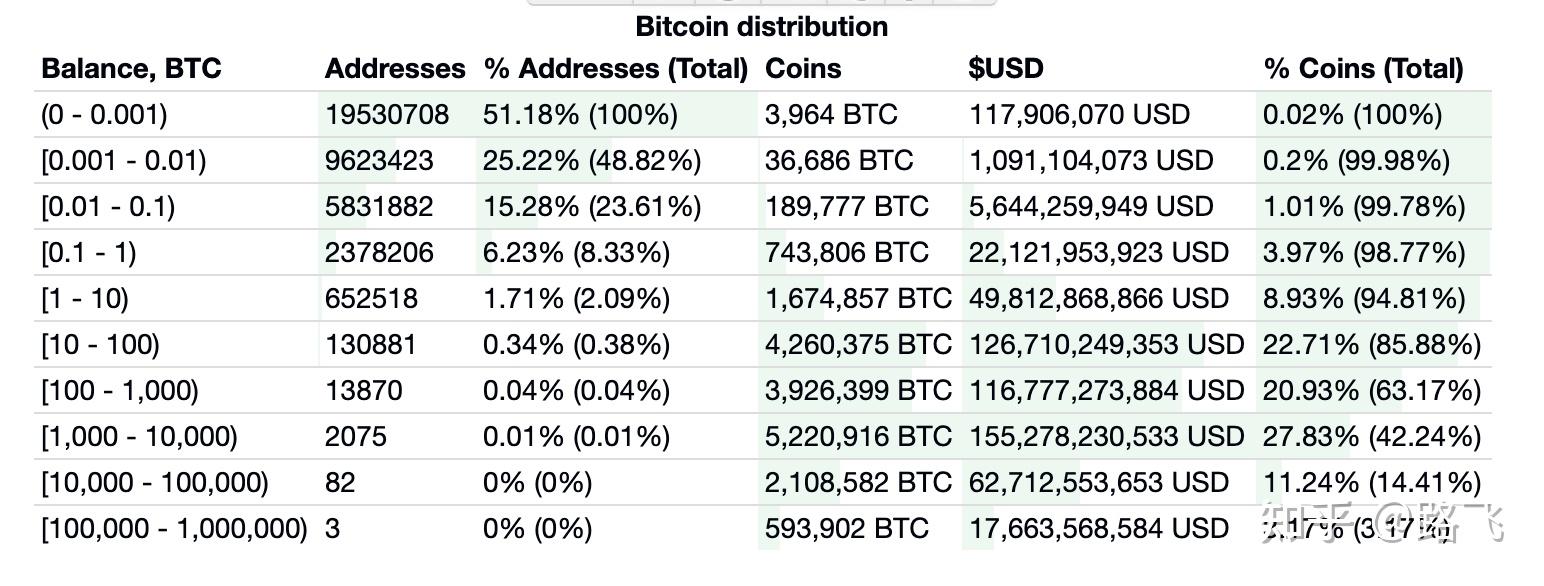
Third, look at the website of the digital currency rich list (one of the interesting data): Top 100 Richest Bitcoin Addresses and Bitcoin distribution
I think the most interesting data on this website is its ranking on the rich list. Of course, it is mainly calculated based on the account amount of the currency-holding address. For example, in the chart below of the continuous number of BTC, the total number of addresses is close to 20 million, but more than 50% of the addresses hold only 0-0.001 BTC. If you own 0.1 BTC, you can be among the top 10% of the BTC rich list.
Fourth, add an important index tool called Bitcoin Ahr999 Index. When the index is lower than 0.45, it is a relative bottom, and you can feel free to buy the bottom. However, it is not recommended to copy all the funds at once. It is best to build a position in batches. Each time the price continues to dip, buy a little more to reduce the overall position cost. If you miss the period below 0.45, you can also make fixed investments within the range of 0.45 - 1.20, and you can make fixed investments on a daily or weekly basis.
With the Bitcoin Ahr999 Index, determining the relative bottom of a bear market is easy. Of course, if it is a more experienced analyst, combined with current macro data, etc., the judgment range of the relative bottom will be more accurate.
However, it is not that easy to judge the relative top of the bull market, and it is even more difficult to escape from the absolute top. Different analysts will have different expectations for the top of each bull market, but there is no doubt that it will exceed the previous high of the previous bull market.
Finally, the questioner mentioned a website for viewing projects. I recommend one: https://www.maxweb.red/
However, I would like to remind everyone that this circle is very deep. Don’t pay too much attention to those unknown projects. If you don’t know how to touch them, more than 99% of them are scammers and empty projects. If you focus on studying well-known projects such as Bitcoin and Ethereum, and understand what’s inside, you will be much better than those who claim to be “blockchain experts” on the market.
The blockchain circle is too impetuous, and those who hope to settle down are those who truly like and recognize the long-term value of this new technology.
Recommend some good books on blockchain. If you are interested, you can read them.

What’s the difference in “playing style”?
When humanoid robots enter the public eye to the beat of the Spring Festival Gala, and when large models begin to redefine the boundaries of "labor," a dramatic change in the times is accelerating.
This year's government work report proposed "creating a new form of smart economy" for the first time. New words such as "intelligent body", "smart native" and "satellite Internet" also appeared in the report, attracting much attention.
On March 6, Zheng Shajie, director of the National Development and Reform Commission, introduced at the economic press conference of the Fourth Session of the 14th National People's Congress that the "artificial intelligence +" action will be deepened to empower thousands of industries and serve thousands of households. The scale of artificial intelligence-related industries will grow to more than 10 trillion yuan by the end of the "15th Five-Year Plan".
As soon as my eyes fell, this "secret war" about the future had quietly begun.
After sorting through the 2026 government work reports from various regions, it was found that all 31 provinces across the country have made deployments in areas related to artificial intelligence and smart economy, hoping to win the opportunity in a new round of fierce competition.
As artificial intelligence is widely integrated into thousands of industries and deeply embedded in the underlying genes of regional economies, what various regions are facing is no longer a single technology competition, but an ecological reshaping that is tailored to local conditions.
In other words, the key to winning the initiative in the future is to find the "ecological niche" of differentiated breakthroughs in this wave of change.
lead
The smart economy is an economic form formed by the deep integration of artificial intelligence technology and various economic and social fields. Its core is to reconstruct the allocation of production factors through data, computing power, algorithms, etc., reshape the industrial competition pattern, reconstruct the division of labor in the global value chain, and ultimately promote the transformation of production and lifestyle and form new momentum for economic development.
Among them, technology is undoubtedly the driving force behind everything. Continuously breaking through the "ceiling" of technological innovation will inevitably require pathfinders to take root in the "no man's land", and Beijing is a typical representative.
On February 28, Beijing held a 2026 global digital economy benchmark city construction press conference and revealed that so far, a total of 216 large models have been registered, ranking first in the country. Behind this is its absolute leading core strength in the field of basic scientific research.
Data shows that the number of people in Beijing shortlisted for the AI 2000 list of the world's most influential scholars accounts for more than 40% of the country's total, and the total number of AI scholars reaches 15,000, accounting for 30% of the country's total. The unparalleled level of universities, human resources and innovation sources has become an important basis for anchoring its goal of becoming the “first city in artificial intelligence in the world”.
At the same time, Beijing is deeply involved in the formulation of the AI regulatory system and industry standards.
The work report of the Beijing Municipal Government clearly stated in the key tasks for 2026 that it will support the construction of an artificial intelligence cluster in Zhongguancun Science City; solidly promote the construction of a benchmark city for the global digital economy, promote the construction of new infrastructure such as intelligent computing power, comprehensively implement the "artificial intelligence +" action, and build a national artificial intelligence application pilot base.
According to the plan, Beijing will take about two years to achieve the scale of the core artificial intelligence industry exceeding one trillion yuan, and become a global artificial intelligence innovation highland with technological source power and industrial competitiveness.
Besides Beijing, Shanghai provides another “pathfinding” paradigm.
In January last year, in order to promote the high-quality development of my country's artificial intelligence industry, the Ministry of Industry and Information Technology and the Ministry of Finance took the lead in establishing the National Artificial Intelligence Industry Investment Fund. The fund has a total scale of 60.06 billion yuan and is located in Xuhui District, Shanghai.
Prior to this, an artificial intelligence fund of funds with a scale of 22.5 billion yuan has landed in Xuhui District in 2024. Xuhui District, where the fund is located, is also the first artificial intelligence development cluster in Shanghai.
The Shanghai Municipal People's Government press conference held on February 7 further revealed that Shanghai will also build an AI international open source community and establish an AI Youth Entrepreneurship Fund to support the development of young entrepreneurs in Shanghai.
The "admission" of national AI strategic capital is not only a deep penetration of the entire artificial intelligence industry chain, but also a strategic investment in future industry dominance.
“A Shanghai plan for the joint development of finance and science and technology is taking shape.” According to local media, Shanghai has unique financial and scientific and technological resources to promote the joint construction of an international financial center and an international science and technology innovation center. Shanghai is already piloting the project.
This year's Shanghai Municipal Government Work Report has released a clear signal that it will "make greater efforts to cultivate and strengthen long-term capital and patient capital, improve the industry-finance docking mechanism, and promote more financial resources to support the expansion of domestic demand, technological innovation, advanced manufacturing, green development, and small, medium and micro enterprises."
application
Behind Beijing and Shanghai, a number of major economic provinces with manufacturing and market advantages regard the new form of smart economy as a new driving force for economic growth.
The urban evolution theory combed through the provincial government work reports and found that industrial empowerment and terminal applications have become the two core tracks for the deployment of smart economy in many major economic provinces.
As the world's largest manufacturing country, my country's manufacturing transformation and upgrading is an important scenario for "artificial intelligence +". Major manufacturing provinces have tacitly targeted manufacturing upgrades as the main battlefield for "artificial intelligence +".
As a major province in manufacturing and digital economy, Guangdong has an early layout in this field and has a clear practical path. Guangdong has all 31 major categories of the national economy in manufacturing, 15 of which rank first in the country in scale. In 2025, the scale of Guangdong's digital economy has exceeded 8 trillion yuan, ranking first in the country for nine consecutive years.
In other words, Guangdong’s confidence lies in the fact that it has both the most complete “scenario soil” and the most mature “digital base.”
Based on this, this year’s Guangdong government work report proposes to “accelerate the promotion of high-level applications of artificial intelligence in all areas, all-time, and across industries” and makes embodied intelligence and manufacturing upgrades the focus of industrial empowerment.
In specific practice, Guangdong will implement the "artificial intelligence +" action in depth, focusing on strengthening future industries such as intelligent robots, embodied intelligence, and brain-computer interfaces. At the same time, it anchors the position of manufacturing owners, uses AI to run through the entire chain of R&D, production, and sales, and creates a number of large vertical-field models and small scene-specific models to promote the in-depth transformation of "Made in Guangdong" into intelligence.
Different from Guangdong's "universal coverage" logic, Jiangsu and Shandong have taken different paths of "diagnostic upgrade" and "large-scale application" respectively.
Jiangsu relies on 16 advanced manufacturing clusters and 50 key industrial chains to carry out the "artificial intelligence + manufacturing" diagnostic action to promote the intelligent upgrading of the entire manufacturing process and move from a "big manufacturing province" to a "strong manufacturing province".
Based on a complete industrial system, especially industrial software, furniture and home appliance industries, Shandong has launched the "Double Hundred Project" of artificial intelligence, cultivating more than 100 characteristic enterprises and more than 100 industry-level and scenario-level large models and agents, and applying AI to all walks of life on a large scale.
In addition to the deep empowerment of industries, another core track of the smart economy is terminal applications.
Zhejiang has become a core representative of this track with its keen business sense. In 2025, Zhejiang's artificial intelligence core industry revenue will be approximately 680 billion yuan, an increase of more than 20%, confirming the strong monetization capabilities of its AI industry.
This year’s Zhejiang government work report clearly stated that it will vigorously develop “artificial intelligence + consumption” and promote the aggregation of multiple business formats and the integration of multiple scenarios.
Du Ping, deputy director and researcher of the Zhejiang Provincial Institute of Development and Reform, previously wrote that Zhejiang should give full play to its advantages as a highland for the development of artificial intelligence and a benchmark province for new consumption, use artificial intelligence to empower consumption upgrades and drive industrial investment, and enhance the important role of consumption in expanding domestic demand and optimizing supply.
difference
For the central and western provinces and the old industrial bases in Northeast China, AI is a historic opportunity for their industries to catch up. Different from the eastern region's pursuit of a "large and comprehensive" whole-industrial ecology, these provinces are taking a "differentiated entry" path by relying on their respective characteristics and advantages.
Among them, some provinces with relatively good foundations in the science and technology industry have taken the lead in targeting subdivided areas and striving to seize the right to speak about artificial intelligence nationwide.
Anhui, Hunan, and Sichuan are simultaneously making efforts to build and strive to create a national artificial intelligence application pilot base, striving to solve the problem of disconnection between laboratory technology and industrial production lines; Chongqing is focusing on the circulation of data elements and promoting the innovative development pilot of the national trusted data space; Shaanxi is stuck in the smart manufacturing track, relying on the construction results of 16 national outstanding smart factories to form a first-mover advantage in the field of industrial intelligence.
For more central, western and northeastern provinces, it is a more common path to rely on unique local resource endowments to create AI comparative advantages. Computing power has become the common starting point for such regional layouts, and various regions have built computing power systems according to local conditions:
Chongqing iteratively upgrades the national (western) computing power dispatching platform, coordinates the layout of local computing power and integrates Xinjiang computing power into Chongqing, and makes good use of computing power coupons to reduce the cost of using computing power for small and medium-sized enterprises;
Anhui has improved its "four-in-one" overall planning and dispatching capabilities of general computing, intelligent computing, super computing, and quantitative computing, adding 17,000 P of intelligent computing power;
Liaoning plans to build green computing power centers in Shenyang, Dalian and western Liaoning.
In addition to the common layout of computing power, many places have deeply explored local characteristic resources and location advantages to create a unique "moat" for AI development and achieve misaligned competition:
Shanxi is solidly promoting the construction and operation of the national artificial intelligence application pilot base in the coal direction; Jilin is focusing on supporting areas such as machine generation and ice and snow sports...
Hubei takes advantage of the geographical center advantage of the "thoroughway of nine provinces" to build three major computing power circles: Wuhan, Yichang, and "Xiangshi";
Guangxi relies on its unique location facing ASEAN to build the "China-ASEAN National Artificial Intelligence Application Cooperation Center" with high standards. In the next three years, Guangxi will allocate 45 billion yuan to support the development of new productivity led by AI, including the construction of the ASEAN corpus and the Guangxi-ASEAN embodied intelligent pilot training ground, etc., to seize the opportunity of cross-border cooperation in AI.
A clear logic emerges from the deployment of these central and western provinces - they combine their own strengths with AI, either specific resources, unique locations, or subdivided industries that have been cultivated for many years.
This path of "making breakthroughs in long boards and using points to lead to areas" is becoming the confidence for the central and western regions to embrace the smart economy and pursue "overtaking on corners".
Looking at the artificial intelligence-related layout in various regions across the country, as each province finds its position in the "national game of chess", a new pattern of China's AI development with clear gradients, diversified distribution, and efficient coordination is accelerating to take shape.
On March 5, the fourth session of the 14th National People's Congress opened in the Great Hall of the People in Beijing. Premier Li Qiang of the State Council mentioned "computing and computing collaboration" for the first time when delivering his government work report.
The report proposes in the "Step up to cultivate and expand new driving forces" section that we should implement new infrastructure projects such as ultra-large-scale intelligent computing clusters and computing and power collaboration, strengthen national integrated computing power monitoring and dispatch, and support the development of public cloud.
With the development of large models, especially the increase in parameter scale and context length of large models, the demand for computing power is also increasing day by day. This has also led to a relative shortage of electricity, especially green electricity, and energy storage is a "stabilizer" that regulates the fluctuations of green electricity.
The concept of “computing and electricity collaboration” is hot
On March 6, the concept of “computing and computing collaboration” gained momentum rapidly. Jinkai New Energy's "6 days and 3 boards", Tongli Tianqi, China Energy Construction, GCL Nengke, and Yuneng Holdings hit the daily limit, and Henghua Technology also followed suit. Among them, Jinkai New Energy and GCL Nengke are clean energy operators, while Henghua Technology has long provided power system planning and design services to power grid companies and power generation groups.
According to the "Research Report on Coordinated Development of Computing Power and Power (2025)" of the China Academy of Information and Communications Technology, computing power synergy is supported by new power systems, guided by the high-quality development of computing infrastructure and the construction of a national integrated computing network, comprehensively considering all factors and the entire life cycle, deepening intelligent dispatching, source network load storage, new power supply and backup, green power aggregate supply, etc. Technological and mechanism innovation enables the two major productivity forces of computing power and electricity to achieve global optimization at the levels of industrial planning, production operations, resource dispatching, and market systems, and create a cluster of green computing power centers with advanced technology, supply and demand matching, green, low-carbon, safe and reliable, support the flexible adjustment and digital transformation of the power system, and jointly promote the high-quality development of the digital economy and energy economy.
It can be seen that "computing and electricity collaboration" first requires intelligent dispatching, and secondly it requires green and low carbon. Henghua Technology meets the smart dispatch standards, while Jinkai Xinneng and GCL Nengke meet the green and low-carbon standards.
Based on the development trajectory of artificial intelligence technology, China Academy of Information and Communications Technology has constructed three differentiated development scenarios: high, medium and low. Under the high scenario, artificial intelligence will grow explosively, and my country's computing power centers will consume more than 700 billion kilowatt-hours of electricity in 2030, accounting for 5.3% of the entire society's electricity consumption; under the medium scenario, artificial intelligence will grow at a constant rate, and my country's computing power centers will use Electricity may exceed 400 billion kilowatt hours, accounting for 3.0% of the entire society's electricity consumption; under the low scenario, artificial intelligence grows slowly, and the electricity consumption of my country's computing power centers will reach about 300 billion kilowatt hours in 2030, accounting for 2.3% of the entire society's electricity consumption.
It is worth noting that domestic computing power’s demand for electricity does not match the supply of green electricity. According to the above report, as of the end of 2023, the number of racks in the eight major hub nodes accounted for more than 70% of the country. Among them, the national proportions of the number of racks in use in Beijing-Tianjin-Hebei and the Yangtze River Delta were 21.5% and 24.5% respectively. The remaining six major nodes accounted for 25.5% in total.
In other words, the demand for computing power is mainly concentrated in the Yangtze River Delta and the Beijing-Tianjin-Hebei region, while the supply of photovoltaic and wind power is mainly concentrated in Xinjiang, Inner Mongolia, Gansu, Qinghai and other regions.
The mismatch between computing power and green power supply further highlights the scarcity of smart dispatch and clean energy operators.
Energy storage becomes the “guardian” of green electricity stability
It is reported that the coordinated development of computing power and power includes two key elements: computing power system and power system. The key entities of the computing power system include computing power suppliers and computing network operators; the power system mainly includes power generation parties, power grid parties, and energy storage parties.
At the power generation level, green power power plant manufacturers are mainly large central state-owned enterprises such as the "Five Big and Four Small"; at the power grid level, the main domestic ones are the State Grid and China Southern Power Grid. Energy storage is widely distributed, including independent energy storage power stations, distributed energy storage and household storage.
For the first time that "computing and electricity synergy" was written into the government work report, Zhu Junpeng, president of the Jiangsu Energy Storage Industry Association, told the "Daily Economic News" reporter: "This is definitely a major benefit. Behind computing power is electricity, and 'computing and electricity synergy' is an important direction for the development of new productivity."
He said: "The inclusion of 'computing power synergy' in the government work report shows that the coordinated development of computing power and power has become a top-level design at the national level. At present, China has the most abundant power in the world and the best power infrastructure."
What is the role of energy storage in “computing and electricity collaboration”? Zhu Junpeng said: "Energy storage is the guardian of power supply stability, the regulator of green power consumption and the core of business model innovation."
The China Academy of Information and Communications Technology also stated that on the one hand, energy storage systems can participate in power grid peak regulation and can effectively utilize market-based mechanisms such as peak-valley electricity price differences to obtain economic benefits for computing power companies; on the other hand, energy storage systems can be used as emergency power sources to improve the reliability of power consumption in computing power centers.
However, the energy consumption of computing power centers is huge. At this stage, energy storage capacity is difficult to meet the demand for megawatt-level electricity. The high cost of energy storage projects is also one of the main obstacles to industry development. Although technological progress has alleviated this problem to a certain extent, the pressure on initial investment and operating costs still exists.
daily economic news
 How Can A Newbie Buy Bitcoin? From Account Opening To Purchase, It Takes 30 Minutes2026-03-09Comments(0)
 Head Coach Of The Chinese Women's Football Team: Most Of The Team's Players Appeared In The Group Stage, And The Coaching Staff Trusts Everyone2026-03-13Comments(0)
 Renhe Group's Dai Xiuli May Take Over Hull City In The Premier League, Chinese Acquisition Of The Premier League Adds Another Variable2026-03-07Comments(0)