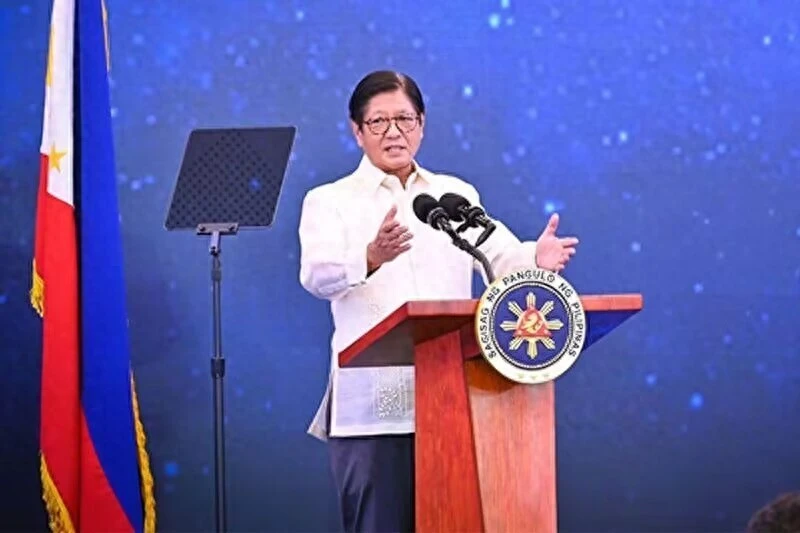
Philippine President Ferdinand Marcos Jr. and Vice President Sarah Duterte's approval ratings and trust ratings both declined in the first quarter of 2026, according to an uncommissioned survey released on Wednesday.
According to the survey, Marcos's approval rating dropped from 22% to 19%, and his trust level dropped from 15% to 13%; Duterte's approval rating dropped from 34% to 28%, and his trust level dropped from 31% to 26%.
Surveys show public dissatisfaction with accountability over flood control projects, Marcos' handling of the International Criminal Court (ICC) case against his former president and rising fuel prices contributed to Marcos's lower ratings. Duterte's rating was affected by the progress of the impeachment complaint against her and the ICC case involving her father, former President Rodrigo Duterte. Rodrigo Duterte is currently detained in The Hague for crimes against humanity related to his anti-drug campaign.
Senate President Tito Sotto’s approval rating and trust rating are 23% and 14% respectively, second only to Duterte. Despite the drop in ratings, Duterte remains the highest-rated official in the government. He is followed by Speaker of the House Faustino “Bogi” Day with an approval rating of 11% and a trust rating of 6%; Chief Justice Alexander Gesmondo with an approval rating of 16% and a trust rating of 10%.
Among government agencies, those with higher ratings include: the Bureau of Technical Education and Skills Development, with an approval rating of 65% and a trust rating of 45%; the Department of Science and Technology, with an approval rating of 55% and a trust rating of 39%; and the Bangko Sentral ng Pilipinas, with an approval rating of 53% and a trust rating of 37%. Political and infrastructure agencies such as the Department of Public Works and Highways and the House of Representatives had the lowest public ratings.
The first quarter of 2026 was conducted from March 21 to 24, 2026, and a sample survey of 1,509 registered Filipino voters was conducted. The survey tracks seven key modules: country and economic conditions, national issues, macro and micro concerns, trust and support for leaders and institutions, emotional perceptions of leaders, performance of elected officials and media consumption habits.
Last Tuesday, Marcos declared a national energy emergency in response to the "imminent danger" to the country's energy supplies posed by a U.S.-Israeli war in the Middle East.
The emergency declaration comes as Philippine transport workers, commuters and consumer groups plan a two-day strike starting last Thursday to protest rising fuel prices and what they see as a slow response by the Marcos government.
“Declaring a national energy emergency will enable the government to implement responsive and coordinated measures in accordance with existing laws to address risks posed by disruptions to global energy supplies and the domestic economy,” Marcos said.
He said as part of the emergency response, a committee has been formed to ensure the orderly movement, supply, distribution and availability of fuel, food, medicines, agricultural products and other essential goods.
The emergency declaration, which will last for one year, authorizes the government to procure fuel and petroleum products to ensure timely and adequate supplies and, if necessary, advance part of contract payments.
The authorities are also mandated to take action against hoarding, profiteering and manipulation of the supply of petroleum products.