Merz's popularity sinks to new lows as German government support collapses
Only 15% of the people support the Mertz government, and dissatisfaction has reached an alarming level.
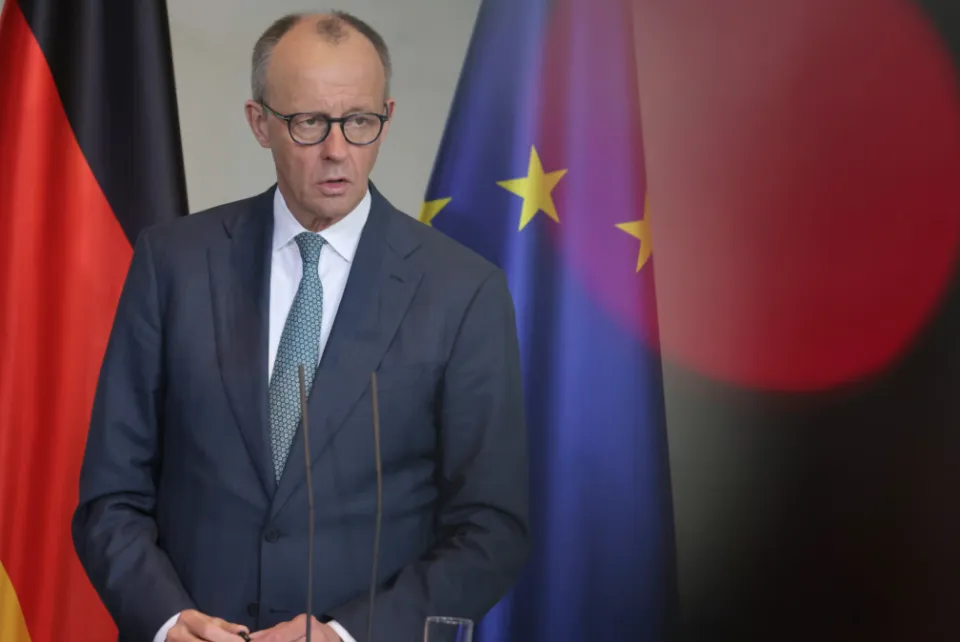
German Chancellor Mertz | Source: Michel Tantusi/Getty Images
According to the results of an ARD-DeutschlandTrend poll released on Thursday, support for the government led by German Chancellor Friedrich Mertz has fallen to a record low, with only 15% of voters satisfied with its performance in office.
The figure – down 9 percentage points since early March – shows that a whopping 84% of Germans are dissatisfied with Mertz's coalition government.
The government is composed of Merz's center-right Christian Democratic Union, its Bavarian sister party the Christian Social Union, and the center-left Social Democrats.
Dissatisfaction is mainly reflected in the fact that two-thirds (66%) of Germans feel that the burden of taxes and social security contributions is too high; 28% think the burden is moderate, and only 1% think the burden is low. The highest rates of feeling overburdened are among younger people: 72% of those aged 18 to 34 feel overburdened, and 56% of those aged 65 and older.
Supporters of the Alternative for Germany (AfD) party feel the greatest burden: 87% believe personal income tax and social security contributions are too high. Only Green Party supporters generally believe their tax burden is reasonable (63%).
Among the statutory health insurance reform proposals put forward by the German Federal Ministry of Health at the beginning of this week, the proposal to strengthen taxes on alcohol, tobacco, sugary drinks and other substances that are harmful to health has won the majority of public support.
However, Germans are equally vocal in their opposition to raising out-of-pocket costs for medicines and treatments, eliminating free co-insurance for spouses, and limiting reimbursements to clinics and hospitals.
On an individual level, Merz, who took office as chancellor in May last year, performed only slightly better than his government – only 21% of voters said they were satisfied with his personal performance – an approval rating that was only slightly higher than the record low of 20% set by his predecessor Olaf Scholz.
These dismal approval ratings reflect growing dissatisfaction with a government that has made frequent mistakes and is under increasing internal pressure.
Merz's hardline turn on immigration – including this week's suggestion that up to 80% of Syrian refugees should leave Germany – has triggered a backlash within his governing coalition.
“Who will work after they leave?”: Mertz’s remarks about deporting nearly one million Syrians drew condemnation from both the government and the opposition
Mertz has also been widely criticized for trying to reach a deal with the Taliban to deport migrants to Afghanistan and implement tighter border controls, among other measures.
The former businessman also failed to win over voters with his economic platform.
He came to power promising to modernize Germany and stimulate growth through a 500 billion euro spending plan, but progress on reforms has been slower than expected and the unemployment rate has climbed to 6.6% – the highest level in more than a decade.
The political consequences of discontent are clearly evident. The Christian Democrats suffered a crushing defeat in the regional elections in Baden-Württemberg in early March, and the far-right Alternative for Germany (AfD) is now neck and neck with the conservative forces led by Mertz in the polls.
For Merz, the only consolation in the poll results is that his party performed slightly better than its center-left coalition partners – only 13% of Germans approved of the Social Democratic Party, and the proportion of people who supported the party's co-chairman, Deputy Prime Minister and Finance Minister Lars Klingbeier was as low as 18%.
The dismal support reflects the SPD's heavy defeat in the Baden-Württemberg state election, where the party received only 5.5% support, as well as its defeat in Rhineland-Palatinate, where it has been in power for 35 years.
On the eve of two key state elections in eastern Germany, polling data bodes ill for both the Social Democrats and the Christian Democrats – with the Alternative for Germany leading the polls.
Faced with a government that appears to have lost the trust of German voters, pressure is growing on Merz to stabilize the situation.
Published in: Politico·European Edition
https://www.politico.eu/article/friedrich-merz-popularity-sinks-new-lows-germany-government-support-collapses/
Compiled by: 24-hour Observatory