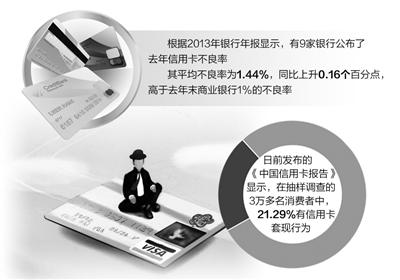
Credit card is a non-cash transaction payment method. The recent increase in arbitrage behavior has increased the dual risks of credit card users and banks, making credit card applications more difficult. According to the 2013 bank annual report, 9 banks announced their credit card non-performing ratio last year. Their average non-performing ratio was 1.44%, a year-on-year increase of 0.16 percentage points, which was higher than the 1% non-performing ratio of commercial banks at the end of last year.
The recently released "China Credit Card Report" also shows that among more than 30,000 consumers sampled, 21.29% have engaged in credit card arbitrage. In other words, on average, more than 2 out of every 10 consumers have used credit cards to cash out.
During the interview, the reporter learned that there is a gradual increase in the number of applications for credit cards being rejected, and some consumers have had their credit card limits suddenly reduced. Many of them have good personal credit records and their monthly income is above the credit card limit. Industry insiders said that although some cardholders can ensure timely and full repayment after cashing out, banks strictly monitor the use of credit cards for fund turnover, and will therefore be subject to reduction or card suspension. Cardholders should be careful when using credit cards to cash out and return them on time to avoid negative credit records.
Personal POS machine complete cash channel
A few days ago, the third-party payment company Lakala launched a "Collection" POS machine for individuals, which was questioned as "can be used for cashing out with credit cards." "Shuibao" is a POS machine launched for individuals, priced at 299 yuan. Consumers only need their ID card, name, and merchant name to activate and register. After binding a debit card number, they can swipe debit and credit cards through the POS machine to collect payments or repay credit cards.
It is understood that the credit card swiping rate of "Shuibao" debit card is 0.5%, and the credit card swiping rate is 1%. Compared with the current mainstream credit cards that charge a handling fee of 1% of the cash withdrawal amount, the handling fee of "Shuibao" has no advantage at all. However, withdrawing credit card cash through POS machines can avoid the 0.05% daily interest generated by credit cards when withdrawing cash through bank ATMs. Currently, Lakala's daily credit card payment limit for merchants without complete information is 5,000 yuan, and the monthly limit is 20,000 yuan.
For example, if a customer withdraws cash with a credit card through a bank ATM machine, and the amount of 20,000 yuan is withdrawn and repaid 50 days later, the fee to be borne is 20,000 yuan × 0.05% × 50 days = 500 yuan; while the cost of using "Collection Treasure" for multiple operations is only 20,000 yuan × 1% = 200 yuan. In comparison, the cash-out fee is lower using "Shuibao".
It is understood that "Shuibao" has sold more than 500,000 units so far. There are many personal POS machines similar to "Shuibao" on the market, and many third-party payment companies such as Kuaiqian and Qianfang have launched similar products.
Hidden funds and credit risk
Although it is convenient for individuals to cash out on credit cards, it is not necessarily "cheap", and cashing out may also affect personal credit.
Assume that the cardholder cashes out 50,000 yuan using "Aipay", and the handling fee he needs to pay is 500 yuan. Taking advantage of more than 50 days of interest-free use of the "card to maintain card" method, you need to cash out about 7 times a year. In other words, if you cash out 50,000 yuan a year, you will need to pay a 7% handling fee, which is 3,500 yuan. With the current annualized rate of return of less than 5% for Yu'E Bao, Cash Bao, etc., using cashed-out funds to purchase monetary funds outweighs the gain and loss. If you choose higher-yield products such as P2P, the risk will be even greater.
Earning card swiping fees is one of the ways for third-party payment institutions to make profits, and it is also an important reason why they actively promote personal POS machines. This causes third-party payment institutions to fail to strictly implement merchant qualification review requirements when developing special merchants. Industry insiders said that credit card cash-out not only occurs on personal POS machines, but also on traditional POS machines. However, the possibility of cashing out on personal POS machines is relatively high. Because in order to compete for the market, third-party payment companies will try their best to handle as many POS merchants as possible.
According to industry insiders, in order to prevent credit card arbitrage, credit card swiping at personal POS machines was once banned. However, this regulation was canceled in the "Bank Card Acquiring Business Management Measures" issued in July last year, giving people an opportunity to cash out. It is understood that for the purpose of strengthening supervision, the People's Bank of China is studying the specific operation method of recording cardholders' cash-out behavior into the personal credit system. If implemented, it will directly affect the personal credit records of credit card cash-out users.
In fact, arbitrage behavior is not only a risk point for banks, but may also have adverse effects on individuals. The banking system will monitor card swiping data, etc., and will verify any abnormality. Once it is confirmed that it is a arbitrage, measures will be taken. Therefore, for cardholders, even if they can ensure timely and full repayment after cashing out, the bank will reduce the credit limit or suspend the card, and include it in the personal credit reporting system of the People's Bank of China. Cashing out with credit cards can easily cause cardholders to fall into a vicious cycle of "using the card to support the card" and "using debt to support the debt." Reporter Wang Lu