This article analyzes and discusses the feasibility of automatic stock trading products. I hope the ideas and methods can provide you with some reference.

1. Background analysis 1. Why do we invest?
Personal investment methods and projects can be diverse, but the purpose of investment is the same: to obtain income and avoid wealth depreciation. Therefore, individual investors will choose to invest their funds in the market when their funds are idle or when the returns from capital operations are lower than expected.
Depending on the amount of idle funds, circulation cycle and expected returns, different investment selection strategies will appear: currencies, bonds, futures, real estate, funds, stocks, etc.
2. How do we get returns on our investments?
Here, the author takes stocks as the object of analysis and simply sorts out the relationship and investment logic between listed companies, markets, and investors. The main reason for choosing stocks for analysis is that the stock trading market is highly digitized, the investment threshold is low, and the income ceiling is high, so there are a large number of investors (high 2C potential).
First, let’s briefly analyze the stock investment logic under a rational market. When a company's cash capital cannot keep up with its development needs, it will choose to go public if relevant conditions are met, and sell a part of the company's shares to obtain capital reserves for development; investors are optimistic about the company's development and buy its shares to obtain equity and enjoy the company's development dividends (company profit dividends). In this process, the company shared its development dividends with the market for development needs, and investors used idle funds to obtain corresponding returns.
Next, let’s analyze the impact of irrational logic on investment decisions. Due to the large number of listed companies in the market, the investment decisions of stock investors have become complicated. Due to barriers to information transmission between the market and investors, and between investors, it is difficult to establish comprehensive investment trust. Mutual suspicion makes the market unpredictable under the intervention of irrational logic. This is manifested when good news comes from a company, and the stock price continues to rise, far higher than the company's value; or negative news causes the company's stock price to plummet, far below the company's value. As a result, some smart investors have appeared in the market. They are keen on short-term operations, selling high and buying low. As long as there are ups and downs in the market, they can profit from their advantages in information acquisition and capital volume.
In the complex system of the market, rationality and irrationality jointly determine investors' trading decisions.
3. The essential reasons why the Internet brings industry changes
The improvement of chip computing power is based on the optimization of the rules and efficiency of electrical signal transmission. The operation of society also relies on rules and efficiency. Rules are the logic of information transmission, and efficiency is the speed of information transmission. Abstract information is given to entities. It can be knowledge, capital, productivity, technology, or everything that is transferred between people and between people and society. The emergence of the Internet is equivalent to opening up the channel for information transmission across time and space. In most industries, massive decentralized information will promote transparent and efficient dissemination of information within the industry.
In the PC era, the Internet entered the public eye with content entertainment (games, information), connected the public with instant messaging, built a social ecology, and connected supply and demand information through e-commerce platforms to achieve efficient circulation of resources on both sides. In the mobile Internet era, smartphones broke the barrier between people's online and offline information transmission. Since then, the Internet has begun to penetrate all aspects of people's lives, using efficient and transparent information transmission to reconstruct the operation of many industries.
2. Feasibility of automatic stock trading products 1. Can investment strategies be machine learned?
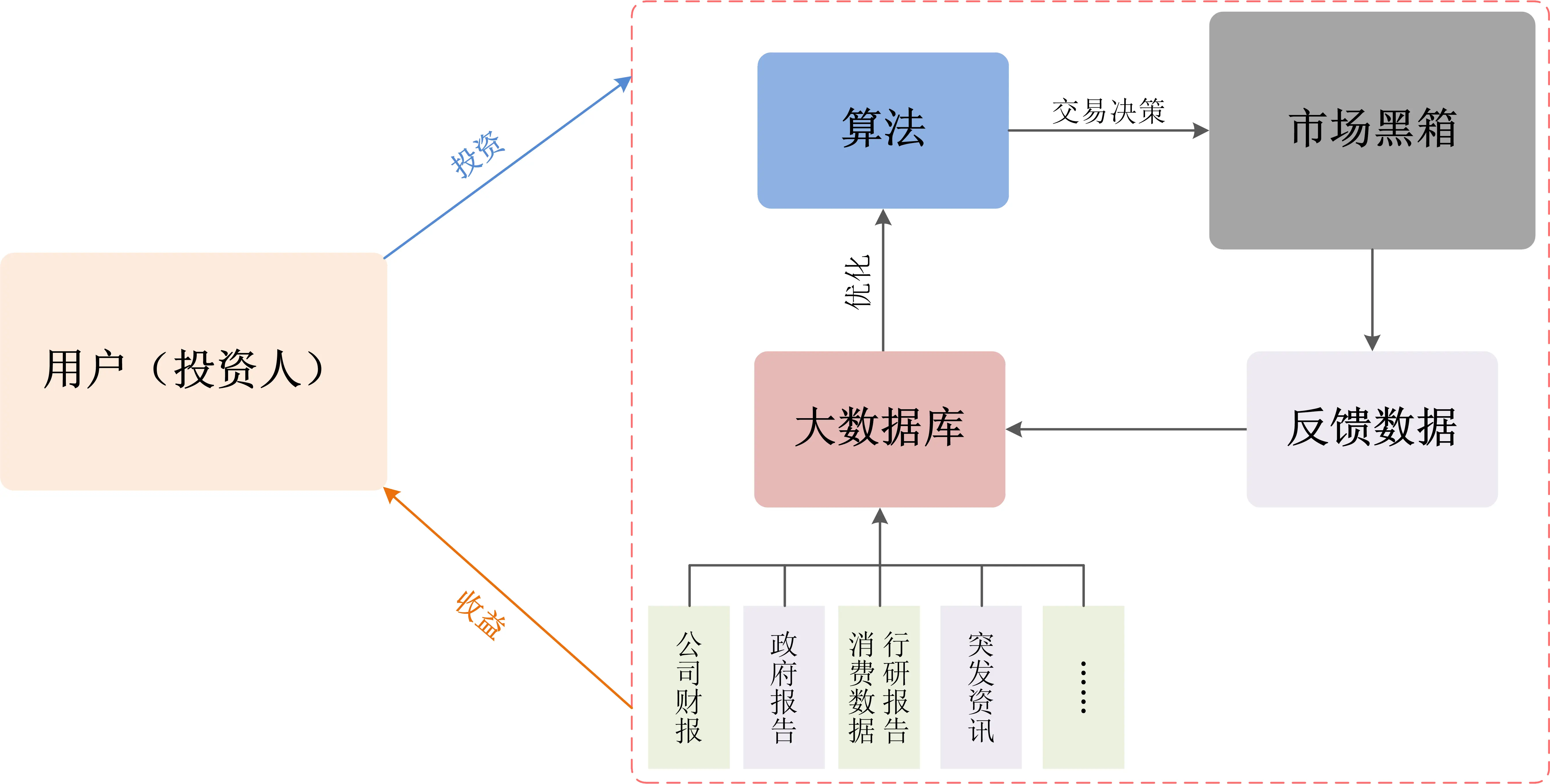
A senior investor will dynamically adjust investment behavior based on market reaction based on his rich investment experience and logical judgment. By treating investment experience as historical data and logical judgment as investment algorithms, the investment process of an automatic decision-making machine investor can be programmed. The market environment and various news information are used as input data. After calculation by the investment algorithm, the optimal trading decision can be obtained. Such an investment algorithm requires large samples of historical data for training and optimization. Since there is such a large data sample library in the stock market, it should be feasible to identify the complex system of the market and find the "optimal" algorithm. A simple schematic diagram is given as follows:
2. Product functions and marketing strategies at different stages
The first stage: Comply with the speculative nature of the current market to complete user growth
The first thing to make clear is that in the early stages, automated trading products are suitable for short-term swing investment strategies. At the same time, the investment volume should not be too large, otherwise the algorithm will fail due to the degree of market participation. Based on this premise, the core functions and marketing strategies of automatic trading products are described.
The simulated trading game allows users to choose stocks on their own and compete with machine decision-making for profit in the same time period and under the same capital conditions. It builds users' preliminary understanding of automatic trading products. For users whose return rate is higher than machine decision-making, their trading data will be recorded in a large database to optimize the algorithm.
Provide trading decision-making advice and investment advice with different levels of intervention for users with different needs. For users who are willing to invest on their own, it can provide sudden information on listed companies related to the stocks in their warehouses. For users who are willing to accept product investment suggestions, it can provide trading decision-making information, push transaction content (number of stocks bought and sold, prices, etc.) and vibrate reminders at the appropriate trading time.
With relevant qualifications, we accept user investment entrustments, implement automatic transactions, and provide customized investment services based on the user's investment amount and time.
Set up a stop-loss liquidation mechanism to fully or partially subsidize losses. In order to build user trust, the stop-loss liquidation mechanism is triggered under fully authorized transactions, and corresponding subsidies are provided after liquidation.
The second stage: establishing an investment environment with transparent information and rebuilding credit
With a certain number of users, short-term investments will gradually become ineffective, and product investment strategies will gradually shift to value investments. In order to determine the value and prospects of a listed company, it is necessary to have rich data information about the company and the industry. Financial reports and announcement information are far from enough. Fortunately, the Internet of Things and the industrial Internet are developing rapidly, and production and sales data will become more transparent and efficient. Real-time information release will help reduce investment suspicions and help listed companies grasp market demand and constantly adjust production and R&D directions. The entire market will promote the optimization of the efficiency of capital investment and allocation.
Returning to product functions, at this stage, the weight of toB business will be higher than that of toC. The main purpose is to establish financial databases related to listed companies, publicize them, and establish corporate credit. The C-side is classified according to the length of time users have idle funds, and the capital structure is adjusted to ensure the stability of funds.
The third stage: establishing an investment ecosystem and realizing the sharing of social development dividends
At this stage, the market information is transparent, the credit system of enterprises and investors is complete, and the value investment system based on rational judgment has an environment to rely on. Building a rational investment society and breaking down information barriers effectively reduces the capital bubbles in some industries caused by concentrated speculation, which is conducive to the sharing of social development dividends and the dynamic orientation of labor and R&D capabilities, making it possible for social development to be invested by all people, production and construction to be participated by all people, and development dividends to be shared by all people.
Summary and reflections
The value of the stock market should be to integrate and rationally allocate idle social resources to promote industrial development, rather than to seize profits through information transmission barriers or time differences and abandon industries. The development of the Internet and Internet technology has penetrated all aspects of society and life, bringing about the transparent and efficient transmission of information. When information barriers and information delays in the market no longer exist, it is time for the Internet to reconstruct the financial investment system. Only by facing the contradiction between market demand and scientific and technological development and rationally allocating capital and resources can the benefits of social development be maximized.
Back to the present, the biggest competitor in the market investment industry may be Alibaba. Alibaba has established a national credit system through personal consumption data obtained through products such as Taobao and Alipay. Alibaba provides cloud computing and cloud storage services to enterprises through Alibaba Cloud. Alibaba only needs to obtain enterprise data information when the time is right. Alibaba itself is both the largest capital supplier and the largest capital demander. By then, Alibaba's destination may be to optimize social development and protect enterprises.