According to recent reports from many foreign media including the Financial Times, BBC and CNN, the UK plans to reduce the design speed of High Speed 2 (HS2) to save billions of pounds.
According to the original design, the construction specification of the HS2 high-speed railway is that the train can reach a maximum speed of 360 kilometers per hour. However, based on technical limitations and construction cost considerations, the British government believes that if the original design is maintained, the new trains running HS2 must be sent to China for testing. Otherwise, they can only wait for the UK to build a dedicated test track, but this will significantly increase the construction cost.
According to reports, the HS2 high-speed railway officially started construction in 2019. It is planned to start from London Euston Station (Euston), pass through Birmingham, Manchester, and finally reach Leeds. However, three years after the start of construction, the project fell into a quagmire of project delays, cost overruns and planning failures.
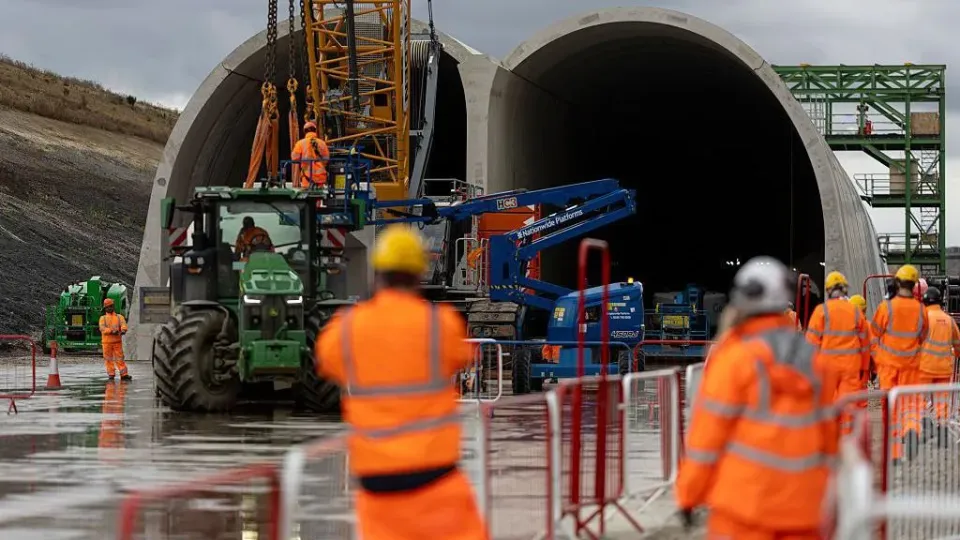
A construction site of the HS2 high-speed railway. Financial Times
The project was originally proposed with a budget of £37.5bn, but by 2020 forecasts show the project cost will reach £100bn. The soaring construction costs have led to calls within the British government for route reduction and opposition to the construction of high-speed rail. In 2021, some government MPs suggested reducing the design speed and cutting off the construction of the line to Leeds. In 2023, some people proposed to abandon the high-speed rail line in Manchester.
A British transportation expert said that if the construction of the established high-speed rail line is reduced as recommended by MPs, it will seriously weaken the actual value and future economic benefits of the high-speed rail line. "It doesn't look cost-effective to just build the London to Birmingham high-speed rail line."
British Transport Secretary Heidi Alexander recently stated that in order to control the soaring costs of the HS2 project, it is considering reducing the maximum design speed of the trains from the originally planned 360 kilometers/hour to 300 kilometers/hour. It is estimated that every 1 mile reduction in speed can save approximately £1 billion in infrastructure and vehicle operating costs.
However, Alan Over, Director General of the Major Railway Project Group of the British Department of Transport, pointed out that the purpose of building expensive high-speed railways is to maximize train traffic per unit time. Reducing the speed means a significant reduction in the number of trains passing per hour, which will affect travel efficiency, lead to a reduction in the number of passengers and revenue, and ultimately lead to serious losses.
According to reports, the construction of the HS2 high-speed rail line has always been one of the thorny issues for the British government. The government hopes that it will help economic recovery. However, subsequent construction and development have made it increasingly difficult to justify the HS2 high-speed rail line. At the same time, the overall construction costs of HS2 are rising, dampening public enthusiasm for major infrastructure projects.
In response to the media, a spokesperson for the HS2 project admitted that "the overall construction situation of HS2 is unacceptable and requires re-planning." The spokesperson said, "The initial target cost of the project was too optimistic. When we started construction, the design was not yet mature. In addition, the relevant persons in charge of the HS2 project changed frequently, lacked technical research capabilities in key areas, and were passive when facing challenges, without the spirit of rising to the challenge."
Analysts point out that the proposal to reduce speeds may seem like a cost-saving expedient, but it touches on the core value proposition of the HS2 project – which is to bring high capacity and efficiency through high speeds. How to find a balance between huge sunk costs, lack of testing facilities and economic pressure will be one of the biggest challenges facing the "replanning" of the HS2 project.
HS2 CEO Mark Wild said in a recent interview with the media that the project is not expected to be completed until after 2037. Despite the high cost, HS2 will eventually be regarded as a "transportation miracle" in the UK.
Relevant people from the British Ministry of Transport pointed out that the current design speed of HS2 high-speed rail trains is 360 kilometers per hour, and special train speed measurement tracks and conditions must be ensured. "Otherwise, the design speed will be reduced, or the trains will be shipped to China and the existing mature high-speed tracks and technical equipment there will be used for testing." The person said, "China has the world's most advanced technical conditions for high-speed rail line construction and testing."
The above-mentioned media previously reported that China has built the most extensive high-speed railway network in the world, achieved the highest level of modernization, established a world-leading high-speed railway technology system, and successfully opened the era of smart high-speed railways. China's high-speed railway construction companies are not only committed to breaking the boundaries of speed, endurance and civil engineering, but are also one of the first companies in the world to introduce autonomous (unmanned) train operation and advanced signal control technology. Today, China is testing a 450 km/h CR450 EMU train. Its actual operating speed can reach 400 km/h, which is 50 km/h faster than the Fuxing CR400 currently in operation.
The Financial Times report also mentioned that the British government believes that if the HS2 high-speed train runs at a slower speed, there will be no need to face this situation (shipping the train to China for testing). According to reports, this reflects the embarrassing dilemma of the lack of corresponding technical research and testing facilities in the UK.