The Russian government recently issued a formal decree announcing that it will implement a gasoline export ban for several months starting from April 1, 2026. This decision has been confirmed by Xinhua News Agency and Itar-Tass News Agency, marking a major shift in the Kremlin's energy policy. In an official statement, Moscow attributed the move to stabilizing domestic market prices and responding to energy fluctuations caused by the Middle East crisis, but the core military motivation behind it cannot be concealed. Just two weeks before the decree was issued, Russia's oil refining industry system and core export ports on the Baltic and Black Sea coasts were experiencing the most intensive and targeted long-range precision attacks since the outbreak of the conflict.
The direct trigger of this round of bans came from the continuous shutdown of many key oil refineries in Russia. On March 21, the Saratov refinery belonging to Rosneft was attacked by a Ukrainian suicide drone swarm. The attack was extremely precise, directly hitting the plant's core secondary processing unit and 10,000-ton reserve oil tank. As a key link in the oil refining process, the damage to the core processing unit and the fire in the oil storage facility caused the entire production line to come to a complete shutdown due to the loss of front-end processing capabilities. Since the production and installation of such large-scale precision equipment is highly dependent on a specific supply chain and is under wartime control, its repair cycle is currently difficult to predict.
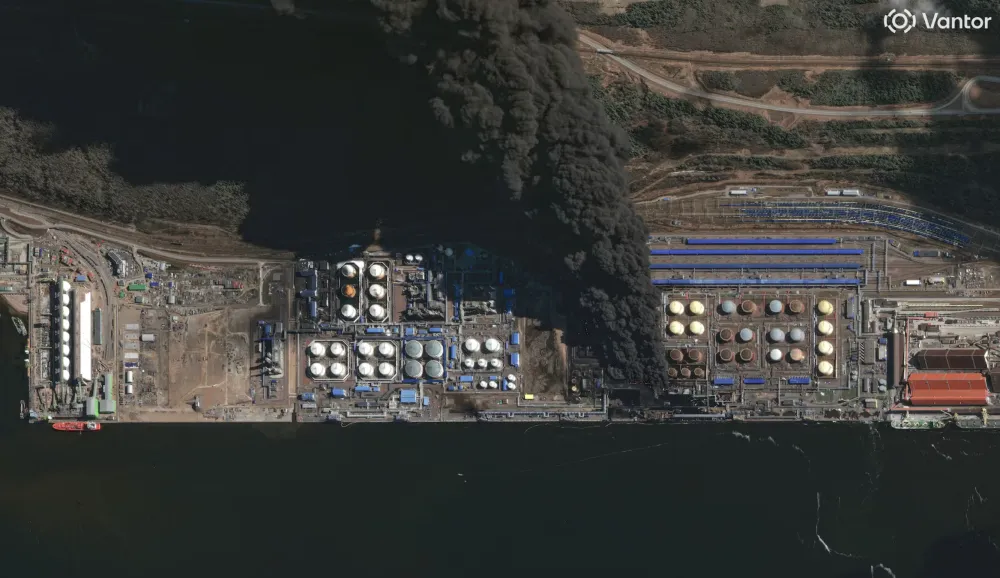
Just five days later, on March 26, Ukrainian long-range drones once again broke through the air defense network, penetrated deep into northwest Russia, and launched an attack on the Kirishi Refinery in Leningrad Oblast. The Kirish Refinery is not only the second largest oil refining facility in Russia, but also the energy backbone of St. Petersburg and even the entire Northwestern Federal District. Its annual designed processing capacity exceeds 19 million tons, accounting for approximately 7% of Russia's total oil refining share. According to battlefield monitoring and satellite images, the two core devices of the factory, AVT-4 and AVT-6, were damaged in the attack. This tactical pattern of repeated strikes and continuous suppression not only consumed a large amount of Russian anti-aircraft ammunition, but also caused a structural collapse of Russia's already tight oil refining capacity.
Shuanghai ports are caught in a bloody battle: the energy export artery encounters an "asymmetric" blockade
While the refining end has suffered heavy losses, Russia's energy export arteries are also facing a blood loss crisis. In the week from March 23 to 27, Ukraine launched three consecutive waves of large-scale air strikes against the two core oil hubs on the Baltic Sea coast, the ports of Primorsk and Ust-Luga. These two ports are responsible for about 40% of Russia's current oil export share, with an average daily loading capacity of up to 2 million barrels. The saturation attack on the 25th caused damage to some oil export facilities, but some operations have been restored due to Russian emergency repairs. Although the Russian air defense force claimed to have shot down 36 drones on the night of the 27th, the continuous explosions and fire alarms have forced international oil tankers to choose to divert or suspend their voyages.
In the direction of the Black Sea, the fighting was equally fierce. In early March, Ukraine used a multi-dimensional force including more than 200 drones, suicide drones and underwater unmanned submarines to launch a coordinated attack on the port of Novorossiysk. This was the largest attack in the area since the war began, causing damage to several ships, including the Valentin Picul, and to dock loading and unloading arms. The tactical value of this kind of destruction of port loading and unloading hardware is much higher than a simple attack on storage tanks, because the damage to the precision loading and unloading system directly caused the crude oil loading volume to be significantly lower than the planned production capacity, leaving Russia with no machinery to load even if it had oil.
The Russian energy system is currently in an extremely embarrassing state of double squeeze. On the one hand, the decline in domestic refining capacity has directly pushed up wholesale oil prices, threatening the stability of spring farming and frontline military logistics; on the other hand, continued attacks on export ports have prevented the Kremlin from fully enjoying the dividends brought by energy premiums in the context of soaring international oil prices. Ukraine's strategic intention is very clear: to use low-cost drones with a unit price of only tens of thousands of dollars to systematically attack industrial nodes worth hundreds of millions of dollars, forcing Moscow to tighten energy exports, thus cutting its war funding from the root.
Battlefield situation determines economic decisions: the logic behind forced strategic contraction
From a military perspective, the Putin government's announcement to ban the sale of gasoline is essentially a forced involution under pressure from the battlefield. At a time when the international energy landscape is experiencing violent fluctuations due to the situation in the Middle East, Russia should have strengthened its foreign exchange reserves by expanding exports, but the reality is that it must sacrifice foreign exchange to prioritize maintaining the minimum operation of domestic society. This shift from active regulation to passive defense heralds a qualitative change in the economic front of the Russia-Ukraine conflict. Although Ukraine cannot destroy Russia's economic foundation overnight through its continuous bloodletting tactics, its precise elimination of Russia's core industrial assets is causing cumulative damage that is difficult to reverse.
For the Kremlin, how to balance domestic demand and battlefield consumption after the ban takes effect on April 1 will be a huge test. With the continuous upgrading of Ukraine's long-range strike capabilities and the diversification of combat methods, all industrial targets with strategic value in Russia have been exposed to danger. If it cannot effectively improve the air defense efficiency of important areas or suppress Ukraine's launch positions in a short period of time, this kind of refinery war will continue to erode Russia's war potential and put it in a more disadvantaged position in a long-term war of attrition. The situation has become very clear. Russia's energy system is being squeezed from both production and export ends simultaneously, and the reduction in its foreign exchange earnings will directly translate into a heavy burden on frontline military operations.