In the countryside, we need to retain nostalgia and see the mountains and rivers. This is the ideal and goal. The reality is that due to low income in rural areas, many young people go out to work, leaving farmhouses uninhabited, and the countryside is seriously hollowed out. Farmland is uncultivated and abandoned land has appeared. Many people believe that rural areas in many places are in decline.
Rural revitalization was proposed at the 19th National Congress and written into the Party Constitution, which clarified the direction of future rural development. The reform of the three rural areas has also been activated with the promotion of the national top-level design. The Urban and Rural Planning Law once again clarified the legal seriousness of rural regional planning. Many regions have hired urban designers to settle in the countryside, hoping to change the appearance of the countryside and replace the inherent "quality" of the countryside with "appearance". I personally think this is a misunderstanding.
The decline of rural areas is an inevitable result of the urbanization process, and this pattern is followed all over the world. People go to higher places, and water flows to lower places. What retains the countryside cannot always rely on nostalgia and beautiful countryside. What retains the countryside is income.
my country's floating population is slowly declining. The decline of the floating population also means that the urbanization process is slowing down and the role of new urbanization is beginning to appear. The countryside is an important space that carries a new round of population transfer. The countryside is a spatial concept with counties as units.
Many current plans are drawn on paper and hung on the wall. They are arbitrary and lack sustainable guidance, and often the plans cannot be implemented. Rural planning, like the national development plan, needs to comprehensively consider the functional combination of rural space from the perspective of county economic development, with "development axes and transportation facilities" as the core, "concentration" as the guide, "industrial clusters" as the guide, "industrial chain" dislocation layout as the starting point, and "project implementation" as the driving force, to form the core competitiveness of the county economy, see Figure 6-1.
Figure 6-1 Rural planning framework and main content map
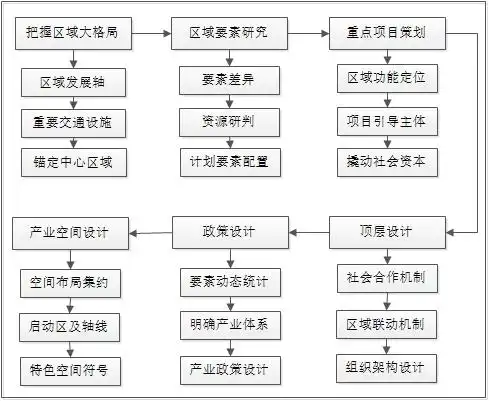
Rural planning requires a long-term perspective, a grasp of the overall regional pattern, and the establishment of a "big picture view."
Since it is a plan, it is necessary to take a future perspective, assess the situation, grasp trends, and determine the overall development direction of the county.
1. The development axis means the order of regional development focus
From the perspective of county development, it is necessary to consider the direction and process of the development axis of the city to which it belongs. Because the development axis is basically the direction connecting the city and external regions, it is a key area for urban infrastructure investment, a priority area for major projects, and an area of great concern to municipal and even provincial leaders. From the perspective of towns, villages or villages, we need to think about issues around the development axis of the county. After all, the closer you get to the grassroots level, the weaker the resources at the grassroots level, and all they can rely on are the resources and strength within the county.
I was originally entrusted by many real estate developers and local governments to help them review projects and make plans. Because I go deep into the front line, every time I go to a place, I always pay attention to the local urban planning, population density, fiscal revenue, GDP structure, real estate prices and other issues. Some local governments have made a lot of plans. I remember once I went to a provincial development zone. They spent tens of millions on planning. In the end, they found that these plans were useless and could not be implemented. Please I went to see it, and I raised core issues with them face to face. Among them, the most important one is that they did not consider the surrounding competition and cooperation relationships and the urban development axis. Therefore, no matter how beautiful the pictures they drew, and even if their plans were based on higher-level planning, they forgot that it is the current leadership team that leads urban planning, and they are the ones who determine the regional development axis. Therefore, as time goes by, the planning axes of the development zone and the municipal level cannot be synchronized. The development zone has spent huge sums of money on regional infrastructure, which is equivalent to a waste of water and has no effect.
The same goes for many real estate owners. Lucky people succeed, while unlucky people fail. The key to whether he was lucky or not was whether he had the right rhythm.
2. Major transportation facilities are the basis for changing the regional development pattern.
The channel for regional development to connect to the outside world is transportation. Whether it is highways, high-speed rails, airports, railways, ports and subways, they all transport "guests" and "goods".
Regional economy is driven by the transactions and flows of production and living factors. The cost of factor flow has an economic calculation formula, that is, logistics cost is equal to the "transportation price per unit" distance time. For mature transactions, what changes the flow of factors may be costs, and what changes costs is often changes in transportation methods.
When we make plans, we usually investigate factories or scenic spots in the area. Factories that export goods and scenic spots that import passenger flow are often the most sensitive to traffic. For the implementation of major transportation facility projects, we can foresee some trends in industrial development.
3. Population size and population density can anchor the central area
Although the migrant population is important to regional development, what is more important is the nearby urbanization of the rural population in the region. The driving force of urbanization is nothing more than real estate. In the past, people liked to move from rural areas to big cities. Beijing, Shanghai and Guangzhou were so squeezed that they divided the population into "layers" and were picky. Later, new first-tier cities gave new immigrants more opportunities to settle down. When the new first-tier cities were "sustained", the shantytown reform gave some opportunities to third- and fourth-tier cities. Soon, many county-level cities emerged one after another. Many small counties now make you unable to recognize their original appearance many years ago.
However, the source of population in these third-, fourth- and fifth-tier cities no longer depends on policies, but on “mother-in-laws”. Nowadays, when rural people want to get married, the woman usually requires a wedding room in the town or county. Therefore, when planning, we need to consider the possibility of future urban space based on the size of the local population, and recommend key urbanization areas based on the existing population density. Rather than considering building new cities and pursuing urban population expansion.
Rural planning relies on factor research
The initial development of any place requires an industrial foundation and industrial guidance. This process must be promoted and realized by socialized subjects in advance. Developing industries means developing enterprises, and enterprises are the carriers of industrial elements. Elements include land, buildings, facilities, labor, goods, talents, funds, technology, information, knowledge, etc. The local government is actually a land company. Local finance mainly relies on taxation and land. All industries are ultimately implemented on land and construction. Other supporting or extended industries also need to be configured as needed.
1. Differentiation of regional economic development factors
Transactions are possible because of the existence of reasonable demands and differences in factors. Research elements need to be researched and analyzed from land, buildings, facilities, labor force, commodities, talents, funds, technology, information, knowledge and other elements. Through factor analysis, we can find out the family background, grasp the trump cards of economic development through factor analysis, and determine the order of playing cards.
Rural planning serves local governments and must be analyzed from two different interfaces: the market and the "mayor". The core is the principle of "leverage", which is to establish an industrial foundation with minimal investment, improve functional construction or form an output mechanism. When we were doing industrial planning for a town in Zhejiang, the biggest problem we encountered was the lack of statistical data. Many towns did not have township or town records. Based on this situation, we could only conduct on-site surveys and communicate face-to-face with entrepreneurs based on existing projects to form corresponding basic information. Of course, some towns and villages have some planning foundations and some basis for judgment.
2. Resources have differentiated characteristics
Resource mining is often not a unified concept. Everyone sees things from different perspectives and understands resources differently. It is difficult to form a unified understanding of the definition of resources. This is usually the case when we communicate with local government leaders about "local resources."
Every local leader will say "our place is very good", and the objects of their comparison are often based on surrounding areas rather than market demand. At this time, you often need to explain to them that resources are relative. Xinjiang's arid areas are short of water, and water is a resource in Xinjiang. In the Jiangnan area, annual rainfall is large, so water is not rare.
Moreover, resources have three characteristics, namely uniqueness, scarcity and irreplaceability. These three characteristics are compared to market demand. Therefore, regional industries must have market positioning, and market positioning determines market demand and forms the characteristics of resources.
3. Region needs planning element configuration
The region is a whole and an inseparable part of the regional economy. The region needs unified planning, unified operation and unified coordination. Unified development is conducive to unifying thinking and pace, conducive to concentrating resources to do major things, and is conducive to coordinated development.
Based on overall considerations, it is necessary to think about the priority development sequence and resource allocation of regional elements. After all, resources and funds in each region are limited. From a land perspective, start-up areas can be designated to concentrate resources to create new industrial landmarks. From an industrial perspective, leading local economic enterprises can be cultivated to create new driving forces. From a cultivation perspective, key projects need to be planned and supported.
There is an agricultural county that wants to develop the crayfish industry. The key to crayfish farming is sales. Local leaders first sought investment to build a lobster city in the most densely populated area of the county to gather dining and consumption venues. Note that there can only be one lobster city in the entire county. The county has a population of 400,000, and the locals also have consumption habits of eating lobster. Soon, the Lobster City project was launched. The combination of agricultural products and catering consumption has formed a closed loop, which has stimulated farmers' enthusiasm for cultivating lobsters and cultivated several leading shrimp farming enterprises. Shrimp farming has become a local specialty industry, and subsequently, it has attracted people from surrounding counties to consume it.
This is a good case for the development of agriculture in the county. In order to cultivate consumption space in stages, it is necessary to appropriately reduce the construction of duplicate functions and thereby gather popularity. The consumption space is immovable. In the early stage, duplication of construction needs to be avoided, different functional areas need to be identified, and key projects need to be arranged and supported in a planned manner.
Project planning is the core of rural planning
Many plans become mere formalities because they are based on form and description of the future. The core essence of rural planning is to achieve sustainable development of the regional economy and social harmony, and it is a guide to the future development direction based on the development stage of the region. Therefore, spatial layout, key project layout, economic calculation, institutional mechanism design, implementation plan and policy design are also needed.
1. Project planning is based on regional functional positioning
Land is the root of everything. Based on regional land cost calculations and the overall functional positioning of regional development, a series of projects need to be planned to support and guide regional economic development.
For example, if the area is positioned for the cultivation of agricultural products, the circulation and processing of agricultural products can be considered, focusing on the deep processing capabilities of agricultural products within the county, planning logistics parks and deep processing industrial parks, and the construction of transportation facilities to form external transportation of agricultural products.
2. The industry needs project guidance entities
There are many villages that are still in the stage of agricultural society and cannot be called industries and lack an industrial foundation. For such areas, it is necessary to consider the planning and layout of major projects required for the development stage. If we develop industry, we need to plan industrial parks and identify key processing industry projects. If you develop tourism, you need to plan travel routes, layout of tourism projects, etc.
Industrial transformation is a process, but when the transformation begins, there must be a guidance period, which requires a market-oriented enterprise (guidance body) to coordinate and lead.
3. The focus of government investment is to leverage social capital
At present, many local governments are the main implementation entities of the regional economy. When the local economy has not yet been able to form internal driving forces, the financial resources of local governments are very limited. Spending small amounts of money to do big things is the starting point for third-party planning units to help local governments maximize their economy. Local governments are under great pressure. Limited funds must be invested not only in economic development, but also in various social undertakings such as people's livelihood.
Spending a small amount of money to do big things requires planning. Although some local governments do not have much funds, they have local administrative power. Power and planning are the main tools to leverage social capital.
There are industrial foundations in various places. The "entrepreneurs" in some places understand the local situation and have connections, so some projects can be launched by relying on them. However, they lack synergy and have backward project management concepts. In fact, their contribution to local development is limited and even hinders it to a certain extent. It is a good thing for local enterprises to be motivated, but what they fear most is piecemeal implementation. At this time, project planning is an important step in implementation. It is necessary to plan the key projects needed in the early stage from the overall positioning of regional economic development, and guide local enterprises to coordinate operations.
Rural planning requires top-level design at the county level
Rural areas require overall planning for counties, and the same applies to towns and townships. In the early stages of economic development or in the transition period, the resource allocation of county committees and county governments plays a crucial role.
For counties similar to raw material bases, unified planning is needed to focus on the construction of deep processing parks. During the implementation process, institutional mechanisms need to be fully considered to form a linkage mechanism with relevant industrial entities in the county.
1. Social cooperation activates the operating system
Local governments generally serve one term, and when the term expires, they have to move to another place. Therefore, many plans become "paintings." This is a problem of the local administrative system. If the development of a place changes due to changes in leadership, the people who will be harmed will always be the local people. People say that "parent officials" refer to local leaders who can make local people have enough food and clothing. However, due to their short tenure, local leaders tend to act short-sightedly and do not think strategically. They think more about political image. Therefore, when we visited many places to inspect, the best-built houses were government compounds. Some of the places we visited were also image projects, and there was no strategy at all.
To this end, regional development needs to introduce social capital. During planning, it is necessary to communicate more with local leaders, sort out the interface between local government and market-oriented operations, propose necessary implementation paths, and propose a government-enterprise cooperative development system suitable for local development.
2. Establish a county-level linkage mechanism
Development has its own sequence, affairs have different sizes, and regional planning needs to divide key areas and non-key areas. Each local government will be constrained by factors such as local financial resources and talents. Many local governments will feel that they have more than enough ambition but not enough power.
The relationship between key areas and non-key areas is not separate, but a relationship of division of labor and cooperation. However, each area must have parents and brothers like a family. At this time, it is necessary to establish a regional linkage mechanism through meetings, activities, etc. to achieve information sharing and resource integration.
3. Organically designed unified organizational structure
The biggest fear of planning is not being implemented. After clarifying the goals and tasks, it is necessary to set up corresponding organizational departments to implement and promote them. The organizational structure of the planned implementation is different from the existing government department structure, but it can be combined in a matrix system without changing the original departmental structure. However, it can adopt the organizational form of leadership groups and working groups to break down departmental barriers and form a battle.
In organizational design, help local governments integrate assets, resources and intelligence as much as possible. Make full use of existing human, financial and material resources, and provide clear suggestions on cooperation mechanisms and structures.
Rural planning requires more policy design
Planning is not a picture, it is a process of drawing and a dynamic process of thinking to realize the future vision. Rural planning needs to be based on industry, not just buildings and space. It needs to put industry first and then space. The essence of the economy is input and output. In planning and design, policy design and statistical design of dynamic data are needed.
1. Determine functional positioning and flow elements
With the advent of the big data era, future regional management will be digitized. The core of data is analysis, and the core of analysis is a scientific indicator system.
The input and output of a region are nothing more than passenger flow, commodity flow and capital flow. Take passenger flow as an example, including diners, tourists, guests, and business people. It imports diners, exports catering consumption, imports tourists, exports tourism consumption, imports guests, exports guest room consumption, imports businessmen and exports conference services, guest room and other comprehensive consumption.
The functional positioning of different areas will affect the frequency of element flow (input and output). In rural planning, it is necessary to determine the overall functional positioning of the region and determine the functional symbols. For example, going to Wuzhen is for ancient town tourism (attracting tourists), going to Yuanjia Village is for snacks (attracting diners), going to Moganshan is for staying in B&Bs (attracting guests), and going to Dream Town is for looking for business opportunities (attracting businessmen).
2. Determine leading industries, core industries, derivative industries and supporting industries
The functions of a region can be determined according to the industry employment rate, that is, the main functions of the region are determined according to the number of employees/industry ÷ the total number of employees. Functions are oriented to internal employment, while functions are oriented to external influences. The key to forming regional functions and functions is industry, and it is enterprises that carry the industrial mission. In the entire regional operation process, industry is the core of regional economic development, including leading industries, core industries, derivative industries and supporting industries. Usually, the leading industry can be selected based on the actual situation. At the same time, the entire industry chain can be analyzed according to the leading industry, and possible industrial links can be analyzed through the entire industry chain map to determine core industries and derivative industries. And use relevant cases to analyze and determine relevant supporting industries.
3. Industrial policy design
Industry is a market behavior, but for regional economies, industry is cyclical. At each stage of regional development, corresponding industrial policies need to be formulated to encourage and guide.
Industrial policy is mainly reflected in how to provide policy support in terms of finance and taxation, land use, employment, brand marketing, rent, etc. based on the actual needs of industry enterprises.
Traditional planning generally does not provide industrial policy design guidelines, but under the new "multiple regulations into one" orientation, current rural planning needs to provide more detailed policy design guidelines for planning implementation.
Rural design is located in industrial space
The No. 1 Central Document of 2019 pointed out that strengthening planning management should be regarded as the basic work of rural revitalization to achieve full coverage of planning management. The county as a unit should promptly prepare or revise the village layout plan, and the county-level party committee and government should coordinate and promote rural planning work. Rural areas must follow the principle of planning first and then construction, comprehensively consider land use, industrial development, residential construction, residential environment improvement, ecological protection and historical and cultural inheritance, pay attention to maintaining local features, and prepare practical village plans that integrate multiple plans into one. Strengthen the management of rural housing construction permits.
1. Rural areas need to reconsider the “intensive” spatial layout
The backwardness of rural areas is not only because the original subsistence agriculture only met the problem of food and clothing, but also because the distribution of rural space is too discrete, which leads to an overburden of infrastructure investment and inefficient use of agricultural land. Therefore, “concentration” must be taken into consideration during the planning process. On the one hand, there is concentration of residence. For some villages and towns with large waste of land and small population, the merger of villages and towns will be implemented to concentrate the population from the perspective of increasing population density; on the other hand, the concentration of agricultural production land, fully sort out the volume of permanently protected basic farmland, non-permanent protected basic farmland, collective construction land, and homesteads. According to the population size and industrial development needs, set up spatial layouts such as residential settlement construction, industrial park construction, transportation facility construction, and supporting facilities construction. The purpose of merging villages and towns is to consolidate land and improve efficiency. Therefore, in the entire planning, the requirements of industrial development need to be fully considered. This is also in line with the practical village planning requirements of "multiple regulations into one" proposed by the Central Government's No. 1 Document.
2. Determine the county start-up area and development axis
Regional development must have a sequence. When considering industrial spatial layout, there must be a start-up area. Through the construction of the start-up area, the resources within the county can be integrated and coordinated to tilt towards the start-up area.
Different regions have different geographical conditions and different industrial development orientations, but the core is to develop industries. The No. 1 Central Document in 2019 proposed that county-level finances be allowed to integrate various funds for the improvement of rural living environment. This also requires planners to think about the investment direction of funds and the possible social and economic benefits from the perspective of county-level governments.
For this reason, when planning the development plan of the county, it is necessary to focus on the start-up area and at the same time, consider the direction of the development axis. The development axis is the geographical direction of the region where the government is willing to invest in economic development, infrastructure construction and other aspects. The development axis also indicates the priority of regional construction and the height and pattern of coordinated development.
3. Spatial design that enhances rural characteristics
Rural space is multi-dimensional. When considering the construction of residential areas, it is necessary to take into account the features of urban and rural areas. The floor area ratio of urban areas can be appropriately increased, but the floor area ratio of rural areas must be rural with small buildings and large views. The floor area ratio should not be increased, but concentrated construction of farmhouses can be implemented to form settlement-style rural residences.
Rural space design needs to adhere to local culture and carefully design architectural styles, architectural colors, landmark buildings, signage, etc.
Every place has its own unique culture. Culture is a symbol and a characteristic that needs to be refined and designed. Once a cultural symbol is formed, it can be integrated into various aspects such as architecture, signs, and daily necessities.
In addition to cultural symbols, it is also necessary to explore local local brands and achieve external export through brand building.
Based on the rural texture, when constructing residential areas, it is necessary to consider activity space, commercial space, and landmark construction. Landmarks are the architectural soul of a village. Through landmarks, they can show the unique rural charm of a place and can also set up a directional sign for the region.
Summary: Rural planning is a systematic project. It is a comprehensive and systematic plan that integrates multiple plans and can be implemented based on the long-term development of the region. (Sun Wenhua)