Analysis of single sentence components
In this article, we will first talk about single-sentence grammar. Sentence components are the components of the sentence structure, including subject, predicate, object, attributive, adverbial, and complement. According to different standards, sentences can be divided into many types. According to structure, they can be divided into two categories: single sentences and complex sentences.
(1) What is a sentence?
A sentence is a language unit that has a sentence tone (formally with a period, question mark, and exclamation mark) and can express a relatively complete meaning. Such as: ①Wonderful! ②Who? ③It’s windy. ④He is very strong.
(2) Sentence components
Sentence components are the components of the sentence structure, including subject, predicate, object, attributive, adverbial, and complement.
Among them, the subject, predicate, and object are the backbone of the sentence, which expresses the main meaning of the sentence; the definite, adverbial, and complement are the branches and leaves of the sentence, which make the meaning expressed by the sentence more concrete and vivid.
According to different standards, sentences can be divided into many types. According to structure, they can be divided into two categories: single sentences and complex sentences.
A single sentence is a sentence composed of a phrase or a single word.
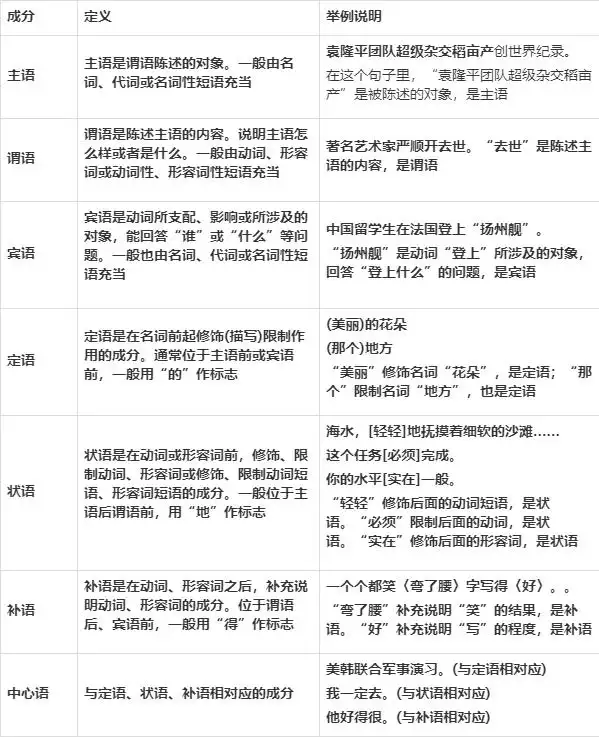
In a complete and typical sentence, the relationship and order between the various components of the sentence are generally:
Example: (All) classmates ‖ finished their (Chinese) homework.
(attributive) (subject) (adverbial) (predicate) (complement) (attributive) (object)
When dividing sentence components, the "symbol diagram method" is generally used:
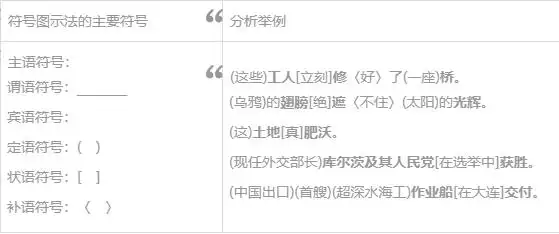
1. Use symbols to divide sentences into components.
(1) Premier Li Keqiang of the State Council chaired a symposium of experts and entrepreneurs on the economic situation on the 6th.
(1) (Premier of the State Council) Li Keqiang presided over a symposium (experts and entrepreneurs on the economic situation).
(2) On the calm and dark sea, the moonlight opened up a long and narrow bright cloud.
(3) The United Nations passed a convention banning nuclear weapons on a global scale with 122 votes in favor, 1 against, and 1 abstention.
(4) Chinese aviation experts and scholars at home and abroad from professional fields such as the Chinese Society of Aeronautics and Astronautics and the American Association of Chinese Aerospace Engineers discussed the theme of "Development Prospects of China's General Aviation Industry".
(5) Now, the teacher and the whole class believe that although he has fallen behind in many courses, as long as he persists and catches up, he will definitely not be worse than others!
2. Use the method of dividing sentence components to indicate the cause of the following sentences.
(1)Through this exercise, I gained insights.
Answer: (1) The subject is incomplete
(2) This year's wheat harvest is the best in several years.
(3) The principal, vice principal and other school leaders attended the orientation meeting.
(4) He worked hard and finally wrote a script that was loved by readers.