First: "Subject" in English
1. The meaning of the subject:
The subject is the "sender of the action" (in the subject-verb-object structure) or the "object of expression" (in the subject-relative structure). It is usually placed at the beginning of the sentence, sometimes in the middle or at the end of the sentence. The subject can be a noun or pronoun; it can also be a phrase or infinitive; it can even be a whole sentence. Therefore, when looking for the subject, you must have these cognitions in your mind.
2. What are the subjects?
(1) Noun/pronoun/numeral as subject

(2) Infinitive/nominal phrase as subject
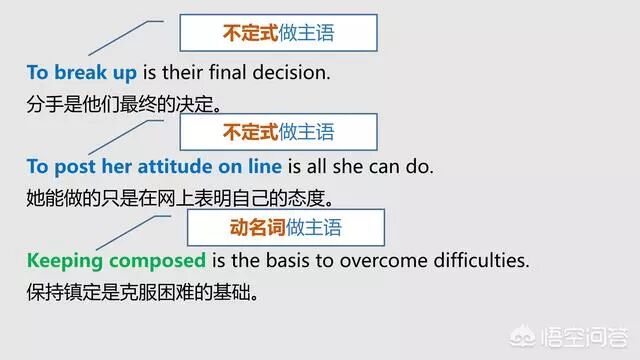
(3) The clause serves as the subject (i.e. subject clause)
A sentence in which a subordinate clause is the subject is the "subject clause" we have learned. The subject clause can be introduced by the conjunction that/whether; it can also be introduced by the relative pronoun what/who/which; it can also be introduced by the connecting adverb how/when/why/where.
Details are as follows:

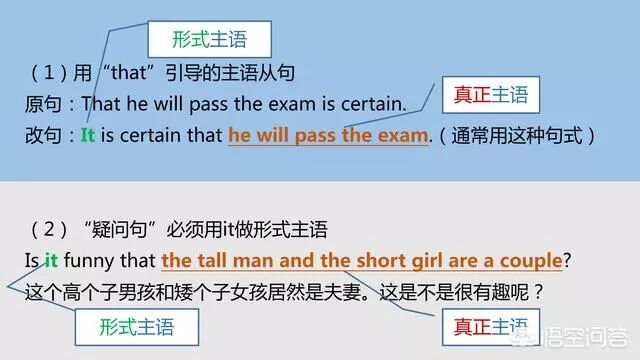
(4) Sometimes in order to avoid being top-heavy, "it" is often used as the formal subject, and the real subject is placed at the end of the sentence:
(5) "There be…" sentence pattern
"There be…" is rather special. In this sentence pattern, the subject is in the middle. for example:
There are six beautiful French ladies walking on the street.
Six beautiful French girls were walking on the street.
Second: "Predicate" in English
1. Meaning:
The predicate is the soul of the sentence and is mainly used to "state the state of the subject" or "show the action taken by the subject."
2. Classification: simple predicate, compound predicate
(1) Simple predicate: a predicate composed of a verb or a verb phrase;
I love my girlfriend.
I love my girlfriend.
My boss stayed up late last night.
My boss stayed up late last night.
(2) Compound predicate:
① Modal verb/auxiliary verb + verb formation

② Coupling verb + predicative composition

③ Modal verb + linking verb:

Third: "Object" in English
Meaning: The object is opposite to the subject, indicating the recipient of the action. Nouns, pronouns, numerals, and sentences can all be objects (object clauses).
(1) Direct object & indirect object/pronoun as object/noun as object

(2) Numerals/clauses serve as objects

Fourth: "Attributive" in English
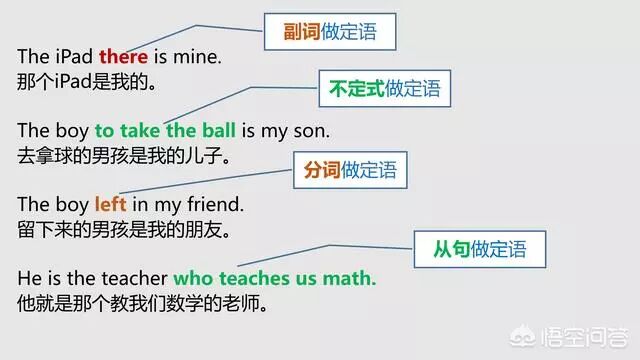
As the name suggests, "attributive" is used to define a certain component in a sentence. Adjectives, numerals, pronouns, clauses (attributive clauses) and other components can basically be used as attributives (except verbs). If the attributive precedes the word it modifies, it is called a prepositioned attributive; if it goes before the word it modifies, it is called a postpositioned attributive.

Fifth: "Adverbial" in English
In English, the information conveyed by adverbials includes: time, place, reason, purpose, result, method, degree, etc. The purpose of its use is to make the expression more full and specific.
Adverbs, infinitives, prepositions, nouns, clauses, etc. in English can all be used as adverbials.
So how to determine which components are "adverbial"? The key depends on whether the word/phrase/clause is modifying a verb, an adjective, an adverb, or the entire sentence.
For specific usage, see the picture below:


Sixth: "Exposition" in English
Predicatives exist in the "subject expression structure" in English and are mainly used to explain the nature, status, characteristics, etc. of the subject.
Similarly, the predicative can be a noun, an adjective, an adverb, a prepositional phrase, an infinitive, etc., or the entire clause can serve as a predicative (i.e., a predicative clause).



Seventh: "Complement" in English
Complements, intended to supplement the subject or object, are called "subject complement" and "object complement" respectively, and the latter is used more frequently.
(1) Subject complement:

(2) Object complement:


After analyzing the above seven language components one by one, I believe that you already have a relatively basic understanding of the composition of English sentences.
Finally, share a jingle for judging subject + predicate + object:
Subject, predicate and object, definite form and complement, main trunk, branches and leaves clearly separated.
The attributive must come before the subject and the object, and the predicate is preceded by the adjective and the predicate is supplemented by the predicate.
Adverbials sometimes precede the subject and are separated by commas.
The basic components are subject, predicate and object, and the joint components are definite form and complement.
The attributive must come before the subject and the object, and the predicate is preceded by the adjective and the predicate is supplemented by the predicate.
It is difficult to distinguish the relationship between the six, so I have to analyze the right and wrong in my mind.
Who is called Lord, and what he does is enough to fulfill the title;
The object verb dominates and answers the predicate "who".
The time and place of the preceding adverbial object, the meaning remains unchanged and can be reset.
The complement is from the back to the previous predicate, and the attributive is matched with the last object.
The introductory phrase has many adjectives and complements and cannot serve as object, subject, and predicate.
The shape and form of the place are determined, and the language marks the right and wrong.
To understand what a subject, predicate, object, attributive, and predicate are, it is best to understand them in specific and practical sentences with definitions. There are simple sentences and complex sentences. Simple sentences are relatively easy to judge, but complex sentences really need to be analyzed carefully.