It has indeed fallen again…
On March 23, the major A-share indexes collectively fell by more than 3%, and the Science and Technology Innovation Composite Index fell close to 5%. CSI 300, Hong Kong Stock Connect Technology, and Science and Technology 50 collectively hit a six-month low.
Many friends are asking ETF owners: Should they "buy the bottom" when the market plummets? When A-shares plummeted before, which ETFs were the “bottom-hunting funds” buying?
Today we will use real data to review the real trends of fund-sweeping ETFs during the last three iconic drops in the Shanghai Stock Exchange Index!
When the Shanghai stock index fell by more than 3%, which ETFs did the "bottom-hunting funds" frantically buy?
Let’s talk about the time and daily decline first: on April 7, 2025, the Shanghai Stock Index fell by 7.3% on a daily basis; on November 22, 2024, the Shanghai Stock Index fell by 3.06% on a daily basis; on October 9, 2024, the Shanghai Stock Index fell by 6.62% on a daily basis.
April 7, 2025:
On this day, A shares encountered "Black Monday". Affected by the surprise attack on U.S. tariff policies, global stock markets have become more volatile. The Shanghai Stock Index plummeted 7.34% in a single day, closing at 3096.58 points, with more than 2,900 stocks falling by their limit.
Stock ETFs collected 74 billion yuan of funds in a single day, a record amount. Behind this, we cannot do without Central Huijin, China Chengtong, China Guoxin and other collective holdings to maintain the smooth operation of the market.
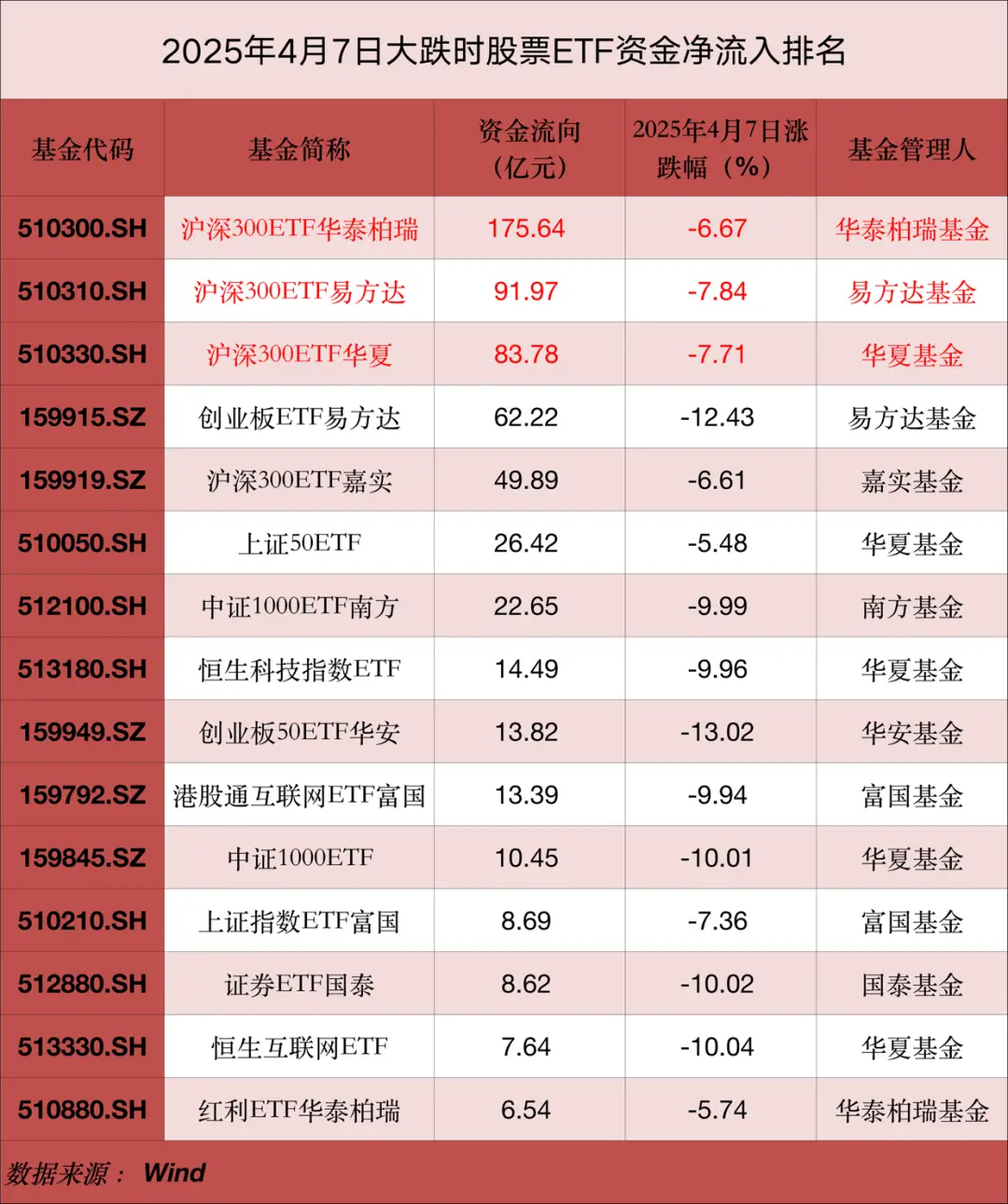
The direction of fund sweeps is very clear, and broad-based ETFs are the strongest at attracting gold. In terms of the CSI 300 ETF, the CSI 300 ETF Huatai-PineBridge had a net inflow of 17.564 billion yuan. The single-day net inflows of E Fund and ChinaAMC's CSI 300 ETF reached 9.2 billion yuan and 8.4 billion yuan respectively. The CSI 300 ETF Harvest attracted nearly 5 billion yuan in a single day.
In addition to the CSI 300 ETF, other broad-based and cross-border ETFs are also targeted by funds: the Growth Enterprise Market ETF "attracted 7.99 billion yuan in a single day, the CSI 1000 ETF had a single-day net inflow of 3.8 billion yuan, the Hong Kong Stock Technology ETF had a net inflow of 3.18 billion yuan, and the Shanghai Stock Exchange 50 ETF had a net inflow of 3.01 billion yuan.
The corresponding "menu" is as follows:
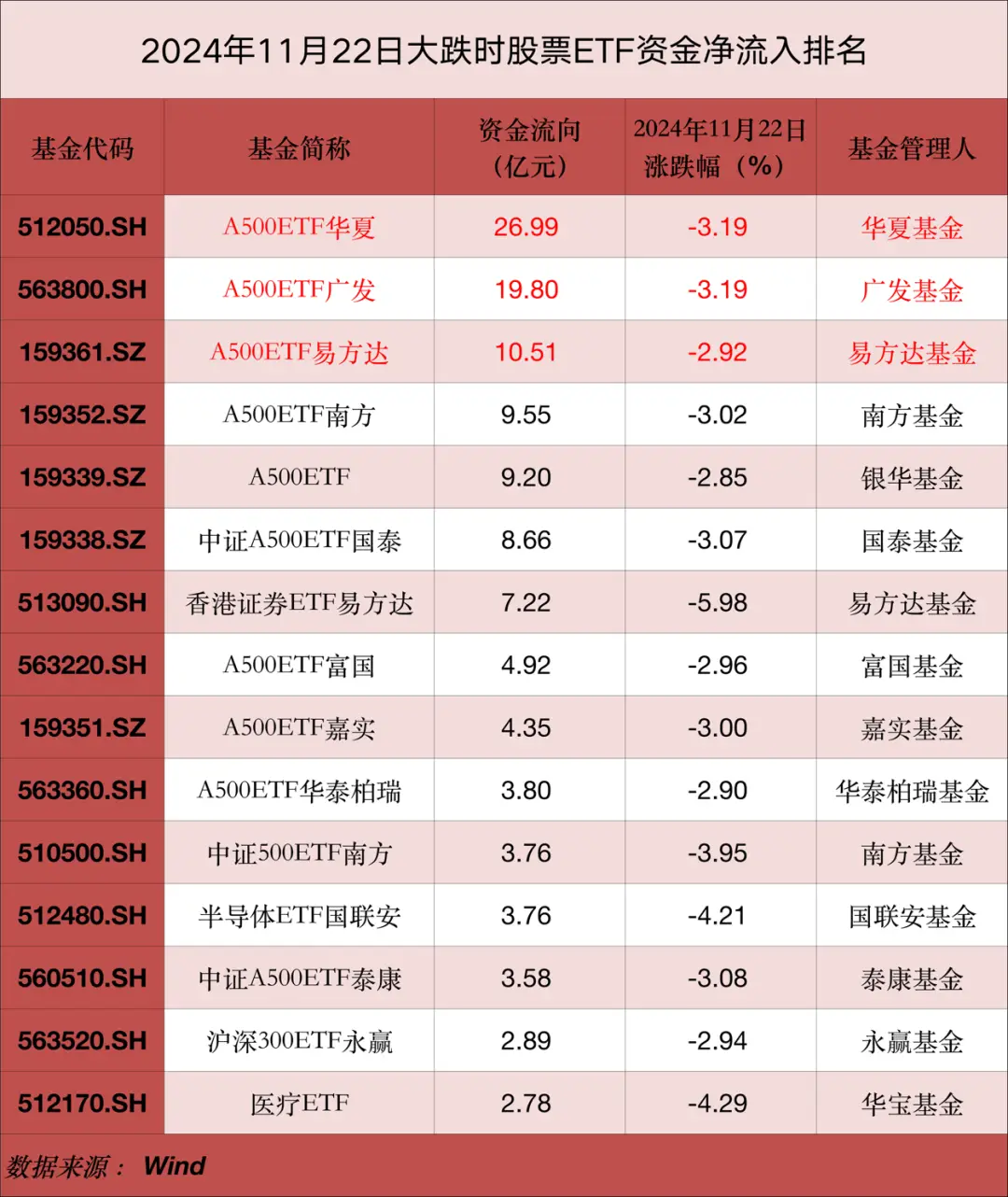
November 22, 2024:
Volatility in the A-share market intensified that day, with the three major indexes falling by more than 3% on heavy volume. The Shanghai Stock Exchange Index fell directly to 3,300 points, and market sentiment was gloomy.
Different from the market situation on April 7, 2025, this time the bottom-hunting funds were deployed decisively and steadily, with a net inflow of 7 billion yuan in stock ETFs in a single day.
This time, bargain hunting funds are focusing on the CSI A500 ETF. The overall net inflow of the CSI A500 ETF exceeded 10 billion yuan. Observed from the perspective of the 5th, the cumulative net inflow of the CSI A500 Index reached 36.71 billion yuan, leading among all stock ETFs.
At the same time, cross-border ETFs and some industry-themed ETFs also received some funds to add positions, with Hong Kong securities ETF E Fund, semiconductor ETF Guolianan, medical ETF Huabao and other products leading the net inflows.
The corresponding "menu" is as follows:
October 9, 2024:
After the market surged in the early stage, A-shares experienced a correction. The major indexes collectively fell by more than 6%, and the GEM fell by more than 10%. However, bargain-hunting funds entered the market decisively.
More than 50 billion yuan of funds have been borrowed from stock ETFs to buy stocks at the bottom, bucking the market trend and laying out a high-growth track. The Science and Technology Innovation Board, GEM-related indexes or industry-themed ETFs have become the main sources of gold.
The net inflow of broad-based ETFs still maintained its lead, with a single-day net inflow of 38.861 billion yuan. Among them, the Science and Technology Innovation 50 and GEM index-related ETFs had the largest single-day net inflows, with single-day net inflows reaching 11.159 billion yuan and 10.595 billion yuan respectively.
In terms of individual ETFs, the gold-attracting effect of leading products is full. GEM ETF E Fund and Kechuang 50 ETF Huaxia attracted 8.799 billion yuan and 5.435 billion yuan respectively in a single day; GEM 50 ETF Huaan, Kechuang 50 ETF E Fund, and CSI 300 ETF Huatai-Berry all had net inflows of over 2.5 billion yuan, and GEM 50 ETF Invesco Great Wall also exceeded 1 billion yuan.
What’s more noteworthy is that driven by the hot market for chip semiconductors, the Science and Technology Chip ETF Harvest attracted the most gold. The ETF’s share doubled that day, and the net inflow of funds reached 14.176 billion yuan.
The corresponding "menu" is as follows:
[Understand ETFs in seconds]
Investors ask: Why are broad-based ETFs always the “first choice” for bargain hunting?
ETF Jun: Broad-based ETFs such as CSI 300, CSI 1000, and CSI A500 are always the focus of funds. The core reason is that their risk diversification and valuation may be at a low level, which meets the needs of funds to "buy low".
Generally speaking, top ETFs are more popular. Whether it is a broad-based fund or an industry-themed ETF, the products of leading fund companies have liquidity advantages and will generally become the "first choice" for bargain hunting funds, and their ability to attract gold far exceeds that of similar products.
Today I would like to remind you: There are risks in buying the bottom. Investors need to consider their own risk tolerance, make rational arrangements, and avoid blindly following the trend of "buying the bottom".