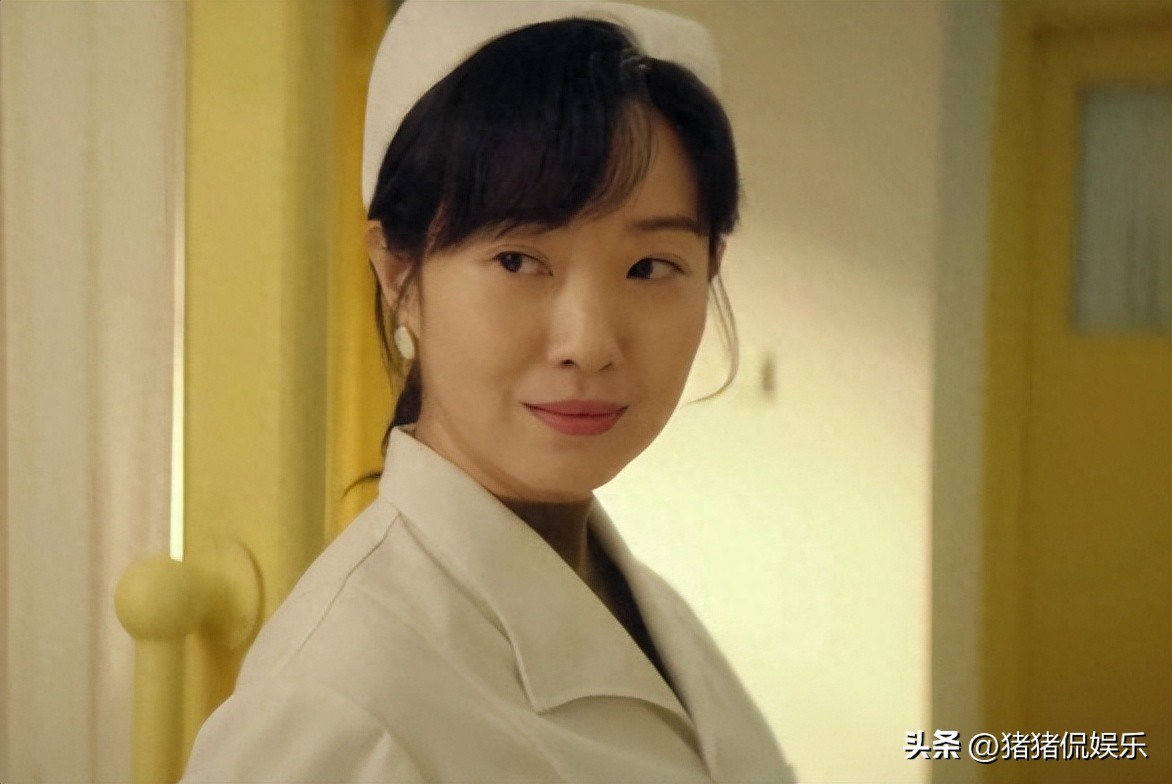
The newly released "Wuthering Heights" is probably the largest theatrical movie this year.
Top cast, top screenwriters, and top IP, turned out to be a masterpiece made into "Fifty Shades of Grey".
Classics turned into porn?
The director said that he would adapt "Wuthering Heights" according to a subversive aesthetic that is different from the past.
I originally thought it might be a niche masterpiece, but it turned out to be half a sex scene.
In the original novel, there is no sexual description of Catherine and Heathcliff. The love between two people is promoted through suggestion.
But this version of "Wuthering Heights" puts all the emphasis on the erotic drama.
Soul resonance turns into physical entanglement.
At the beginning of the movie, a man was hanged, but the attention of the onlookers was on his bulging lower body.
This is especially true for the male and female protagonists. Whether it's the dough, the whip marks on the back, the eggs on the bed, or poking the fish with your fingers, almost every scene is related to lust.
Even the supporting characters are playing SM.
No wonder the audience complained that this was to make up for the regret that it could not be released in the mainland with restricted ratings.
The director's purpose is obvious, which is to use eroticism to show contemporary avant-garde aesthetics.
Not only "Wuthering Heights", many movies with many erotic scenes are under the banner of avant-garde.
During the promotion period for "Poor Thing", it was said that it used lust to show female rebellion. Although it won an Oscar, I could only feel empty after watching it.
When did people start to think that the more sexually explicit content, the stronger the sense of avant-garde?
Large scale = avant-garde aesthetic?
The reason why everyone has this kind of thinking inertia is largely because the creators are lazy.
In the last century, the space for social criticism was limited, and the body and sex became one of the few areas that could be legally offended. Therefore, in that era, challenging taboos was indeed a revolutionary and pioneering act.
In art history, these works are often described as "artistic breakthroughs achieved by challenging taboos."
Therefore, it is easy for future generations to misunderstand "challenging taboos" as an eternal "pioneer formula" when studying.
As a result, "boldness" was narrowed to "erotic boldness", "avant-garde" was downgraded to "sexual avant-garde", and the large scale also inexplicably carried symbolic meaning.
Over time, the concept of "scale = pioneer" has been continuously strengthened.
The problem is that those behaviors were pioneering because of the specific historical environment. Once "challenging taboos" itself becomes a routine, it becomes the opposite of pioneering and becomes a new cliché.
Moreover, in an era when attention is scarce, eroticization is a relatively low-cost, high-recognition differentiation strategy, which has also led to many creators not "using it because they need it" but "using it because it is effective."
Eroticization no longer has its original role.
Moreover, it also cleverly meets the multiple psychological needs of the audience, constituting a "double displacement" of psychology.
Consuming a large-scale award-winning film can bring a psychological benefit to the audience——
"I can appreciate something that others can only see as pornographic."
This can make people feel that they are not conservative and tasteful, and at the same time gain a sense of aesthetic superiority and moral vanguard.
Like critics, they too need to establish their own authority of taste.
And discovering and defending these works is the most direct way to prove that you have elite judgment. Not only are they promoting this work, but they are also telling the world that they have advanced taste.
A set of discourse is difficult to question when it provides identity benefits to all.
But in essence, this is just a kind of vicarious satisfaction, through consuming the "avant-garde of lust" to experience the "critical illusion".
The collection of capital directly turns it into a business model.
When capital discovers that "eroticization + discussion/award-winning" is a proven path to success, it will try to dismantle the formula:
A director who is good at visual aesthetics + a topical literary IP + enough erotic scenes + social issues such as "female awakening" and "body politics".
In the end, a large number of "pseudo-pioneer" works proliferated. Although they were really similar in form to those award-winning "true pioneers", their core was empty and boring. "Pioneer" changed from a value judgment to a marketing classification.
The controversy over "Wuthering Heights" is largely due to the fact that capital used this formula to create a classic that is not suitable at all.
What is an effective sex scene?
What's interesting is that the audience's reaction to these erotic scenes was "boring".
There is a threshold for human aesthetics.
Especially in an era where everyone can customize AI porn videos with one click, and when a certain G-spot has been calloused by hands, it becomes increasingly difficult for erotic scenes to impress the audience.
After all, even the island country’s AV share has been declining year after year, and it is difficult to hope to hit the audience through visual stimulation.
So, what should a good erotic drama look like? Or what does the audience want to see?
One direction is to move away from mere physical presentation and toward relational narratives.
The erotic scenes that really touch people are never about the body, but what happens between people.
In other words, the changes in the relationship between the characters should be shown through the thunderous hook between two people. The purpose of showing the body is to show the heart.
"Paradise Lost" does this very well.
In the beginning, when I was just pursuing the excitement of cheating, the erotic scenes were straightforward and crude.
Later, when the two decided to get together and start their own family, the shooting technique shifted from the overall to the partial, focusing on portraying the tenderness between the two.
In the end, the cheating was revealed, and the two of them were dressed in black and lying on white sheets. They turned from tenderness to sacrifice for their love.
The body is the initial channel of expression that precedes language, and the purpose of erotic drama should be to show the past experiences, traumas, and memories carried by two bodies. Pure physical stimulation will only make people bored.
The other is a shift from visibility to invisibility.
When there is an excess of content, restraint, omission, and hinting become the scarcest qualities.
Therefore, the picture should be left blank. The shadows outside the door, the swaying curtains…these "non-presentations" can activate the audience's imagination more than "presentations".
Moreover, it is best to prioritize the sound over the picture. In terms of creating a sense of atmosphere, the sound can be several levels higher than the picture.
The sound of breathing, the friction of clothes, the sound of breaking… Because it stimulates imagination, it makes people feel the tension even more.
"Portrait of a Lady on Fire" is an example.
When two people look at each other at a bonfire party, their skirts catch fire, the music stops, and the whole world disappears. There is no nudity, no physical contact, but the erotic tension is at its peak.
Erotic drama is not going away, but the way it is presented will become increasingly difficult in the future.
This kind of difficulty is not a technical difficulty, but an artistic difficulty.
It needs to have narrative capabilities and human insights, and move from hitting the audience to embedding it in the audience.
"Xiaoyin Anli TIME"-Welcome to follow Yinke Aesthetics Video Account-