Nearly 40 billion funds have evaporated! Digital currencies experienced a flash crash across the board today, with Bitcoin once falling below $52,000! 470,000 people were wiped out! Who washed the market with blood?
On the morning of April 18, Bitcoin suffered a flash crash, plummeting nearly $8,000 within an hour, once falling below $52,000 per coin, and falling by more than 15% within the day. Previously, the price of Bitcoin continued to strengthen, once exceeding the $64,000/coin mark on April 13.
Not only Bitcoin, but also digital currencies fell across the board. Within 24 hours, more than 470,000 people liquidated their positions and nearly 40 billion in funds were wiped out.
What happened?
Dogecoin, which was born to ridicule Bitcoin, has seen its currency value rise far beyond the original target of ridicule in recent months.
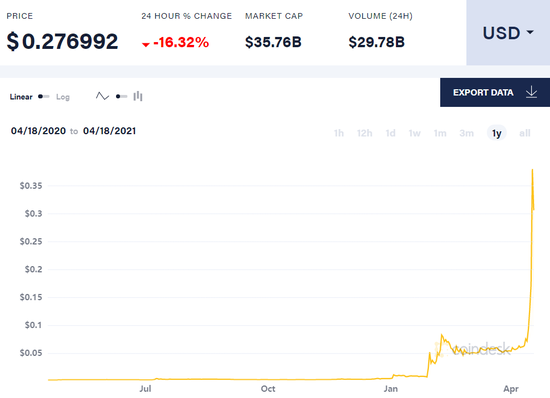
Since the beginning of 2021, the highest increase of Dogecoin is close to 100 times; if calculated from the low of $0.001158 on March 13, 2020, in 13 months, the price of Dogecoin has increased by up to 405 times.
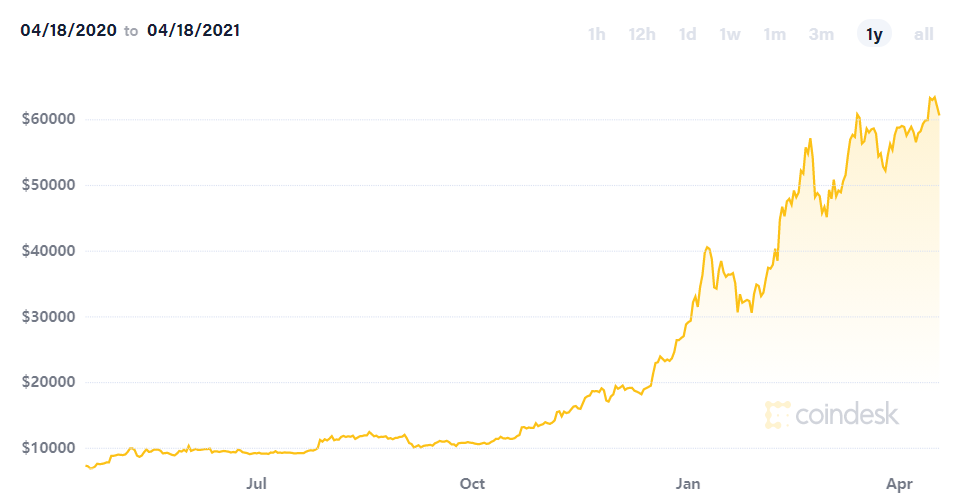
In contrast, the price of Bitcoin, the "coin leader", has increased by "only" 733% in the past year, which is far behind the rising star Dogecoin.
On April 16, the madness of the Dogecoin hype reached its climax. On this day, Dogecoin once rose by 250% within 24 hours, reaching a maximum of $0.47 per coin, and the total market value once exceeded $60 billion.
However, over the next two days, the price of Dogecoin began to retrace sharply. According to data from Coindesk, as of press time, Dogecoin is quoted at US$0.27 per coin, with a total market value of US$35.8 billion, which has shrunk by 40% from its high point two days ago, and has fallen by more than 16% in 24 hours.
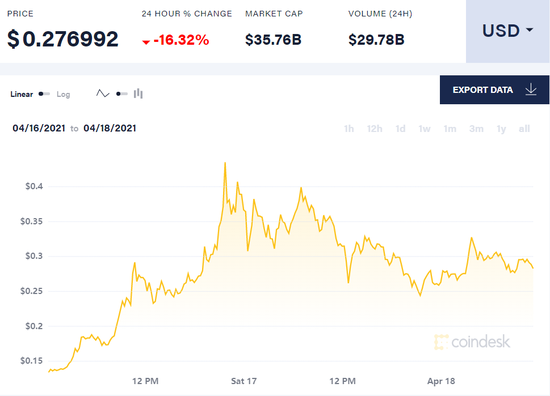
Not only did Dogecoin plummet, but many cryptocurrencies, including Bitcoin, experienced collapse at the same time.
Digital currency crash
On the morning of April 18, Bitcoin, which has been trending recently, experienced a flash crash, plunging nearly $8,000 in one hour.
10:18: Bitcoin fell below $59,000 per coin, the first time since April 11.
11:20: Bitcoin continues to decline, falling below $58,000 per coin.
11:22: Bitcoin fell below US$55,000 per coin, falling more than 8% during the day; Ethereum fell below US$2,150 per coin, and Ripple fell more than 13% to US$1.34 per coin.
11:36: Bitcoin fell below $52,000 per coin, with an intraday drop of more than 15%.
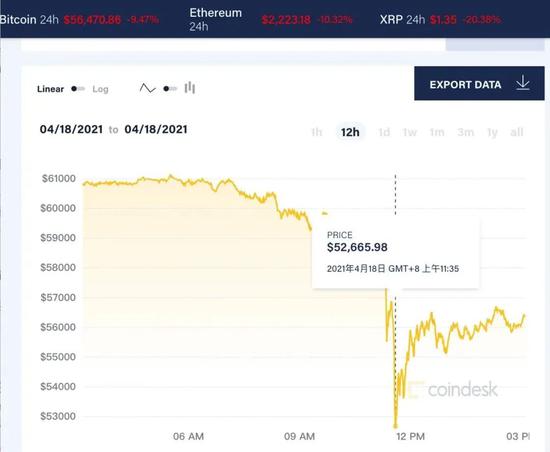
It is worth mentioning that Bitcoin has continued to strengthen recently after breaking through $60,000. On April 13, Bitcoin once exceeded the $64,000 mark, reaching a maximum of $64,778. After that, the price of Bitcoin fell back for several days until it crashed on April 18.
On the same day, digital currencies fell across the board: based on 24-hour declines, Ethereum plummeted 12%, BNB plummeted 13.33%, Ripple plummeted 20.87%, Dogecoin plummeted 12.87%, Litecoin plummeted 20.87%, and EOS plummeted 23.45%.
Bitcoin's rapid decline caused heavy losses to long investors. According to data from Bitcoin Home, the number of people liquidating their positions has increased sharply in the past 24 hours. More than 470,000 people have liquidated their positions, and 39.5 billion funds have been wiped out. The funds liquidated in the past hour reached 538 million yuan. Among them, BTC liquidated 3.638 billion, about 70,000 pieces.
Who bloodbathed digital currency?
What happened? From the current point of view, there are three main reasons.
The first reason is that there are rumors in the market that the U.S. Treasury Department will accuse multiple financial institutions of using cryptocurrency for money laundering. Prior to this, both U.S. Treasury Secretary Yellen and Federal Reserve Chairman Powell had expressed negative views on digital currencies.
The second is that Türkiye will ban the use of digital currency payments on April 30. Türkiye recently announced a ban on cryptocurrency as a means of payment. The ban does not prohibit the purchase of Bitcoin, but there may be obstacles to depositing funds through the country's banks. Cryptocurrencies and other digital assets based on distributed ledger technology cannot be used directly or indirectly to pay for goods and services, the Central Bank of Turkey said in the Official Gazette. The ban will take effect on April 30. Coindesk expects India and Morocco to introduce similar policies. Previously, India had already made rumors and caused sharp fluctuations in Bitcoin. The recent currency inflation in Türkiye has led to a sharp increase in domestic demand for cryptocurrencies such as Bitcoin, which has even directly increased the traffic of many exchanges.
The third is that Coinbase, which just went public, suffered a sell-off from executives. According to Cointelegraph, according to Capital Markets Laboratory data and documents on the Coinbase investor relations website, Coinbas CEO Brian Armstrong sold 749,999 shares in three transactions at different prices, totaling approximately $292 million. CFO Alesia Haas sold all 255,500 shares for $388.73, for a total of approximately $99.32 million. This news may mean that even the trading platforms themselves are not optimistic about the future of digital currency trading.
Inverse Bitcoin ETF Launches
Notably, just as the plunge occurred, the first inverse Bitcoin ETF was launched on April 15, which would provide investors with a way to short Bitcoin without using a margin account or shorting futures.
Horizons ETF announced the launch of the BetaPro Bitcoin ETF (ticker HBIT) and the BetaPro Inverse Bitcoin ETF (ticker BITI). The ETFs were listed on the Toronto Stock Exchange (TSX) on April 15. HBIT and BITI provide long and inverse exposure to the Horizons Bitcoin Front Month Rolling Futures Index respectively. BITI is the world's first ETF to provide inverse Bitcoin futures exposure.
A statement from Steve Hawkins, CEO of Horizons ETF, shows that the inverse Bitcoin ETF it launched allows investors to establish short positions in Bitcoin futures; the sister product BetaPro Bitcoin ETF (code: HBIT) listed at the same time will charge a 1.00% fee and track Bitcoin futures.
This means that purchasing HBIT and BITI is as simple as buying stocks and other ETFs through a broker, which does not require investors to open a separate cryptocurrency account. Additionally, BITI will provide investors with a way to short Bitcoin without using a margin account or shorting futures.
Notably, the SEC has rejected all Bitcoin ETF applications since 2013, citing concerns about manipulation and criminal conduct. Canadian regulators are much more relaxed than the United States in approving ETFs tracking Bitcoin and SPACs. Less than two months ago, North America's first Bitcoin ETF was listed in Toronto, with assets reaching US$1 billion, or approximately 1.25 billion Canadian dollars.
At the same time, applications for the U.S. Standard Bitcoin ETF are also increasing, with at least eight companies currently participating in the bid, including Fidelity Investments Inc. and Galaxy Digital Holdings Ltd. Companies that get approval first are likely to face overwhelming demand, prompting issuers to keep submitting applications.
Pay attention to global monetary policy shifts
Market participants generally believe that the fundamental reason for this round of Bitcoin bull market is that the loose monetary policies of the world's major central banks since 2020 have brought high inflation expectations to the market. The total upper limit of Bitcoin is fixed and is regarded as "digital gold" by some institutional investors and large companies. They believe that investing in Bitcoin can hedge the demand for inflation. Therefore, many listed companies and institutional investors in the market, such as Tesla, Meitu, Blackstone, etc., have begun to buy and accumulate Bitcoin, which has led to an increase in the price of Bitcoin.
Recently, with the strong rise of Bitcoin, other digital currencies have also shown general gains. ETH, BNB, etc. all hit new highs. Some analysts believe that at present, after the entire encryption market has repeatedly hit new highs in Bitcoin, mainstream currencies have also seen compensatory increases. This is one of the performance characteristics of the mid-to-late period of the bull market. With the rapid surge in market value, future profit-taking selling pressure will become a resistance to the continued upward trend.
Regarding the subsequent development of cryptocurrencies, William, a senior analyst at OKEX Research Institute, said that the key factors that determine whether the current Bitcoin bull market can be sustained lie in two points: the monetary policy shift of the world's major central banks, or the global regulation of cryptocurrencies.
First of all, the current extremely loose monetary policy of major central banks is unsustainable. With the gradual recovery of the global economy, monetary policy adjustments are only a matter of time; secondly, Turkey’s regulatory ban is not the first or the last in the digital currency market; and as encrypted digital currencies are accepted by more and more people, more countries will introduce specific regulatory measures for encrypted digital currencies.
"The above two key events will definitely happen in the future, but we don't know when they will happen. This may be as explained by the Dow Theory: the main trend of the market can be predicted, but the specific movement trajectory is unpredictable." William said.