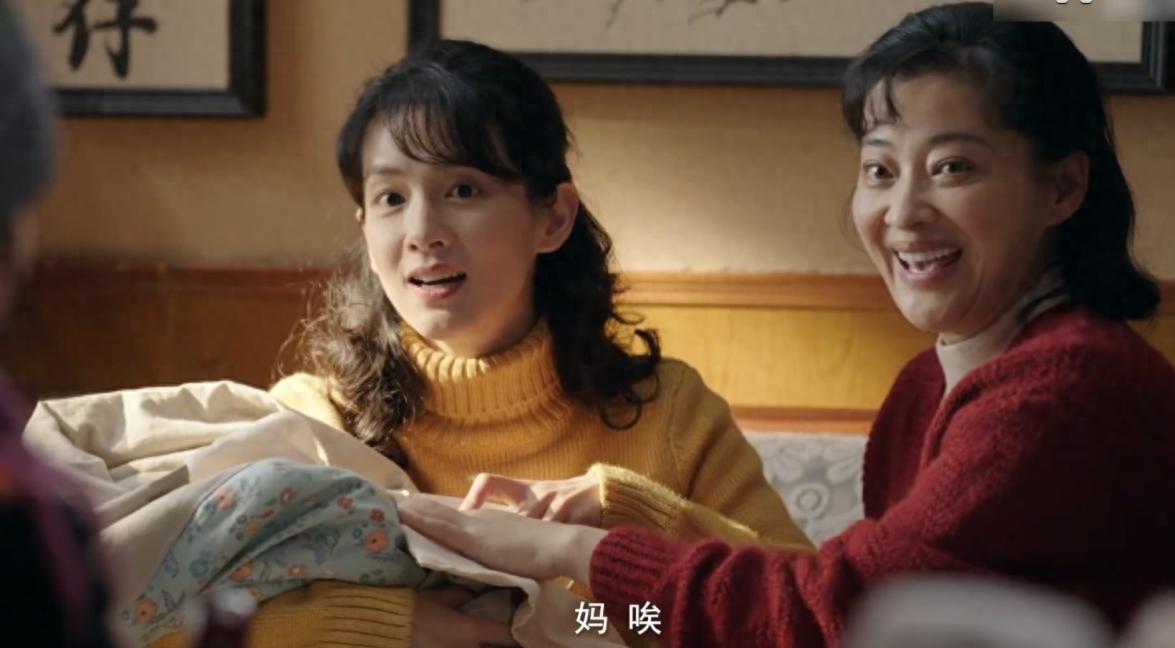
This year's period dramas are really crazy. The first one, "Good Time", has just ended, and the second one, "Winter is Going and Spring Is Coming," has just started airing. The ratings share of CCTV's eight series immediately exceeded 28% as soon as it was launched, and Douban scored 8.6, which is a solid benchmark for period dramas in 2026. I watched four episodes in a row, and the more I watched, the more I felt: the acting skills of this drama are really incomparable. It is not the young leading actors such as Bai Yu, Zhang Ruonan, and Lin Yun who are pulling their hips, but the veteran drama partners Tian Yu, Ding Yongdai, and Sarina. They are so powerful that they welded realism and fireworks to the screen from the very beginning.
"Winter Goes to Spring Comes" spans a full 25 years, from 1993 to 2018, and focuses on a small hotel in Beijing called "Winter Goes to Spring Comes". The walls are mottled and the monthly rent is 120 yuan, but there are six young Beijing drifters with artistic dreams: Xu Shengli who wants to be a screenwriter, Zhuang Zhuang who sings folk songs, Shen Ranran who does a side job, Tao Liangliang who plays the saxophone, Guo Zongbao who pretends to be an actor repairing range hoods, and Cao Ye, a painter who engages in avant-garde art.
There are no cheats or cheating counterattacks, it is all about the embarrassment and persistence of ordinary people struggling between their ideals and food and clothing. The historical details at the beginning are enough to shock people. Yellowed manuscripts, public phones, old-fashioned bicycles, and cheap instant noodles instantly bring people back to Beijing in the 1990s.
Let’s talk about the young starring troupe first. Their performance actually far exceeded expectations, but they were overshadowed by the brilliance of the actors. Xu Shengli, a literary young man played by Bai Yu, deliberately lost 15 pounds in order to fit the role. His thin figure gave him the appearance of a stubborn and poor scholar as soon as he appeared.
He quit his job in his hometown in Shandong and moved to Beijing. He was robbed of all his savings by gangsters and went to work for an editor, but lost everything. He played the young man's impulsiveness, embarrassment and reluctance very well. The disappointment when the manuscript was rejected, the insistence on eating instant noodles in a small hotel, and the youthful quarrel with friends are not deliberately sensational, they are all natural and life-like performances. Netizens said: "Bai Yu has completely lost his idol status this time. He is just a dream-catching boy who came out of a small town."
Zhang Ruonan changed her past label of sweet girl and played the role of Zhuang Zhuang, a folk singer who went to Beijing alone. Her wallet was robbed and she was penniless, so she could only make a living by selling and singing at a stall. She played the softness and stubbornness of a grassroots singer very well. Especially the crying scenes, the grievances suppressed by reality, the determination not to give up on dreams, the eyes are full of drama, there are no exaggerated expressions, but it makes people feel sad. She worked hard to practice her singing skills for the role, and when she opened her mouth, she had a 1990s folk texture, completely tearing off the label of being a traffic vase.
Shen Ranran, played by Lin Yun, dreams of being a heroine but can only play a minor role as a maid. She repeatedly encounters obstacles in her auditions, but sticks to the bottom line after seeing clearly the chaos in the entertainment industry. She played the character's youthfulness, stubbornness and sobriety very naturally, without using too much force. Her humility when playing a small role and her forbearance when being challenged were all in line with the state of dream-chasing girls of that era.
Wang Yanlin has a sense of comedy and relaxation. As soon as he appears with long hair, he plays the saxophone under the bridge and has a sense of literary and artistic abjection, and his compatibility with the character is perfect.
But what really makes this drama stand out is the group of veteran actors who are at the level of Dinghaishenzhen, who are at the textbook level from the very beginning.
Ding Yongdai and Sarina once again partnered up to play parents, it was like seeing them in "The World". In the farewell scene on the train, Ding Yongdai scolded his son for not being practical and refusing to give up the iron rice bowl, and his eyes were full of reluctance and worry; Sarina packed her son's luggage late at night, and gave a soft warning, which instantly brought out the hard words and soft hearts of Chinese parents to the extreme. There was no fuss, just a look or an action, and the weight of family love was played to make people cry. This is the skill of the old drama actor, who can convey emotions without using lines.
Guo Zongbao, played by Tian Yu, is the most poignant character in the show. In middle age, in order to raise money for his seriously ill wife and son, he pretended to be an actor, but in fact he repaired range hoods on the streets. He took on any role to make ends meet. He was best at playing dead bodies and being stand-ins. He brought out the sadness, joy and forbearance of the little character just right. One moment he was bragging and talking about dreams in a small hotel, and the next moment he was worrying about medical expenses. He switched between crying scenes and comedy scenes with ease, and every expression contained the weight of life. Netizens said bluntly: "As soon as Tian Yu appeared, the quality of the drama doubled, and the little characters were brought to life by him."
There is also the hotel owner Xiao Dongbei played by Song Jiateng. He speaks an authentic dialect, is enthusiastic and shrewd. When he stops in front of the counter, the fireworks of a small hotel owner in the 1990s hit his face. The avant-garde painter Cao Ye, played by Cao Zheng, is paranoid and pure. The stubbornness and loss in his eyes make the plight of an artist who is not understood very appealing.
The most rare thing about this drama is that it does not deliberately glorify suffering, nor does it force perfection. The six protagonists faced the darkest moments of their lives in the new millennium: Xu Shengli's script was plagiarized, Zhuang Zhuang was banned for refusing to lip-sync, Shen Ranran had no scenes to film, Tao Liangliang was reduced to a wedding accompanist, Guo Zongbao was overwhelmed by medical expenses, and Cao Ye's paintings were ignored. It is all about the real appearance of ordinary people being beaten by reality. There is no suspended plot, it is all about struggle and perseverance in the atmosphere of fireworks.
After twenty-five years of hard work, they finally ushered in "winter passes and spring comes." Xu Shengli became a well-known screenwriter, Zhuang Zhuang held a solo concert, Shen Ranran won an award and left the circle, Tao Liangliang formed a band, Guo Zongbao returned to the screen, and Cao Ye held an exhibition of his paintings. At the end, the six people returned to the small hotel and looked back on the road to chasing dreams. It was not deliberately sensational, but it made people burst into tears. This is what a period drama should be like, using the fate of small characters to reflect the changes of the times, telling the audience that the cold winter will eventually pass, and that there is hope if you persevere.
Many viewers said that they couldn't help but compare their acting skills while watching "Winter Goes and Spring Comes". In fact, there is really no need. The young actors put aside the baggage of idols and get close to the characters with heart, which is sincere enough; while the veteran actors used decades of experience to play the characters to their core, which directly raised the bottom line of the entire drama's acting skills. It's not that the young actors are bad, it's that this group of actors is so powerful that they joined forces to create this annual hit.
From the creative team to the cast, from the plot quality to the restoration of the times, "Winter Goes and Spring Comes" can be regarded as a new benchmark for domestic period dramas. There is no levitation with heavy makeup, no embarrassing plot, it is all about real life and hot dreams. If you love period dramas and real group dramas, this drama is definitely worth following. It can not only bring you nostalgia, but also find the strength to move forward in ordinary stories.