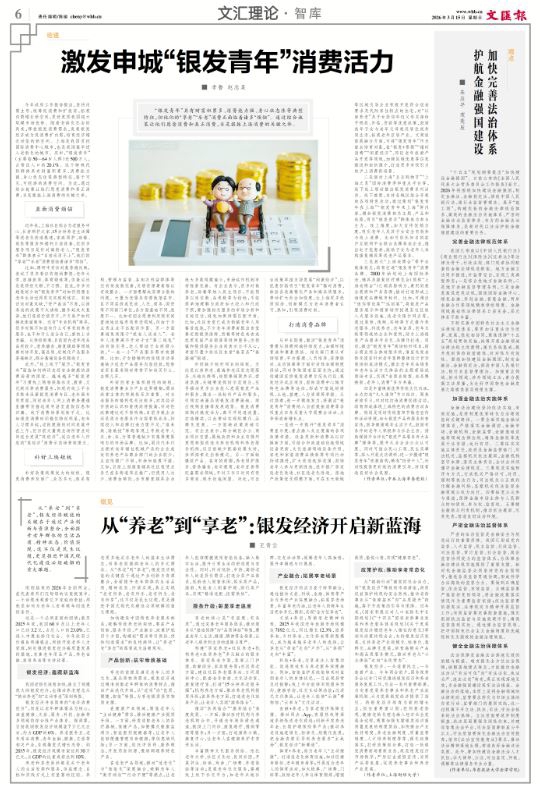

This year's government work report proposes to adhere to the dominance of domestic demand, coordinate the promotion of consumption and expand investment, expand new space for domestic demand growth, and better leverage the advantages of my country's ultra-large market. With the arrival of an aging society, releasing the consumer demand of the elderly and developing the silver economy has become a new space to promote consumption, expand domestic demand, and cultivate economic growth momentum. Shanghai is one of the first international consumption center cities in my country, and also the first city in my country to enter the aging population. Among them, there are nearly 5 million "silver-haired youth" (mainly referring to people aged 50-64), accounting for 20.1% of the permanent population. This special generation group has typical characteristics such as large wealth accumulation, strong consumption power, and good physical and mental status. It is a visible and potential consumption space. To this end, using comprehensive measures to make them willing to consume and actually consume is the key to boosting consumption in Shanghai.
Facing consumption worries
In recent years, Shanghai’s community comprehensive services have accelerated aging-friendly transformations such as elderly service centers, elderly care homes, and 15-minute elderly care living circles. Services and benefits such as home care, meal assistance, and medical assistance have been increasingly improved. However, many service items are targeted at the elderly. The “silver-haired youth” group said that they “are not yet able to use them.” They face many “troubles” in their consumption of “enjoy the elderly” and “enjoy the elderly.”
For example, the respondents in the survey generally reported that they tried many seemingly interesting things, such as senior universities, traveling and living, physical exercise, etc., but in the end they still felt bored and unaccustomed. Therefore, many "silver-haired young people" with few hobbies and interests are confused about how to live their long old life more fully. Some interviewees reported that it is not easy to "realize assets", and the policy of housing for retirement is not clear and too complicated to operate. They are worried about how to exchange for a decent old age with a property worth millions or tens of millions. It is also difficult to find "professional institutions". Many times, I don't know what kind of elderly care services are available, and I don't know what is suitable for me. I am afraid of being deceived. From the supply side, there are currently few categories of elderly products in China, and fields such as nutritious meals and rehabilitation aids have yet to be developed. There is a general lack of high-quality and customized products and services, and some high-end equipment relies on imports.
In addition, there is a disconnect between "online and offline", and "silver-haired youth" are faced with the problem of how to identify friendly, safe and healthy consumption scenarios. More and more "silver-haired youth" are accustomed to online shopping to obtain consumer services such as social networking, education, culture and entertainment. However, most existing online platforms do not have a special consumer area for seniors or a dedicated interface for the elderly. At the same time, online consumption by the elderly is prone to misleading and even false information and fraud through live broadcasts and product push. There is insufficient innovation in offline consumption scenarios. For example, the consumption time of the elderly is obviously misaligned. The elderly are accustomed to getting up early, and the most active time periods are concentrated in the morning. However, currently, the operating hours of a large number of commercial places are suitable for the development of the "night economy", and there is a lack of "morning economy" consumption demonstration scenarios that adapt to the elderly's work and rest.

Fix three shortcomings
Make up for the shortcomings in policy coordination. Silver consumption involves a wide range of industries and diverse business formats. The system structure, management and supervision, and relevant interest groups have yet to be matured and improved, and it is difficult to effectively integrate related resource elements. On the one hand, we need to solve the problem of resource dispersion. A large number of service resources for the elderly are scattered at different levels of the city and district or in different departments and units such as civil affairs, human resources and social security, commerce, and state-owned assets, with different foundations and varying progress in all aspects. For example, some state-owned enterprises were willing to use existing idle sites and facilities to develop in the elderly care field, but gave up because they did not match their main responsibilities and main businesses. On the other hand, we should avoid being limited to "talking about the elderly about the elderly." The consumption of the elderly is inseparable from the effective guidance of their children's "second wallet". The elderly help their children take care of the children, and the products and services of "one old and one young" need to be effectively bundled. For example, the promotional activities that children are exposed to generally lack the content of products and services suitable for the elderly. When they want to buy for their elders, they often don’t know what to buy and where to buy it.
Make up for the shortcomings in the enthusiasm of business entities. The boundaries between silver consumer businesses and industries are blurred, and it is crucial to mobilize the enthusiasm of business entities. More attention is paid to the welfare of services for the elderly, while awareness and emphasis on its economic value needs to be improved, and targeted policy recommendations are not clear enough. At present, most companies still regard services for the elderly as exploratory businesses, with insufficient continuous investment and brand building. The problem of "who will do it and who dares to invest" objectively leads to the general lack of market brands with aggregation and influence in the clothing, food, housing, transportation, etc. of the elderly. For example, there are few companies in the domestic automobile industry that have elderly welfare machinery products or have senior care product divisions, and there is insufficient publicity and promotion, and market awareness is not high. Another example is that the community rental business of rehabilitation assistive devices in Shanghai has been promoted in various streets. However, the number of users and the consumption amount are low. The vast majority of rehabilitation assistive device companies in the city are small in scale, and the market operation mechanism needs to be explored and improved. Some companies said that in many cases, elderly care and meal assistance are included in people's livelihood projects, and the number of beds and categories cannot be simply used as indicators. It cannot simply be understood as an increase in government investment and administrative intervention. Market analysis and target positioning of related services must be strengthened to avoid exacerbating the contradiction between supply and demand. For example, community canteens have become the first choice for elderly people in streets and towns to dine. Many elderly consumers have proposed that canteens should regularly provide seafood, Western food and other specialties, or sell high-quality agricultural and sideline products and other extended services. However, streets and service companies have expressed that they are unable to do so and hope that there will be as few community canteens as possible with "high-end dishes" and "high-end" reports.
Make up for the shortcomings of the lack of benchmark projects. Whether it is housing-based elderly care, high-end elderly care, volunteer services, interest groups, etc., the key to building consensus and creating an atmosphere in the short term is to exert a good demonstration effect, guide and promote more enterprises to invest in the development of silver products and services, launch a number of benchmark products and services, and lead the creation of a high-quality silver consumption highland. Comply with development trends such as live video streaming. To stimulate the vitality of silver consumption in the short term, it is inseparable from creating traffic and creating hot products, so as to drive the development of scale and branding. On the one hand, there is a lack of policy breakthrough demonstrations. Some companies said that some urban office and commercial projects are vacant, and local governments and owners have a strong desire to transform into elderly care institutions and elderly care service institutions. However, there is currently a lack of supporting policy support, and there is an urgent need to explore new models. On the other hand, there is a lack of popular products. In some business districts, in areas with strong demand such as elderly care services, nutritious meals, education for the elderly, and livability for the elderly, many businesses and entertainment facilities are idle during normal working days. In this regard, policies and measures can be introduced to support the development of the "idle economy", attract "silver-haired young people" to consume at the right time at preferential prices, and experience various high-end products and high-quality services, thereby expanding social awareness, allowing more high-quality supplies and innovative models in Shanghai to be recognized and familiar to older consumers, and leading consumer fashion.
Build consumer brands
In the medium to long term, efforts will be made to activate the consumption demand of "silver-haired youth" from both supply and demand ends, and strengthen environmental creation and factor supply. Relevant departments should strengthen institutional supply in a targeted manner from the aspects of market cultivation, platform building, personnel training, resource linkage, and legal protection. At the same time, they must seek support from the national level and form implementable fiscal, taxation, land, infrastructure, human resources and other measures through the creation of national-level silver consumption demonstration pilot zones, silver economic pilot projects, and international consumption center city characteristic brands. In the near future, further targeted efforts will be made to activate the consumption of "silver-haired youth" into the current key tasks of boosting consumption and major festivals, exhibitions and competitions, and strive to form new growth points.
The first is to further enhance the consumption visibility of "silver-haired youth" and focus on integrating various policy initiatives that attract high attention. In terms of equipment updating and consumer goods trade-in, we can continue to promote special actions such as equipment updating in the municipal infrastructure field, equipment upgrading in the cultural tourism field, and replacement of household appliances and home decoration consumer goods, expand the scope of renovation options, encourage the elderly to participate in the renewal and renovation, and gradually promote aging-friendly renovation of homes and aging-friendly renovation of communities. In terms of optimizing and adjusting real estate policies, enterprises can be guided in the five major new cities and other areas to actively develop housing that meets the requirements of the elderly and the characteristics of intergenerational living. Preferential policies such as taxes, subsidies, loans, etc. will be provided for "housing for the elderly" and for children who choose to buy houses for their elderly parents in the neighborhood. Adult children and elderly parents will be encouraged to live nearby or live together, and the livable industry for the elderly will be expanded. In terms of the integration of cultural, business, tourism and sports exhibitions, "silver-haired youth" can be regarded as the key cultivation targets, and in the fields of "silver-haired + ticket stubs", "time-of-slip consumption", "idle economy", suburban elderly tourism product development and other fields, the information push and organizational promotion of promotional discounts and other information can be strengthened to create more attractive new consumption scenarios in Shanghai.
The second is to link up with Shanghai’s “May 5th Shopping Festival” and “Shanghai Summer” international consumption seasons and key platforms, and launch a series of silver consumption activities offline and online. In the offline dimension, we support various special activities jointly carried out by various urban areas. By planning content such as "Silver Youth in Shanghai" and "Silver Youth Come to Shanghai", we will increase topics, products and routes related to silver consumption, and attract the "silver youth" group to become the main participants. In the online dimension, we will increase publicity and promotion efforts to attract the elderly and their children to safely and effectively participate in online consumption. For example, you can rely on a well-known Internet platform in Shanghai to co-brand elderly care companies to launch electronic coupons to encourage children to purchase rehabilitation aids and other elderly-friendly products and services for the elderly.
The third is to amplify the effect of platform carriers such as the "Shanghai Olds Expo" and cultivate and create a "silver-haired youth" consumer brand. The Shanghai International Elderly Care, Assistive Devices and Rehabilitation Medical Expo (referred to as "Shanghai Elderly Care Expo"), founded in 2000, has become quite influential. It is necessary to make good use of exhibition exhibitors and product resources to promote the formation of Shanghai's silver brand city identity. For example, "mini permanent exhibitions" and "touring exhibitions" can be launched to expand the display and sales venues of silver hair products and services to community embedded service facilities, aging-friendly bank outlets, etc., and promote enterprises and cases in the fields of elderly care services, technological elderly care, livability for the elderly, and entertainment for the elderly through exhibition boards, videos, physical objects, etc., to help professionalize and brand Shanghai silver hair products and services. At the same time, the "Silver Youth" shopping mall benchmark project was launched, combined with the transformation and upgrading of commercial complexes, drawing on the successful model of overall design of department stores for elderly customers in the first aging countries, and launching themed shopping malls or shopping mall areas for senior product sales and senior lifestyle experiences to achieve a win-win situation for "old business transformation, old brand replacement, and senior consumption".
The fourth is to enrich and renew the connotation of excellent traditional culture and strive to create a festival economy for the "Double Ninth Festival". Focus on family holidays, create targeted consumer promotion activities, and cultivate a consumer activity brand that reflects Shanghai's characteristics. In particular, we should make good use of the resources for traditional Double Ninth Festival respecting the elderly publicity and activities, increase the popularization of silver products and services, advocate a healthy lifestyle in old age, and encourage qualified elderly people to actively participate in social life. Use media platforms to evaluate the "Top 100 Brands of Silver Hair Products and Services" list to enhance the public recognition of enterprises in the industry. At the same time, we can conduct in-depth interviews and surveys based on public support projects and people's livelihood issues to further understand the base structure of "silver-haired youth", accurately "invest in people", provide more effective consumption guidance in a targeted manner, and continue to create a good social atmosphere.
(Author’s unit: Shanghai Municipal Party School of the Communist Party of China)