On December 15, a seminar on the ideological and political construction of financial professional courses in the digital education era, jointly sponsored by the School of Finance and the Academic Affairs Office of Central University of Finance and Economics, was held at Shahe Campus. Ding Zhongming, deputy chairman of the Ministry of Education’s Financial Professional Teaching Steering Committee, Zhu Mengnan, member of the Ministry of Education’s Financial Professional Teaching Steering Committee, Li Jianjun, member of the Standing Committee of the Party Committee and Vice President of Central University of Finance and Economics, and Lei Hongfeng, member of the Standing Committee of the Party Committee and Minister of the Propaganda Department, attended the meeting.
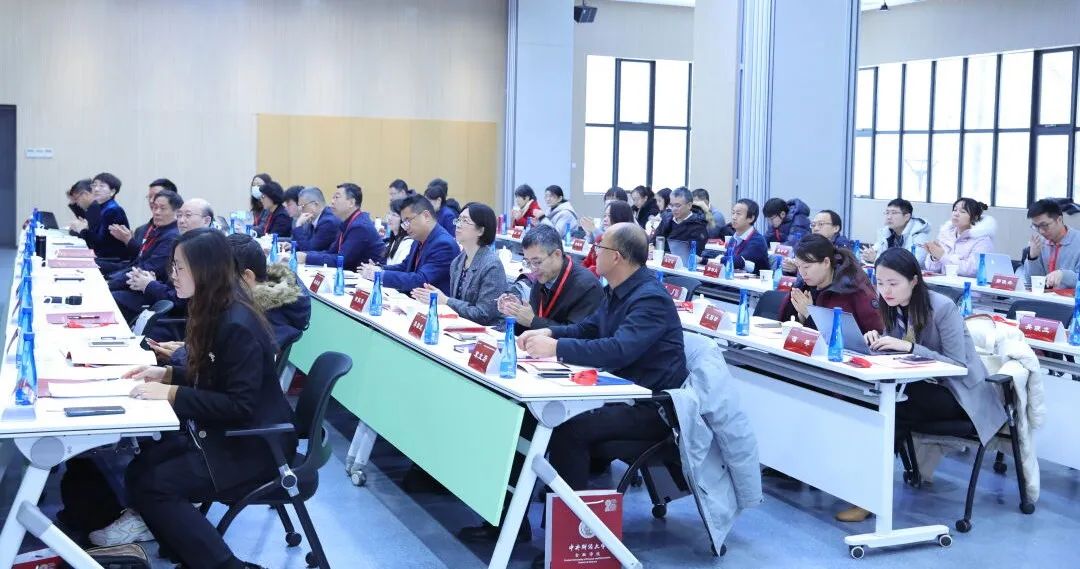
Meeting site
Li Jianjun, member of the Standing Committee of the Party Committee and Vice President of Central University of Finance and Economics, delivered an opening speech and expressed welcome and gratitude to the guests. He emphasized that solidly advancing the ideological and political construction of the curriculum and cultivating a large number of high-quality financial talents with both ability and political integrity are the basic and strategic support for accelerating the construction of a financial power and realizing Chinese-style modernization. He pointed out that Central University of Finance and Economics has promoted ideological and political construction of courses by formulating policies, setting up topics and holding seminars, deeply exploring ideological and political elements, innovating methods and paths, and has achieved good results in ideological and political construction of courses. He believes that this seminar focuses on the cutting-edge issues of ideological and political curriculum construction and talent training in the digital education era, and provides in-depth exchanges and sharing of construction experience. It creates a communication platform for the collaborative integration of professional courses and ideological and political courses and jointly builds a pattern of ideological and political education. It is of great significance for promoting the high-quality development of ideological and political courses in schools and improving the quality of independent training of financial professionals.
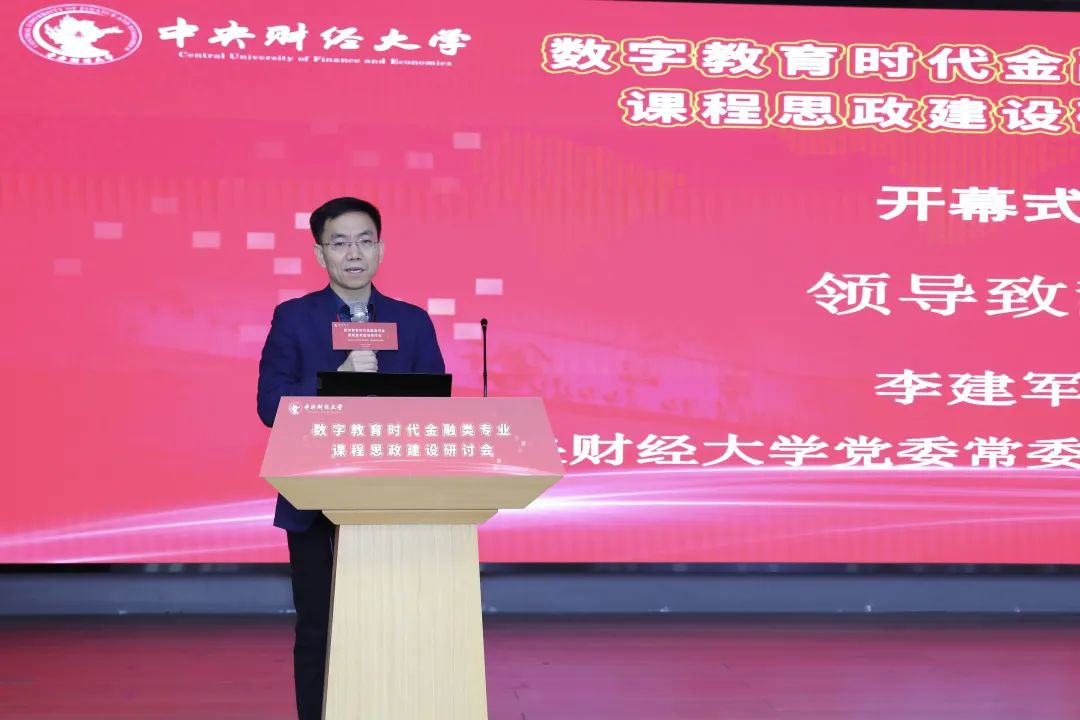
Vice President Li Jianjun delivered an opening speech
Zhang Xueyong, Dean of the School of Finance at Central University of Finance and Economics, presided over the opening ceremony. Wang Hui, Secretary of the Party Committee of the School of Finance, introduced the ideological and political construction of the School of Finance's courses with the title of "Exploration and Practice of the '43554' Course Ideological and Political Model".
Ding Zhongming, deputy chairman of the Financial Professional Teaching Steering Committee of the Ministry of Education and former Party Secretary of Anhui University of Finance and Economics, delivered a keynote speech titled "Thinking and Practice of Ideological and Political Curriculum Construction – Taking "Securities Investment" as an Example", pointing out that the core of ideological and political curriculum construction is to comprehensively improve the ability to cultivate talents. The focus is to further promote the introduction of Xi Jinping Thought on Socialism with Chinese Characteristics for a New Era into textbooks, classrooms, and minds. The method is to integrate ideological and political elements and innovative method systems into the classroom. Teachers strengthen their awareness of educating people and improve their ability to educate people. They also shared their thoughts and practices on the ideological and political construction of the "Securities Investment" course.
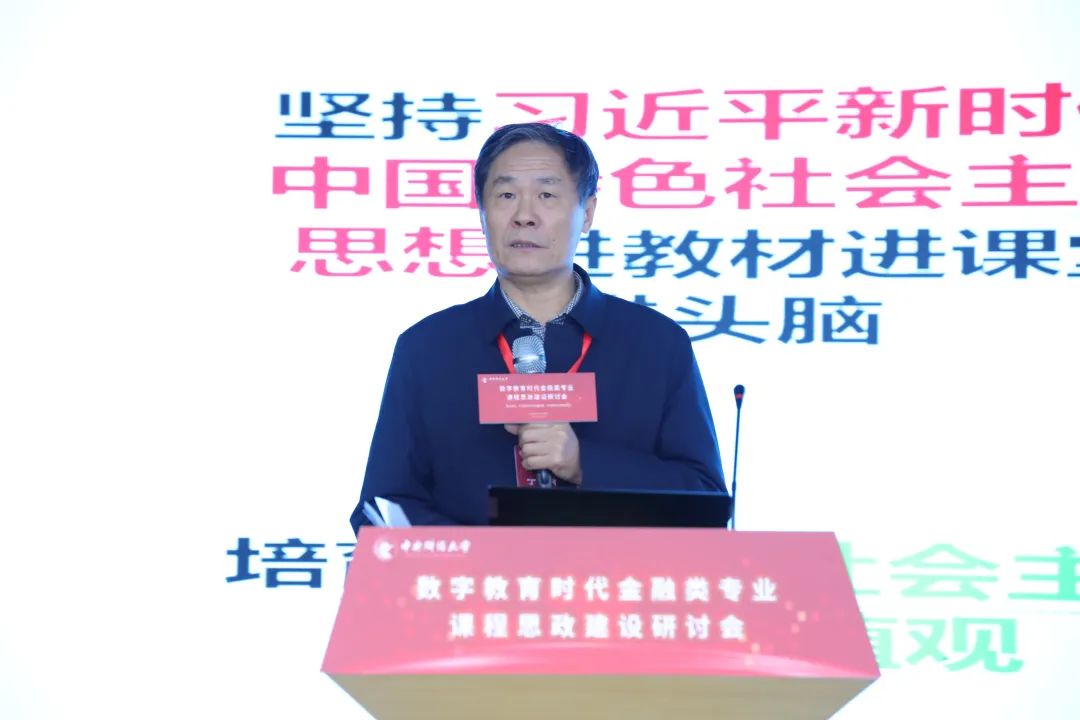
Ding Zhongming, former Party Secretary of Anhui University of Finance and Economics, delivered a keynote speech
Zhu Mengnan, a member of the Financial Professional Teaching Steering Committee of the Ministry of Education and a professor at the School of Economics of Xiamen University, delivered a keynote speech titled "'Three Hows' on the Construction of Ideological and Political Courses in Financial Majors – Taking "International Finance" as an Example". He introduced the experience of ideological and political construction of the "International Finance" course from the aspects of the connotation of the ideological and political course, methods of exploring the ideological and political elements of the course, and ways to improve the effect of the ideological and political construction of the course. He believes that in the practice of curriculum construction, ideological and political education itself is an integral part of the curriculum. It must be organically integrated into ideological and political content, so as to moisturize things silently, lead by example and practice it.
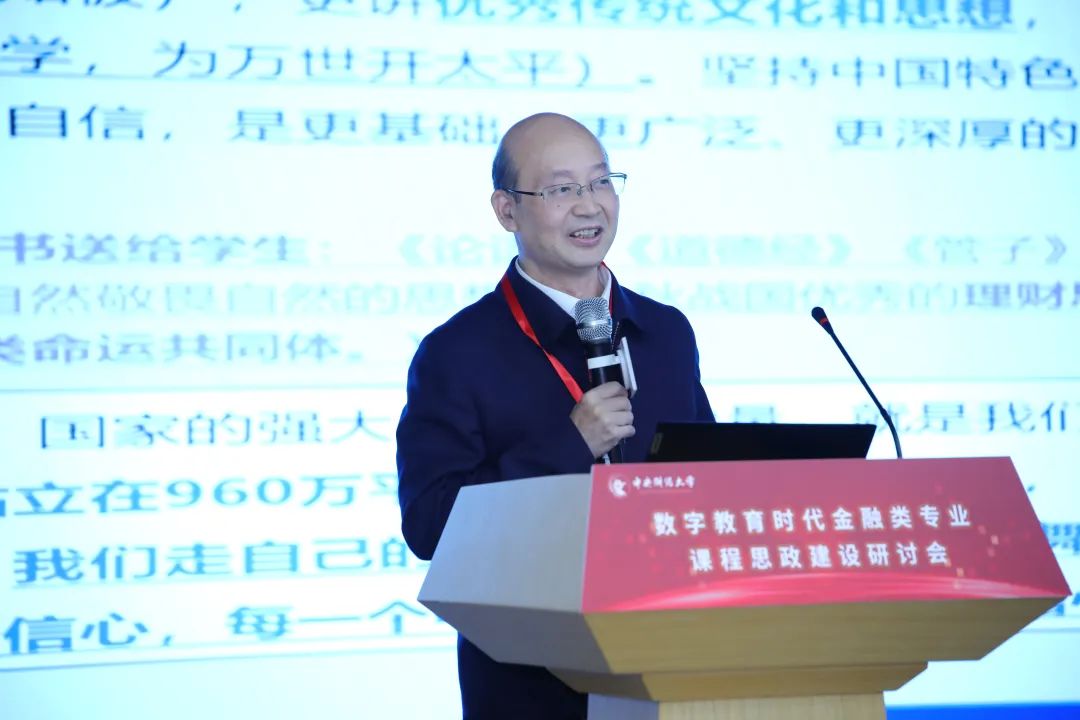
Zhu Mengnan of Xiamen University delivered a keynote speech
Zhang Qiaoyun, a professor at the School of Finance at Southwestern University of Finance and Economics, delivered a keynote speech on "How to Improve the Timeliness and Effectiveness of Ideological and Political Courses in Professional Courses – Taking Commercial Bank Operations and Management as an Example." He believes that teaching material construction and classroom teaching have gradually shifted from the traditional teaching of knowledge to the three functions of knowledge as the basis, research as the core, and ideological and political education as the soul. Taking the "Commercial Bank Management" course as an example, he introduced in detail the method system that integrates knowledge, research, and ideological and political education to improve the timeliness and effectiveness of professional ideological and political courses. At the same time, a rich ideological and political teaching resource library has been built for young teachers to carry out ideological and political courses.
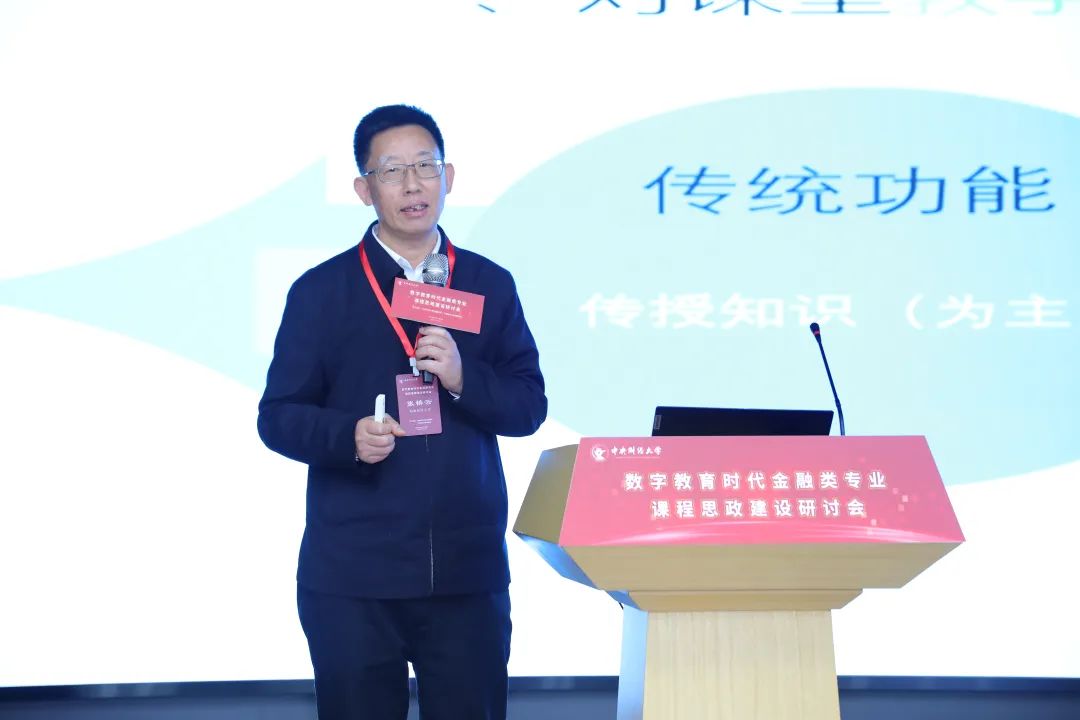
Zhang Qiaoyun of Southwestern University of Finance and Economics delivered a keynote speech
Zhang Chengsi, deputy dean of the School of Finance at Renmin University of China, delivered a keynote speech on the theme of "Adhering to the Construction of a Four-dimensional, Three-dimensional and Diversified Talent Training System". He shared the talent training system established by the School of Finance of Renmin University of China that adheres to the four principles and is three-dimensional and diversified. He pointed out that the system carries out all-round ideological and political education through grand masters, gathering teams of famous teachers, telling Chinese stories, strengthening practical teaching, building Chinese cases, innovative communication mechanisms, etc., and solves the problem of "what kind of people to train" based on the "Four We" innovative training system, builds a three-dimensional talent training system to solve the problem of "how to train people", and focuses on Chinese issues to solve the problem of "for whom to train people."
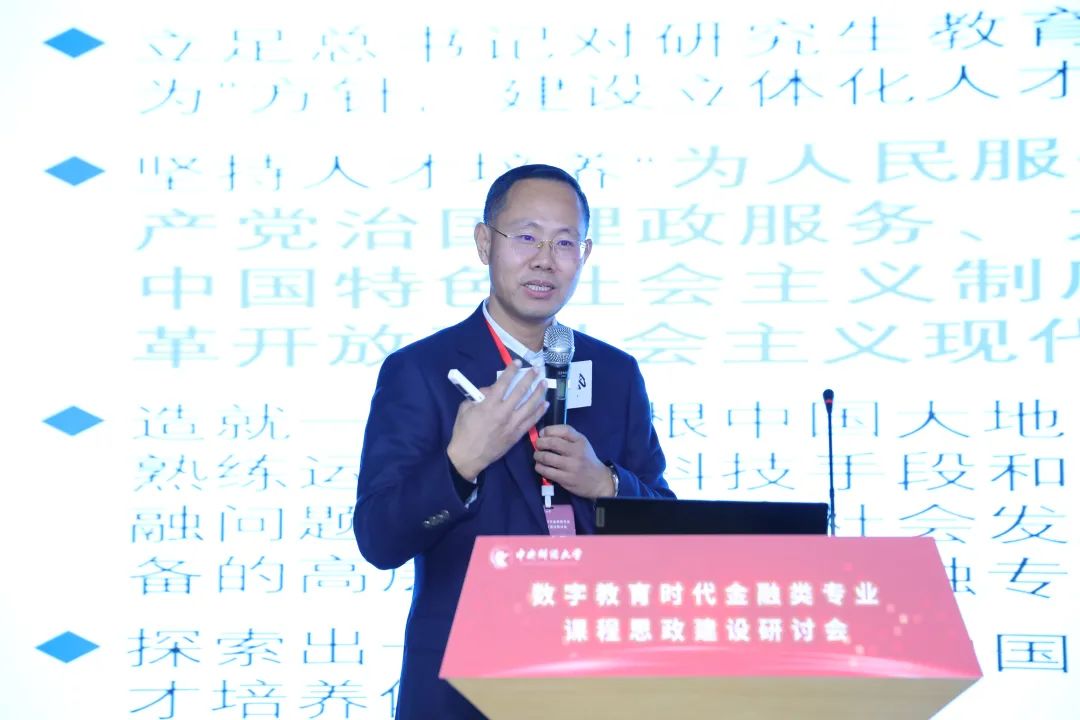
Zhang Chengsi from Renmin University of China delivered a keynote speech
Zhang Teng, a distinguished associate professor of the School of Finance at Anhui University of Finance and Economics, delivered a keynote speech titled "Three-level Integration and Four-Method Synergy: Teaching Innovation in Finance Courses and Exploration on Ideological and Political Construction of Courses". Taking "Securities Investment" as an example, she introduced the course team's innovation in the ideological and political teaching model of the course in response to the learning pain points of fragmented knowledge, inert thinking, and practical values.
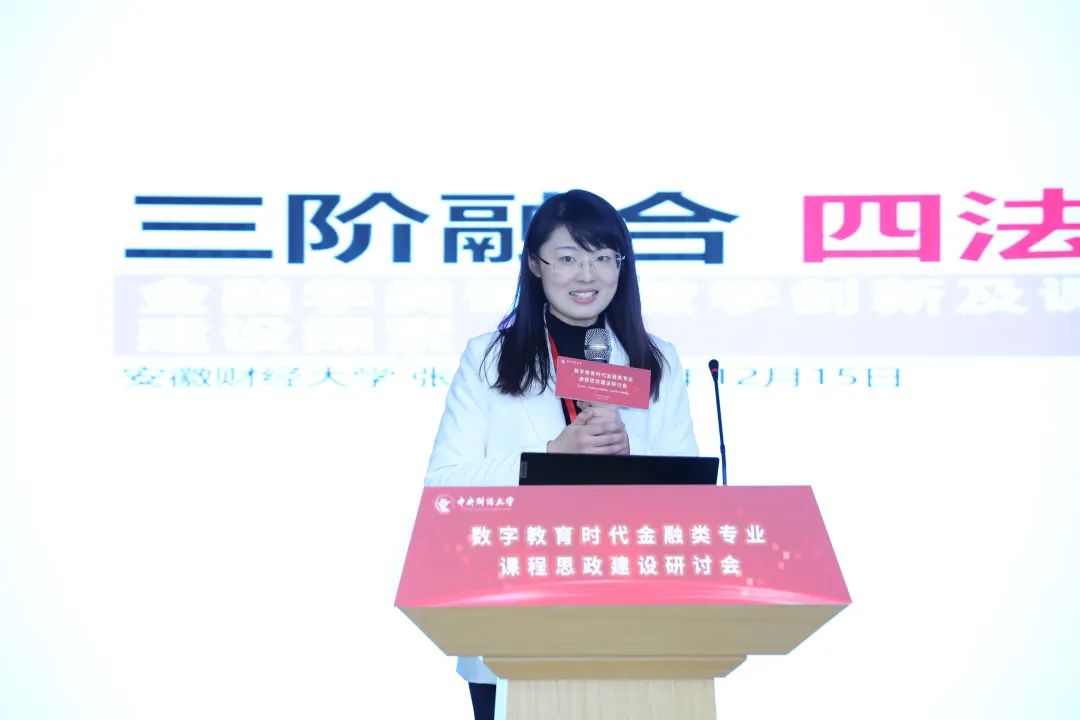
Zhang Teng from Anhui University of Finance and Economics delivered a keynote speech
Gou Qin, deputy dean of the School of Finance at Central University of Finance and Economics, presided over the seminar. Lin Guangbin, director of the Academic Affairs Office, Bai Yanfeng, director of the Graduate Affairs Department and dean of the Graduate School, and Qin Chunlei, deputy director of the Faculty Affairs Department and deputy director of the Personnel Office, delivered special speeches. During the free speech session, experts and scholars such as Liu Lixin, Dean of the School of Statistics at the University of International Business and Economics, Li Guowu, Dean of the School of Social Sciences and Psychology at the Central University of Finance and Economics, Song Liyan, Secretary of the Party Committee of the School of Sports Economics and Management, Liu Jinke, Deputy Dean of the School of Finance and Taxation, Wang Lizhen, Deputy Dean of the School of Insurance, and Li Yuhuan, Deputy Dean of the School of Government shared their experiences and suggestions on the ideological and political construction of the course.
Two parallel forums "Research and Exchange on Ideological and Political Construction of Undergraduate, Master and Doctoral Courses in Finance Majors" were held in the second teaching building of Shahe Campus of Central University of Finance and Economics. They were hosted by Li Ji, deputy director of the Academic Affairs Office of Central University of Finance and Economics, and Xiao Tusheng, deputy director of the Graduate Affairs Department and deputy dean of the Graduate School. Jin The construction team of the 10 ideological and political demonstration courses of the School of Finance reported on the ideological and political construction of the courses respectively. Ding Zhongming, deputy director of the Financial Professional Teaching Steering Committee of the Ministry of Education and former Party Secretary of Anhui University of Finance and Economics, Ding Zhongming, member of the Financial Professional Teaching Steering Committee of the Ministry of Education, Xiamen Zhu Mengnan, Professor of the University School of Economics, Zhang Qiaoyun, Professor of the School of Finance, Southwestern University of Finance and Economics, Liu Lixin, Dean of the School of Statistics, University of International Business and Economics, Liu Qiang, Director of the Academic Affairs Office of Capital University of Economics and Business, Tan Xiaofen, Professor of the School of Economics and Management of Beihang University, Beijing Technology and Business University Cao Xianbing, a professor at the School of Mathematics and Statistics, Feng Jianfen, a professor at the China School of Finance at the University of International Business and Economics, Shen Ji, an associate professor at the Guanghua School of Management at Peking University, and Zhang Teng, a distinguished associate professor at the School of Finance at Anhui University of Finance and Economics respectively made wonderful comments and put forward valuable opinions and suggestions.
The successful holding of this seminar has injected new ideas and ideas into accelerating the ideological and political construction of professional courses at Central University of Finance and Economics. In the future, Central University of Finance and Economics will continue to thoroughly implement the guiding spirit of the Party Central Committee and the Ministry of Education on the construction of ideological and political courses in colleges and universities, resolutely shoulder the important task of cultivating high-quality financial talents with strong political skills, excellent work styles, and profound professionalism, deeply explore the ideological and political elements of courses in financial professional courses, strengthen the implicit educational function of ideological and political courses, firmly believe in educating people for the party and educating talents for the country, and make greater contributions to cultivating builders and successors of the socialist cause in the new era.
Experts and scholars from Peking University, Renmin University of China, Xiamen University, Beihang University, University of International Business and Economics, Southwestern University of Finance and Economics, Capital University of Economics and Business, Beijing Technology and Business University, Anhui University of Finance and Economics, relevant units and department heads of the Central University of Finance and Economics, as well as teacher and student representatives attended this seminar.
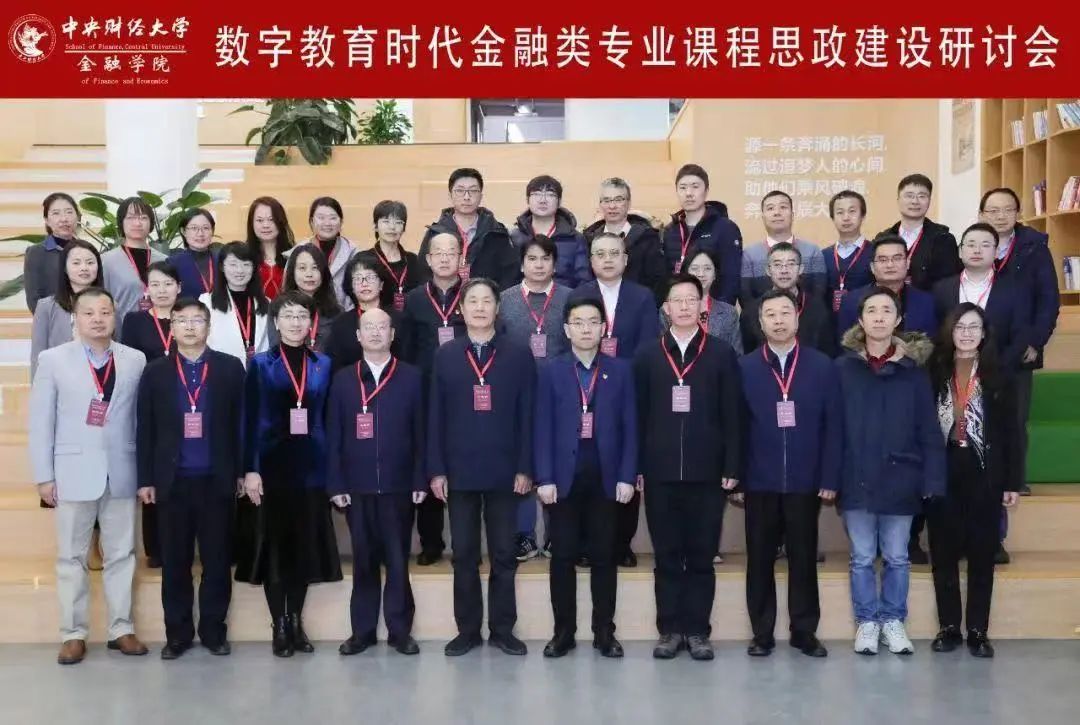
Group photo of guests attending the meeting
Writers: Zhao Xuehui, Zhao Guojun, Hou Jiao; Reviewer: Wang Hui