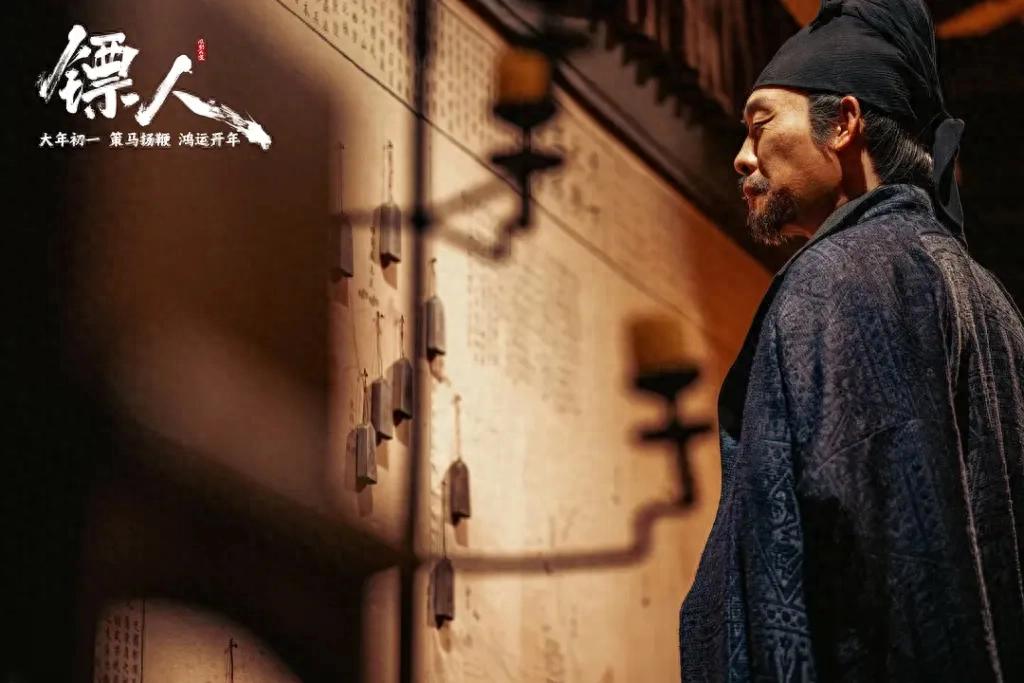
During the Spring Festival, riding on the historical craze caused by the historical drama "The Peaceful Year", the movie "The Bodyguard", which is set in the troubled times of the Western Regions in the late Sui Dynasty, also attracted a lot of attention. In the movie, the protagonists' action scenes with exciting moves and punches captured the attention of the audience, but what caught the author's attention was the powerful Sui Dynasty official Pei Shiju, who was hidden behind the scenes, playing tricks and only occasionally showing up in the middle of the plot. Thanks to actor Zhang Yi's penetrating portrayal, Pei Ju's image of a powerful official with a deep palace and sophisticated methods who manipulates various ethnic groups in the Western Regions is vividly displayed on the screen. He has become a rare and classic character in the entire film in addition to action stars, handsome men and beautiful women. As a historical figure who actually existed and played an important role in the late Sui Dynasty and early Tang Dynasty, Pei Ju, also known as Pei Shiju in the film, had considerable military and diplomatic talents, and to a large extent shaped the internal affairs and diplomatic pattern from the Sui Dynasty to the early Tang Dynasty.
Meritorious Service: A unified minister who has risen through the ranks
Pei Ju was born in the Pei family in Hedong, a well-known family in Hedong from the Northern Dynasties to the Sui and Tang Dynasties. His original name was Pei Shiju. In order to avoid the name taboo of Emperor Taizong Li Shimin of the Tang Dynasty, later generations deleted the word "Shi" and changed his name to Pei Ju. He was born at the end of the troubled times of the Southern and Northern Dynasties, and his fate was rough when he was young. His father Pei Nazhi was an official in the Northern Qi Dynasty. He was dismissed from the official position due to being implicated and died soon after. Pei Ju was raised by his uncle Pei Rangzhi. As an adult, Pei Ju was knowledgeable and scheming. The chaotic world affairs and ups and downs experiences jointly created his outstanding talents and understanding personality, which also laid a solid foundation for him to establish his achievements and become a great minister later.
After the Northern Zhou Dynasty was destroyed and the Northern Qi Dynasty unified the north, Pei Ju gained a relationship with Yang Jian, the upstart of the Northern Zhou Dynasty and the governor of Dingzhou, and became the secretary of the governor's office. He praised military aircraft and was deeply trusted. Yang Jian replaced Zhou Jian in the Sui Dynasty, and later sent Jin Wang Yang Guang to lead an army south to ping Chen. Pei Ju was appointed as the secretary of the Marshal's Mansion, and he rose to prominence and quickly became Yang Guang's confidant. After conquering the Chen Dynasty, Pei Ju and another important general Gao Jiong "collected the Chen books and returned them to the secret palace" ("Shui Shu Biography of Pei Ju"), making great contributions to the emerging Sui Dynasty. The next year, Pei Ju was ordered to patrol Lingnan. Before he even set out to Jiangnan, a rebellion launched by Gao Zhizhi and Wang Wenjin broke out. The rebellion was so powerful that "Wuyue Road was closed." At the same time, Wang Zhongxuan, the indigenous leader of Lingnan, supported his troops in rebellion and approached Guangzhou. His general Zhou Shiju besieged Donghengzhou, the gateway to Guangzhou. The situation was corrupt, and the entire southern region was in serious danger of losing what was gained. At this time, Pei Ju did not flinch, but insisted on moving quickly. After arriving in Nankang, Pei Ju defeated thousands of troops. Later, he joined forces with General Lu Yuan to defeat Dayu Ridge and Yuan Chang Ridge. They defeated Zhou Shiju, defeated Wang Zhongxuan, and recovered more than 20 states in Lingnan, achieving a complete victory. Yang Jian, Emperor Wen of the Sui Dynasty, lamented: "Wei Gu led 20,000 troops and could not even step into Lingnan, but Pei Ju went straight to the South China Sea with 3,000 weak soldiers. With such a minister, I have nothing to worry about!" Pei Ju was named the Duke of Wenxi County.
Pei Ju was not only good at civil and military affairs, but also quite diplomatic. At that time, the Turks were powerful, and Princess Dayi, the wife of Dulan Khan and the daughter of the clan of the Northern Zhou Dynasty, repeatedly encouraged the Turks to invade the border areas in order to avenge Yang Jian's usurpation of the Zhou Dynasty and the Sui Dynasty. In the thirteenth year of the founding of the Emperor, Pei Ju saw the information provided by Changsun Sheng that "Princess Dayi had an affair with her entourage", and immediately asked the Turks to send an envoy to report to Dulan Khan to alienate the Turks. As a result, Princess Dayi was killed. He also cooperated with the famous general Shi Wansui to successfully defeat the invading Turkic Datou Khan and stabilize northern Xinjiang.
As the Sui Dynasty unified the world and the Turkic forces were weakened, countries in the Western Regions gradually resumed trade with the Central Plains, and merchants gathered in Zhangye, an important town on the Silk Road. After Yang Jian's death, the newly succeeded Emperor Yang Guang of Sui Dynasty became ambitious and intended to expand the influence of the Sui Empire in the Western Regions. Pei Ju knew that Yang Guang and his father Yang Jian had a relatively simple life style and prudent foreign strategy. They liked extravagance and were "far-sighted and far-sighted", so he took advantage of the convenience of being in charge of trade with surrounding ethnic groups to induce the Hu people to talk about the mountains, rivers, customs and products of his hometown. Based on this, he compiled three volumes of the geographical monograph "Illustrated Records of the Western Regions", which introduced the forty-four countries in the Western Regions. Emperor Yang of the Sui Dynasty was overjoyed and summoned him every day for questioning. Pei Ju took the opportunity to introduce the treasures in the Western Regions, claiming that Tuyuhun was easy to annex, and advocated the use of foreign troops. Under Pei Ju's planning, Emperor Yang of the Sui Dynasty visited the right side of the river. King Gaochang, Yiwushe and other 27 kings came to welcome him. He also defeated Tuyuhun and expanded the territory thousands of miles away. Emperor Yang of the Sui Dynasty visited Luoyang, the eastern capital. In order to show the strength of the "Celestial Kingdom" to the barbarians, Pei Ju suggested that 100,000 geishas from all over the world be searched and perform in Duanmen Street in gorgeous costumes for a month. He also asked the shops along the street to entertain the Tibetan people. Envoys and merchants from various countries all called China "the home of the Immortal Emperor" ("New Book of Tang Dynasty: Pei Ju's Biography"). Emperor Yang Guang of the Sui Dynasty greatly satisfied his vanity and praised Pei Ju, "If you don't serve the country wholeheartedly, how can it be evil?" The international reputation of the Sui Dynasty reached its peak, and Pei Ju's honor and favor also reached the extreme.
Ups and downs: unpredictable times and circumstances
In the seventh year of the Great Era, Emperor Yang of the Sui Dynasty went on a tour to the north of the Great Wall. At the tent of the Turk Qimin Khan, he received a piece of news that shocked him extremely: Goguryeo, located on the northeastern border of the empire, actually communicated with the Turks without communicating with himself. This made him feel deeply damaged in his self-esteem. Pei Ju noticed the emperor's displeasure and immediately said: "Goguryeo was originally a Guzhu country, and it has been Chinese territory since ancient times, but now it does not surrender. How can your Majesty allow this inherent territory to remain the land of barbarians while your Majesty is in power?" He persuaded Emperor Yang to summon him to the court. If Goguryeo refused, "He should lead the Turks and kill them immediately." Pei Ju would not have thought that one of his suggestions would actually start the three-conquer Goguryeo war that led to the fall of the Sui Dynasty.
Emperor Yang of the Sui Dynasty failed to attack Goguryeo for a long time, but suffered heavy casualties and emptied the treasury, which aroused resentment among the people in the country. The hero Yang Xuangan rebelled. After finally pacifying it, Emperor Sui Yang was satisfied and visited Jiangdu. Pei Ju, as his favorite minister, could only follow him. It seemed that everything was still peaceful. However, at this time, the world was in constant turmoil and popular uprisings occurred. "The emperor's policy was weak and everyone was rebellious" ("Book of Sui: Biography of Pei Ju"). General Yu Wenshu of Zuo Yiwei, Minister of Internal Affairs Yu Shiji and other sycophants The entire court was courteous and courteous, and bribery was common. Pei Ju was worried that the Sui Dynasty, which was not yet stable, was in danger of overthrowing, so he could only take care of himself. "There is no sound of filth and filth, so it is known to the world."
In the thirteenth year of Emperor Yang's great career in the Sui Dynasty, Li Yuan, who stayed in Taiyuan, raised his troops and went south. In less than a year, he gathered hundreds of thousands of troops and captured Chang'an. He established the acting king Yang You as emperor, appointed himself prime minister, and actually took control of the situation in Guanzhong. Faced with the influx of urgent documents, Pei Ju felt that the crisis was imminent and asked Emperor Sui Yang to lead the Xiaoguo Army back to Guanzhong to have a showdown with Li Yuan. But at this time, Emperor Sui Yang had long lost the enthusiasm he had when he first succeeded to the throne, and remained indifferent. Seeing that the emperor was so depressed, the Xiaoguo army accompanying him was homesick, their hearts were in a state of confusion, and many of them fled. Emperor Sui Yang became anxious and asked Pei Ju what to do. Pei Ju took his savvy to the extreme and suggested marrying Jiangdu's widows and unmarried women to soldiers. Xiaoguojun was therefore grateful to Pei Ju. When Yu Wenhuaji used Xiaoguo's army to launch a palace uprising in Jiangdu and killed Emperor Yang of Sui Dynasty, Pei Ju was also captured. At the critical moment of life and death, Xiaoguojun was grateful for his kindness. Instead of killing him, he supported Pei Ju and became the right servant of Yu Wenhuaji. After Yu Wenhuaji was defeated by Dou Jiande, Pei Ju defected to Dou Jiande again, still served as a minister of the prime minister, and also helped Dou Jiande formulate the court etiquette. Then Li Shimin, Wang Shichong and Dou Jiande fought at Hulao Pass and "captured both kings in one battle", and Pei Ju surrendered to the Tang Dynasty. The following year, he became Prince Zuo's concubine and was soon promoted to Prince Zhan Shi and became the steward of Prince Li Jiancheng.
Pei Ju's wandering life journey did not end when he took refuge in Li Tang. The Xuanwu Gate Incident broke out, and King Li Shimin of Qin attacked and killed the brothers Li Jiancheng, the prince, and King Li Yuanji of Qi. However, the situation was not clear. Li Jiancheng's remnant party still occupied the palace city and wanted to fight the King of Qin decisively. Li Shimin sent Pei Ju to tell him that "the palace troops will be dispersed." Pei Ju, who was already eighty years old, brought this "Xuanwumen Revolution" to an end. Although he is old, Pei Ju is "refreshing" and is highly respected for his ability to learn stories. He has also become a high-ranking official like the Minister of the Ministry of Civil Affairs. When Taizong first came to the throne, he heard that some officials were bending the law for personal gain and seeking power to take bribes, so he started "fishing for law enforcement" and deliberately sent people to pay bribes. One of the ministers, Shi, accepted a piece of silk as a bribe. Emperor Taizong was furious and wanted to punish him with death. Pei Ju argued with reason: "This man should indeed be killed for accepting bribes, but this is the result of His Majesty's temptation to use property. If he is executed, it is the so-called setting someone up for a crime. If he follows the example, it may not be in line with the principle of guiding virtue and observing etiquette and law." Taizong listened to his opinion and called on all officials to follow Pei Ju as an example.
When Pei Ju died in the first year of Zhenguan, Emperor Taizong gave him the title of governor of Jiangzhou, with the posthumous title of Jing. Only then did Pei Ju complete his magnificent and magnificent life.
Long-cherished Wish: The Deep Plot of Dynasty Revival
Throughout his life, Pei Ju served six monarchs and heroes including Emperor Wen of the Sui Dynasty, Emperor Yang of the Sui Dynasty, Yu Wenhuaji, Dou Jiande, Emperor Gaozu of the Tang Dynasty, and Emperor Taizong of the Tang Dynasty. He always held high positions and survived the complex political environment. Historians of the past dynasties believe that he relied on his extraordinary political sense and domestic and diplomatic skills to flexibly adjust his way of life according to the political environment and monarch preferences of different eras, so he could always remain invincible. A typical example is Sima Guang's comment that he was "sycophantic in the Sui Dynasty but loyal to the Tang Dynasty" ("Zi Zhi Tong Jian, Volume 129"), believing that this was not a change in nature, but that "if the king is evil and hears his faults, his loyalty will turn into a sycophancy; if the king is happy to hear his outspoken words, sycophancy will turn into a loyal one". The monarch is like a "table" (benchmark), and his ministers are like "shadows". If the watch moves, the shadow will follow. And Pei Ju perfectly interpreted the survival philosophy of "The Analects of Confucius" "If a state has the right, threatening words will endanger the deeds; if a state does not have the right, deeds will endanger the descendants" – only by being upright and courageous in admonishing when the political situation is clear, and being upright and prudent in speaking when the country is dark, can we maintain the foundation of a gentleman in troubled times.
This is certainly good, but I think it still misses the point.
Pei Ju's life was full of ups and downs, going through the Northern Qi, Northern Zhou, Sui, and Tang dynasties. He witnessed the changes from the end of the division of the Southern and Northern Dynasties to the unification of the world, and the Sui and Tang dynasties. He became an important participant and promoter during the period. He can be called a "living fossil" of Chinese history from great division and turmoil to great unification and great integration. Behind his life experiences and major choices are the historical thinking and collective demands of the political and cultural elites of that important era.
Different from the way that various regimes managed the Western Regions during the Wei, Jin, Southern and Northern Dynasties, Pei Ju not only divided, disintegrated, penetrated and integrated the various ethnic regimes in the Western Regions at the practical political and diplomatic levels, and strengthened economic and trade ties, he also focused on the theoretical level to systematically sort out and explain the Sino-foreign commercial exchanges since the Western Han Dynasty carved out the Western Regions, especially the central dynasty's governance of the Western Regions. He inspected historical materials, conducted interviews and research, and wrote the three-volume "Illustrated Records of the Western Regions", which records in detail the organizational history, geography and customs, religious culture, uniforms and products of various countries in the Western Regions, as well as the successes and failures of the central governments' management and control strategies in the Western Regions since the Western Han Dynasty, providing reference for the Sui Dynasty to strengthen its rule. He also described in the book "the appearance of kings and common people according to their country's costumes and manners, that is, the appearance of the king and the common people, that is, the painterly imitation". He also had in-depth understanding and on-the-spot investigation, and recorded in detail the three trade routes from Dunhuang in the east to the Mediterranean in the west. While allowing the monarchs and ministers of the Central Plains to gain a perceptual understanding of the far-off Western Regions, they also gained a panoramic understanding of the ancient Silk Road that lasted for more than 700 years, laying an important foundation for the smooth flow of goods during the Sui and Tang dynasties and the grand scene of the Celestial Dynasty where all nations came to congratulate them.
What's even more commendable is that according to the "Jingji Zhi" of "Old Tang Book", Pei Ju not only wrote "Illustrated Records of the Western Regions", he also wrote a volume of "Goryeo Customs"; and used the experience of quelling the Chen Dynasty as his The contents include twelve volumes of "The Record of Kaiping Pingchen"; ten volumes of "Stories of Yedu" based on his family's past as an official in the Northern Qi Dynasty; and co-authored with Yu Shinan of ten volumes of "Books of the Tang Dynasty", but unfortunately all of them have been lost. Pei Ju became a rare and famous official in the Sui and Tang dynasties who was both accomplished and well-known. It is conceivable that after three hundred years of great division and turmoil since the Wei and Jin Dynasties, Pei Ju was heartbroken by the history of the Five Husties that disrupted China and the decline of the dynasty. He deeply felt that unification and stability were hard-won, and was full of desire to rebuild the powerful dynasty that expanded thousands of miles and had ambitions in the Qin and Han Dynasties. Therefore, in a series of works, he showed a high degree of historical consciousness of learning from the past and the present, and carrying on the past and forging ahead into the future. As he made clear in the preface of "Illustrated Records of the Western Regions", the purpose of writing this book was to help the Sui Dynasty government to "raise banners over the Mongolian waters, and leap horses across Kunlun. It is as easy as flipping the palm of your hand, but there is nowhere to go." The unified and powerful Sui Dynasty also provided a solid foundation for the realization of this ideal.
Because of this grand long-cherished wish to revive the dynasty, when the Goguryeo envoys crossed the Sui Dynasty and sent envoys to the Turks, not only Emperor Yang of the Sui Dynasty, but also Pei Ju's self-esteem was greatly stimulated. Therefore, he advocated taking tough measures against Goguryeo, which directly led to Emperor Yang of the Sui Dynasty issuing an edict to conquer Goguryeo. It also inadvertently opened the prelude to the demise of the Sui Dynasty soon after unification.
Root cause: the collective choice of the elite of the era
In fact, if you examine this period of history, you will find that Pei Ju's actions and achievements are not an isolated case. It has become the collective consciousness of the political and cultural elites in this period to study the experiences and lessons of the rise and fall of past dynasties, to end hundreds of years of division and turmoil, and to rebuild a unified dynasty.
Not long after the establishment of the Sui Dynasty, unification had not yet been completed, and many wastes were waiting to be revitalized. Niu Hong, the regular servant of Sanqi and the secretary supervisor, presented the famous "List of Routes for Requesting the Presentation of Books", which listed the five major events in the history of Chinese classics, pictures and literature since the establishment of the Qin Dynasty. Catastrophes (i.e., the "Five Disasters"): the burning of books and entrapment of Confucian scholars, Wang Mang's Rebellion, Dong Zhuo's Rebellion, Yongjia Rebellion, and the Burning of Books in Jiangling. The continuous wars and continuous wars resulted in "all the tombs of the former kings were swept away" ("Book of Sui·Niu Hongzhuan"). After thousands of years, I still deeply feel the author's heartache and heartache. In the table, Niu Hong clearly pointed out that "the foundation of a country depends on Dian Mo. Nothing is more important than this before it is the foundation of the country." He earnestly hopes that the new dynasty can collect and organize the cultural classics scattered among the people, laying a cultural foundation for eliminating the gap between the north and the south, ending the division and turmoil, and welcoming the coming era of great unification. As soon as this is shown, Emperor Wen of the Sui Dynasty issued an order to all the people to "dedicate a volume of books and a piece of steel", so "in one or two years, the books were slightly prepared", which also became a major symbol of the cultural unification before the geographical unification of the north and the south.
Later, he moved to the Ministry of Rites, and Niu Hong integrated the northern and southern rituals and compiled one hundred volumes of "Five Rites" covering auspiciousness, misfortune, military, guest, and honor, which stipulated the basic rules of political and social life in the Sui Dynasty. Niu Hong also became a key figure in the "Profit and Loss of EMI" and the Lecheng Ceremony in the Sui Dynasty. In addition to etiquette, under the strong support of Yang Jian, Niu Hong, together with Su Wei, Pei Zheng and others, combined the essence of the criminal laws of the Cao Wei, Western Jin, Northern Qi, and Southern Liang dynasties, comprehensively considered light punishments and severe punishments, and adopted the principle of eclecticism to formulate new laws. It was later revised and made into the final text of "Kaihuang Code". Although the Sui Dynasty collapsed after two generations, the "Kaihuang Code" was respected by later historians as good law and good governance. Various basic systems were directly inherited by the "Yonghui Code" of the Tang Dynasty, becoming the direct cornerstone of the Tang Code. Later, it was used by the Song, Yuan, Ming and Qing dynasties. It played an important role in the history of Chinese legal system and had a profound impact on the legal system construction of ancient East and Southeast Asian countries.
A similar thing happened to the famous minister Yu Wenkai. As a master of urban planning and architectural design deeply trusted by Emperor Wen of the Sui Dynasty and Emperor Yang of the Sui Dynasty and his son, Yu Wenkai presided over the construction of the Daxing capital of Chang'an and the eastern capital of Luoyang. The two capitals were "extremely magnificent" and unprecedented in scale. When Emperor Yang of the Sui Dynasty visited the north, he built a large tent that could accommodate thousands of people. He even used ingenuity to build a movable "Guanfengxing Hall" that could accommodate hundreds of people. "The wheel and axle were placed… It was like a magical skill. When Rong Di saw it, everyone was horrified" ("Shui Shu·Yu Wenkai Biography"). Later generations often use this to prove that Emperor Yang of the Sui Dynasty was extremely extravagant and greedy for great achievements, and regarded Yu Wenkai as an accomplice and sycophantic ministers to criticize and criticize him. However, what is less known is that in order to establish the legitimacy of the rule of the Sui Dynasty, Yu Wenkai carried out an overall design for the Mingtang, a symbol of the etiquette of the dynasty's rule. Its main ideas are also reflected in Yu Wenkai's "Mingtang Meeting".
Since the beginning of Shennong and through the Xia, Shang and Zhou dynasties, the Mingtang has been the core of the ritual system where "the king must reside" as a place for offering sacrifices, praying for crops, and administering government and bringing peace to the people. After the Yongjia Rebellion in the Western Jin Dynasty, Mingtang was abolished for nearly three hundred years. The Sui Dynasty unified the world and returned to unification. The reconstruction of Mingtang became a key measure to demonstrate its inheritance of Zhou and Han orthodoxy, complete the revival of rituals and music, and consolidate the legitimacy of its rule. Therefore, Yu Wenkai "examined the public records extensively" and gathered public opinions to systematically sort out the structure of the Mingtang from the Three Dynasties to the Wei and Jin Dynasties, refuted the assumptions of various Confucian scholars, established the Five Chambers Theory (Zheng Xuan Ancient Literature School), and opposed the Nine Chambers Theory (Jinwen Jingxue). Although the Mingtang Hall was not built in the Sui Dynasty, Yu Wenkai's research insights became the core of the politics and ritual system of the Sui Dynasty, demonstrating the Sui Dynasty's ambition to unify the world and revive rituals and music, and also provided a direct legacy for the construction of the ritual system of the Tang Dynasty. Yu Wenkai also preserved a large number of Mingtang documents from the third generation to the Wei and Jin Dynasties in the meeting table, providing precious historical materials for future generations to study the history of ancient Chinese rituals, architecture, and thought.
Tian Dong