"On a hot day in May, the sun is rising, and the tea shed is high beside the green shade. A bowl of tea soup relieves the heat, and the villagers give alms without asking for compensation." – This anonymous poem on bamboo branches spread among the people in eastern Zhejiang. In just a few strokes, a picture of tea giving in the past has been slowly unfolded: an ancient summer road, a thatched tea shed, villagers passing by, and a thick bowl of tea.
"Shicha" means giving tea soup, which is the "mortal tea" of Chinese tea. In the long days of traveling by foot, "giving tea" was often juxtaposed with "giving medicine" and appeared in classics, documents and inscriptions. It was the daily kindness and compassion of the ancient ancestors. Tea service places are mostly located near bridgeheads, ferries, on mountains, at the entrance of temples, and at street corners of thoroughfares in villages and towns. Tea pavilions, tea sheds, and roadside corridors are the most common ones. They have a few large pottery bowls and a bucket of hot tea for porters, merchants, scholars rushing to take exams, and passers-by to drink for free and take shelter from the wind and rain. This bowl of tea is not for elegance, but for resting one's feet and quenching one's thirst. The compassion of the world is the "book of tea" written between the mountains and the sea, on the earth.
The Jinsu Temple at the foot of Jinsu Mountain in Haiyan, Zhejiang was founded by the Kang Senghui, a group of eminent monks who lived in Kang during the Chiwu period of the Three Kingdoms period. It is located next to the Hangjia Ancient Road and is one of the earliest temples in the south of the Yangtze River. Kang Senghui not only preached Dharma here, but also "constructed a pavilion and served tea" here. The stone tablet "Reconstruction of Jinsu Guanghui Zen Temple" erected in the 14th year of Zhengtong in the Ming Dynasty (1449) specifically records this event, leaving important relics of "giving tea".
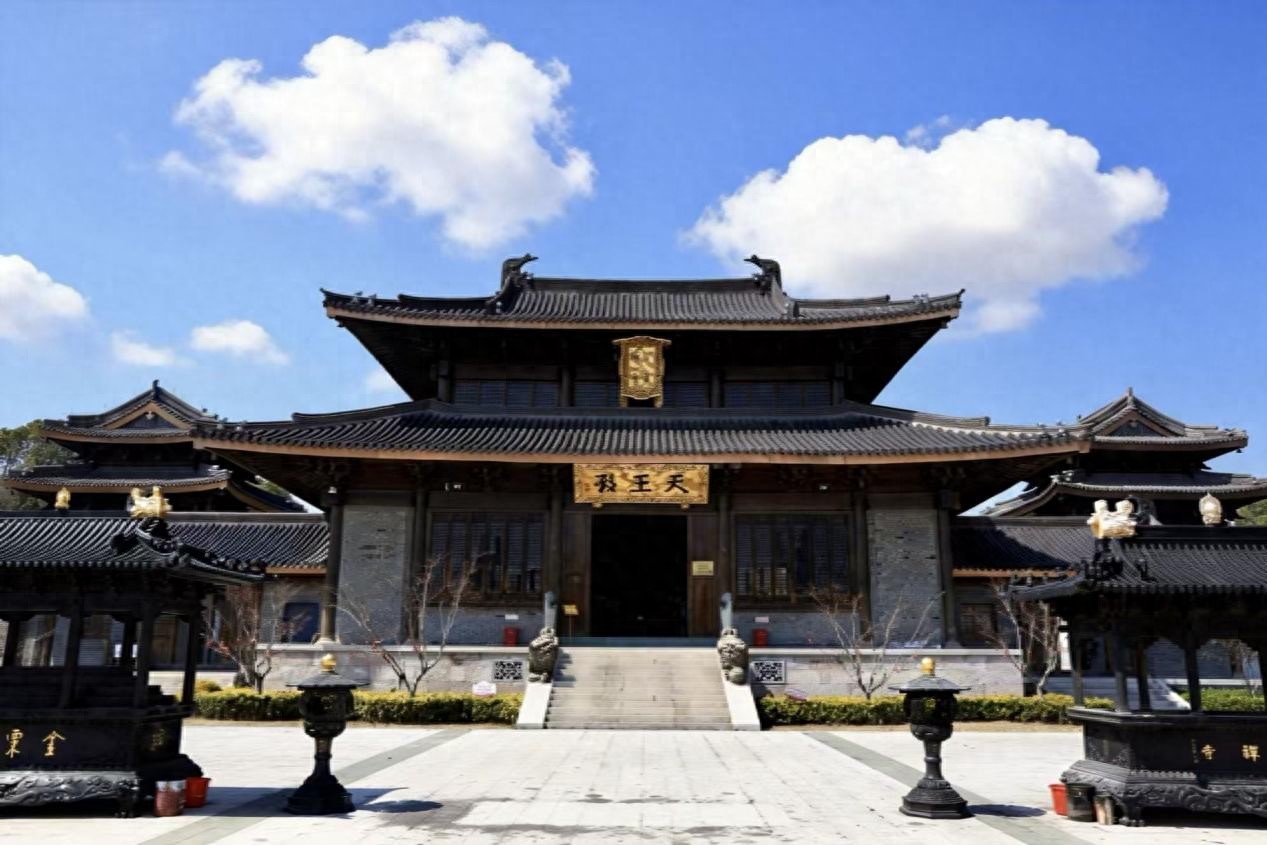
Photo by Zhu Hong from Jinsu Temple in Haiyan
After the Lantern Festival of the Year of the Horse, we chose a beautiful spring day to go to Haiyan Jinsu Temple to look for this ancient monument from the Ming Dynasty. In history, Jinsu Temple has experienced several ups and downs, honors and disgrace. When Jinsu Temple was rebuilt in 2008, a stele "Reconstruction of Jinsu Guanghui Temple" was unearthed at the site. Jinsu Temple is majestic and majestic, and transport ships often pass by at the Tea Garden Harbor outside the temple. In order to protect this precious monument, a stone pavilion with overhanging eaves and four corners was built beside the "Kangseng Bridge" bridge to protect the monument from wind and rain.
The ancient stele is made of bluestone, with a height of 2.22 meters, a width of 0.98 meters, and a thickness of 0.27 meters. The inscription was written by Hu Ying, the Minister of Rites of the Ming Dynasty. The article records: "Kang Monk traveled to Jinsu Mountain in Haiyan. It was a hot summer day and he built a pavilion to serve tea to relieve his thirst. The court heard about it and gave it the name of Tea Garden." The lineage of Jinsu Temple has thus become an important source of tea-serving culture in the south of the Yangtze River.
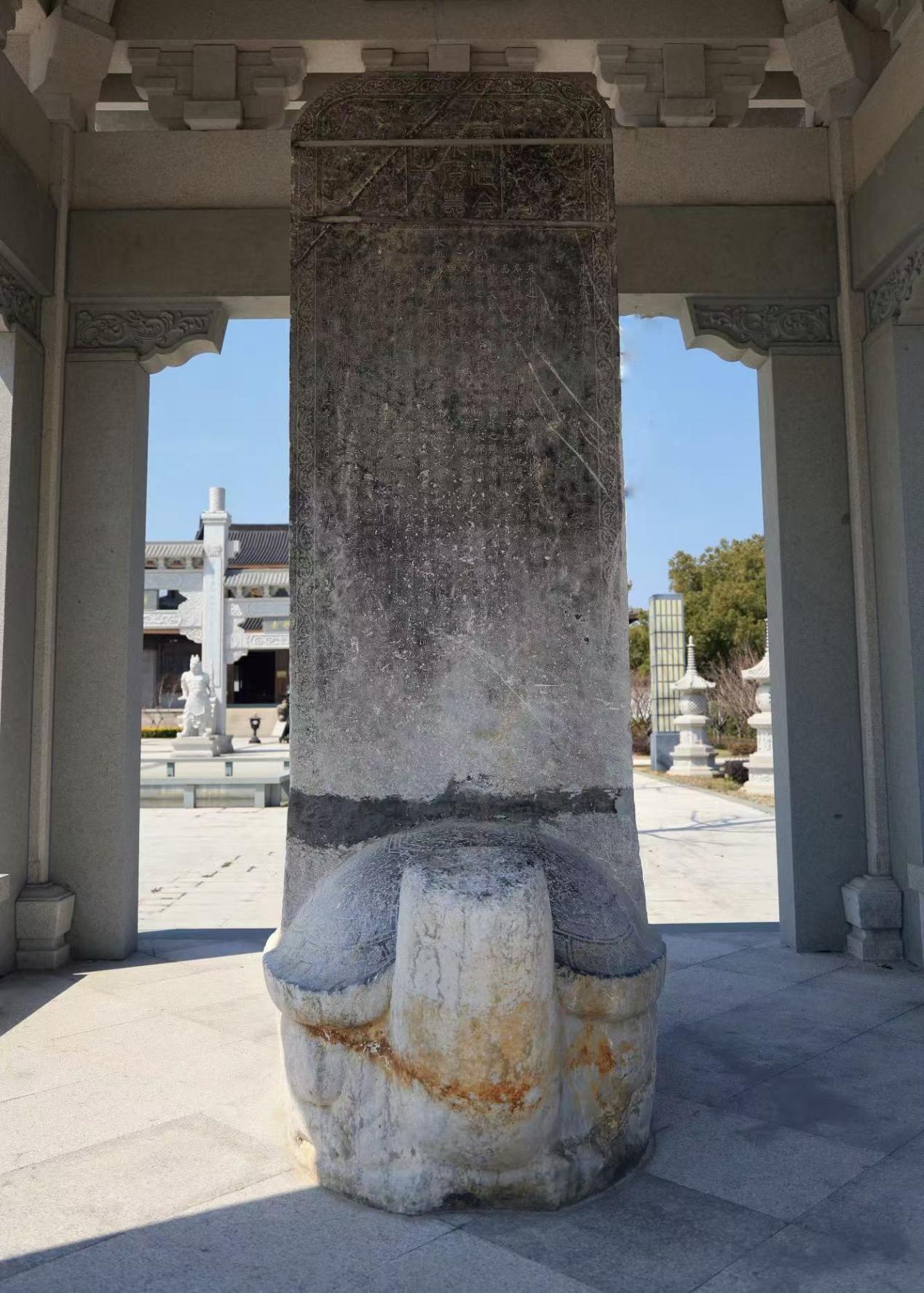
The Ming Dynasty Monument and the Inscription at Jinsu Temple, photographed by Zhu Hong
When it comes to "giving tea" at Jinsu Temple, the most legendary protagonist is Qian Liu, the founding monarch of the Wuyue Kingdom in the Five Dynasties and Ten Kingdoms. Qian Liu, a hero in troubled times, possesses the domineering spirit of "a sword that freezes fourteen states", the tenderness of "the flowers bloom on the road, she can slowly return home" to his poor wife Wu, and the Buddhist compassion of "nurturing the people with kindness".
At the end of the Tang Dynasty, Huang Chao's army rose up and the world was in chaos. Qian Liu separated the two Zhejiang provinces and established the Wuyue Kingdom to protect himself in the southeast. It is said that when Qian Liu was young, he trafficked illegal salt to make a living and traveled along the two Zhejiang Salt Roads. The tea served at Jinsu Temple became the sweet rain in Qian Liu's mouth when he was hungry and thirsty.
In order to repay the kindness of giving tea, some scholars have verified that in the second year of Kaibao in Song Dynasty (969), Qian Liu, the king of Wuyue Kingdom, named Jinsu Temple "Tea Giving Garden". This is the earliest record of the term "tea service" in literature. The place name "Chayuan Village" where Haiyan Jinsu Temple is located has been used ever since.
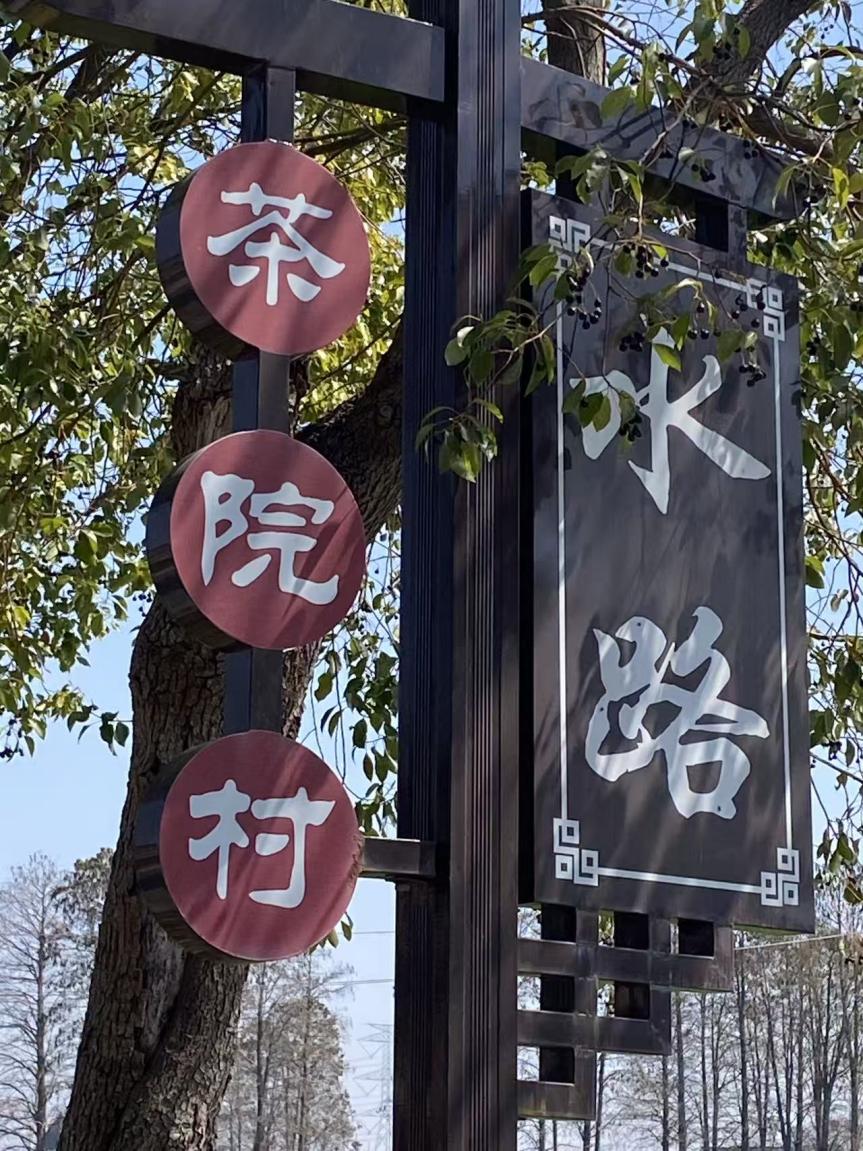
Chayuan Village road sign photo by Zhu Hong
Looking back even further, tea sage Lu Yu also had an indissoluble bond with tea serving in temples. In the mid-Tang Dynasty, tea service gradually became popular in monasteries, combining Buddhist compassion with daily practice, and became a way for monks to spread Buddhism.
Lu Yu lost his parents at a young age and was a helpless orphan. He was adopted by Zen Master Zhiji of Longgai Temple in Jingling, Hubei Province. He made tea, drank water and learned to read in front of the Buddha, which nourished his initial perception of the nature of tea and introduced this stubborn young man who stuttered, argued and had "many intentions" to the mysterious world of tea. Without the initial habit of giving tea soup in the temple, it may be difficult to have the depth of the "Tea Sutra" that connects heaven and earth and integrates human feelings.
Different from the general "tea party" gatherings, along with the popularity of the custom of "serving tea", the "tea party" once had a unique meaning in the history of Chinese tea. "Tea parties" are usually organized voluntarily by local gentry, businessmen and ordinary people. Those who have land, money, and strength set up tea pavilions and corridors on official roads and post roads to provide tea for free. It is a kind of folk charity embedded in the rural social structure. The "Tea Party" steles scattered on the tea pavilions and corridors of the ancient Ming and Qing roads in eastern Zhejiang are precious imprints of the "Tea Party" in the past.
After the beginning of spring this year, I made an appointment with my friend Wang Qun from Xiangshan, Zhejiang, and climbed to the top of the local ancient Qing Dynasty trail walker Lingtou, where I saw the Qing Dynasty "Tea Party" monument that I had longed for. Wang Qun is tall and burly, and he was originally a good figure for sailing on the seaside. When he was young, he pioneered bamboo carving with a pair of big trawling hands, and became famous in the world of bamboo root carving for his skillful carving of ancient ladies. In recent years, when launching the "Xiangshan Ancient Ferry Tracking Tour" activity, we found the Qing Dynasty stone tablet at the Lingtou Tea Pavilion.
We walked from the Crab Claw Ferry by Sanmen Bay on the ancient moss-covered slickstone path. As soon as we climbed up to Walker Ridge, we saw a small tea pavilion with a green tile roof standing quietly among the mountains and trees. Wang Qun pointed to the tea pavilion from a distance and told me that the ancient stele was in the tea pavilion.
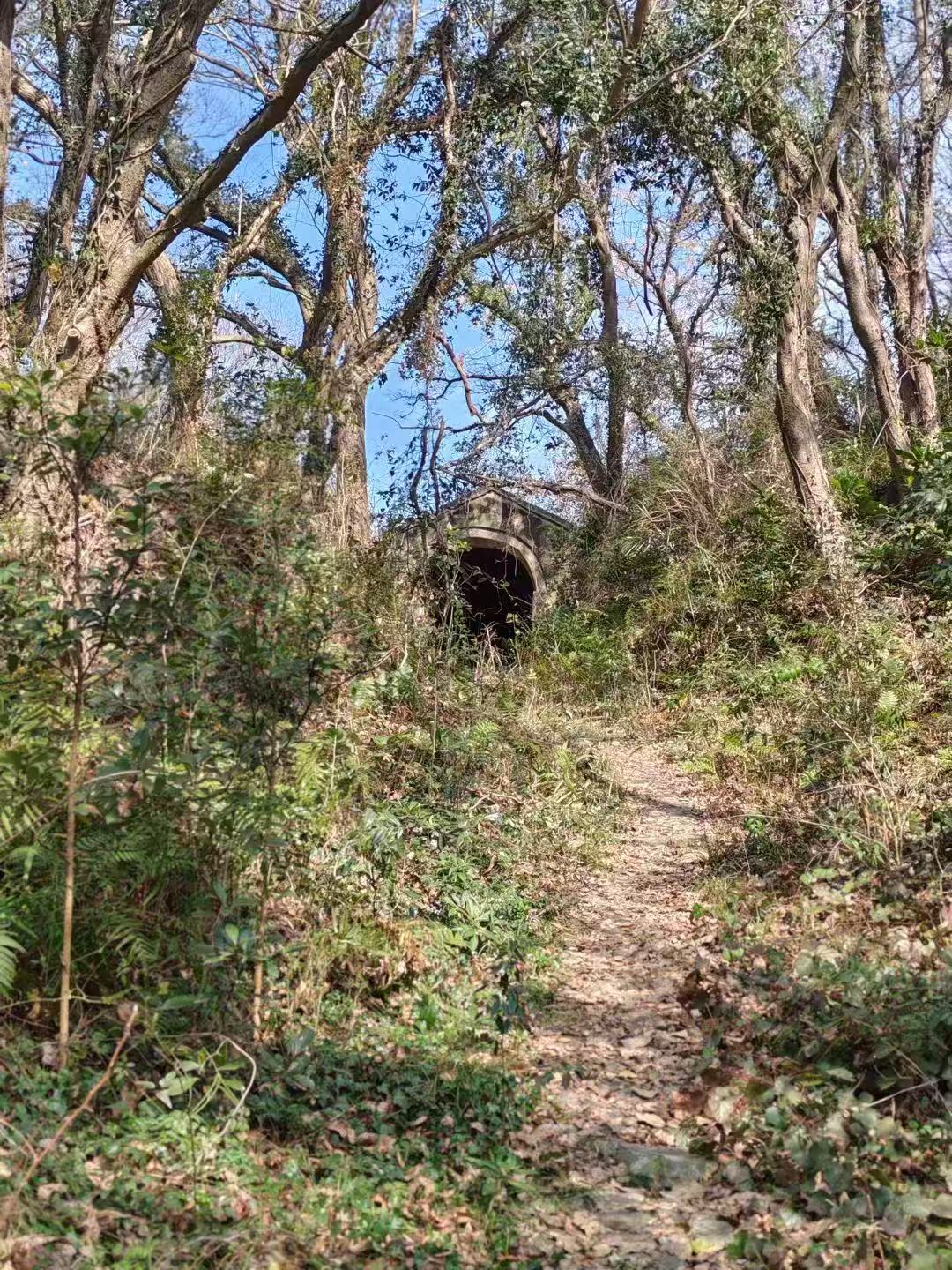
Photographed by Wang Qun at Xingzhe Lingtou Tea Pavilion
The tea pavilion runs from east to west and is a three-bay corridor-style building. There is a small temple in the north. There are four ocher red square stone beams in the pavilion. There are stone benches built on the north and south sides for pedestrians to rest. There are two stone steles embedded in the north and south walls respectively. In the south are the Qianlong and Guangxu steles, and in the north are the Daoguang and Xianfeng steles.
Among the ancient steles, the Guangxu Stele is the most complete, with clear text on the surface, "Xingzhe Ling Pavilion" horizontally engraved on the forehead, and "Rebuilt by Wang Hengli in the 19th year of Guangxu" vertically engraved below. The words "Jiuqing Tea Party" remain on the forehead of the Daoguang stele. "Jiuqing" is the name of the village here. The word "Tea Party" is very precious. Unfortunately, the two characters in the middle and the rest of the text on the stele are unclear. The characters on the Xianfeng Monument are blurred and cannot be read.
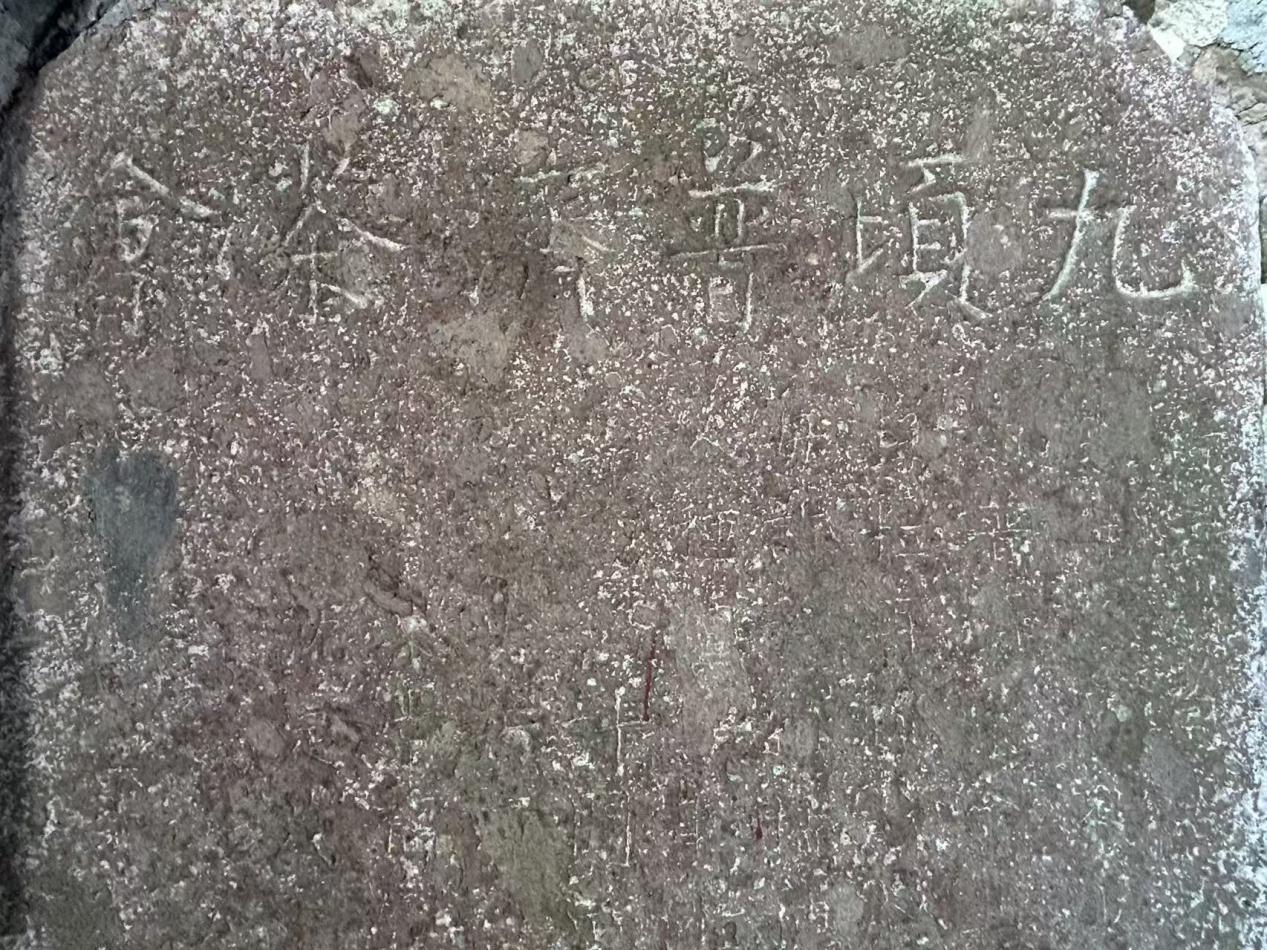
"Jiuqing Tea Party", the words are shown in the Daoguang Monument of the Qing Dynasty, photographed by Wang Qun
The Qianlong "Tea Party" stele was erected in the fifth year of Qianlong's reign. The inscription is written in a bold and free-spirited style, recording the origin of the stele, the name of the donor, the donated mountain land, the area of the land, and the management details. In front of the monument, there is a tea pavilion built at the head of the pedestrian ridge. The resident monk Jueming of Wanshou Temple next to the pavilion is responsible for the daily supply of tea to quench the thirst of travelers during the summer heat. Local villagers donated fields to the temple and rented the fields to pay for the monks' tea, firewood and daily expenses. The monks felt that they were "not short of food" and the tea pavilion was operating normally.
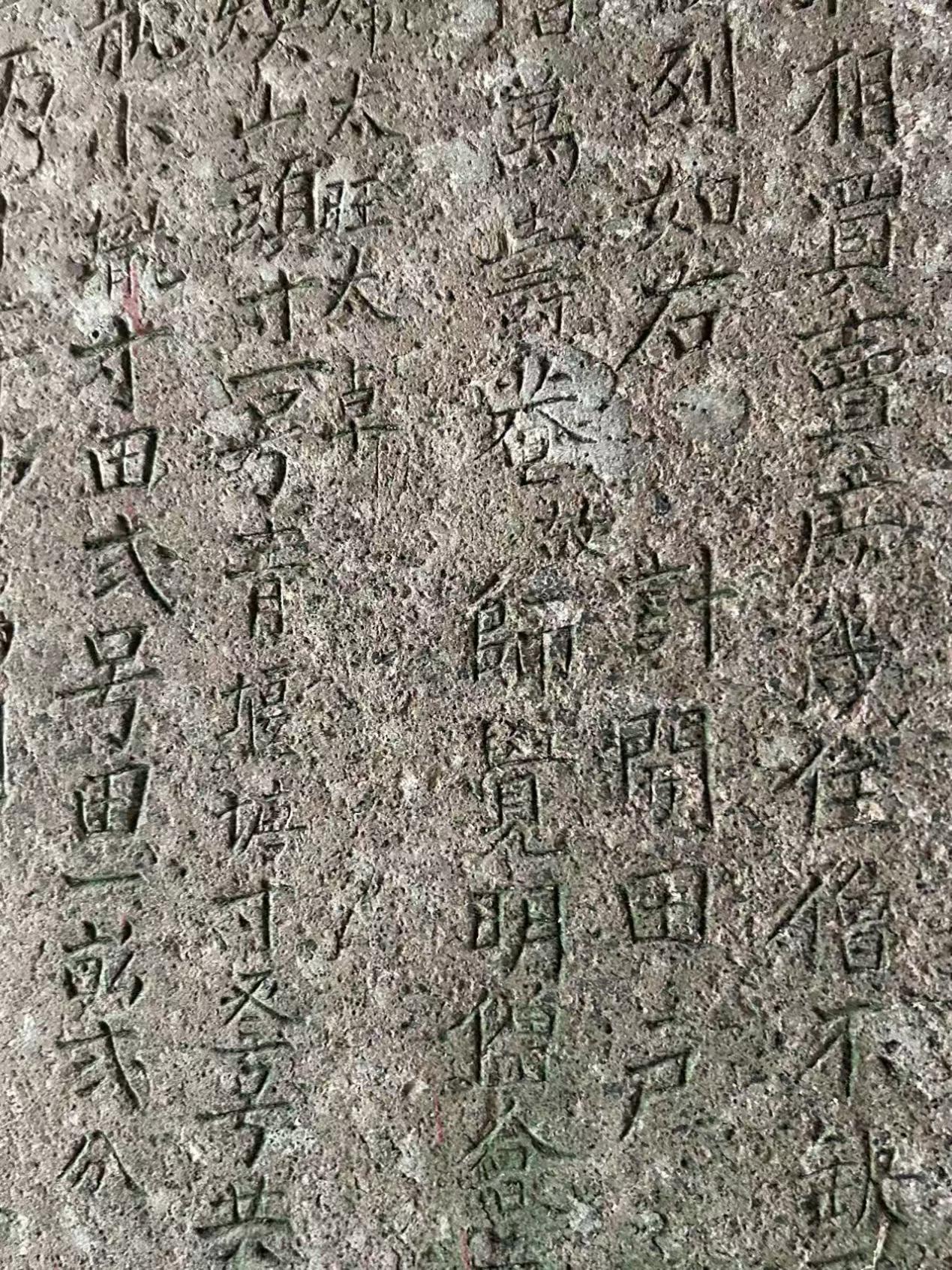
Photo by Wang Qun of the "Tea Party" Monument of Emperor Qianlong of the Qing Dynasty
As time went by, the original tea fields were "privately sold", and the temple life could not be maintained. For this reason, the villagers erected this monument and made an agreement on the donor and the number of acres of land "as engraved on the right". The inscription can reveal the general contents of the donation of Lingtou Mountain and Qingyantang fields by Zheng Taihuan and four other brothers, as well as the donation of fields by Li Yuanlong. Unfortunately, due to the passage of time, the number of acres cannot be clearly identified.
The small temple outside the north wall of the tea pavilion may be the "Wanshou Temple" in the Qianlong Monument, and is now called "Huiyun Temple". There are five or six red and yellow-edged silk banners hanging on the walls of the nunnery, one of which is printed with the words "Worship the Empress of Suzhou, Suzhou Bodhisattva and Marshal Ma". It can be seen that although this place is remote, the incense is constant.
Since the Kangxi and Qing Dynasties of the Qing Dynasty, the world has been at peace, and tea drinking places are spread all over the countryside and famous mountains and rivers. Mount Tai is the "first of the five mountains". Emperor Qianlong climbed Mount Tai for the sixth time and ordered the abolition of the incense tax on Mount Tai, so that people could freely enjoy incense. In order to rush to the top of the mountain at dawn to burn "first incense", pilgrims from all over the world often choose to set off in the middle of the night. Mount Tai has "ten thousand lights" at night, and is known as the "Mountain that never sleeps".
Ten years after the "Tea Party" monument of the Qing Emperor Qianlong in Lingtou, Xiangshan Walker, was built, Hou Yihe, a Shanxi merchant who was doing business in Tai'an Prefecture, where Mount Tai is located, Shandong Province, and others initiated and united with fellow villagers to donate more than 300 taels of silver to build a tea pavilion opposite the Guandi Temple located at the "toe of Mount Tai" to provide free tea to climbers to relieve the thirst of passers-by. Local official Wan Sinian specially wrote the "Inscription of the Creation of the Tea Pavilion" to record this good deed. "Each year there are hundreds of thousands of people who climb mountains to offer incense, and they rarely take a rest." The pilgrims are so tired from toiling that "suddenly there is a pavilion to stop, and there is tea to quench their thirst."
China's tea-giving custom, which began with religious compassion in the Middle Tang and Five Dynasties, gradually evolved into the "road corridor tea pavilion" culture that was filled with the Confucian "Jianji" spirit and spread all over the world during the Ming and Qing Dynasties. Its meaning is just like what is said in Wan Si Nian's inscription: "If a man is good, how can he be divided into big and small?"
When I was in elementary school, not far from my home was Ru River, which leads to the sea. A five-hole stone bridge "Wuyan Bridge" spanned the stream. After crossing the bridge, there was a tea pavilion with a corridor named "Wuli". After walking for five miles from "Wuli Pavilion", we arrived at Shipu Town and Yanchang Primary School where we studied.
"Wuli Pavilion" is a happy teahouse where adults from nearby villages talk about the past and present, a roadside market for small businessmen and vendors, and a youth paradise for me and my playmates. There is a long stone bench against the wall of the tea pavilion, with a large stoneware vat in the middle, and two semi-round wooden covers placed on top to block dust and flying insects. Every day after school, we walked along the dirt road beside the Yanchang Citrus Field and played the game of "field war" all the way home.
When we arrived at the tea pavilion, we drank a few bowls of tea to quench our thirst. I remember that Prunella vulgaris is added to the tea soup in summer, and sometimes ginger slices, platycodon, etc. are also added. Lu Yu advocated tea drinking, from sencha in the Tang Dynasty, ordered tea in the Song Dynasty to loose tea in the Ming and Qing Dynasties, pursuing the purest flavor of this magical leaf, and eventually became the mainstream of the tea world. Interestingly, Lu Yu did not agree with the inclusion of ginger, orange and other flowers and plants in tea in the "Tea Classic". In the vast rural China, they are like clear springs flowing freely in the mountains, continuing the origin of tea drinking as "medicine and food come from the same source". Regardless of the pungency of ginger, the fragrance of orange, the sweetness of dates, or the bitterness of grass, they can all be used in tea, with thousands of mountains and valleys, and a variety of flavors.
In the tea pavilion, we played tops, made bets on folded pieces of paper from cigarette boxes, and the most exciting thing was pulling sugar cane shreds. Sugar cane is sold at a roadside stall outside the tea pavilion. Sections of sugar cane are placed on the small table. The green skin is refreshing and the purple skin is sweet and thick. The price varies from one cent to two cents. Pick a section of sugar cane and ask the master to gently cut a circle in it with a sugar cane knife. My playmate and I each hold one end and use our skills to break the sugar cane. Whoever has the longest sugarcane silk in his hand wins, and the loser pays.
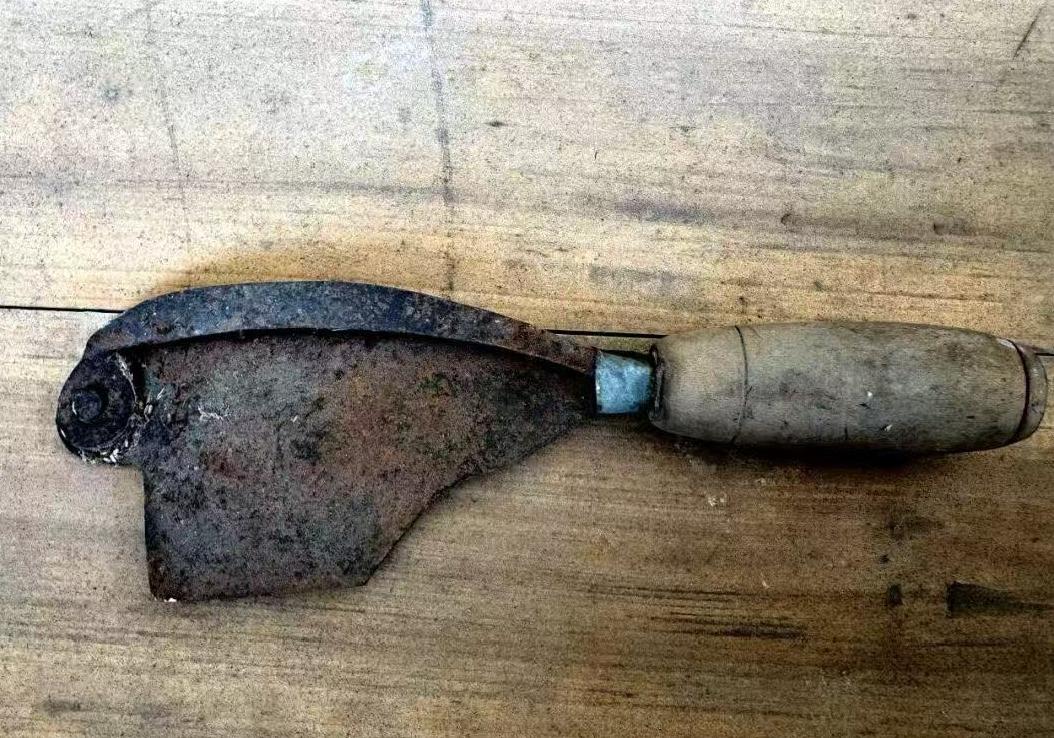
Sugar cane knife picture taken from the Internet
On the Ming and Qing ancient road from "Wuli Pavilion" to the town, the most famous tea pavilion is the "Zhongxi Pavilion" halfway up the Hougang Mountain. It was rebuilt in the 1920s and is called "Sanwan Road Corridor" by the locals. The "Sanwan Corridor" is built across the road, facing east from the west, overlooking the boundless East China Sea.
During the Spring Festival this year, I walked to this corridor that I often walked through when I was young. The corridor has been abandoned for a long time. Fortunately, it is located in the middle of the mountain and its overall appearance is still there. It has been listed as a county-level cultural protection unit. The corridors have gabled Guanyin gables in the north and south. The square stone pillars in the corridors are cinched up and the ground is paved with stone. The Lulang Bodhisattva "Sangha Bodhisattva", also known as "Sizhou Bodhisattva", is enshrined in the west wall of the corridor. It is regarded as the male incarnation of Guanyin Bodhisattva. It is a god who prays for wind and rain among the people along the coast of Zhejiang and Fujian.
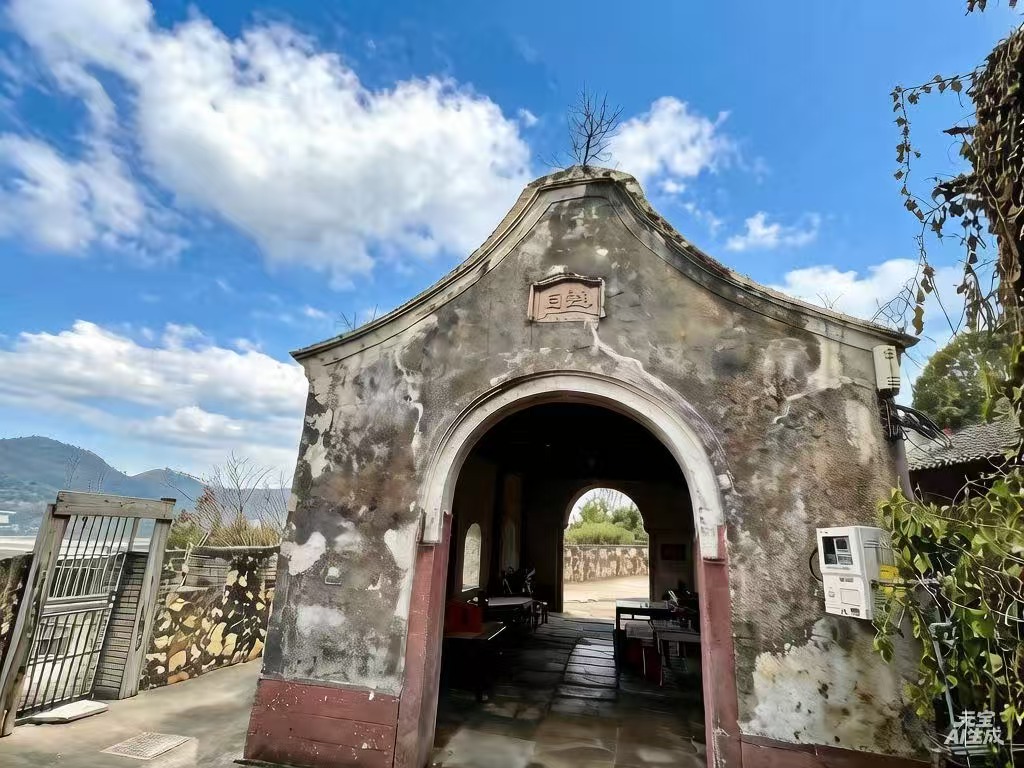
"Sanwan Road Corridor" in Shipu, Xiangshan. Photo by Gao Zihua
The couplets on the stone pillars on the left and right of the shrine express the meaning of enlightenment: "The grace of Sishui River lasts through the ages; the rain of Dharma in Lijiang River spreads to all people."
There is another couplet on the two stone pillars in front of the shrine, which integrates the customs, mountains and sea scenery of Shipu Ancient Town, giving it a unique flavor. Unfortunately, like the couplets above, they are in disarray, and we have to consult local literature to complete them. The left couplet is: "The tide of copper tiles is coming, and I stand still to listen to several fishermen's songs. A sky supports the river, and the illustrious gods always protect it." The right couplet is: "When Shijiang enters the city, you can see thousands of dragons and lins. Three bays lead to Shizhen, and old and old passers-by are temporarily connected."
There are two arched doors on the west wall of the corridor, which are narrow on the outside and wide on the inside. This design can reduce the intrusion of wind and rain when the seaside climate is unexpectedly stormy. The round stone plaque above the lintel is embossed with four characters in a ring, which are: "It's okay to sit down; come when you go." The words are simple and straightforward, which is very consistent with the character of the fishermen on the seaside.
Walking out of the corridor, the fishing port in front of you is densely packed with steel fishing boats returning to the port during the Spring Festival. The boats are lined with masts and colorful flags are flying. In the distance, the sea and the sky meet in the vast expanse. All kinds of emotions suddenly come to my heart.
This is the philosophy of serving tea: rooted in secular life, simple and gentle, whether you are a nobleman or a commoner, it is a bowl of water when you are thirsty and a comfort after a tiring journey. A bowl of tea soup can reveal people's hearts, equality and compassion. Just like the earth bearing the dew, it doesn’t fight or reveal itself, but it spreads in all directions, realizing the eternity of the moment.