Source: jiji
You may have heard that the ground is collapsing, but did you know that the ground can also "spit" out buried pipes?
At about 6:50 in the morning on March 11, 2026, under the New Midosuji Viaduct in Tsuruno-cho, Kita-ku, Osaka City, passers-by called the police saying that concrete fragments fell from the construction site.
Source: jiji
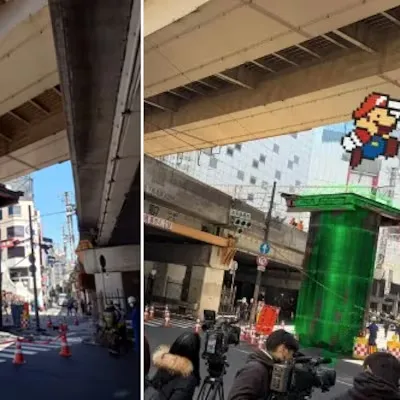
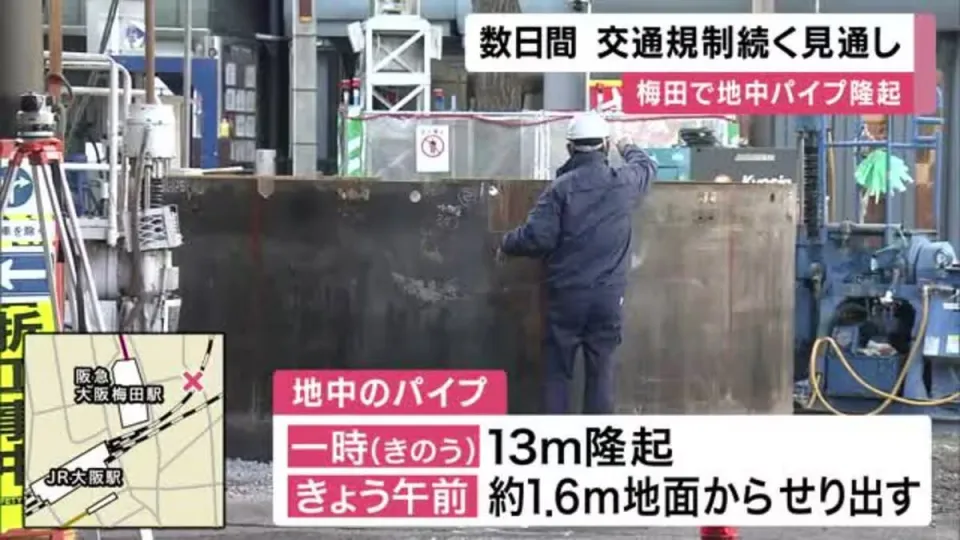
A steel casing with an outer diameter of about 3.5 meters and a total length of about 27 meters rushed vertically out of the road from a sewer construction site without an earthquake, explosion, or any external force. The highest exposure was about 13 meters, which is close to the height of a four-story building.
Witnesses recalled to Kansai TV that the object suddenly stood up and they had no idea what was happening. A nearby worker initially thought a new road support column had been built overnight.
The image of the tube standing next to the HEP FIVE Ferris wheel spread across social media around the world, and CNN used "Super Mario" in the accompanying text of the news.
Source: Internet
Why is this happening?
This pipe weighs dozens of tons (estimates vary from source to source). It is a vertical working shaft of a sewer renovation project in Osaka City. Its scientific name is "vertical pit".
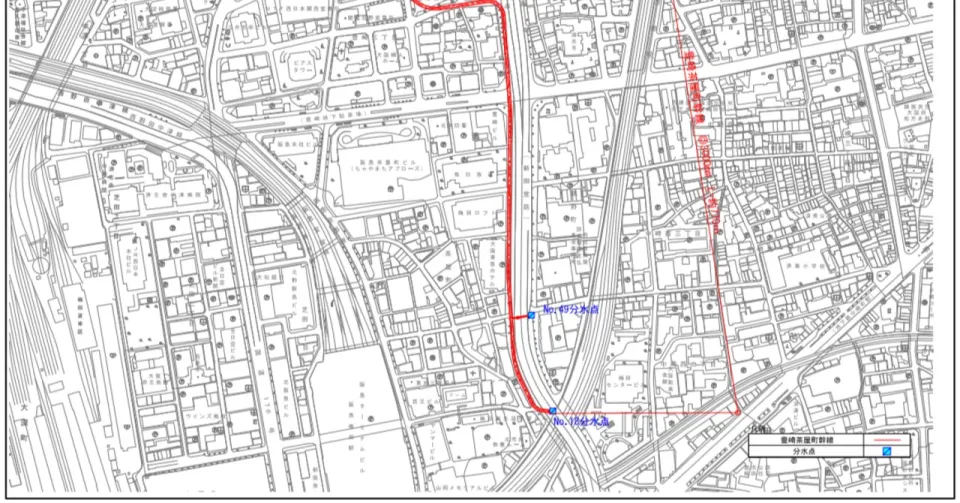
The construction adopts the full casing excavation method, which means that the steel pipes are rotated and pressed into the ground to form a vertical passage. The pipe installation began on January 21, 2026, and was eventually driven into the ground to a depth of approximately 30 meters. The goal of the project is to build a deeper rainwater storage pipe under the existing sewer, which can be used for temporary water storage during heavy rains to prevent waterlogging in the Osaka Station area.
The picture below shows the route map of Osaka City’s “Toyosaki to Chayamachi Main Line” underground pipeline project:
Source: jiji
During the day on March 10, construction workers drained the water inside the pipe as planned. No abnormalities were found after the extraction. But this operation fundamentally changes the mechanical state of the tube.
Here we must first explain a basic principle: hydrostatic buoyancy. When an object is immersed in a liquid, the liquid exerts an upward force on it equal to the weight of the liquid it displaces. If the interior of the object is empty and the volume of liquid displaced is much greater than the volume of the object's own material, the upward buoyancy force may be greater than the downward gravity.
The groundwater level in the Umeda area is extremely high, only about 2 meters above the ground. The total length of the pipe is about 30 meters, which means that there are about 28 meters of water column above the bottom of the pipe exerting upward pressure on the pipe wall and bottom. When the pipe is filled with water, the internal and external water pressures are roughly balanced. Coupled with the friction between the pipe wall and the soil and the approximately 2-meter-thick anti-floating concrete poured at the bottom of the pipe, the system is in a stable state.
But once the water in the tube is evacuated, there is no more internal water pressure to offset the external water pressure, and the net buoyancy increases sharply.
Source: FNN
Expert analysis from MBS News pointed out that there are two key factors that cause the pipe to rise: the buoyancy force generated by underground water pressure, and the friction between the pipe wall and the surrounding soil is insufficient to resist this buoyancy force.
According to an estimate by a Japanese registered technician on the platform, the buoyancy force exceeded the sum of the pipe's own weight, anti-floating concrete and soil friction. The internationally recommended anti-buoyancy safety factor for underground structures in areas with high groundwater levels is above 1.25, that is, the resistance should be at least 1.25 times the buoyancy. The actual safety factor of this construction site obviously did not meet the standards.
So the tube floats. Instead of seeping out slowly, it broke through the asphalt road surface within a few hours and rose vertically 13 meters.
In short, for pipes, no matter how heavy they are, as long as your heart is empty enough, water can always hold you up.
What to do after the tube comes out?
The Osaka Fire Brigade’s plan is very straightforward:
Since the pipe floats because it is too light, fill it with water and let it sink again. The specific method is to use a welding gun to cut a square opening on the pipe wall exposed above the ground, and extend the fire hose into it to fill it with water. The pipe then sinks, and the incision is lowered to the ground and then welded shut, and a new opening is cut above to continue filling. Repeatedly.
Follow-up: At 3 p.m. on March 13, the official account of Osaka City Kobo announced that the elevated section had resumed traffic, but the Chayamachi exit and surface roads were still under control.


Image source: Stephen Axford, Planet Fungi Curtis
In recent years, cultivating small luminous mushrooms (such as Mycena chlorophos, pictured above) as indoor ornamental fungi has become an experimental direction for some biology enthusiasts.
However, this fungus is not suitable for growing indoors.
Luminous mushrooms are naturally distributed in tropical and subtropical humid forest areas. The formation and maintenance of luminous fruiting bodies usually require a constant temperature of 25 to 27 degrees Celsius and a relative humidity of more than 80%. Ordinary indoor environments are usually dry and have large temperature fluctuations, which cannot meet the conditions for mushroom production.
At the same time, glowing mushrooms are saprophytic fungi that rely on decomposing organic matter such as rotten wood and fallen leaves to grow. Arranging and maintaining rotten substrates indoors can easily lead to contamination by Trichoderma, Penicillium and other miscellaneous bacteria, and breed indoor pests such as mushroom midges and mites.
Moreover, the fruiting bodies of glowing mushrooms only last a few days, and the brightest glowing stage usually only occurs one or two nights before the spores are released.

Source: giphy
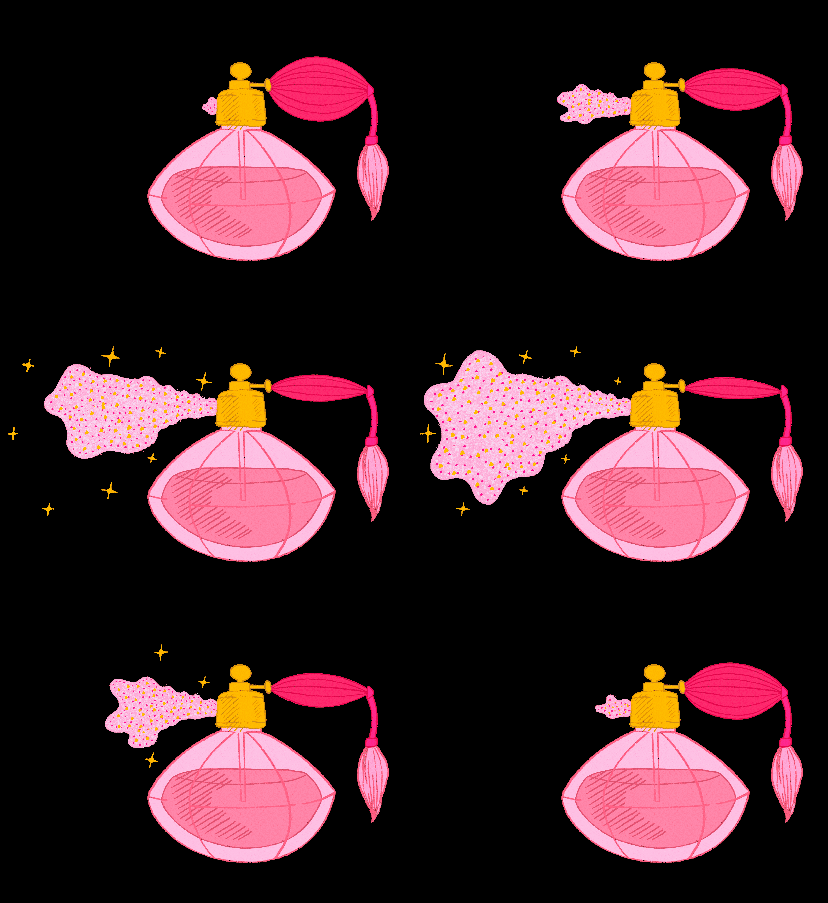
The main ingredients of perfume are solvents (usually more than 70% ethanol) and a variety of volatile essential oils and aromatic compounds.
Most plastics (such as polymers such as PET, PE or PP) are prone to chemical reactions when exposed to such organic solvents. Ethanol may dissolve additives or plasticizers used in the plastic manufacturing process, causing these chemicals to seep into the perfume and change the original smell.
Certain aromatic ingredients can also cause plastics to degrade, turn black or deform. The main component of glass is silica, which is chemically stable and inert. It will not react with perfume ingredients and can keep the liquid pure.
Moreover, plastics are porous at a microscopic level and are semipermeable materials. If you store perfume in plastic bottles, highly volatile molecules will gradually escape through the plastic walls.
At the same time, external oxygen can also enter the bottle through the plastic, causing the fragrance ingredients to undergo oxidation reactions, destroying the chemical structure and odor levels of the perfume. Glass is a dense material that can block gas exchange and prevent internal volatilization and external oxygen intrusion.