According to Hong Kong's "South China Morning Post" report on March 16, Fu Zhiwei, a representative of the National People's Congress and chairman of Xuzhou Bokang Chemical Technology Co., Ltd., a domestic leader in photoresist, revealed during the two sessions that China's photoresist industry is moving from "single breakthrough" to "system development" and will enter a critical stage of accelerating breakthroughs and large-scale applications in the next few years. He said that the company plans to achieve mass production of multiple advanced process core photoresists within five years. At present, it has conquered the entire chain of mid-to-high-end photoresist technologies in KrF and ArF. The products have been verified by the head wafer factory and are gradually starting to increase in volume.
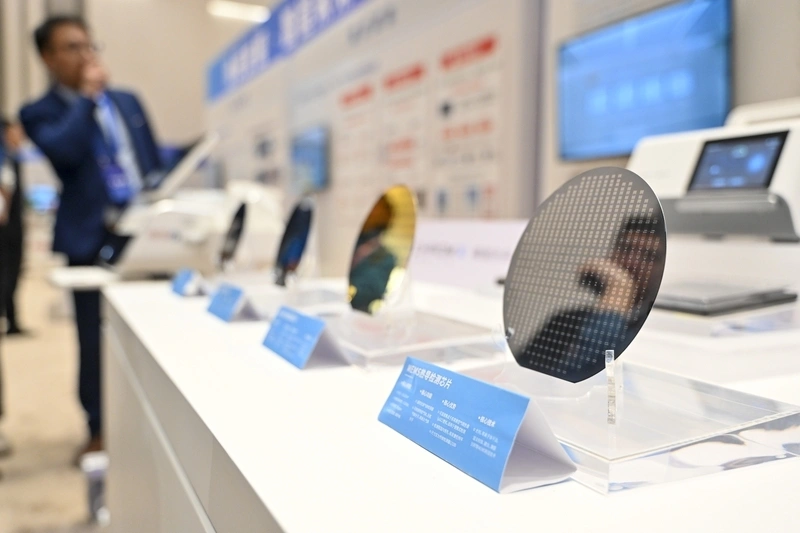
On February 24, 2026, the 2026 Guangdong High-Quality Development Conference was held in Guangzhou. The picture shows the chip products displayed at the conference. IC Photo by China News Service reporter Chen Jimin
Photoresist is an organic chemical material that is sensitive to light. It is coated on the surface of the wafer during the photolithography process and forms a patterned film through exposure and development. It is used as a mask for processes such as etching or ion implantation. It is the core basic material for chip manufacturing. The material is classified according to exposure wavelength, including G line, I line, KrF, ArF, EUV and electron beam, among which KrF, ArF and EUV belong to the most advanced technology categories.
The importance of photoresist is self-evident, but the high-end market has been monopolized by Japanese and American companies for a long time: 95% of the photoresist market for integrated circuits is occupied by Japanese and American companies. Major companies include Japan's JSR, Shin-Etsu Chemical, TOK, Sumitomo Chemical, and DuPont of the United States. Among them, JSR and TOK hold monopoly positions in the field of high-end EUV photoresist.
However, domestic companies have also accelerated their layout in recent years, striving for local substitution.
Fu Zhiwei said in an interview with the South China Morning Post during the National Two Sessions last week that the photoresist industry, as the core material of the photolithography process, will enter a critical stage of "accelerating breakthroughs and large-scale applications" in the next few years. The company's goal is to achieve mass production of multiple advanced process core photoresists within five years.
Fu Zhiwei said that with increased investment, the domestic photoresist industry is moving from "single breakthrough" to "system development."
He said that Xuzhou Bokang's core goal is to overcome key technologies in "stuck" fields such as KrF and ArF photoresist.
"We will mobilize our core resources to focus on the research and development of high-end photoresist for more advanced process nodes."
Fu Zhiwei revealed that the company has achieved independence in the entire industry chain from monomers, resins, photoacid to final photoresist products. Among them, KrF and ArF mid-to-high-end products have been verified by the head wafer factory and are gradually being mass-produced.
The report described that at a time when competition in advanced semiconductor technology between China and the United States is intensifying, the above statement highlights China's latest move to strengthen its chip independence strategy in accordance with the "15th Five-Year Plan".
In recent years, my country has continued to make efforts on the policy front to promote the localization of photoresist. The "15th Five-Year Plan" outline clearly states that the integrated circuit industry requires refined and mature processes, improves advanced process manufacturing capabilities, accelerates the development of key equipment, materials and components, and develops high-performance processors and high-density memories.
According to a research report released by Caitong Securities, many domestic companies in ArF/ArFi photoresist are in the development and verification stage.
For example, Dinglong Co., Ltd.’s Qianjiang Phase II high-end KrF/ArF wafer photoresist mass production line with an annual output of 300 tons has entered the trial operation stage as planned. The current overall rhythm is good. Its Qianjiang Phase I 30-ton KrF/ArF high-end wafer photoresist production line has mass production and supply capabilities; Shanghai Xinyang has built I-line, KrF, A A complete R&D and production platform for various types of rF dry and ArF immersion photoresists, and has achieved mass sales; Tongcheng New Materials subsidiary Beijing Kehua's multiple KrF photoresist products have passed mainstream wafer factory and storage plant certification and entered the batch supply stage; Nanda Optoelectronics' three ArF photoresists in 2024 have achieved revenue of tens of millions of yuan.