She has long regarded Xi'an as her real home, but the family still tenaciously maintains the Persian traditions of incestuous marriage, chanting scriptures, and worshiping fire.
They spoke Chang'an dialect, and the men often wore robes to worship fire and recite scriptures. They were soldiers or businessmen by profession. They opened rows of shops in the East and West Markets of Chang'an. Ma Xishi's clothes and home furnishings must have been filled with carpets, spices, jewelry, and clothing materials from Persia.
The magnificence of the tolerant Tang Dynasty not only allowed a group of Persians to find a second home, but also allowed Chinese civilization to integrate into global civilization and gain a new life.
When the young girl passed away, her tomb seamlessly blended Tang Dynasty and Persian styles:
The walls are painted with images of flying apsaras, and Persian silver coins are placed in the corners. Craftsmen carved bilingual inscriptions with a Sasanian crown pattern cast on the surface; a Persian-style oil lamp with flame patterns engraved on the body to highlight their faith;
Speaking of the Persian Sassanid Dynasty that the Persians of the Tang Dynasty keep in mind, people are full of emotions.
This was the last pre-Islamic empire in Persian history and one of the pinnacles of ancient Persian civilization. From 224 to 651, it lasted more than 400 years.
The silverware of the Sassanid Dynasty is world-famous. Gilt silver plates and stained glass became daily necessities in the Tang Dynasty. Sasanian silver coins and silverware were scattered like pearls on the oases of the Silk Road.
The Sassanid Dynasty was one of the centers of world civilization at that time. It had an "Academy of Wisdom" that originated from a library as large as Alexandria in Egypt. It also had an academic center like the Academy of Athens in ancient Greece, integrating Greek, Indian, and Persian knowledge. It is an indispensable and important memory in the history of human civilization.
Human greed makes it difficult for a certain civilization to last forever.
On the Central Asia Road, northwest of Kabul, the Bamiyan Buddhas, which are more than a thousand years old, were blown up by artillery fire. The artillery fire that fell on Tehran in 2026 destroyed the Rose Palace, a world civilization heritage in Iran, and covered the floor with glass.
When people praise the magnificence of war, I prefer to praise ordinary happiness and the openness and comfort in the blending of cultures.
War is inevitable, but war is not worthy of praise.
During the Five Dynasties, Li Xun, a descendant of the Persian Sasanian royal family and a famous poet, wrote the famous line, "The west wind looks back with sadness, and the evening rain sprinkles the empty temple", which expresses the desolation of history.
The development of mankind is accompanied by countless wars. This time, what will happen on the land of Persia? What will happen in the future?


Quick victory is just a fantasy, we will see the real story in a month
On March 9, 2026, the US-Israeli military strike against Iran entered its 10th day.
Lao Chuan's war bet became inconsistent.
On March 7, Lao Chuan made a high-profile statement at the Western Hemisphere Leaders' Meeting in Miami that the US military operation was very successful. At the same time, he adjusted his remarks about the war.
From the initial attempt to overthrow the Iranian regime, to the subsequent efforts to destroy Iran's missile capabilities, annihilate its navy, and prevent it from possessing nuclear weapons, to US Defense Secretary Hegseth's clarification that it was not a regime change war.
Both sides are likely to get stuck in the quagmire.
On March 9, Phoenix News client chief writer Tang Pihu analyzed the battle losses on both sides. The reality is cruel: Iran's military counterattack capabilities are shrinking at a faster rate than the "Twelve-Day War" in 2025.
Iran's average daily launch volume of ballistic missiles dropped off a cliff: 350 on the first day, 175 on the second day, 120 on the third day, 50 on the fourth day, 40 on the fifth day, 32 on the sixth day, 28 on the seventh day, and only 15 on the eighth day.
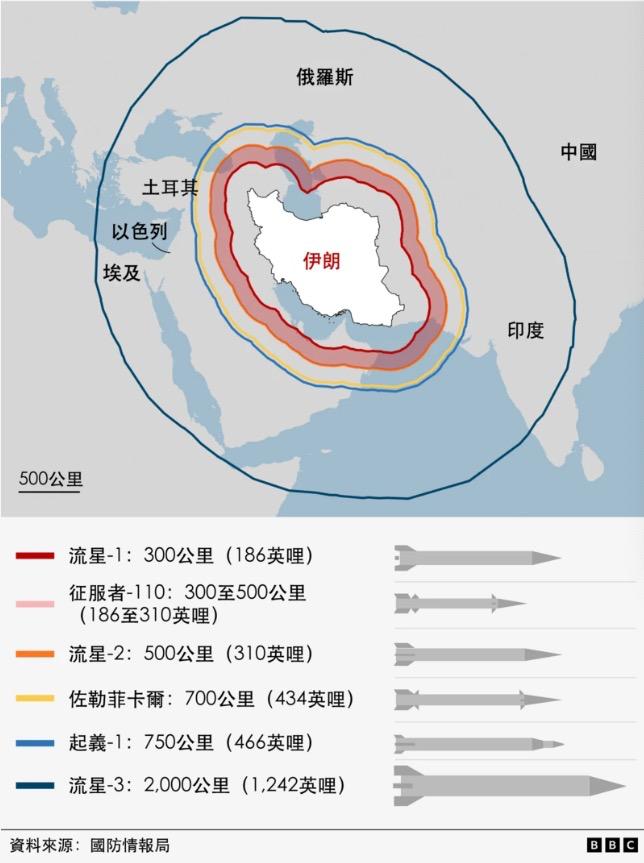
The number of suicide drones launched by Iran dropped from the initial 540 to only 12.
Importantly, most of the missile transport and launch vehicles (TEL) were destroyed. The Israeli army announced that it had destroyed more than 300 vehicles. Before the war, there were only about 400 vehicles left in Iran. Iran has more than 800 medium-range missiles and more than 200 short-range missiles remaining in stock, and is unable to use them.
Moreover, because they are monitored in real time by drones and infrared satellites, Iran's missile forces are trapped in the dilemma of being "destroyed upon launch".
So, is it time for the United States and Israel to declare victory? The situation is not that simple.
The development of a region cannot be solved by a decapitation operation or a war. Afghanistan and Palestine are examples of this.
Although the U.S. weapons inventory is abundant, it is temporarily unable to meet the needs of extreme warfare.
Tang Pihu estimated that if the United States and Israel wanted to destroy Iran just as the Kosovo War destroyed Yugoslavia, based on the same military density of "dropping 2,300 bombs per 10,000 soldiers", 104,000 ammunition would be needed against Iran's 450,000 troops (equivalent to 4.5 Kosovo Wars).
Taking into account the fact that almost 100% of modern ammunition is precision-guided munitions (only 35% in Kosovo), 36,000 precision-guided munitions are needed.
According to the BBC report, the U.S. inventory of precision-guided missiles is extremely depleted. On March 6, Lao Chuan held an emergency meeting and asked military industrial companies to expand production to meet the requirement of "nearly unlimited supply."
In response, the U.S. military industry sector responded, but not strongly.
Back to square one, war is a confrontation between economic and technological power.
We-media IPP comments quoted an analysis article published by the Center for Strategic and International Studies (CSIS) on March 5. In the first 100 hours, the total cost was estimated to be approximately US$3.7 billion, with an average daily cost of approximately US$891 million.
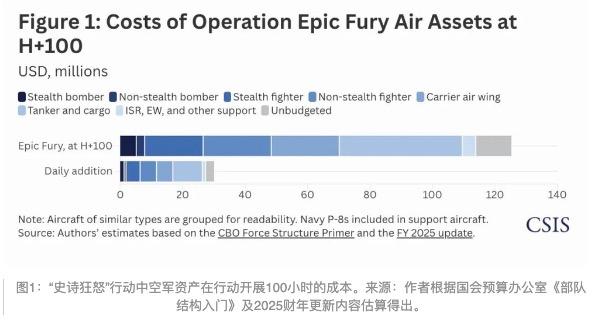
According to some people's estimates, if the war lasts for one month, the cost will be about 30 billion US dollars. If it enters a ground war, the cost will be even higher.
Of the $3.7 billion in costs, only $200 million has been included in the budget, and the remaining $3.5 billion is unbudgeted expenses that need to be filled by the Pentagon through supplementary appropriations bills or budget reconciliation bills.
It's not that easy to get taxpayers to foot the bill. Although the U.S. Department of Defense's defense budget for fiscal year 2026 is as high as US$1.01 trillion, the funding gap for the Iran war needs to go through legal procedures.
The war further tore American society apart.
A Reuters/Ipsos poll conducted on March 1 showed that only a quarter of Americans support the use of force against Iran. According to history, the longer the war lasts, the lower the support.
However, a poll conducted by NBC News on March 8 showed that 90% of MAGA supported Lao Chuan’s use of force against Iran. Supporters and opponents are incompatible.
If this was Lao Chuan's purpose, to disrupt the country so that he could go against common sense in the midterm elections, then he succeeded.
If the war situation is not clear by the end of March, the problem will be serious.


The market is calm, this is an illusion
On the surface, global markets are relatively calm.
At 7 pm Beijing time on March 9, WTI and Brent crude oil prices fell from their morning highs of around US$116 per barrel.
On March 9, the Zero Hedge website published an article by Tony Pasquarillo, head of Goldman Sachs’ hedge fund business, pointing out that market calm is an illusion.
Since the outbreak of war in Iran on February 28, the S&P 500 has fallen only 2%, masking an undercurrent of chaos and panic.
The article is very long, so I found a graph that best illustrates the problem. Take a look at the oil price volatility below, which is the fear index for WTI crude oil.
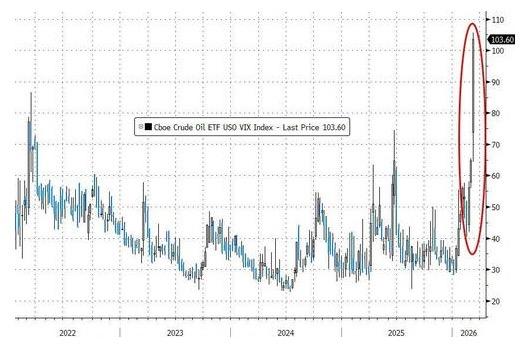
Global oil prices are unstable and the economy cannot be stable.
Another piece of data also showed the illusion of market calm. Goldman Sachs pointed out in another analysis article that although the maximum retracement of the S&P 500 index was only -3.4%, the Goldman Sachs U.S. Volatility Fear Index closed at 9.72 on March 6.
The internal pressure is huge, the index is calm, and the gap is huge. In our first analysis article after the war, we pointed out that such illusions currently exist in both domestic and external markets.
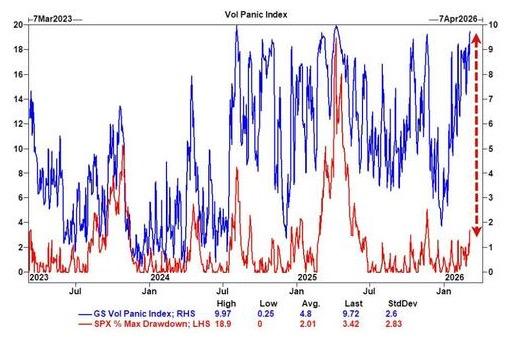
Judging from the data, the market is extremely volatile, the leverage ratio is high, and only a handful of people are making big money. Many investors want to take advantage of the war to make a fortune.
Sure enough, wealth is often stained with blood.
In the face of a possible energy crisis, China has become a rare safe haven, with the smallest decline, which can be regarded as a win. In the past, we always compared A-shares to men's football. When the international market rises, it falls, and when it falls, it also falls. But this time we are tough. Why?
Because China's manufacturing is not what it used to be. The more turbulent it is, the more resilient it is.
According to statistics from Zhongtai Securities, the conflict that began in 2022 became an opportunity for manufacturing in China. Since then, the proportion of China's exports has continued to rise, and in 2025 it hit the highest record in history.
Will the conflict in 2026 be a repeat of the situation four years ago? At present, it is very possible.
Under the influence of the conflict, industries with high energy costs such as chemicals, metals, and ceramics are changing in a direction that is beneficial to Chinese manufacturing.
In the petrochemical field, the entire Middle East is falling into a wave of production shutdowns, and almost all upstream raw materials are experiencing sharp prices.
Europe suffered greatly from the round of changes in the petrochemical industry in 2022, and history is repeating itself this time.
Huntsman and other European petrochemical industry giants have already suffered losses due to rising raw material prices. The sudden outbreak in 2026 will make these giants even more uncomfortable. Simply raising prices is far from enough to make up for the losses caused by the lack of raw materials.
Chinese chemical companies, which have sufficient energy reserves and rely on coal as their core energy source, are gradually filling the market gaps created by their competitors.
Changes in oil prices often have an impact on agricultural products, partly due to changes in fertilizer prices.
The place where this round of conflict occurred is the core supply area of nitrogen, potash and phosphate fertilizers in the world. After the conflict, news of the suspension of production of related fertilizer production capacity continued to spread.
China is the world's largest producer of chemical fertilizers, with its production of nitrogen fertilizers, phosphate fertilizers and potash fertilizers accounting for 26%, 30% and 14% of the global total respectively. Under the current circumstances, China Fertilizer will undoubtedly benefit greatly.

There are many categories similar to the petrochemical industry, such as electrolytic aluminum and ceramics.
The closure of the Strait of Hormuz has caused 90% of production capacity in India, the world's second largest ceramic producer, to be suspended.
The chairman of the Morbi Ceramics Manufacturing Association said that ceramics is a typical energy-intensive industry. India mainly relies on liquefied petroleum gas as raw materials. With the closure of the Strait of Hormuz, the liquefied petroleum gas inventory of Indian ceramics can only last for 3 days.
As the world's largest ceramic supplier, Chinese companies are gearing up.
In 2022, Europe will be short of natural gas and other energy sources, leading to higher-than-expected energy storage demand.
Now it may happen again.
Before the conflict, Europe expected that energy storage capacity would increase by 55% in 2026. The sudden start of the war forced many dealers to stock up and place orders in advance.
According to Yangtze Securities, European energy storage demand is expected to improve across the board in the second quarter, and inverter shipments have begun to be revised upward. The production schedule of some companies in 26Q1 is close to the level of 2025.
On March 6, a domestic energy storage company signed a two-year 8.3GWh energy storage system supply agreement in Italy.
8.3GWh What is the concept? This is equivalent to the annual installed capacity of energy storage in a medium-sized European country.
No one knows when there will be a ceasefire and when the waterway will be unobstructed, but after experiencing so many turbulences, the strength of China's manufacturing industry can no longer be affected by turmoil.
I hope that today’s China will be as generous and open-minded as it was in the Tang Dynasty, providing shelter to the 26-year-old Persian girl and their tribe, and giving themselves a broader space for development.
No matter what the market says, one conclusion is certain, war causes suffering to civilians.