On March 17, local time, Francis Donovan, commander of the U.S. Southern Command, revealed during an inquiry that the military is closely monitoring China's 23 port projects and 12 aerospace-related facilities in Latin America, and has labeled them all as so-called "potential dual-use assets", claiming that these facilities may "provide support to China's military operations" in the future, thereby posing "risks" to the United States. Analysts believe that this is just another manifestation of the U.S.'s "Tang Luo Doctrine" hegemonic thinking.
According to the Hong Kong English-language media South China Morning Post, Donovan disclosed the relevant information at a hearing held by the House Armed Services Committee on the U.S. military posture in the Western Hemisphere.
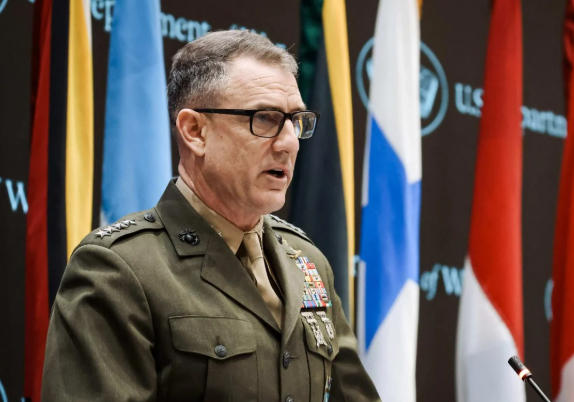
Francis Donovan, commander of U.S. Southern Command
When asked by U.S. Rep. Lance Gooden, Republican of Texas, whether China’s commercial projects in Latin America “may be used for military purposes,” Donovan said that no matter how these projects are constructed, the U.S. Department of Defense regards them all as “dual-use facilities.”
“I think they are all dual-use,” Donovan said. “To be specific, whether they are built in the context of military infrastructure or just as a functional facility, they may be used to support Chinese operations.”
He also exaggerated that China's growing influence in the mining and processing of key minerals in Latin America poses "long-term risks" to the U.S. defense industrial base. Donovan said that 12 aerospace-related facilities are concentrated in the southern region of South America, but did not disclose the specific names of these facilities and the countries where they are located.
The hearing comes as the Trump administration has cited China's infrastructure development in the region as a major security concern.
In December last year, the White House released a national security strategy, promising to prevent non-Western countries from expanding their foothold in the Western Hemisphere. The document lays out what officials call the "Donno Doctrine," asserting that the United States will prevent rivals outside the Western Hemisphere from owning or controlling strategically important assets in the region.
Joseph Hummel, the U.S. Department of Defense’s senior civilian official for Western Hemisphere affairs, echoed this statement. He also said at the hearing that the US policy is to prevent opponents from entering key areas from Alaska and Greenland to the Panama Canal and surrounding countries.
When talking about Brazil, Donovan said that the United States is intentionally pushing the Brazilian military to distance itself from China.
In September 2024, in the "Operation Formosa", one of the largest amphibious exercises in Latin America led by the Brazilian military, the US military and the Chinese army jointly participated in the exercise for the first time. This was also the first time that the two militaries trained side by side since 2016. The following year, the United States withdrew from the exercise, citing its unwillingness to share training grounds with Chinese troops.
Donovan said that this year, China will be excluded and the United States will participate in the exercise. The Brazilian Ministry of Defense has not yet responded to whether China will be invited.
Donovan said that strengthening the relationship between the United States and the Brazilian military is the direction of advancement for the United States, and that broader diplomatic issues will be handled by the U.S. State Department.
Analysts pointed out that the above-mentioned stance reflects that the United States is making full efforts to restrict China's infrastructure layout in Latin America.
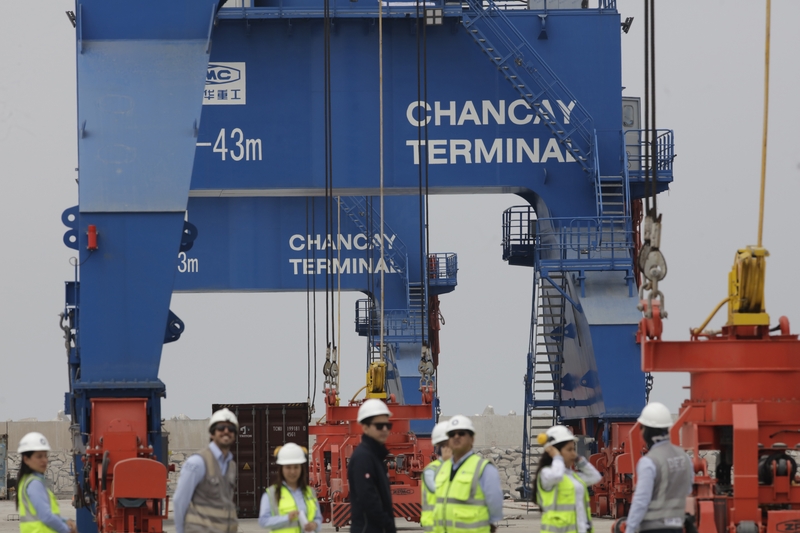
Port of Chancay, PeruIC Photo
The South China Morning Post reported earlier that a U.S. diplomat had put pressure on Brazilian port executives in Santos, saying that the U.S. did not want Chinese companies to obtain the main container terminal concession in Latin America’s largest port. The U.S. Consulate General in Sao Paulo later confirmed that the U.S. was concerned about Chinese companies participating in the bidding.
During the hearing, Rep. Jennifer Keegans, a Republican from Virginia, mentioned the advancement of the Belt and Road Initiative in Central and South America and asked whether governments in the region were becoming increasingly skeptical of China’s infrastructure proposals.
Donovan responded that the United States is "still concerned" about China's ability to deploy "military and civilian dual-use projects" in the region, and compared it with Djibouti, claiming that China established its first overseas military base in Djibouti through port financing.
Donovan and Gen. Gregory Gilot, commander of U.S. Northern Command, also confirmed that U.S. Northern Command and Southern Command are cooperating through a series of joint exercises called "Elite Constellation" to coordinate the assessment of the so-called "China threat" from the level of joint combat commands in each theater.
In fact, these arguments do not exist in isolation, but are concrete manifestations of the Trump administration's pursuit of the "Tang Luo Doctrine" and its attempt to exclude China's influence in Latin America. Recently, the United States has been increasingly pressing on Latin American countries through China-related issues.
The Bureau of Western Hemisphere Affairs of the U.S. State Department hyped on social media in February that it was "concerned" about Peru's possible inability to supervise the Port of Chancay operated by Chinese companies, and said: "We support Peru's sovereign right to supervise critical infrastructure within its own territory. This should serve as a warning to the region and the world: cheap Chinese funds come at the expense of sovereignty."
In the face of the US's hegemonic policy of exclusion in the name of competition, China has always adhered to an open attitude of equal cooperation.
China has emphasized many times that China maintains friendly exchanges and cooperation with Latin American and Caribbean countries. No matter how the situation changes, we will continue to be a friend of Latin American and Caribbean countries and develop cooperation with Latin American and Caribbean countries. We will continue to support each other on issues involving national sovereignty, security, territorial integrity and other core interests and major concerns, continue to support each other in pursuing development paths that are in line with their own national conditions, jointly oppose power politics, and jointly safeguard peace and stability in this region.