On April 1, 2026, Apple will be 50 years old.
In the words of Confucius, you have reached the age of knowing the destiny of heaven.
At this special moment, technology columnist David Pogg wrote a new book "Apple: The First 50 Years" to review Apple's 50-year history and, at the same time, commemorate Steve Jobs.
Today, there is no one like Steve Jobs. Beliefs, principles, ideals…these fires of the soul that shape Silicon Valley are slowly extinguishing, replaced by unprecedented competition, plunder, and criticism.
In order to commemorate Steve Jobs and that wonderful era, Apple CEO Tim Cook had a rare in-depth conversation with David Pogg, taking us through the original flavor of Apple.
Tim Cook said that he thinks of Jobs almost every day, not about what he would do, but about his forward vision and firm principles.
Cook believes that Jobs' greatest invention was not a product, but Apple itself, which he injected into the soul.
His principles are Apple's DNA.
Jobs has always believed that "collaboration" can bring great results, "1+1 equals 3, not 2."
As long as an idea is shared and debated, it will become bigger and better. Bringing people together with different perspectives and ideas is like putting stones in a roller and constantly rolling and colliding with each other. In the end, something extraordinary will be polished.

Of course, everyone has to be focused enough.
In Steve's eyes, you have to say "no" to a thousand things before you can say "yes" to the one thing that really matters.
What you do must be excellent. It is not enough to be good, you must be "unbelievably good".
Cook said that these things are the spiritual core of Apple, which have existed since the day Apple was born, and they still are like this now.
People should have values, and companies should also have them.
Corporate values make companies more important, because only in this way can we see the direction clearly and always move towards the North Star in a world that is constantly changing and shaking.
Cook will never forget the gift of life that Jobs gave him:
Never ask "What would I do if it were me (Jobs)?" Just do the right thing.
David Pogg said that at Apple, people don’t look back, they only look forward.
This sentence applies to each of us.
The North Star is always there, and hope is always before our eyes.
Energy is king
The panic has temporarily come to an end, and the market has returned to volatility. This week, the market has repeatedly competed around 4100 points. It is difficult to go up and it is not easy to come down.
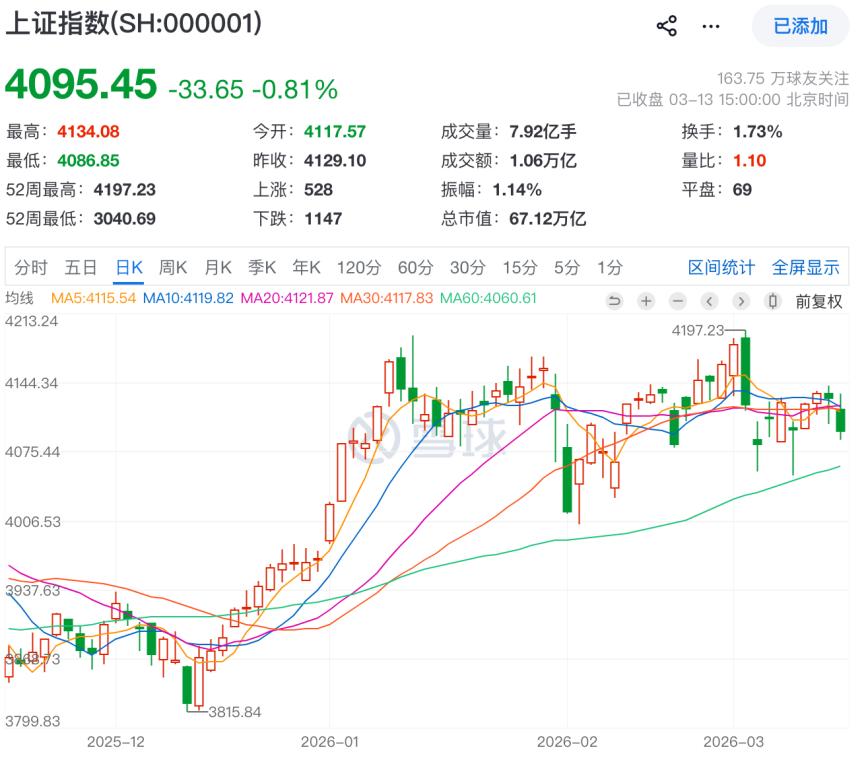
The point is still that point, but the capital structure has changed.
The broad-based ETFs that will shine in 2025 are no longer at their peak as GJD reduces its holdings. Instead, commodity ETFs have taken an independent stance.
According to the Economic Information Daily on March 11, in 2026, all market ETFs will shrink by nearly 1 trillion yuan compared with two months ago. As of March 8, the total size of 1,446 funds in the market was 5.30 trillion yuan.
In terms of major categories, the largest declines in the past two months were stock ETFs and bond ETFs, which fell by 990 billion and 200 billion respectively.
Commodity ETFs and currency ETFs have become rare "winners", bucking the trend and growing by 90 billion and 20 billion respectively in two months.
The market sentiment of broad-based ETFs is obviously negatively affected by GJD. More and more funds are choosing gold and other commodity-themed ETFs, such as Huaan Gold ETF, Cathay Gold ETF, and Bosera Gold ETF, which "attracted gold" of 33.288 billion yuan, 17.466 billion yuan, and 13.840 billion yuan respectively during the year.
Despite market volatility, private equity has not been hit too hard.
According to a report from the Financial Associated Press on March 9, as of the date of publication, the number of tens of billions of private equity companies has reached 126, setting a new record high. In February, four private equity firms broke into the tens of billions list.
Judging from the filing and registration status, enthusiasm for private equity is high. Compared with January, 1,296 private equity funds across the market completed registration in February, a 100% month-on-month increase.
Quantitative private equity, which was criticized by Dan Bin, has become a major new force.
I still remember that Liang Wenfeng said in his 2019 speech "The Future of China's Quantitative Investment in the Eyes of a Programmer" that quantitative investment has already made money from the technical school, and will also snatch the money from the fundamental school in the future.

A few years later, the prediction seemed to come true. In the current market, apart from index products, the most profitable products are quantitative ones.
It is difficult for ordinary investors to maintain complete independence. Most people's choice is to join instead of fighting.
After talking about capital changes, let’s look at structural hot spots.
There are two main directions leading the market this week, one is energy, and the other is AI applications – stir-fried "lobster".
Let’s talk about energy first. As oil prices strengthen and AI is extremely hungry for energy, new and old energy sources have once again become the focus.
Needless to say, the oil price factor is like snowflakes, flying all over the sky.
Regarding AI’s thirst for energy, Huang Renxun recently published a special article:
Looking at AI from an industrial perspective, its architecture can be broken down into five layers, with energy at the bottom. As the most basic level, energy is the primary consideration for AI infrastructure and is also the bottleneck factor that restricts how much intelligence the system can generate.
New energy and old energy have become popular at this time.
Among the old energy sources, coal focuses on independence and controllability, and oil emphasizes price increases, both of which have reasons for rising prices.
What about new energy? More excitement.
Recently, many domestic and foreign institutions predict that in order to ensure energy security, global demand for new energy will surge, and the expected growth rate of household storage installed capacity has been repeatedly raised. There are frequent calls for short-term sales in Europe, the Middle East and other places.
According to the Daily Economic News on March 11, the British Department of Commerce and Trade announced that import tariffs on 33 wind power components will be canceled starting from April 1, and the tax rates on core components such as blades and cables will be reduced from 6% and 2% to 0 respectively, aiming to release 22 billion pounds of investment.
Faced with high oil prices, Europe has even temporarily abandoned tariff barriers and accelerated the deployment of new energy sources.
While overseas demand is boosting, CATL, the overall leader in the entire new energy sector, has also released major benefits.
On March 9, CATL announced its 2025 results, and all indicators exceeded market expectations.
In 2025, CATL's annual revenue will reach 423.7 billion, a year-on-year increase of 17%, and the net profit attributable to the parent company will be 72.2 billion, a year-on-year increase of 42%.
The performance in the fourth quarter of 2025 was particularly impressive, with single-quarter revenue increasing by 37% year-on-year and 35% month-on-month. In terms of profit attributable to parent companies, it increased by 57% year-on-year and 25% month-on-month.
When the growth rate of new energy sources gradually slows down or even becomes excessive, CATL can still maintain a profit growth rate of more than 40%, which is really impressive.
Many organizations describe the Ningde era as saying that elephants can fly.
Japan and South Korea have always paid close attention to CATL, and Nikkei News immediately conducted an in-depth analysis of CATL’s business situation.
Data from South Korean research company SNE Research shows that CATL’s vehicle battery installation volume will increase by 35.7% in 2025 compared with 2024. The global market share reached 39.2%, an increase of 1.2 percentage points from the previous year, maintaining the first place in the world.
Like BYD, overseas markets have become the main source of growth. In 2025, CATL's overseas vehicle installation volume will grow by nearly 40%, exceeding the domestic market's 34% growth rate.

In terms of photovoltaics, although oversupply is still the main problem, some inverter and energy storage companies that use Europe, Australia and other places as their main markets have reached record highs.
The wind of energy has even blown up big state-owned enterprises such as China Energy Construction Co., Ltd., and it has risen again and again.
Stir-fried lobster is another hot spot at the market this week. As long as you are in the self-media, I believe you have received relevant information about OpenClaw.
OpenClaw has been popular overseas for a while, why did it suddenly become popular in China? It is inseparable from the official media and local governments.
On March 10, Cailian News Agency reported that recently, Shenzhen, Foshan, Wuxi, Changshu and other places have intensively introduced support policies and encouraged "lobster farming" with real money.
Chancheng District of Foshan City has launched a free "crayfish" deployment service for the public; Hefei High-tech Zone has launched 15 hard-core measures for "lobster farming" with a maximum subsidy of 10 million yuan; Changshu has stopped "lobster farming" and plans to support "one-person companies" with up to 6 million yuan…
Various localities have issued policies, and many official media are also actively "cooperating" and vigorously publicizing them.
Capital markets responded quickly.
On March 10, Hang Seng Technology, which had been dormant for a long time, rebounded sharply under the leadership of Tencent, with the index rising by 2.4% that day. Tencent’s increase was even more exaggerated, exceeding 7% in a single day.
Tencent founder Ma Huateng did not expect that free installation of OpenClaw would become so popular.
Perhaps because of the craze for nationwide applications, there are constant rumors in the market that Tencent’s Family Bucket will be connected to OpenClaw or build an intelligent agent.
Compared with the established Internet companies, large model companies are the first to try "lobster". Companies such as MiniMax deployed early, and their stock prices rose again and again.
What is disappointing is that the founder of MiniMax, who once worked at Baidu, made the company's market value exceed that of his old employer in just 4 years.
In the AI era, disruptive changes are indeed too fast.
The southbound funds that had started to leave the market not long ago also made a comeback under the stimulation of OpenClaw. The single-day net selling record was followed two days later by the single-day net buying record.
According to data from Oriental Fortune, on March 10, southbound funds bought HK$36 billion in net, setting a record for the highest single-day net purchase in history.
However, not everyone is suitable for OpenClaw, and installing it rashly is extremely risky.
On March 10, the National Internet Emergency Center issued a risk warning about the security application of OpenClaw, recommending relevant units and individuals to take security measures to prevent personal information from being leaked.

The National Internet Emergency Center puts forward several guidelines:
1. Strengthen network control, do not give OpenClaw too high permissions, and do not directly expose OpenClaw to the public Internet (where personal information is involved)
2. Strengthen certificate management and avoid storing keys in clear text in environment variables;
3. Strictly manage plug-in sources, disable the automatic update function, and only install extensions from trusted channels;
On March 10, Cailian News reported that in order to ensure the security of the company's network and information, a number of securities companies prohibited employees from installing and using OpenClaw in company computers and other asset environments.
On March 11, Bloomberg reported, citing people familiar with the matter, that government agencies and state-owned enterprises, including large banks, have received notices not to install OpenClaw software on office equipment due to security concerns.
Another person familiar with the matter said that this ban has also been extended to military families.
No matter how good the lobster is, it must be washed and cooked before tasting, otherwise, it is better to let it jump again.
AI automates white-collar jobs, and future jobs will be "bluer". American Wall Street giants are subsidizing blue-collar workers.
According to the Associated Press of Finance on March 10, BlackRock, the world's largest public fund management company, announced that it will invest US$100 million in technical worker training projects, which will benefit technical workers including electricians, plumbers, HVAC technicians and steel workers.
The plan aims to benefit 50,000 workers over the next five years to fill the growing shortage of skilled workers in the United States.
BlackRock CEO said that by 2033, the United States is expected to need US$10 trillion in infrastructure investment to upgrade old systems and build new energy, digital and artificial intelligence infrastructure. But funding alone is not enough. Talent is the core of building America’s future.
Yes, talent is the core, both white and blue are needed.
As oil prices rise, the probability of the Federal Reserve cutting interest rates has dropped again and again.
According to Sina Finance news on March 13, the latest probability from FedWatch shows that traders in the federal funds futures market have basically ruled out the possibility of an interest rate cut in September, and now believe that the Federal Reserve may only cut interest rates once in December.
Even though Lao Chuan hopes that the Federal Reserve will cut interest rates immediately, this demand is destined to not be realized until the new person takes office.
If inflation rises, it depends on how Lao Chuan performs.
Made in China explodes
This week, the most exciting news is that the import and export data exceeded expectations.
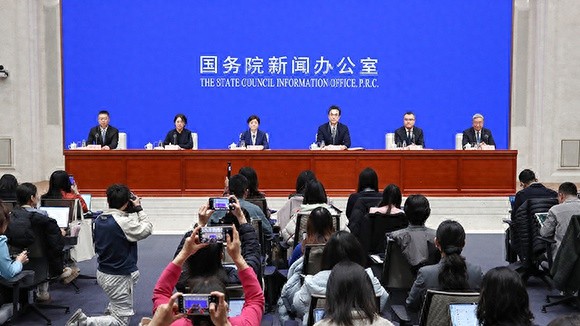
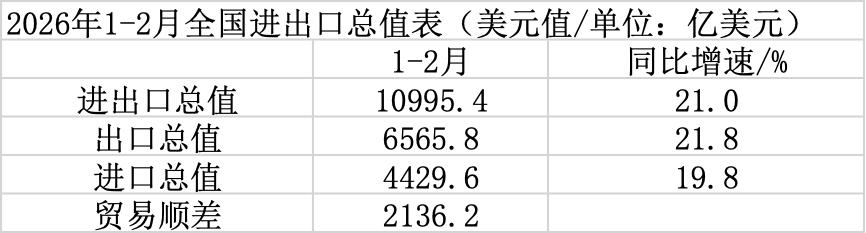
On March 10, data from the General Administration of Customs showed that in the first two months, my country exported US$656.58 billion in goods, a year-on-year increase of 21.8%, and imported US$442.96 billion, a growth rate of 19.8%.
Although the import growth rate was fast enough, it still failed to catch up with exports. As a result, the trade surplus increased by 26.2% in the first two months, reaching
US$213.62 billion.
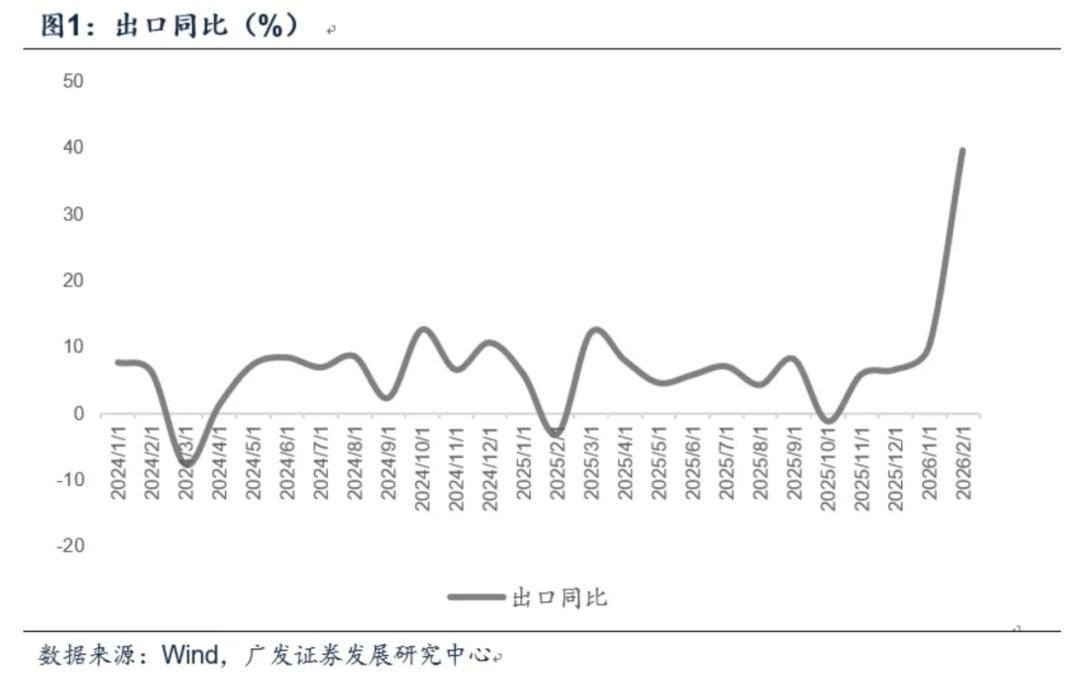
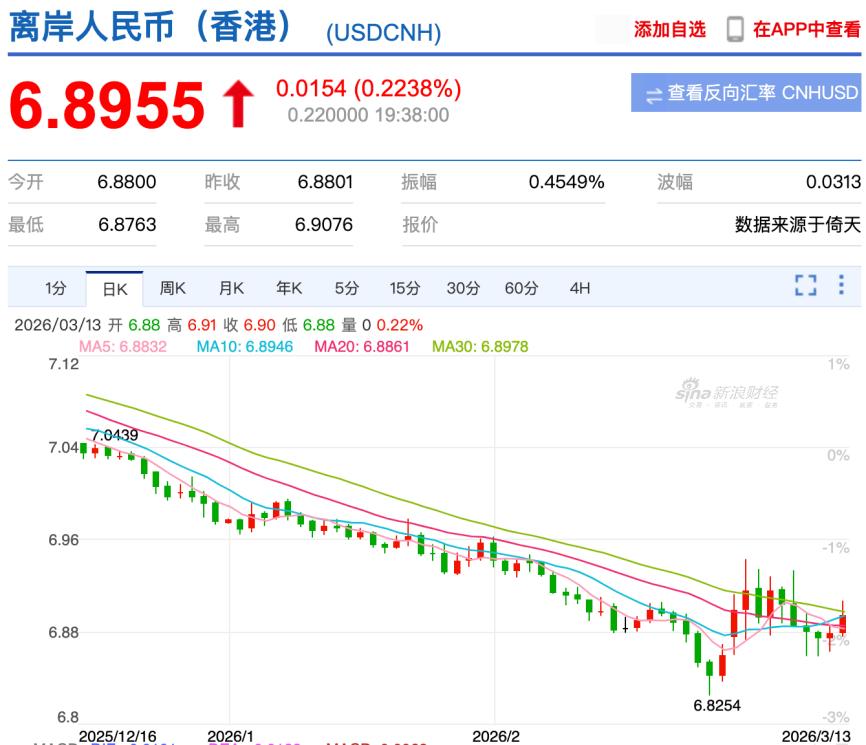
You know, in the past two months, the RMB has been appreciating against major currencies such as the US dollar and the euro. Against this background, it is very impressive that import and export can still be so strong.
Just like our reaction, as soon as the import and export data came out, domestic and foreign institutions unanimously agreed that it exceeded expectations!
According to statistics from Caixin.com, 13 domestic and foreign institutions had previously predicted that China's export growth rate from January to February would be 6.3% (average), with the most optimistic forecast seeing 12%, and the average import growth forecast being 5.7%.
Some people say that this is the result of adjusting export tax rebates for some products to compete for exports. Little did they know that agencies had already included this in their forecasts, but it still far exceeded expectations. Why?
From the perspective of export areas, non-U.S. regions have experienced a collective outbreak.
In the first two months, China's export growth to Africa was 49.9%, to ASEAN was 29.4%, to the EU was 27.8%, to Russia was 22.7%, and to South Korea was 27.0%, all significantly higher than the overall level.
As of February 2026, China's exports to ASEAN, Africa, and Latin America combined accounted for 31.2% of China's exports.
Made in China is playing a central role in the urbanization process in less developed regions.
In the first two months, exports declined mainly from the United States. According to data from the General Administration of Customs, the growth rate of China's exports to the United States fell by 11%, and the two sides' direct trade dependence further declined.
Exports are not affected by a stronger exchange rate, proving that the export structure is increasingly less sensitive to exchange rates.
Judging from the structure of export commodities, this is indeed the case.
According to GF Securities and other institutions, in the first two months, the export growth rate of the four major labor-intensive products (textile yarn, bags, clothing, toys) was 16.1% year-on-year, which was lower than the overall level.
The export of mechanical and electrical products and high-tech products is the core driver of exports. In the first two months, exports of mechanical and electrical products and high-tech products increased by 27.1% and 26.9% respectively year-on-year.
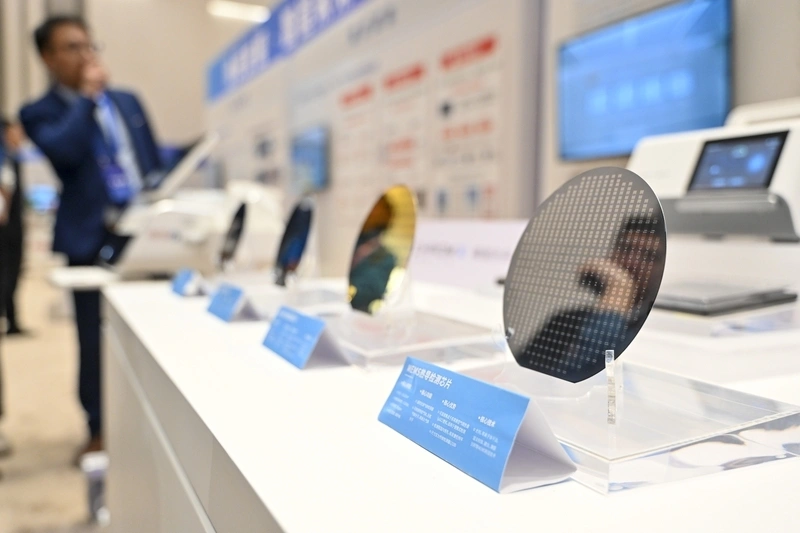
Among them, exports of integrated circuits and automobiles surged, with growth rates of 72.6% and 67.1% respectively; ship exports were also very impressive, with growth rates of 52.8%.
Exports have always been top students. In contrast, imports have exceeded expectations and are even more surprising.
Overall, the reason why imports can grow so fast is because of the low base. In the same period of 2025, the import growth rate was -8.4%.
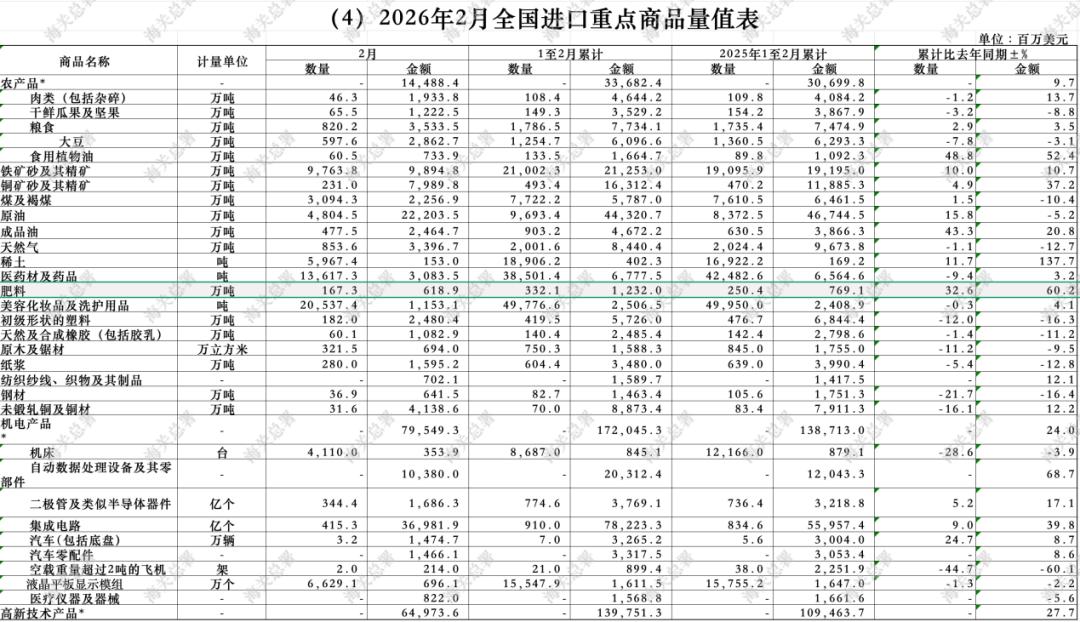
Apart from the base effect, many imported categories are surprising.
In terms of quantity, the fastest growing imports were edible vegetable oil (48.8%), natural gas (43.3%), and fertilizers (32.6%). Crude oil, iron ore, rare earths, and automobile chassis also grew rapidly, all above 10%.
More than half of the above categories are related to petrochemical energy. Before the conflict between the United States and Iran, petrochemical products were imported so quickly, which was a great way to prepare for a rainy day.
March is the beginning of the conflict between the United States and Iran. What changes will occur in the import of petrochemical resources at this node deserves special attention in the future. If it can still grow significantly, it means that China's import capacity (pipeline) is indeed strong.
In terms of amount (excluding the above-mentioned categories with rapid growth), integrated circuits accounted for 39.8%, automation equipment accounted for 68.7%, and high-tech products accounted for 27.7%.
Most of these categories are related to AI, which once again proves that AI products are extremely prosperous.
Among imported categories, rare earths, soybeans, and iron ore deserve special attention.
Let’s talk about rare earths first. As we all know, China’s rare earths are mainly exported.
In 2025, China's rare earth exports amounted to US$3.5 billion, about double its imports.
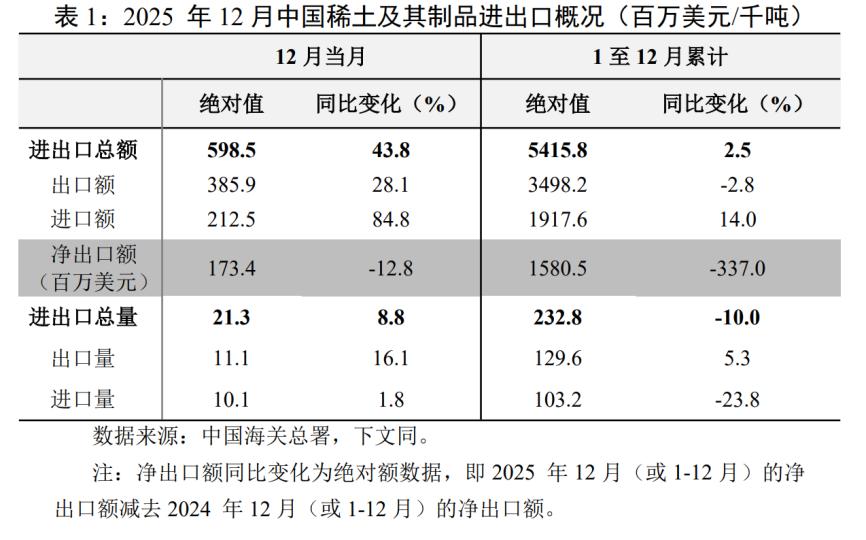
However, at the beginning of 2026, there was a strange situation in which imports of rare earths surged and exports declined.
According to data from the General Administration of Customs, in the first two months of 2026, the export value of rare earths dropped by 15.9%, but imports soared by 137.7%, the fastest growth among all import items.
The surge in imports may be due to hoarding raw materials and further gaining control over rare earths. After all, China's strongest strength in the field of rare earths is not its resource capacity, but its processing capacity.
Soybeans are also very interesting. Lao Chuan is coming in more than half a month. To save face, we should speed up imports. To prevent emergencies, we should reduce imports and increase our chips.
What is the actual situation?
China's choice is to reduce soybean imports. In the first two months, soybean imports decreased by 7.8%, and the import value decreased by 3.1%.
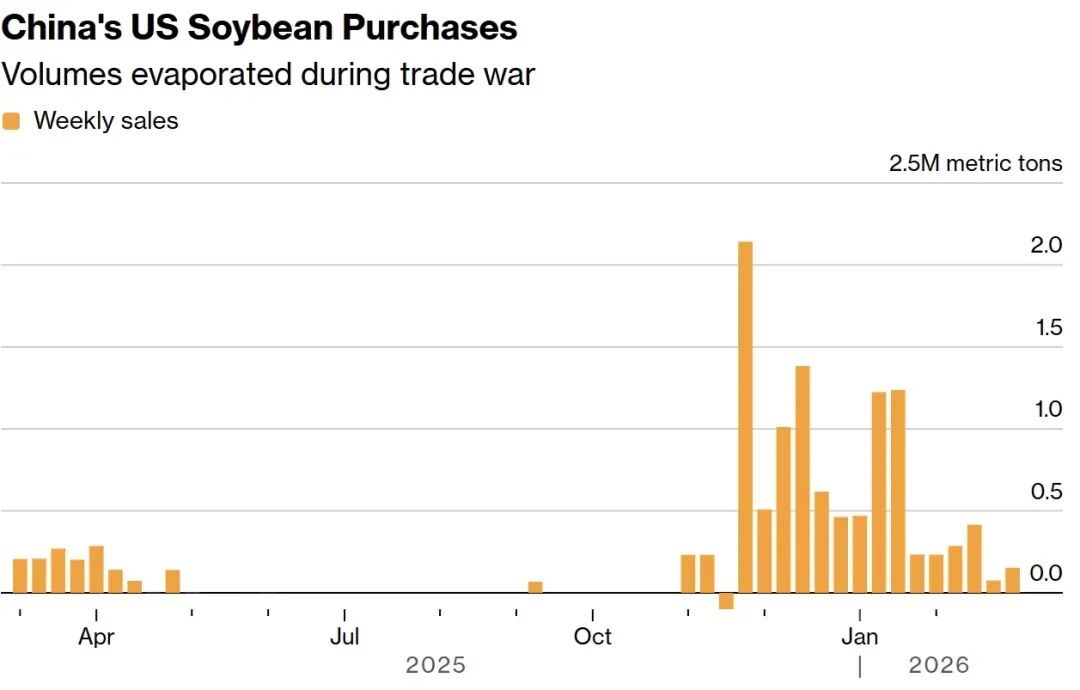
According to Bloomberg, after completing the purchase of 12 million tons of soybeans in January, China’s purchases of U.S. soybeans have basically stalled.
American media analyzed that this may be preparation for the leadership meeting. U.S. traders expect that Chinese buyers may wait until September when the new season of U.S. soybeans becomes available and prices become more advantageous to resume purchases.
Let’s look at iron ore.
In the first two months of 2026, China's iron ore import growth rate was 10%, which is not eye-catching among all categories, but it still remains at the highest level in history.
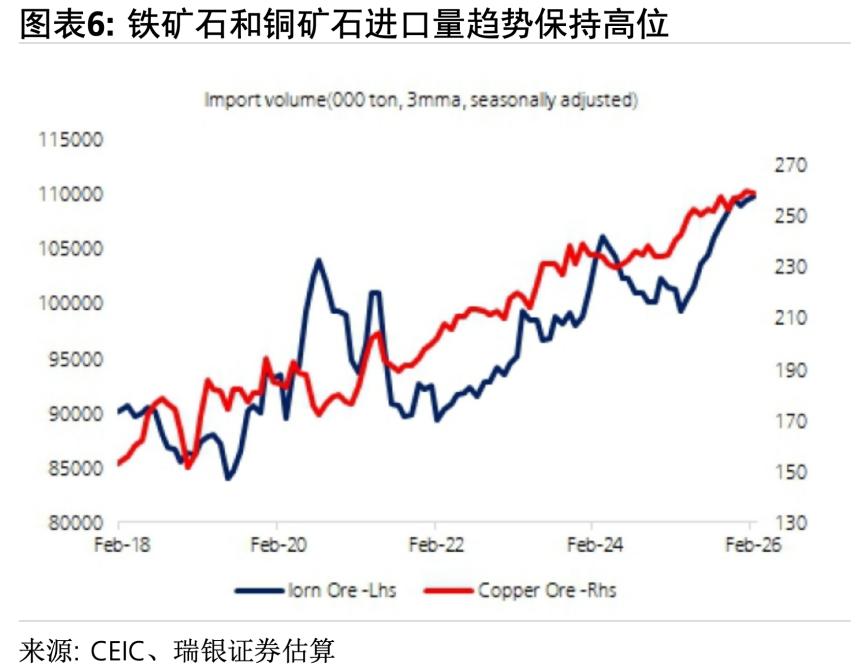
China's steel industry is restricting supply, and crude steel production even experienced a historic decline in 2025. According to data from the Bureau of Statistics, China's crude steel output in 2025 will be 960.812 million tons, a year-on-year decrease of 4.4%.
Steel production has declined, and iron ore is still being imported in large quantities. China seems to be hoarding materials in various categories to prevent problems before they happen.
What is surprising is that iron ore from Middle Eastern customers began to flow into China due to conflicts.
According to Lianhe Zaobao, ship tracking agency Kpler pointed out that after the conflict between the United States and Iran, four iron ore ships originally destined for the Middle East were diverted to China with full iron ore.
After talking about iron ore, let’s focus on two countries, one is Japan and the other is India.
China has an export ban on Japan, but Japan does not have an export ban on China.
What's the result? Many companies are worried about changes in Sino-Japanese relations and have begun to compete for Japanese exports.
In the first two months of 2026, China's imports from Japan grew at a rate of 26.5%, and exports at a rate of 8.9%.
What is imported from Japan? According to media reports such as Nikkei Chinese, as of January, Japan's exports of semiconductors and other electronic components to China have surged by more than 50%.
As the core supplier of AI upstream components and materials, China’s computing power is probably indispensable for Japanese factors.
Thanks to Lao Chuan, Sino-Indian relations have changed subtly, and import and export data are the best indicator.
In the first two months of 2026, China's exports to India increased by 20%, and India's exports to China increased by more than 40%.
According to Nikkei Asia, India’s exports to China have grown significantly, mainly due to seafood and electronic products.

According to a report released by the Indian think tank "Global Trade Research Initiative" at the end of 2025, India's electronic products from China have experienced an unusual increase.
In the first seven months of fiscal year 2025, India's printed circuit board exports to China surged by more than 2,000%, with a total value reaching US$418 million. Exports of mobile phone parts increased by 82% to US$362 million.
In the past, India imported the above products from China, but now India has begun exporting them to China.
According to analysis by Indian scholars, on the one hand, this may be due to a short-term surge in demand in China; on the other hand, it may also be that China has begun to give up production in some categories.
China also has downstream industries, which have already begun globalization.
External demand has exploded and domestic demand has stopped. How will the automobile industry develop?
On March 11, China Automobile released its vehicle production and sales data for February.
The results showed that in February, China's automobile production reached 1.672 million units and sales were 1.805 million units, down 20.5% and 15.2% respectively year-on-year.
Combining January and February, China produced a total of 4.122 million vehicles and sold 4.152 million vehicles, down 9.5% and 8.8% respectively year-on-year.
At the end of 2025, we kept mentioning that the auto market will be under pressure in 2026. Continuous large-scale stimulus has overdrawn purchasing power, and the subsidy fading will undoubtedly put more pressure on the auto market.
The sales volume in the first two months basically confirms this.
Behind the overall decline of the auto market is the huge gap between domestic and foreign demand.
In the first two months, China's automobile exports reached 1.352 million units, a year-on-year increase of 48.4%. Without the rapidly growing export demand, the automobile manufacturing industry has entered winter.
The overall auto market has declined and its structure has begun to diverge. BYD, which has been the most eye-catching company in the past few years, has seen a clear decline and has been continuously surpassed by competitors such as SAIC and Geely. The gap between it and Chery and Changan is not big.
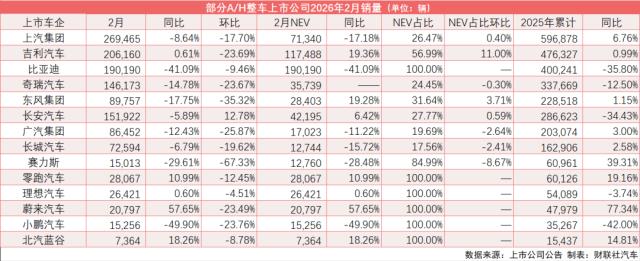
Seeing that domestic demand is weak, exports have become a battleground for military strategists.
In February, BYD, Chery, Great Wall and other car companies all reported that export sales exceeded domestic demand.
Take BYD as an example. Since February, it has sold more than 100,000 vehicles overseas, but only sold more than 90,000 vehicles domestically. This is the first time in history that the internal and external demand has been reversed.
In order to accelerate overseas car sales, BYD may establish the first F1 team of Chinese origin.
On March 11, according to Lianhe Zaobao, people familiar with the matter revealed that Chinese electric vehicle giant BYD is studying to enter competitive motor sports including Formula One (F1) and endurance racing to enhance the brand’s appeal in the global market. Current options include forming its own team or acquiring existing teams.
Although car companies have pinned their hopes overseas, it has to be said that competition in overseas markets is becoming increasingly fierce.
The reason is that the main battlefields of the German and Japanese forces cannot be lost.
On March 10, Volkswagen announced its 2025 results. The result was that revenue was flat and profits dropped sharply.
According to Volkswagen's official website, Volkswagen's full-year sales in 2025 will be 321.9 billion euros, basically the same as the previous year, and approximately 9 million vehicles will be delivered globally, which is also roughly the same as the previous year.
Revenue and sales were solid, but profits were breathtaking. In 2025, Volkswagen's operating profit will drop to 8.9 billion euros, a 53% year-on-year drop.
Revenue remained unchanged and profits dropped sharply, resulting in an operating profit margin of only 2.8%.
Volkswagen explained on its official website and in a conference call that the pressure on profits in 2025 is mainly due to the impact of U.S. tariffs, the impairment of Porsche's goodwill, and intensifying competition in the Asian market.
In 2025, Volkswagen will deliver 2.7 million cars in China, 500,000 more than in 2024, and continue to be the sales champion of foreign-funded car companies in China.
Increased sales did not result in greater profits. In 2024, Volkswagen's operating profit in China will be 1.7 billion euros, the lowest performance in the past ten years.
Once it breaks through the normal state, there is often no lowest, only lower. According to cover news, in 2025, Volkswagen's operating profit calculated using the equity method will be 958 million euros, setting a new record low.
Whether to gain share or maintain profits has become an unprecedented problem that global car companies have to face.
In order to obtain more profits, Volkswagen's choice is to lay off employees and move its R&D institutions eastward.
Volkswagen said it will lay off 50,000 people in Germany by 2030.
Coincidentally, Honda, a Japanese car company that announced its results on March 12, gave almost the same reason for the decline in performance.

According to Xinhuanet, Honda issued a performance warning saying that the company will face its first annual loss since its listing.
The net profit attributable to the parent company of the main business will turn from the previously expected profit of 300 billion yen to a net loss, with the maximum loss reaching 690 billion yen.
Like Volkswagen, Honda expects revenue in 2025 to be basically the same as in 2024.
Honda cited changes in U.S. tariffs, slowing demand growth in the North American electric vehicle market and intensifying competition in the Chinese market as the reasons for the loss.
To sum up, the current situation is that BYD hopes to speed up its overseas expansion and save the country, while overseas competitors hope to maintain local share. In order to survive, no one will give in.
The car market in 2026 will be very tragic.
Are Koreans buying cheap Chinese innovative drugs?
Since September 2025, innovative drugs have basically not risen much and have been abandoned by the technology bull market.
Taking the innovative drug ETF as an example, the net value has dropped from 0.771 in September 2025 to less than 0.6 currently.
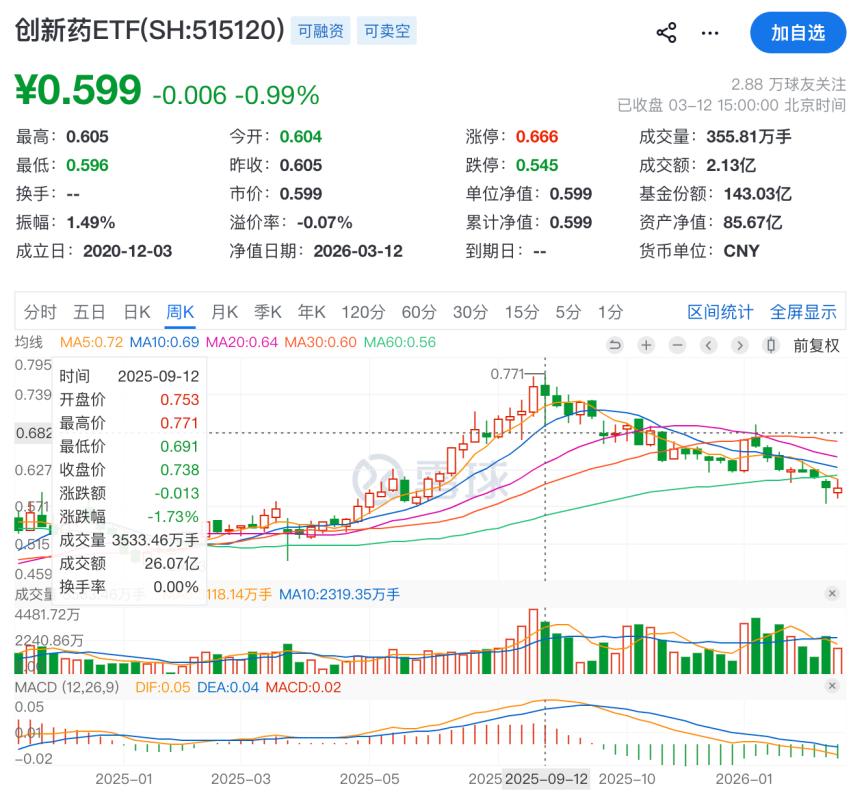
Even though the scale of innovative drug BD in Shanghai and Shenzhen stock exchanges is getting larger and larger, and new drugs are being launched faster and faster, they cannot reverse the bias of investors.
The proportion of pharmaceutical stocks held by public offerings in the market continues to hit new lows, and the proportion of market value has also fallen again and again.
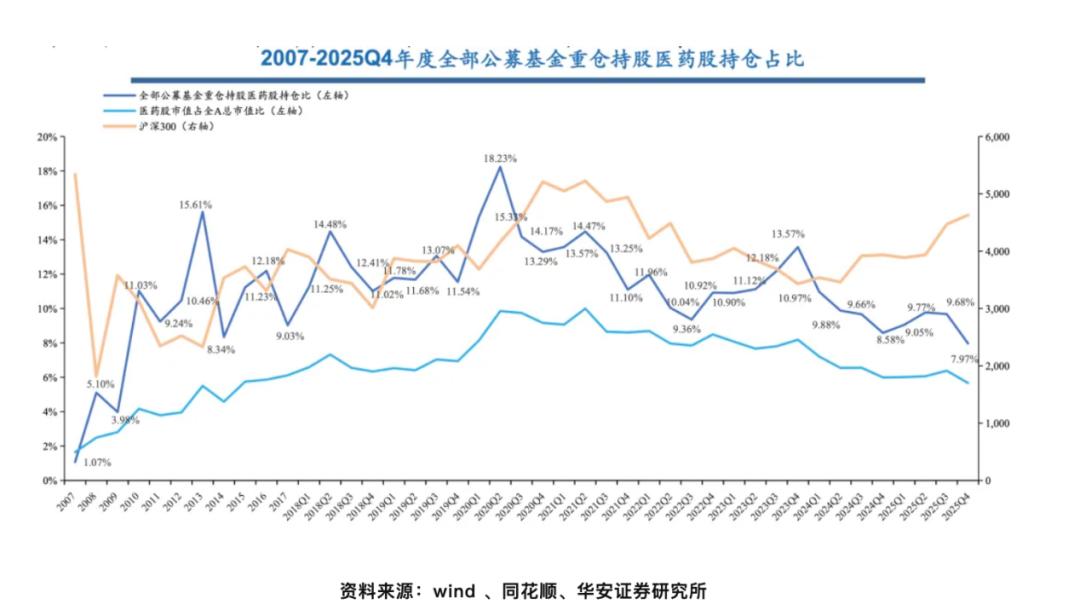
When popularity is bleak, there will always be news about leaving the land of dreams.
After spending many years as a pharmaceutical analyst, a certain pharmaceutical chief chose to give up everything and study for a master's degree in Buddhism at the University of Hong Kong.
She said: Medicine is the sword that can save the world, but the longer I work, the more I feel that physical health is not enough. Human being is a whole body and mind and cannot be cut off. Over the years, in addition to the pain caused by the disease itself, I have also seen people who are in good health, well-educated, and wealthy, mired in mental exhaustion and pain.
The experience of nothingness in the extreme involution has shaken the business logic and life creed that I firmly believed in in the past. She decided to change the underlying system and re-understand the world.
Just when domestic investors and researchers fell into despair, Korean investors bucked the trend.
According to the Financial Associated Press, in the past month, Korean investors have been using ETFs to allocate Chinese assets.
Among them, a certain innovative pharmaceutical industry ETF was the largest net purchase by Korean investors, with a purchase amount of nearly 10 million yuan.
Sometimes, the darkness you are in is the dawn in the eyes of others.
Sooner or later, dawn will break.
As I write this, news has come out from the Chinese and African markets.
Starting from May 1, 100% of the tax items of the 53 African countries that have diplomatic relations with China will not have to pay tariffs when entering the Chinese market. Previously, China had implemented a zero-tariff policy for 33 African countries.
In September 2025, the US AGOA (African Growth and Opportunity Act) expires.
In the past 25 years, the United States has provided tariff-free access to more than 1,800 African products, supporting an export market of US$9.7 billion. I guess what Lao Chuan is thinking is that I want to increase tariffs.
Sometimes, as long as you don't make any mistakes, just wait for the other person to go crazy.