The impact of the U.S.-Israeli war on the first island chain is that the deterrence of the United States has declined rapidly, but the energy business has benefited. Japan, South Korea, the Philippines, and Taiwan have been hit by double impacts on the economic and security levels. However, under the shock, energy diversification, armed defense, and even "nuclear possession" issues will quickly surface.
Regardless of economy, trade and energy, this article focuses on armed defense.
In the third week of the US-Israel war, Trump may be the only one who has not yet realized, or refuses to believe, that this Middle East war will have far-reaching consequences. Not only is it far from the beautiful imagination when he decided to start the war – the United States and Israel jointly manage the Middle East – on the contrary, the deterrence power that the United States originally relied on to maintain the basis of hegemony has been seriously overdrawn, and it is known to the whole world.
Not to mention other areas, in the first island chain in our field of vision, every node is very frightened. The suzerain country's tough words and soft fists have long been a deep concern for the vassal countries. However, in the past, at least on the surface, it was still able to show off its strength, because the weaknesses exposed by the United States were still in a "mosaic" state, and its deterrence power could still be maintained. But now, Iran has revealed the answer to the mystery. Once the United States personally takes action, there is no guarantee that it can defeat a single region or even a single country, let alone global deterrence.
What the first island chain fears most is not the decline in US deterrence, but the fact that this truth has become global evidence.
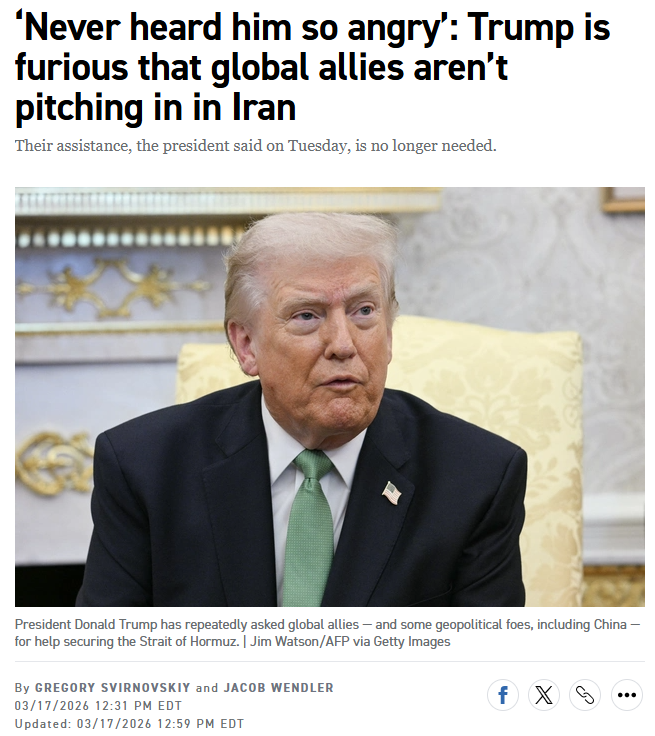
“I’ve never seen him so angry”: Trump is furious because global allies have not contributed to the Iran issue. Screenshot of Politico’s report on March 17
The disillusionment and qualitative change of "security depends on the United States"
It is less than 10 years since the “Return to Asia and Rebalancing” and “Free and Open Indo-Pacific” policies at the end of Obama’s administration, but they still seem like the false pride and empty promises of a century ago. The “Indo-Pacific Quartet” that also recalled Gong Jin’s year is now completely bankrupt. Even Trump’s strategy of retracting in a feinting posture after entering the White House—“focusing on the Western Hemisphere”—was shattered in the US-Israel war, leaving nothing but feathers on the ground.
Since Washington withdrew from the Asia-Pacific economic and trade strategy such as the TPP, military deterrence is the only remaining presence of the United States in the Western Pacific. If you don’t look at anything else but Singapore’s stance in the past 10 years, you will know that the so-called “only one left” is not an exaggeration. For Beijing, the two-sided choice of "depending on China for its economy and relying on the United States for its security" is not necessarily a bad thing, because as long as time is extended, the former will erode the latter, and this is one of the sources of "strategic concentration."
Trump's performance since entering the White House has gradually made "relying on the United States for security" untenable. The first island chain has borne the brunt and has been forced to arm itself and spend money to expand its military. This has only confirmed the necessity of "relying on China for the economy." The most obvious example at this point is the Philippines. There are constant petty quarrels in the South China Sea and rampant vassalism, but its economic and trade dependence on China has only increased.
Until the U.S.-Israeli war broke out, the experiences of the entire Gulf country group turned the fantasy of "security dependent on the United States" directly into the nightmare of "disaster." Security guarantees were out of the question. Instead, they became collateral damage to the U.S. military bases, which immediately affected the economic arteries. Now ask the Gulf countries, what is the deterrent power of the United States? The answer may make people laugh – the deterrence of the United States is the deterrence of Iran.
When US military bases become a nuisance, the vassal dividend disappears overnight, especially in the first island chain, because as mentioned above, deterrence is the only sensible presence of the United States in East Asia. In the same way, US deterrence is China’s deterrence. Japan, South Korea, the Philippines and Taiwan have long been aware of this truth, but the bad thing is that now it has become known to the whole world.
Ryukyu was the first to show anxiety, which is reasonable. It is the United Arab Emirates Zafra Air Force Base in East Asia. If a war breaks out in the Taiwan Strait, Ryukyu will be the most conspicuous missile target and the next "huge crater." The Taiwan Strait, Bashi Strait, and Miyako Strait are today’s Strait of Hormuz.
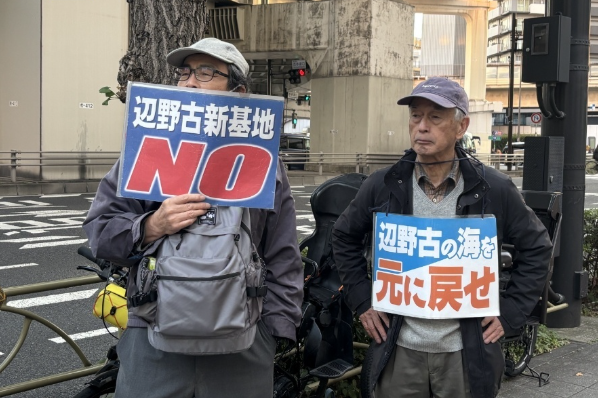
In November 2025, Japanese people from Tokyo, Okinawa and other places held a protest rally in Tokyo to oppose the Japanese government's forcible advancement of the construction of the US military base in Okinawa and to protest against the Japanese government's strengthening of military deployment in the southwest region.
What is worth pondering is, for whom does "asymmetric warfare" make more sense now?
Iran's "asymmetric warfare" is almost identical to the "asymmetric warfare" envisaged by the United States for Taiwan. Responsible Chinese public opinion has long predicted that Iran's "porcupine" situation today will be the tragic situation of Taiwan in the future. However, Iran's asymmetric warfare has severely damaged the United States, Israel, the Middle East, and even the global economy, but it has a completely different meaning.
The expensive missile defense network is no match for the cheap unmanned suicide drones. How can the existing Israeli "Iron Dome", the imaginary American "Golden Dome", the "Taiwan Shield" and Ryukyu's "Missile Islands" deal with the most powerful PLA drone swarm on earth? The object and content of the so-called "asymmetry" may have completely different meanings after the US-Israel-Iraq war.
The above is only the first level of anxiety about "security depends on the United States". There is also the second level of anxiety – US military assets in East Asia are regarded as "surplus" during other regional wars.
To meet the needs of the US-Israel-Iraq War, the United States mobilized US military assets from other regions. The largest number and scale of mobilization was in the Indo-Pacific region, followed by Europe, and then the United States.
Overall, this troop surge in the Middle East is the largest concentration of U.S. military forces since the 2003 Iraq War, totaling more than two aircraft carrier strike groups, more than 13 destroyers, hundreds of fighter planes and a large number of missile interceptors, with the largest amount of military resources coming from the Indo-Pacific theater.
Aircraft carrier strike groups, amphibious ships, Marines, fighter planes, carrier-based aircraft, THAAD high-altitude defense system, Patriot medium-range surface-to-air missile system, aerial oil aircraft, etc., the Indo-Pacific US military assets have been transferred to the Middle East battlefield one after another without notifying the client countries. South Korea couldn't help complaining, Japan didn't dare to say anything, Philippine officials pretended to be fine, and opposition forces started an anti-U.S. trend.
As one of the most peaceful regions in the world, East Asia is naturally regarded as having "military surplus". However, the US military's diligence in mobilizing resources in the region to the Middle East exactly reflects the US's over-exaggeration of the military crisis in East Asia and its bellicose nature and militarism.
On the one hand, American hawks brag that "the US-Israeli war will severely damage China", and on the other hand, they panic that "the US-Israeli war is an opportunity for China." However, observers who know the region believe that it is neither. The war in the Middle East does not mean China's strategic losses, nor does it mean that China will "take advantage of the opportunity" in East Asia.
China has already diversified its energy sources, and Iran will not cut off its main source of income. Moreover, the United States and Israel will definitely lose, and we will not suffer any strategic losses. This one. If China takes advantage of the large-scale movement of U.S. troops to the Middle East and "conquers cities and territories" in the Taiwan Strait, East China Sea, and South China Sea, it will undoubtedly help the United States find a way out in the Middle East, stop wars and losses, and then mobilize global forces to East Asia. If the mainland has no intention of achieving reunification this year, defeating Japan and eradicating the South China Sea issue, then "taking advantage of the opportunity" is a bad idea. This is the second one.
It is true that the US-Israel war contributes to the "China narrative" and it is true that it makes the first island chain tremble. However, even if the mainland wants to "charge a wave" of specific attacks, it will have to wait until the US divisions in the Middle East are exhausted or resources are exhausted before attacking. During the period of standing still, our mere launch of diplomatic war is enough to make the United States suffer so much that it will be unable to move.
Observers in the first island chain can easily draw this conclusion. The American hawks simply "told a lie three times and even believed it themselves." They are completely unable to divert the current embarrassment and predicament of the United States.
China's temporary standstill is tantamount to denying the current self-arming of the first island chain and accumulating evidence for the elimination of militarism in the region in the future. In other words, "temporary" is the key word, because the decline in US deterrence also means the rationality of military expansion in the first island chain and even nuclear possession.
This has triggered a third layer of anxiety, the ineffectiveness of the first island chain’s self-armed deterrence, and the theory of the necessity of nuclear weapons.