How strong will the RMB be in 2026?
This is not only a matter of concern to the Chinese people, but also a topic of concern to the global market.
Unconsciously, the offshore RMB has hit a new high against the US dollar in more than three years and has risen for five consecutive months, approaching the level of 6.3 in 2020.
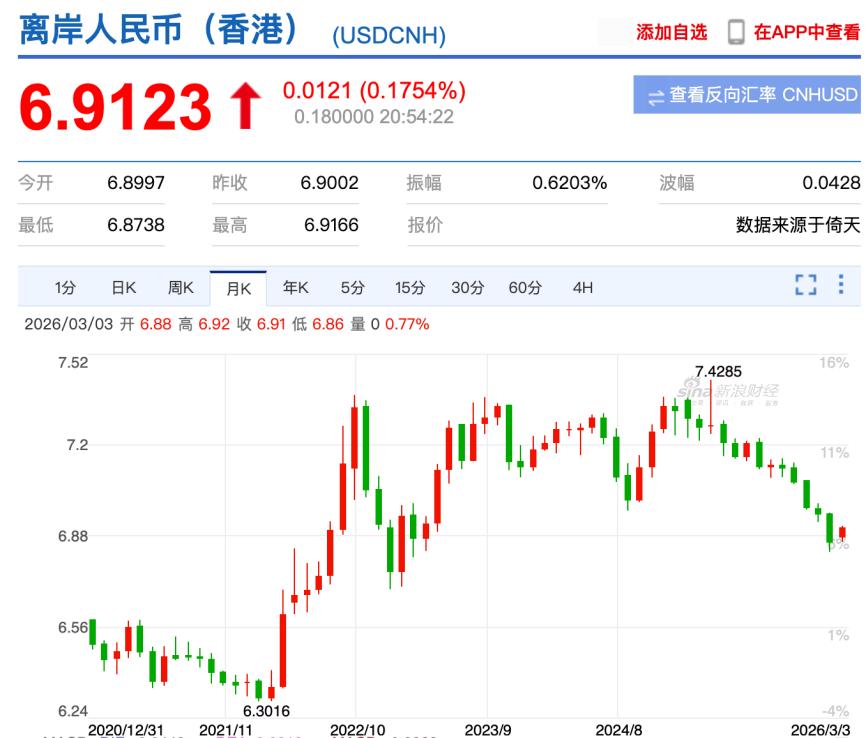
It is different from the past situation where the US dollar depreciated and the RMB passively appreciated. This time, the RMB is obviously more "active".
According to Shen Wanhongyuan’s article, since January 27, the appreciation of the RMB has been achieved against the background of the rise of the US dollar. During this period, the U.S. dollar appreciated by 1.9%, and the RMB rose by 1.5% against the U.S. dollar.
Such a trend is a sign of strengthening from strength to strength.

We once wrote an article analyzing that as the gold content of the RMB continues to increase, it is no longer possible to effectively measure the strength of the RMB by looking at changes against the US dollar, and a more diverse perspective is needed.
If you open the K-line chart of the RMB against the Euro, you will find that starting from February 2026, the RMB against the Euro has also been rising substantially. In one month, it rose from 8.37 to 8.06, an increase of more than 4%.
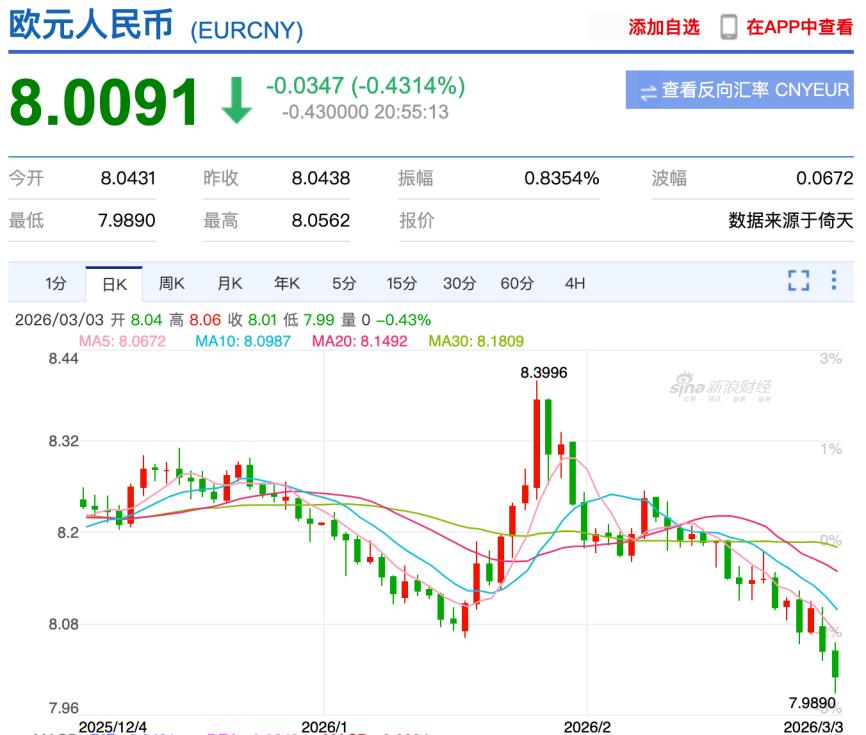
Even after the US-Iran incident broke out, the RMB still appreciated against the euro, which shows the high value of its appreciation.
Seeing that the RMB is so strong, more and more domestic and foreign institutions are tearing up their previous forecasts and becoming bullish on the RMB.
Goldman Sachs’ latest forecast is that the RMB exchange rate against the U.S. dollar is expected to rise to 6.7 by the end of 2026. In the long run, a rise of 25% is not impossible.
In the eyes of Goldman Sachs, the RMB is one of the most certain transactions in 2026. Institutions with similar views to Goldman Sachs are supporting this judgment with practical actions.
According to Wall Street News on February 26, data from the American Securities Depository and Clearing Corporation showed that the trading volume of USD/CNY options has surged significantly recently, and even became the second largest options variety in the world on February 26.
Options bets on the yuan's appreciation have been twice as high as those on its decline.

RMB long forces quickly gathered
Against the background of AI panic and the collapse of US dollar credit, the cheap (low interest rates) and stable RMB is being favored by more and more countries.
According to Lianhe Zaobao report on February 25, Indonesia plans to issue government bonds denominated in offshore RMB for the first time.
Bloomberg reported that the Indonesian government hopes to use the low cost of RMB financing to improve its debt structure and will issue 3-year, 5-year and 10-year offshore RMB bonds in the future.

The situation in Indonesia is by no means an isolated case.
On February 7, according to the official account of Shunzhi Middle East, Abu Dhabi National Oil Company is also planning to issue RMB-denominated offshore bonds (dim sum bonds) for the first time, with a fundraising scale of up to 14 billion yuan.
We have written many times in the past that dim sum bonds have developed rapidly and have become the main form of RMB overseas financing.
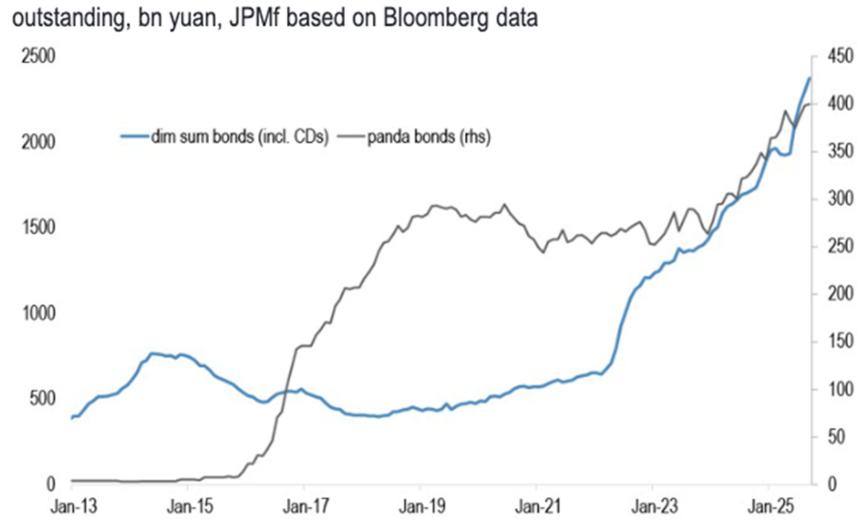
In 2026, this trend will continue. As of February 3, the issuance scale of dim sum bonds during the year has reached a record of 57.6 billion yuan.
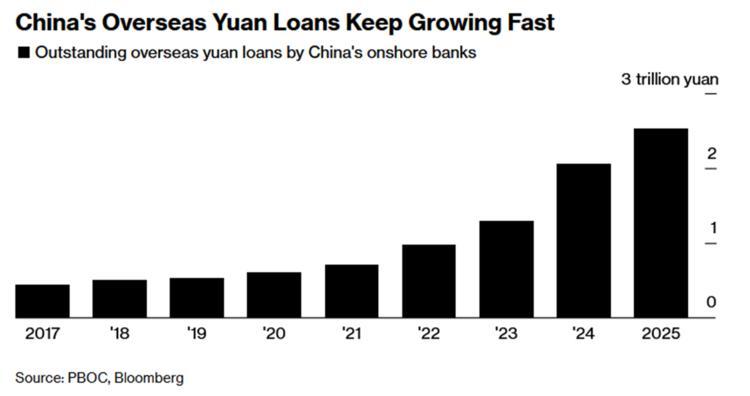
In addition, overseas loans from Chinese banks are also growing rapidly. According to Bloomberg statistics, the stock of overseas RMB loans issued by China's onshore banks has exceeded 2.5 trillion yuan by the end of 2025.
In Africa, the application scope of RMB is also expanding rapidly.
According to a report by Bloomberg on March 2, due to the capricious tariff policies of the United States, Africa has reduced its dependence on the U.S. dollar and instead explored the use of RMB and local currencies for trade settlement.
According to media sources such as Mobile Payment Network, in February 2026, the pan-African payment and settlement system PAPSS reached a cooperation with the Kenyan instant payment system Pesalink, allowing African companies to bypass the U.S. dollar and directly use local currencies to complete settlements. This can not only reduce dependence on U.S. dollar foreign reserves, but also improve settlement efficiency.
As the technology provider of the pan-African payment and settlement system PAPSS, Kenya also plans to convert part of its debt to China from U.S. dollars to RMB, which is expected to save US$250 million in annual costs.
There are more and more countries like Kenya. It is foreseeable that the demand for overseas RMB will rise rapidly, and Hong Kong, the offshore RMB center, is also speeding up its response.
On January 26, 2026, the Hong Kong Monetary Authority announced that in order to cope with the surge in demand for RMB, it would double the total quota for RMB business funding arrangements in 2026 to 200 billion yuan.
At the same time, the Hong Kong Monetary Authority announced the status of RMB deposits. Compared with Hong Kong dollars (1.3%) and foreign currency deposits (-1.1%), RMB deposits increased the most, at 3.5%.
Domestically, the forces that are long on the RMB are also gathering.
According to statistics from Industrial Securities and other institutions, from the end of 2025 to the beginning of 2026, the net amount of RMB foreign exchange settlement has repeatedly hit record highs. Among them, the net foreign exchange settlement amount reached US$99.9 billion in December 2025 and US$88.8 billion in January 2026.
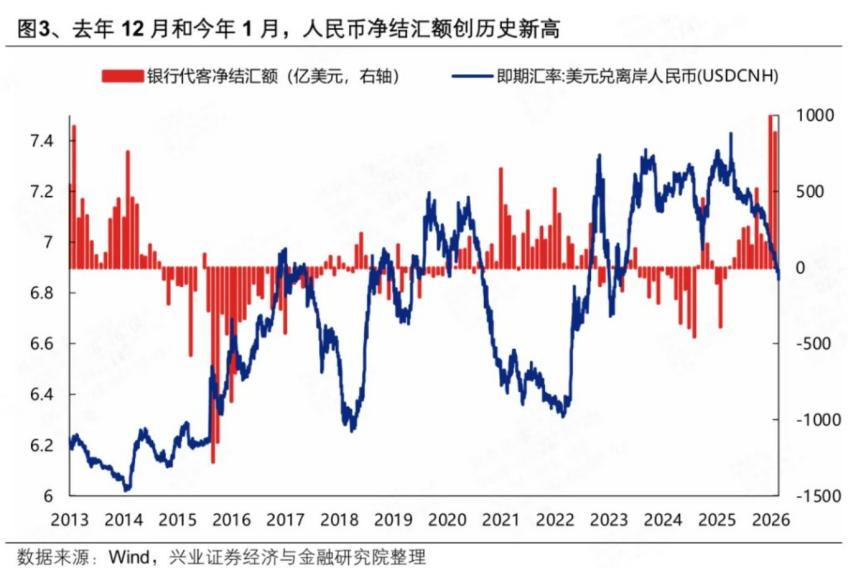
GF Securities believes that this may not be a short-term behavior, but the beginning of the substantial transformation of the large trade surplus accumulated in the early stage into buying orders.
According to GF estimates, the proportion of trade surplus turning into favorable revenue has increased to 77.6% in 2025, the highest level in the past 10 years.

The RMB borrowed from the donkey under the slope will rise naturally.
From the perspective of time points, the pace of this round of RMB rise is quite artistic.
The accelerated pace of appreciation began in December 2025, when leaders from France, Ireland, Finland, and the United Kingdom visited China one after another.
At the end of February 2026, German Chancellor Mertz visited China, and the appreciation of the RMB accelerated again. It is difficult to explain all this by coincidence.
Overseas media such as Lianhe Zaobao and Bloomberg believe that the RMB began to rise when European leaders visited China, perhaps to ease conflicts and balance trade.
Analysts at TD Securities believe that German Chancellor Mertz welcomes the continued appreciation of the renminbi because it will help solve the problem of competitive distortions.
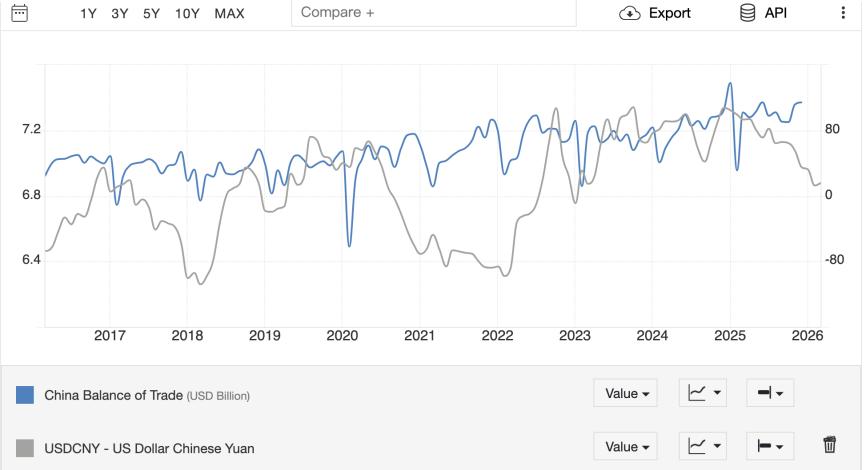
From the perspective of the relationship between trade and exchange rates, the vulnerability of low value-added exports in the past has long since disappeared, replaced by high value-added products and exchange rate derailments.
The blue line (right axis) in the figure below is China's goods trade surplus, and the gray line (left axis) is the exchange rate of the US dollar against the RMB. The two have basically lost the relationship between each other, and even rose together in certain time periods.
In October 2025, Goldman Sachs clearly pointed out that China's exports have achieved a level jump. Among them, from the product perspective, the share of traditional commodities such as toys, textiles and furniture is declining, while high-tech products represented by new energy are rising rapidly.
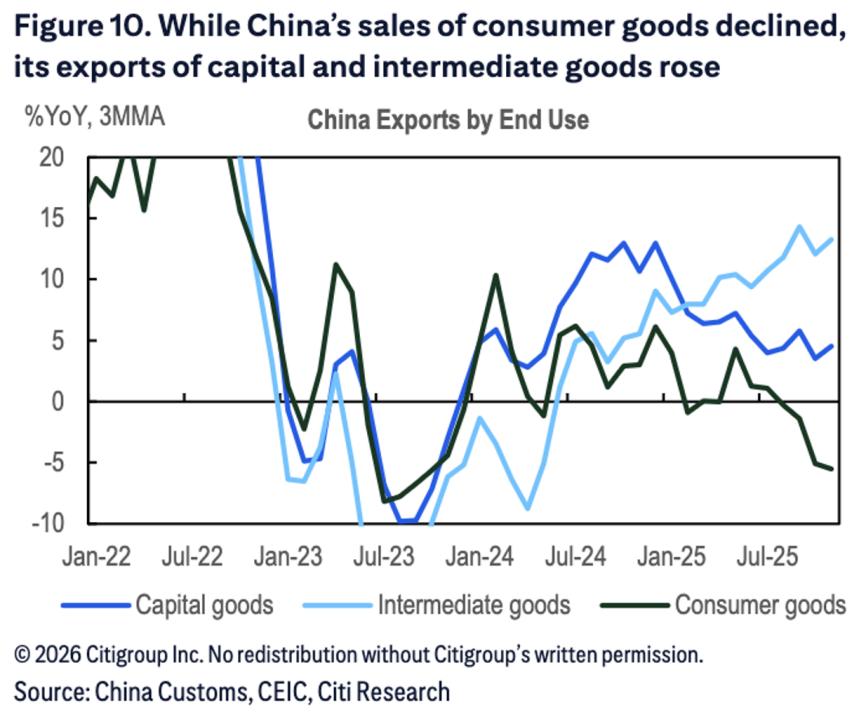
Recent research from Citibank reached similar conclusions.
In the second half of 2025, China's exports of consumer goods will continue to shrink, while capital goods and intermediate goods will continue to grow rapidly.
Changes in the global trade pattern have instead intensified dependence on China's basic industrial products. China is gradually transforming from a supplier of final consumer goods to a supplier of key equipment and raw materials for the global production system.
The past anxiety about RMB appreciation is slowly disappearing, and the RMB can become more independent and valuable.

We don’t want the value to appreciate too quickly, nor should we appreciate it too quickly
Although there is a growing consensus on RMB appreciation, the determination of the Chinese central bank remains the core variable.
The central bank's recent statements on various occasions have been consistent with those in the past, insisting on dispelling the market's excessive unilateral consensus expectations.
The subtext may be that appreciation is okay, but not too fast, and don’t bet on any points. I have the final say in everything.
On February 26, the RMB (against the U.S. dollar) was about to break through 6.82, and the central bank took decisive action. Early in the morning on February 27, a notice to adjust the foreign exchange risk reserve ratio was posted on the official website.
The central bank stated that starting from March 2, 2026, the foreign exchange risk reserve ratio for forward foreign exchange sales business will be reduced from 20% to 0.
In the next step, the People's Bank of China will continue to guide financial institutions to optimize exchange rate hedging services for enterprises and maintain the basic stability of the RMB exchange rate at a reasonable and balanced level.

As soon as the news came out, the offshore RMB fell 0.25% that day, reversing the five consecutive days of rising trends.
The foreign exchange risk reserve ratio tool can immediately change the cost of forward foreign exchange purchases by enterprises. When the RMB depreciates, raising the foreign exchange risk reserve ratio is equivalent to going long in the RMB; when the RMB appreciates, lowering the foreign exchange risk reserve ratio is intended to prevent the RMB from appreciating too quickly.
According to calculations by Huatai Securities, after lowering the risk reserve ratio by 20%, the cost of forward foreign exchange purchases will be reduced by 60 to 80 basis points.
The last time the central bank used the foreign exchange risk reserve ratio was three years ago, when expectations for RMB depreciation were strongest.
The question is, can the central bank completely change the exchange rate trend with just one tool? The answer is clear, no.
According to agency statistics, the central bank has adjusted the forward foreign exchange risk reserve ratio five times in history. Each time, it was effective in the short term and followed the trend in the long term.
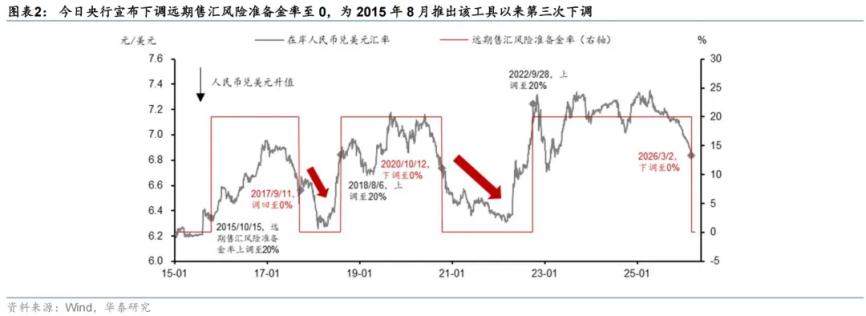
This time will be no exception.
Even with the double "bad news" of the US-Iran incident and the foreign exchange risk reserve ratio, the offshore RMB still remained strong on March 3.
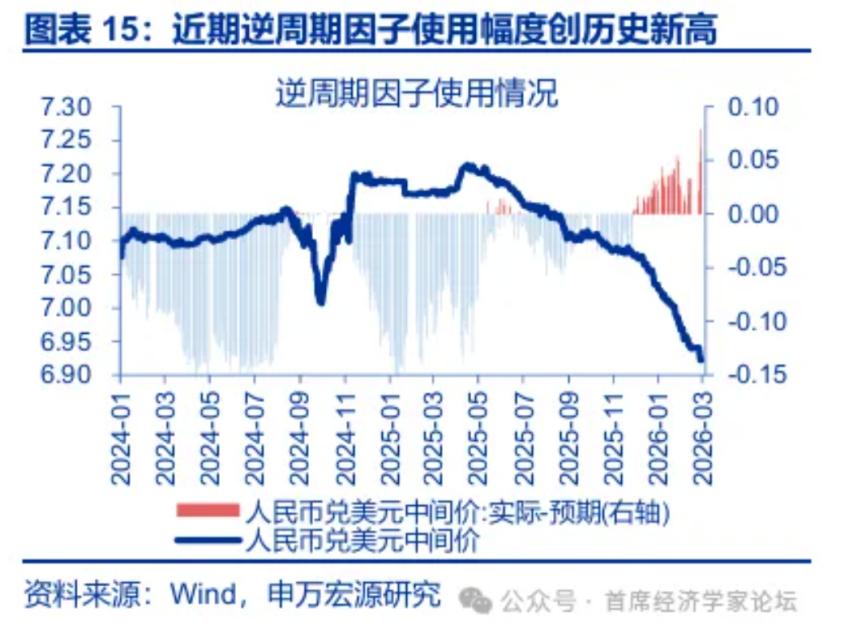
In fact, if combined with another tool in the central bank's toolbox – countercyclical factors, the trend of the RMB is even more unusually strong.
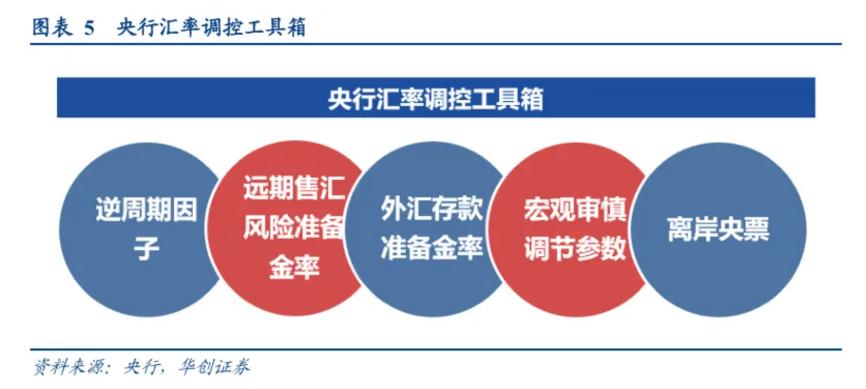
According to statistics from Shenwan Hongyuan, since November 27, 2025, the central bank’s countercyclical factor has quietly turned from positive to negative.
As of February 27, the countercyclical factor has been raised to 793 basis points, the highest level in history. Such strong stabilization tools have not been able to prevent the RMB from accelerating its appreciation.

Ordinary people's problems
Every time the RMB appreciates, all walks of life will worry about traders and exporters. In fact, after years of hard work, exchange rate issues are no longer the main problem for traders.
Those traders who were unable to withstand exchange rate fluctuations have long since withdrawn from the stage of history, and those who remain on the stage are experienced veterans, or in other words, old heroes.
At present, it is actually some ordinary people who are really struggling with the appreciation of the RMB.
According to a report by China Business News on February 27, with the rapid strengthening of the RMB, investors who had previously bought U.S. dollar deposits under the logic of "high interest + exchange difference" began to intensively review their income accounts. The results surprised many people: the interest may not be able to cover the exchange rate losses, and there may even be a shrinkage of principal.
An investor said that at the beginning of 2025, he purchased US$50,000 at an exchange rate of 7.23 and opened a one-year US dollar time deposit with an annual interest rate of 4.5%.
A year later, he received US$2,250 in interest as promised, and made a loss when calculating the general ledger. According to the current exchange rate of about 6.8, he can only get back 355,300 yuan, which is 6,000 yuan less than the original investment.
At present, one-year US dollar deposits are still around 3%, which is still attractive to many people in the low interest rate environment, but the exchange rate issue has become a decisive factor that must be considered.
What to do? Perhaps lowering your rate of return expectations and diversifying your investments as much as possible is a safer choice.
In today's era of collapse of order, safety and security come first.