"It's like there's tear gas in the air, and war has entered our throats," said a Tehran resident who chose to remain anonymous.
After multiple oil depots and oil plants were bombed, Tehran, the capital of Iran, looked like a engulfed city.
The first thing someone noticed was the rain. It was a strange rain. Black raindrops fell on rooftops and streets, leaving paint-like splotches on cars and window sills. Local residents said that when the rain stopped, the entire street turned greasy and black.
Damaged vehicles and thick smoke photographed near an oil storage facility in Tehran, the capital of Iran, on March 8/Source: Xinhua News Agency
Soon, people begin to feel changes in their bodies. Headache, dizziness, sore throat, persistent cough.
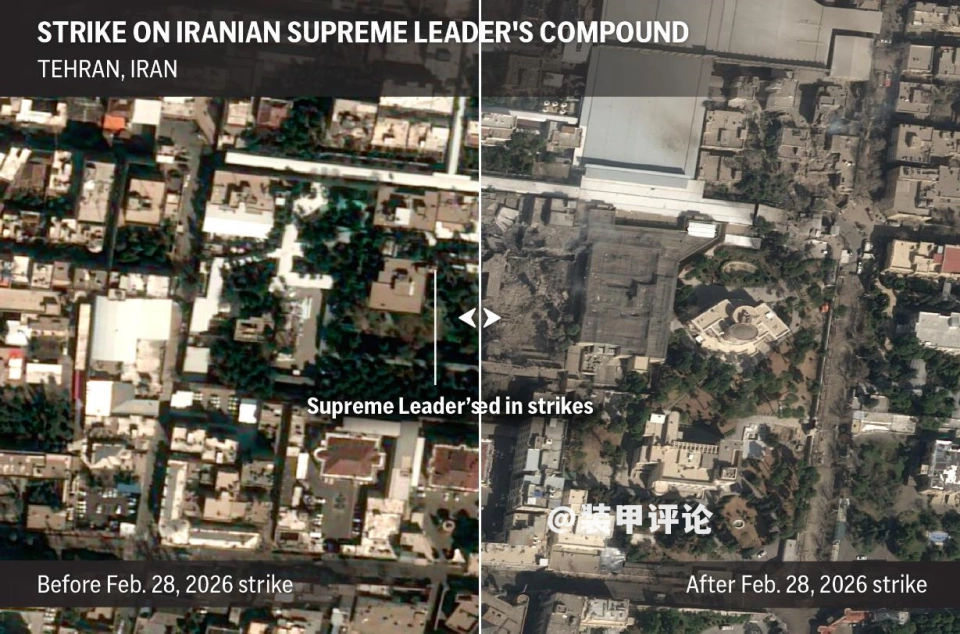
On the night of March 7, local time, Israel airstriked major oil depots and infrastructure in Tehran’s Shahran, Aghdasiya and Shahrrai neighborhoods, as well as in the nearby city of Karaj. A dazzling orange light first lit up on the horizon, and then huge reserves of fuel sparked fires that burned all night long.
The Iranian Red Crescent Society warned residents to stay indoors as much as possible, saying "toxic hydrocarbons, sulfur oxides and nitrogen oxides" had spread in the air and any precipitation could turn into corrosive acid rain. Soil and water resources around Tehran already show signs of contamination. It's unclear how far the toxic smoke will spread. Iran's Foreign Ministry said the act amounted to genocide.
The target of the war has shifted to oil and gas facilities and other infrastructure, and no one can stay away. What deserves more attention is that in a mistake that was simplified as a "target recognition error", a primary school in southern Iran was instantly wiped out, and 180 people were killed (most of them were female students).
An attacked primary school taken in Minab, Iran, on February 28/Source: Xinhua News Agency
On March 11, local time, US media said that a US military investigation found that the US military may be responsible for the fatal missile attack on an Iranian girls' elementary school. Although Trump had previously denied it and claimed that Iran should be responsible, a preliminary investigation showed that the Tomahawk cruise missile strike was caused by a "misjudgment": when the US military used outdated data provided by the Defense Intelligence Agency, it misjudged a building that had long been converted into a school as part of an Iranian military base.
This raises a new question: Can we say "mistake" to avoid responsibility for such a hasty attack on civilian facilities?
For those who live far from a war zone, war is often still understood as a conflict that takes place somewhere. But in the Middle East, ordinary people are facing two different forms of consequences simultaneously: one from the contamination after the explosion, and the other from the increasingly chaotic and out-of-control nature of the war itself.
Pollution has begun to enter the air circulation, water system and food chain; and the mistakes, hastiness and loss of control of the war itself are also spreading to the broader international system.
This is a damaged vehicle and thick smoke taken near an oil storage facility in Tehran, the capital of Iran, on March 8/Source: Xinhua News Agency
Iran has launched a new round of attacks on global energy supplies and neighboring countries, with six ships attacked in the Persian Gulf in just two days. Fuel tanks and tankers also started catching fire at sea, and oil prices rose again. At the same time, the Israeli military said it had begun launching "large-scale" attacks against Iran, targeting the regime's infrastructure across the country. Netanyahu even bluntly stated that he was "destroying the Iranian regime."
This war has moved towards the ultimate chaos sweeping the world, far from being a regional conflict.
Like an earthquake
Since the US-Israeli attack, Tehran residents have gradually become accustomed to the roar of fighter jets in the night sky. But most people still believe that it is still a safe distance away from their lives.
Until March 7th at 10:30pm.
According to the independent media Drop Site News, 24-year-old Sagar (pseudonym) was staying at home in northeastern Tehran with his parents and sister. That night, three huge explosions suddenly sounded.
This is the thick smoke produced after an air strike in Tehran, the capital of Iran, on March 7/Photo by Xinhua News Agency reporter Shadati
“The house was literally shaking, worse than an earthquake,” she recalled. "I still remember the earthquake in Tehran in 2020, but this time it was much stronger."
The windows in the kitchen and living room were instantly shattered, and the chandeliers swung violently like pendulums. Her mother was standing at the sink washing dishes when the explosion occurred. The shock wave knocked her to the ground, and her head hit the floor hard.
They called the emergency number and waited for the ambulance to arrive under the guidance of the phone. About 15 minutes later, paramedics arrived at the scene and took her mother to a nearby hospital. The doctor finally confirmed that it was just a head injury and there was no serious injury.
On March 7, a fire broke out at an oil storage facility in Tehran, the capital of Iran/Source: Xinhua News Agency
It was when the Sagar family returned to their apartment from the hospital to pack their belongings the next day that they truly realized the traces left by the explosion.
"Everything was covered in soot," she said. "Our white refrigerator was completely black. I scratched my finger on the table and my fingertips were immediately covered in black oil." She and her sister spent two hours trying to clean the room. The wet rag quickly became saturated with thick black sludge, and detergent and paper towels had little effect.
“When we finally packed up to leave, our fingernails were covered in black dirt,” she said. “Just breathing in the living room made my lungs hurt.”
The acute symptoms they experience are just the beginning of pollution exposure.
Professor Andrea Serra, professor of inorganic chemistry at University College London, said burning crude oil releases a complex cocktail of toxic chemicals, including substances such as aromatic compounds that are known to interact with DNA and are linked to cancer risk. In Tehran, a city of more than nine million people, "people are actually exposed to a real chemical 'cocktail'."
On March 8, pedestrians walked near an oil storage facility with thick smoke coming out of Tehran, the capital of Iran/Source: Xinhua News Agency
As storage tanks and pipelines are damaged, fuel and residues can also seep into the soil and spread to wider areas under the influence of precipitation, and even risk contaminating drinking water systems.
The Conflict and Environment Observatory, an organization that studies the environmental impact of conflict, has documented hundreds of incidents in and around Iran that may pose environmental risks. Doug Weir, the agency's director, noted that this number is likely an underestimate due to Internet restrictions and delays in obtaining satellite imagery.
Sagar said she never expected that the oil depot next to a residential area would be bombed.
There are many things that Iranians "didn't expect". Attacks over the past two weeks have damaged civilian facilities in Tehran and other cities. The Iranian Red Crescent Society stated that so far, nearly 20,000 civilian buildings have been affected, including at least 16,000 residential units, 77 medical institutions, and 65 schools.
Among them, the explosion at a girls' primary school in Minab, a port city in southern Iran, has particularly attracted attention.
On March 12, in Tehran, the capital of Iran, citizens searched for daily necessities from damaged buildings/Photo by Xinhua News Agency reporter Shadati
Iranian officials have repeatedly emphasized the scale of civilian casualties caused by the conflict. Ali Jafarian, Iran's deputy health minister, said in an interview with Al Jazeera that most of the 1,250 confirmed dead so far are civilians, including about 200 children and 200 women, and more than 12,000 people were injured.
The United Nations Refugee Agency says 3.2 million people have been displaced in Iran.
At the same time, some facilities that may cause greater disasters if destroyed have also become targets.
The entrance building to the Natanz uranium enrichment facility related to Iran's nuclear program was severely damaged in the air strike. The International Atomic Energy Agency said some key structures at the facility had been damaged.
These locations are neither front lines nor "battlefields" in the ordinary sense of the word.
But in this war, launched haphazardly by the Trump administration and always lacking clear strategic goals, chaos has become the norm. And the way Israel behaves in its operations increasingly looks like a comprehensive strike that disregards the boundaries of international humanitarian law.
systematic destruction
If these attacks are simply understood as "accidental attacks", it will not be enough to explain the shape of this war.
In many conflicts over the past few decades, the Israeli military has gradually developed a way of fighting that is different from traditional warfare. The targets are no longer just the military or military installations, but broader social systems: energy, communications, transportation, and urban infrastructure.
This strategy is summarized in military discussions as the "Dahiya Doctrine". This concept originated from the conclusion of the large-scale bombing of the Dahiya area south of Beirut after the 2006 Lebanon War. Its core idea is to force the opponent to bear unbearable costs at the social and political levels through overwhelming destruction.
Under this logic, collateral damage is no longer regarded as a risk that needs to be avoided. This type of collateral damage, which has been repeatedly debated in international humanitarian law, has become a strategic goal of the Israeli military.
On March 12, in Tehran, the capital of Iran, citizens stood in front of building ruins/Photo by Xinhua News Agency reporter Shadati
In recent years, automated target recognition systems have further amplified this method of warfare. In the Gaza War, the artificial intelligence system "Lavender" used by the Israeli military was able to quickly screen a large number of "potential combatants" and mark them as targets for attack. Intelligence agents then pursue the target in a pattern known as "Where's Daddy" – attacking when the target returns to the family home, when the location is easiest to pinpoint.
In this model, the assassination targets are often shot at moments when they are reunited with their families, and those subsequently involved in the attack include their family members, neighbors, or more unrelated civilians nearby.
But what Iran faces is not just this cruel logic of war.
In U.S. military operations, risks come from another dimension—sloppiness and confusion in the strategic decision-making system.
An investigation into the missile attack on an Iranian elementary school revealed that Central Command officers responsible for developing the target coordinates used outdated data provided by the Defense Intelligence Agency to mark the elementary school as a military target. The apparent error went undetected even though multiple agencies, including the Defense Intelligence Agency, the National Geospatial-Intelligence Agency and Central Command, were involved in the review process.
Human Rights Watch analyzed satellite images and noted that the building had been isolated from the military base for at least a decade and had a separate entrance. By 2017, the football field markings could even be clearly seen in the campus courtyard.
Rescue scene of an attacked primary school in Minab City, Iran/Source: Xinhua News Agency
“If anyone takes one look, they know it’s a school,” said Michael Page, deputy Middle East director at Human Rights Watch.
Currently, there is still a lot of important information waiting to be disclosed in this investigation, but Trump seems not to care.
Even though there is evidence that a Tomahawk cruise missile "accidentally" hit the elementary school, and the United States is the only country in this conflict that possesses Tomahawk missiles, Trump still suggested at a press conference that Iran had Tomahawk missiles without evidence.
If Israel’s problem lies in its cruel and reckless war logic that has no regard for collateral damage, Trump brings huge risks due to hasty, chaotic, and haphazard decision-making and execution.
If it is finally confirmed that the girls' elementary school was accidentally hit by the US military, it will become one of the most serious civilian casualties of the US military in recent decades.
community
The chaos caused by the war did not stay in Iran.
Iranian military spokesman Ebrahim Zolfakari warned after the attack: "Be ready for an oil price of $200 per barrel, because oil prices depend on regional stability, and it is you who undermined this stability."
As the conflict escalates, shipping security in the Gulf deteriorates rapidly. On March 11, local time, three merchant ships were attacked one after another near the Strait of Hormuz. Among them, the Thai bulk carrier Mayuree Naree caught fire and forced the crew to abandon the ship. Japanese and Marshall Islands-registered ships were also damaged.
On the same day, a foreign oil tanker was attacked by an explosive unmanned boat in the waters near Basra, Iraq, and caught fire. One crew member died.
This is an attacked oil tanker taken in the waters near Basra Province, Iraq, on March 12/Source: Xinhua News Agency
So far, there have been at least 13 attacks on commercial ships in the Gulf waters.
Behind this unknown attack seems to be a more dangerous signal-Iran is not afraid to expand the conflict in the Strait of Hormuz. U.S. intelligence agencies revealed to the media that Iran has begun laying mines in the Strait of Hormuz. The U.S. Central Command announced that the U.S. military had "annihilated" 16 Iranian mine-laying ships in the waters. Later, Iran denied it.
Sources of threats at sea are becoming increasingly difficult to identify. The British Maritime Trade Action Agency reported that a ship was hit by a suspected unknown projectile about 25 nautical miles northwest of Ras Al Khaimah, United Arab Emirates. The specific situation is still under investigation.
The Strait of Hormuz handles about one-fifth of the world's oil traffic. When conflict enters this waterway, war no longer belongs to just one country.
The geographical location of the Strait of Hormuz/Source: CCTV News
A spokesman for the Iranian Armed Forces' Hatam Anbia Central Command later announced that the previous "reciprocal counterattack" phase had ended. Next, Iran will implement a sustained "serial strike" and will no longer maintain a one-on-one retaliation rhythm.
Some shipping insurance institutions have begun to increase war risk premiums for routes through the Gulf, and shipping companies are also reassessing whether to continue using the waterway.
Faced with rising risks, the energy ministers of the G7 Group issued a joint statement on the 11th local time, stating that countries are discussing the possibility of providing escort for commercial ships and are prepared to use strategic energy reserves when necessary to stabilize the global energy market.
Currently, 32 member countries of the International Energy Agency have formally agreed to provide a total of approximately 400 million barrels of strategic oil reserves to the market. This is the largest joint reserve release operation in the history of the agency.
On March 11, member states of the International Energy Agency unanimously agreed to release 400 million barrels of strategic oil reserves to cope with the tight global oil supply caused by the US and Israeli military attacks on Iran/Xinhua News Agency (Photo by Ahmed Goma)
As the risks of the situation become higher and higher, various countries have begun to frequently discuss the issues of oil supply security and energy prices. But in the various joint statements, people can barely see another set of facts that are also happening: the school that was hit, the oil depot that burned for days, and the missile strike that is still under investigation.
At the same time, the conflict is spreading to new fronts.
On March 12, local time, the Israeli military announced the launch of a new round of large-scale air strikes on "regime infrastructure" in Iran.
At almost the same time, Israeli warplanes also launched a "widespread strike" against Hezbollah targets in southern Beirut, Lebanon, and explosions were heard in many parts of the city. Previously, the death toll from Israel's continued attacks on Lebanon had risen to 634, including 91 children and 47 women, and 1,586 others were injured.
This is a location shot by Lebanese Hezbollah rockets in Hanil, central Israel, on March 12/Xinhua News Agency (Photo by Gil Cohen Magen)
Over the past two weeks, the war has rapidly spread to more dimensions.
For a long time, people have been accustomed to understanding this interdependent world as a cooperative structure—trade networks, energy markets, and supply chain systems constitute a community.
But in this war, the same system is channeling something else: pollution, panic, energy shocks, and ever-expanding security risks.
When war enters these interconnected systems, it eventually enters everyone whose lives depend on these systems.
Author|He Yi