Although China and Brazil are separated by vast oceans, they are "good friends across mountains and seas." The relationship between countries lies in the friendship between people. As the two countries walk hand in hand, overseas Chinese living in Brazil play a unique role. Exchange activities, city interactions, and inheritance from generation to generation have promoted the friendship between the two countries to become increasingly deeper and sublimated.
Each generation has its own mission
"I believe that each generation has its own mission. My dad is from the first generation of overseas Chinese. He immigrated to Brazil and laid a solid foundation. I am considered the 1.5th generation. I have been educated in China and live and work in Brazil. My child was born and raised in Brazil. He is 15 years old this year and will be able to participate in elections in three years." Zhu Xuanchu, president of the Wenzhou Association of Brazil, was born in the 1980s. He arrived in Brazil in 1995. "My goal is to work hard to promote the integration of overseas Chinese groups into mainstream society."
In June this year, representatives from Sao Paulo City, the capital of Sao Paulo State, Brazil, and Wenzhou City, the hometown of Chinese overseas Chinese, signed an agreement in Sao Paulo, officially establishing friendly exchange relations between the two places. Paul City Councilor Sidney Cruz said that he is willing to take this opportunity to enhance the understanding and friendship between the people of Brazil and China, and to consolidate and develop various forms of exchanges and cooperation between the two places in economy, trade, culture, education, tourism and other aspects.
Zhu Xuanchu attended the signing ceremony. "Wenzhou and Sao Paulo are my first and second hometowns. Last year, after taking over as the president of the Wenzhou Association of Brazil, I particularly wanted to do something for these two cities." Zhu Xuanchu, who studied in Brazil, interned in the parliament when he was in college. After graduating from college, he worked in the Brazilian government and also served as the Asian chairman of the Brazilian Workers' Party. This experience gave him the will, ability and resources to work hard to promote the establishment of sister cities between Wenzhou and Sao Paulo. "We hope that the overseas Chinese community can help the two places seek mutual benefit and win-win cooperation in a wider range of fields, promote cultural and educational exchanges to achieve more cooperation, and benefit more young students from both countries," Zhu Xuanchu said.
"Let our group be seen." For this goal, Zhu Xuanchu spared no effort. He actively organized overseas Chinese groups to participate in election activities, allowing Brazilian politicians to see the capabilities of the overseas Chinese groups; he invited Brazilian politicians to participate in various activities of the overseas Chinese groups and bring them closer through communication; he organized the overseas Chinese groups to cooperate with local charities in Brazil and participate in various public welfare activities, allowing the Brazilian people to see the loving and charitable deeds of overseas Chinese in Brazil.
"Our generation has caught up with a good time. On the one hand, China is getting stronger and stronger, and we are more and more confident overseas; on the other hand, we received education in Brazil and entered society, with a language foundation and certain social resources. The right time, place and people." Zhu Xuanchu said, "In recent years, young overseas Chinese leaders have begun to emerge, and everyone is gearing up and eager to try. Recently, I have received many calls asking how to promote exchanges between sister cities. Everyone is moving towards a common goal."
Attracting young people is important
"It is important to attract young people to participate in overseas Chinese youth league activities. This is what Ye Wangyong, the founding president of the Brazilian Chinese Overseas Chinese Youth Federation, said to me at the time. I was deeply impressed." In December 2009, the Brazilian Chinese Overseas Chinese Youth Federation was officially established. Wei Wangu, born in the 1970s, served as the secretary-general. He has been doing this for 12 years. Now, he has been transferred to the position of chief supervisor.
Engage young people with activities. The "Cultural China·Water Cube Cup" Chinese Song Contest and the "Yawen Youth Federation Cup" Basketball Competition are currently the two most eye-catching activities organized by the Brazilian Chinese Overseas Chinese Youth Federation.
"Since last year, we have added a children's group to the Brazilian division of the 'Water Cube Cup' Chinese Song Contest. This year, there are also foreign contestants participating in the Brazilian division. This event has become even more popular in Brazil. Whether they are foreign contestants or overseas Chinese children, they go to China to participate in the competition and experience China's customs firsthand. After returning to Brazil, they have become enthusiastic tellers of Chinese stories." Wei Wangu said.
Although they live in the kingdom of football, the children of the Brazilian overseas community are particularly fond of basketball. The "Yawen Youth League Cup" basketball competition is in its seventh session this year. "The competition is divided into youth groups, children's groups, adult groups and women's groups. There are about 30 teams participating this year. Everyone forms a team and trains together, and the basketball game becomes a very good communication platform." Wei Wangu said.
"The number of participants in this year's game has reached the highest level in history, and the scale is unprecedented; moreover, the team members responded to the call for charity donations and actively donated money and materials." Zhou Wei, president of the Brazilian Overseas Chinese Youth Federation, said, "In Sao Paulo, basketball is not only a sport, but also a cultural and spiritual inheritance."
"In addition to cultural and sports activities, the Brazilian Overseas Chinese Youth Federation also attaches great importance to charity activities. Basically every month, it takes a group of children to slums to participate in charity activities." Zhou Wei said, "We pay great attention to cultivating young people. At present, basketball games are basically left to young people."
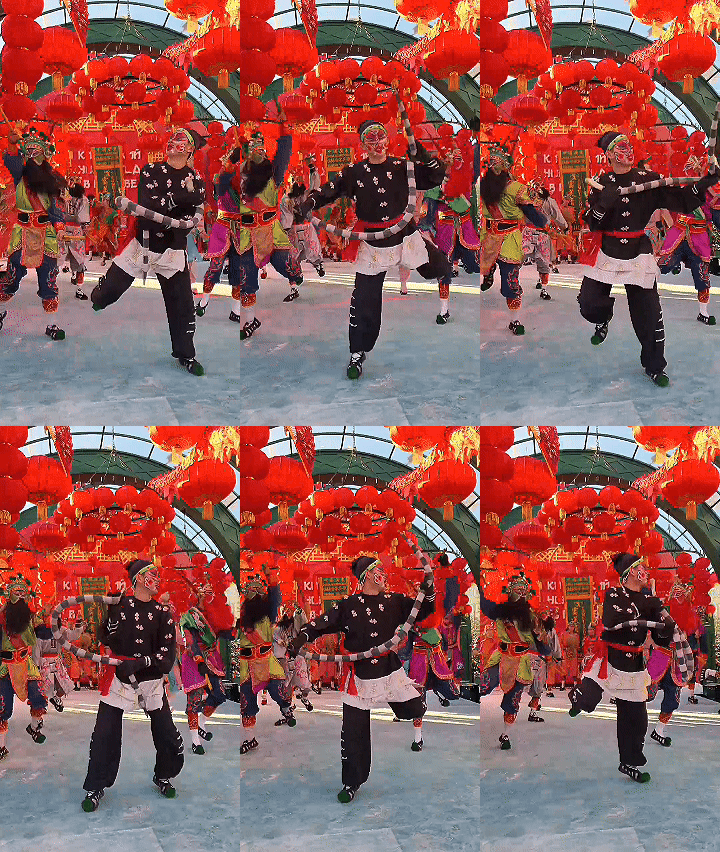
The Brazilian Tang Yun Art Troupe, founded in 1999, also pays attention to attracting young people.
"The first group of members of the art troupe are already over 50 years old, the second group are probably born in the 80s, and now there are many born in the 90s and 00s. These young people were born and raised in Brazil, and are influenced by traditional Chinese culture and have some understanding of Brazilian culture. At present, the art troupe One-third of the more than 20 teachers in the art troupe are young people in their 20s. They know the second and third generations of overseas Chinese in Brazil, so when arranging the program, they will consciously consider the preferences of young people and attract their participation," said Lin Yun, director of the Brazilian Tang Yun Art Troupe.
Give full play to the role of the new generation of overseas Chinese community
"Among the overseas Chinese in Brazil, the majority are new ones. At present, the majority of parents are born in the 60s and 70s. Most of them have studied in China and have a strong sense of identity with China and Chinese culture. The education for the next generation is also relatively timely and comprehensive. For example, there are many Chinese schools in Brazil, and everyone attaches great importance to the Chinese education of their children." Brazil China Peace Reunification Zhang Xiaochun, the president of the First Promotion Association, was born in the 1970s. His two children were both born in Brazil. “We all speak Chinese at home, so my two children, one 18 and one 19 years old, both speak Chinese. This will help enhance their sense of identity with China and Chinese culture, so that they can play their own role in the exchanges between China and Brazil.”
"When we first arrived in Brazil, we, the first-generation overseas Chinese, experienced barriers due to language barriers and different cultures. We also received help through the work of the overseas Chinese group, so we have deep feelings for the overseas Chinese group. The second and third generations of overseas Chinese grew up abroad and adapted well to the local society, so they cannot fully understand our feelings for the overseas Chinese group. Their enthusiasm and sense of responsibility in participating in the work of the overseas Chinese group need to be strengthened, so our usual overseas Chinese group work will consciously provide more training opportunities for young people." Zhou Wei said.