From embodied intelligence to biomanufacturing, from new batteries to green hydrogen energy, more and more new technologies are leaving the laboratory and entering application scenarios, comprehensively reshaping the industrial landscape and the future of economic and social development. The "Fifteenth Five-Year Plan for National Economic and Social Development of the People's Republic of China" released on March 13 proposed that in the next five years, our country will "cultivate and strengthen emerging industries and future industries." It also proposed ten "new industries and new tracks" including embodied intelligence, domestically produced large aircraft, brain-computer interfaces, and low-altitude equipment.
How to achieve this goal? What impact will the layout of new industries and new tracks have on future industrial development? A reporter from the Beijing News interviewed Zhu Keli, a well-known economist and founding director of the Guoyan New Economic Research Institute. He said that emerging industries and future industries represent the forefront of scientific and technological revolution and industrial transformation, and are the core carriers of cultivating new productive forces. Listing them as key industries in the future reflects the strategic vision of "based on the future and planning in advance."
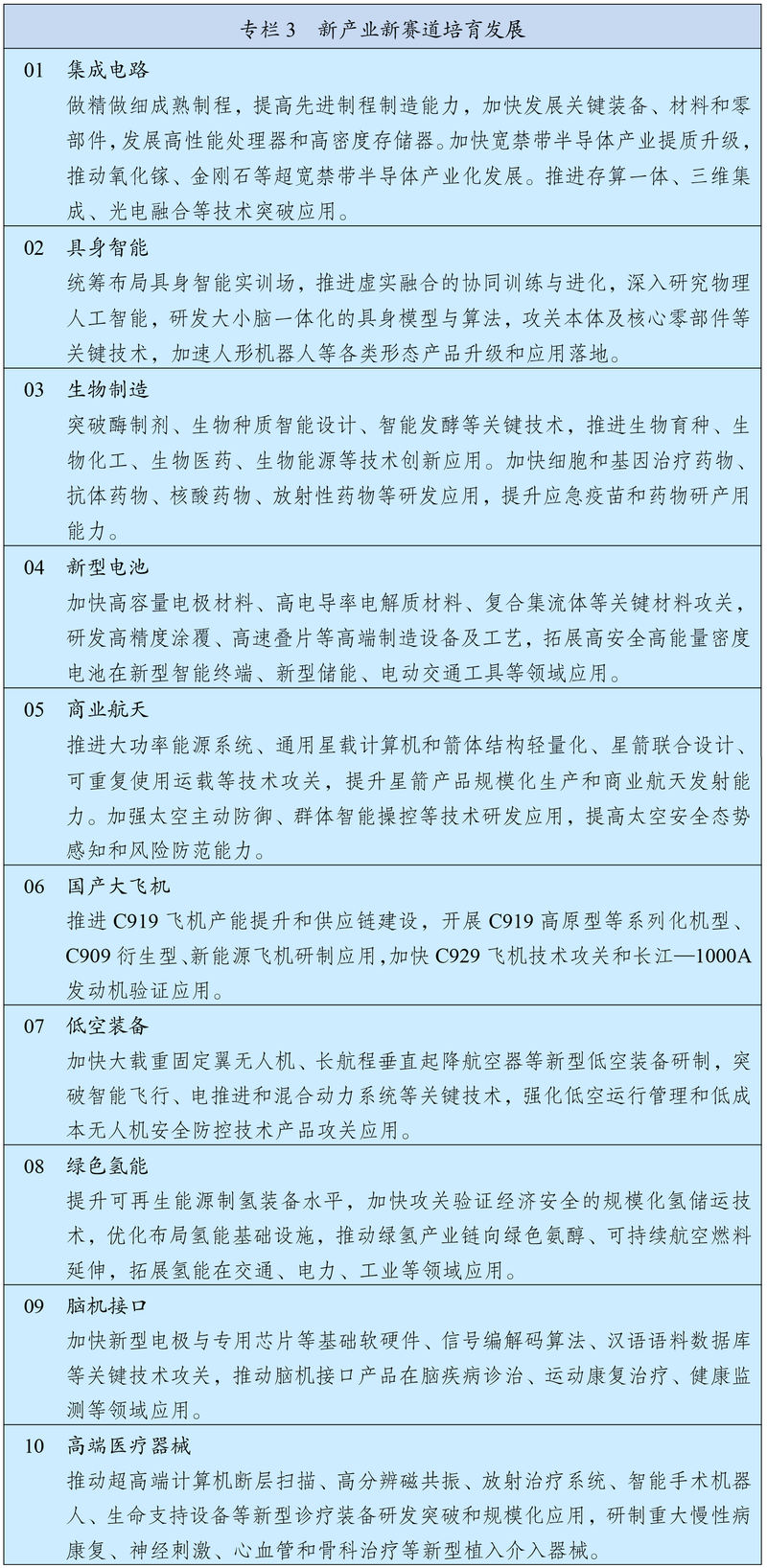
The “15th Five-Year Plan” outlines the layout of ten new industries and new tracks. Xinhua News Agency
New industries, new economic growth poles
When brain-computer interfaces, embodied intelligence, etc. increasingly appear in people's daily lives, they are not only cutting-edge technologies in the laboratory, but also the foundation of industries that will lead the future. Zhu Keli said that this is precisely why the "15th Five-Year Plan" outlines the layout of new technologies, new industries and new tracks at the national strategic level, "reflecting the country's strategic choice on the driving force of economic transformation in the new development stage."
This strategic choice is the inevitable result of adapting to new trends in international and domestic development. Zhu Keli said, "Emerging industries and future industries represent the forefront of technological revolution and industrial transformation, and are the core carriers of cultivating new productivity. Among them, aerospace, low-altitude economy, green hydrogen energy, new batteries and other tracks are accelerating to grow into emerging pillar industries. From an international perspective, global technology competition is intensifying, and all countries are competing in frontier fields. my country must take advantage of the trend to seize the commanding heights of the global industrial division of labor; from a domestic perspective, the fundamental way to solve the "stuck neck" problem and achieve high-level technological self-reliance is to rely on these emerging tracks to achieve technological breakthroughs and industry changes. Placing them in a prominent position is to focus on medium- and long-term competitiveness, build strategic advantages for sustained and healthy economic development, and is also a precise grasp and scientific response to the trends of the times. "
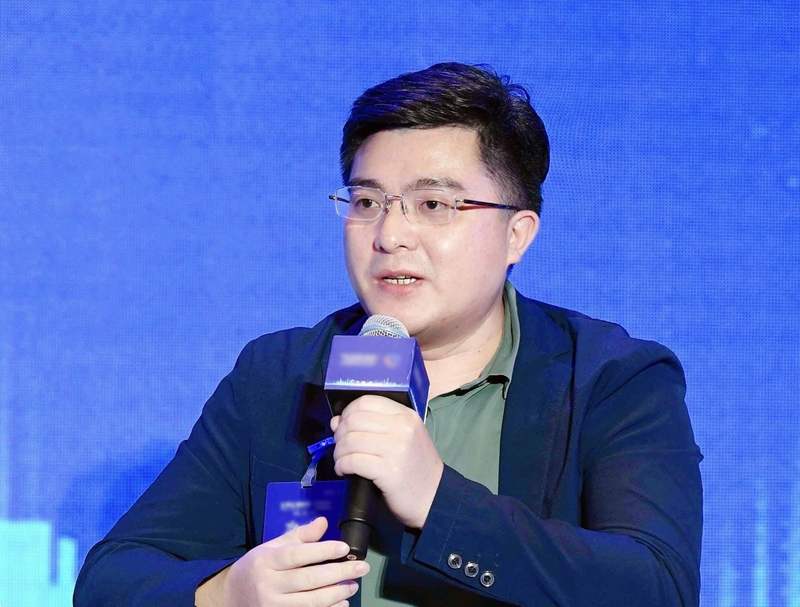
Zhu Keli, economist and founding director of the Guoyan New Economic Research Institute. Photo provided by interviewee
Although at present, some new industries and new tracks, such as embodied intelligence and brain-computer interfaces, still need a process to reach large-scale application, Zhu Keli believes that making them a priority in national planning reflects the strategic vision of "based on the future and planning in advance." "Future industries have long cultivation cycles, large investments, and rapid technological iterations. Strategic reserves must be launched when the technology is still in the breakthrough stage to avoid being controlled by others at the critical stage. These fields contain disruptive technological potential. Once breakthroughs are made, the industrial pattern will be completely restructured and huge economic and social value will be created. For example, the low-altitude economy can link manufacturing, transportation, cultural tourism and other fields to form a new industrial ecosystem. From the perspective of industrial planning According to the law, the development of emerging industries needs to go through a long incubation period from laboratory to industrialization, and early policy guidance and resource support are crucial. Advance planning can accelerate the process of technological maturity and industrialization through policy guidance, factor aggregation and scene opening, and form a first-mover advantage. This is not only an investment in the future, but also to seize the initiative in future industrial competition and inject lasting momentum into national development."
New goals to build a complete business format
In the layout of new industries and new tracks, what goals and paths does the “15th Five-Year Plan” outline show?
Zhu Keli said that from the perspective of goals, the cultivation of new industries and new tracks has clear phased goals. “The overall goal is to build an internationally competitive modern industrial system and provide solid industrial support for the realization of Chinese-style modernization. Specifically, the goals are reflected in three levels. The first is the technical goal. We strive to achieve a number of key core technology breakthroughs in key areas such as embodied intelligence and biomanufacturing in the next five years, narrow the gap with international advanced levels, and achieve international leadership in some areas. The second is the industrial goal, which is to promote emerging industries to become an important pillar of the national economy. In the future, the industry will form a large-scale and industrialized development trend, significantly increase its proportion in GDP, and create a number of industrial clusters with global influence. The third is the ecological goal, to build a number of industrial ecology with aggregation of elements, complete functions, and open collaboration, and to cultivate a large number of leading enterprises and specialized new enterprises with innovative vitality and market competitiveness, laying a solid foundation for the long-term healthy development of the industry."
On August 7, 2025, the world's first "smart canteen" Galaxy Space Capsule with embodied intelligent robots as store clerks was unveiled at Zhongguancun Fusion City. Data map/photo by Beijing News reporter Pu Feng
How to achieve these goals? The “15th Five-Year Plan” outline also draws a clear road map. Zhu Keli explained that the "15th Five-Year Plan" outline emphasizes systematic promotion and precise policy implementation for the cultivation of new industries and new tracks. The core path includes strengthening top-level design and overall coordination, building a three-level linkage cultivation system of national, local and enterprise levels, and clarifying development priorities and implementation steps. Adhere to the innovation drive, increase investment in basic research and cutting-edge technology, rely on national laboratories, new R&D institutions and other platforms to concentrate on breakthroughs in key core technologies and consolidate the foundation for industrial development; deepen openness and collaboration, encourage cooperation between domestic and foreign innovation forces, actively participate in the formulation of international standards, and integrate into the global innovation network; focus on scenario empowerment, targeting low-altitude economies, specific We will build exclusive application scenario demonstration bases and open professional test platforms for featured tracks such as personal intelligence. Through the construction of application scenario demonstration bases and open test platforms, we will promote the iterative verification of technologies in real scenarios and accelerate the transformation of results. We will also improve factor guarantees and give preference to the allocation of funds, talents, data, land and other factors to provide a good ecosystem for corporate innovation. "It can be seen that in the implementation path of the '15th Five-Year Plan' outline, through the above multi-dimensional measures, we will ultimately promote new industries and new tracks from concept to reality and achieve healthy and sustainable development." He said.
New track, multiple measures to lay out the future
Although many new technologies have attracted widespread attention across society, and have even given rise to many hot spots and new trends, many new technologies are still far from being truly universal and maturely applied. The “15th Five-Year Plan” outline also clearly proposes the establishment of a risk-sharing mechanism.
What are the risks of new technologies and new industries in the future? Zhu Keli said that the development of new technologies first faces the risk of uncertainty. The technical routes in frontier fields have not yet been completely finalized. Technologies such as multi-modal perception of embodied intelligence require large R&D investments and high failure rates. There are R&D bottlenecks and technology iteration risks. Secondly, there is the risk of an imperfect industrial ecology. There are shortcomings in the supply chain of core components, materials, equipment, etc. For example, the supporting system for key materials such as new batteries is not yet complete, which restricts the large-scale development of the industry. Thirdly, there are market risks. Application scenarios in some areas have not yet been fully opened. For example, the commercial operation model of low-altitude economy needs to be verified, and there is uncertainty in market acceptance. At the same time, international competition and the risk of technology blockade are intensifying, global technology competition is intensifying, and key technologies and equipment are facing the pressure of being "stuck". In addition, there are still problems such as talent shortage, insufficient capital investment, lagging regulatory rules, safety and ethical challenges, etc., which all pose real challenges to the healthy development of the industry.
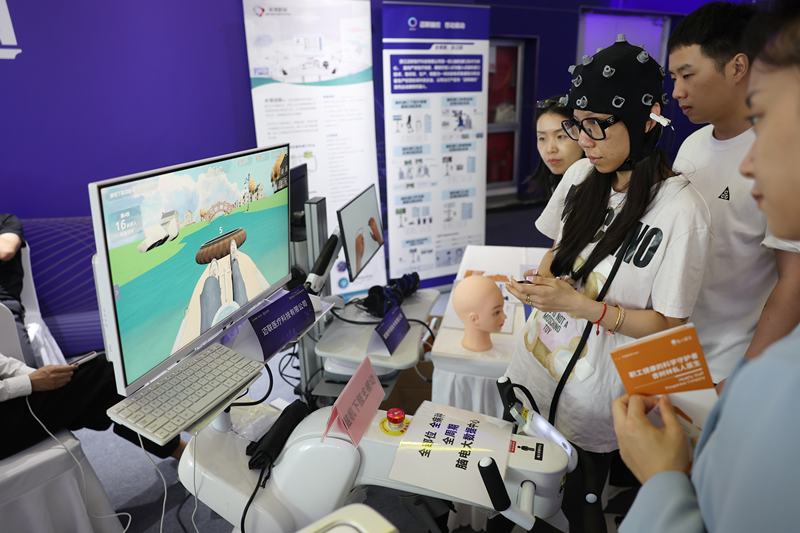
On June 26, 2025, at the Second Intelligent Medical Industry Innovation and Development Conference held in Fengtai District, staff demonstrated brain-computer interface equipment. Photo by Beijing News reporter Tao Ran
How to deal with future challenges and risks? How to establish a risk sharing mechanism? Zhu Keli believes that to deal with challenges and risks, we need to adhere to a problem-oriented approach and take multiple measures. The first is to strengthen core technology research, give full play to the advantages of the new national system, and concentrate resources to break through key bottlenecks in new batteries, low-altitude equipment, brain-computer interfaces and other fields. The second is to improve the industrial ecology, strengthen upstream and downstream collaboration in the industrial chain, cultivate supporting enterprises, and improve the emerging track supply chain system. The third is to optimize the market environment, increase the opening of scenarios, and cultivate market demand through policy guidance and demonstration applications. The fourth is to strengthen international cooperation, actively participate in global governance, and enhance international voice. Regarding the risk sharing mechanism, a diversified system involving the participation of governments, enterprises, financial institutions, and social capital should be established. At the government level, special funds can be set up, risk compensation can be provided, tax incentives can be implemented, and early R&D and trial-and-error costs can be reduced. At the enterprise level, an internal risk sharing mechanism should be established to disperse risks through technological innovation cooperation, intellectual property sharing, etc. At the financial level, develop financial tools such as technology insurance, intellectual property pledge financing, and venture capital to provide capital guarantees for enterprises. At the social level, guide industry associations, scientific research institutions, etc. to participate in risk co-management, forming a good pattern in which multiple parties work together and share risks.