At one o'clock in the morning London time, the madness of the market woke Michael Brown from his sleep. His mobile phone is placed beside the bed, and it is buzzing almost constantly with constant news reminders: Brent crude oil exceeded US$100 per barrel; it exceeded US$110; Nasdaq futures fell 2%; the Nikkei index plummeted 5%.
So Brown, a senior strategist at the brokerage firm Pepperstone, got out of bed, turned on his computer and started answering a flood of calls from Asian clients. "There was already some panic going on," he said.
It was Monday, the 10th day of the war with Iran, that investors suddenly realized the extent of the disruption to oil production in the Middle East. Panic once pushed crude oil prices up by more than 30%, and Gerald Gan, chief investment officer of Reed Capital Partners, was also woken up at home in Singapore. Some of Reed's clients had suffered huge stock losses, and company employees were desperate for guidance, calling him again and again before dawn, saying, "We need to protect our portfolio."
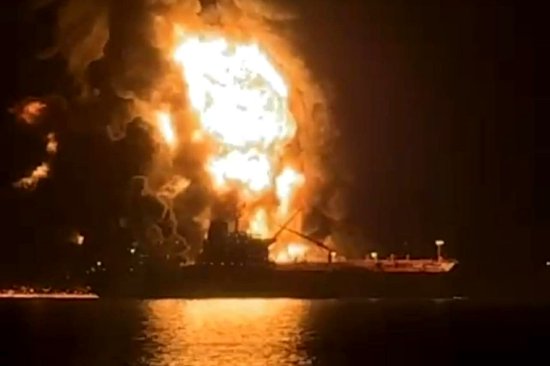
An oil tanker caught fire after being attacked in Iraqi waters.
In America's oil fields, veteran commodities trader Dennis Keesler is busy dealing with an entirely different problem. Many of his clients at BOK Financial Securities are executives from shale oil producers who, as they watched crude prices soar in overnight trading, became increasingly eager to lock in those high prices. From the moment he walked into the Oklahoma City office at 6 a.m. Monday, deal orders came pouring in, and Keesler found himself having to answer three phones at once. By noon, his voice was hoarse.
The war in the past two weeks has triggered violent market fluctuations. The South Korean stock market crashed at a record high, European natural gas futures soared 68% in two days, the Indian rupee and the Egyptian pound fell to historical lows, and investors around the world are on edge. Some made fortunes, others suffered heavy losses, and even some of the biggest names in the financial world were left unscathed, including PIMCO, The Castle and ExodusPoint Capital Management.
"Someone's always going to get hurt," Kiesler said. "In a moment like this, if you don't pay attention and do it the wrong way, you can lose a million dollars in two seconds."
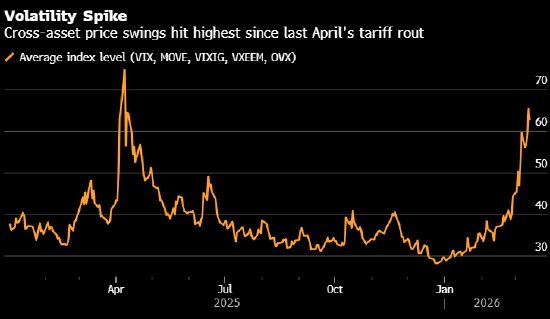
It wasn't just the speed of the moves that shocked traders, but also the dramatic "whiplash effect." Markets can be thrown into turmoil by just one piece of news, even if it's wrong, such as when U.S. Energy Secretary Chris Wright posted on Tuesday that the Navy had escorted an oil tanker through the Strait of Hormuz.
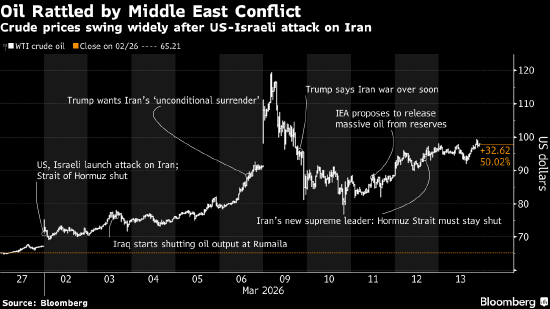
Just the day before, U.S. WTI crude oil futures gave up almost all of their 31% gains after Trump suggested that the war may be nearing an end. This was the largest intraday reversal in at least four decades. The S&P 500 surged in the final hour, notching its biggest gain in a month.
Things have eased slightly over the past few days, however, unlike the brief crash triggered by Trump's reciprocal tariff announcement a year ago, many in the market expect this extraordinary volatility to continue for weeks, if not months. They point out that a real war would be more unpredictable and harder to cool down than a trade war. "I tell all the stakeholders, be careful," Gerald Gan said.
One of the most puzzling features of the sell-off is that traditional safe havens, with the exception of the U.S. dollar, appear to be failing. From gold to the yen, the Swiss franc and U.S. Treasuries, assets typically seen as safe havens in times of crisis are falling as soaring energy prices reignite inflation fears and push interest rates higher.
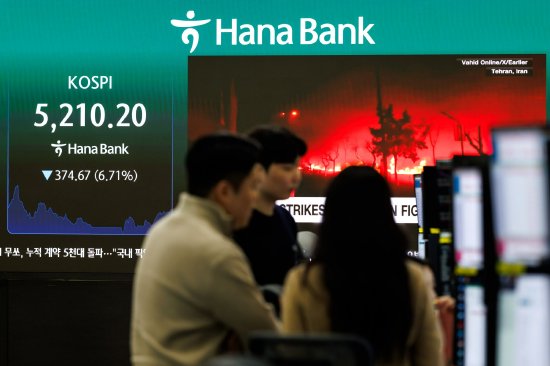
The trading floor in Seoul this week.
Raymond Lee, chief investment officer of Torica Capital in Sydney, had originally hoped to hedge risks by investing in U.S. Treasury bonds. When he saw oil surge early Monday and Treasuries fall again, he decided to cut his losses, ordering traders to sell their holdings of two-year Treasury futures contracts.
He concluded that the U.S. Treasury market had become almost an extension of the oil market, with yields rising and falling with crude prices, and he wanted no part of it until things stabilized. "Trading interest rates is like trading oil, and I'm not an oil expert," Lee said.
But Keesler knew oil.
As BOK's head of energy trading, he spent decades in the trading pool of the Chicago Mercantile Exchange. He had experienced the surge in oil prices caused by the Gulf War in 1990 and the Iraq War ten years later, and the market shock waves at that time are still fresh in his mind.
Keesler has traded through all the oil shocks over the years: the 2008 financial crisis, the coronavirus pandemic, the Russia-Ukraine conflict. No time has produced such a steady flow of customer orders as Monday morning, he said.
Oil prices rose about 30% in the first week after the United States and Israel began bombing Iran, but investor anxiety quickly built ahead of Monday's opening as reports over the weekend began to show more fully the decline in crude production in the region. In just a few minutes after the market opened, WTI rose by more than 10%.
With the Strait of Hormuz all but closed, the International Energy Agency estimates that about 8 million barrels of oil per day will disappear from the market this month. The agency called it the "largest supply disruption" the market has ever seen.
Kiesler reminded his traders that for now, they must always be fully staffed. One of his tips for moments like this: drink less coffee and water, which will reduce the number of trips to the bathroom. "You can never take your eyes off the screen."
Back in Singapore, Gerald Gan followed a similar rhythm at Reed Capital. He went online at 6 a.m. and stared at the screen until about 2 a.m. the next morning.
The region relies heavily on oil and gas imports from the Middle East to drive its economy, and many of the worst market crashes have occurred in Asia. Every surge in crude oil prices will quickly push up inflation expectations, lower economic growth prospects, squeeze the finances of various countries, and put the market under greater pressure.
Along with India, currencies in Indonesia and the Philippines have fallen to record lows. Five of the 10 worst-performing stock markets in the world this month are from Asia. Few fell more sharply than the KOSPI. The index fell more than 7% on March 3 and hit a record loss of 12% the next day before recouping some of its losses in several rounds of wildly volatile trading.
The rout in South Korea's stock market took a "hard hit" to Gan's portfolio, but he said he made a fortune for his clients by buying large amounts of oil at around $60 a barrel a few weeks ago.
Gan said it was like riding a "roller coaster." He was ready for the coming weeks. "This is not over yet."
Brown, a strategist at Pepperstone in London, shares the same concerns. "One minute you think, 'Maybe we're out of this, maybe there's progress,'" he said. "Then the next minute the news completely reverses and you lose money on all your positions. You're back to square one."