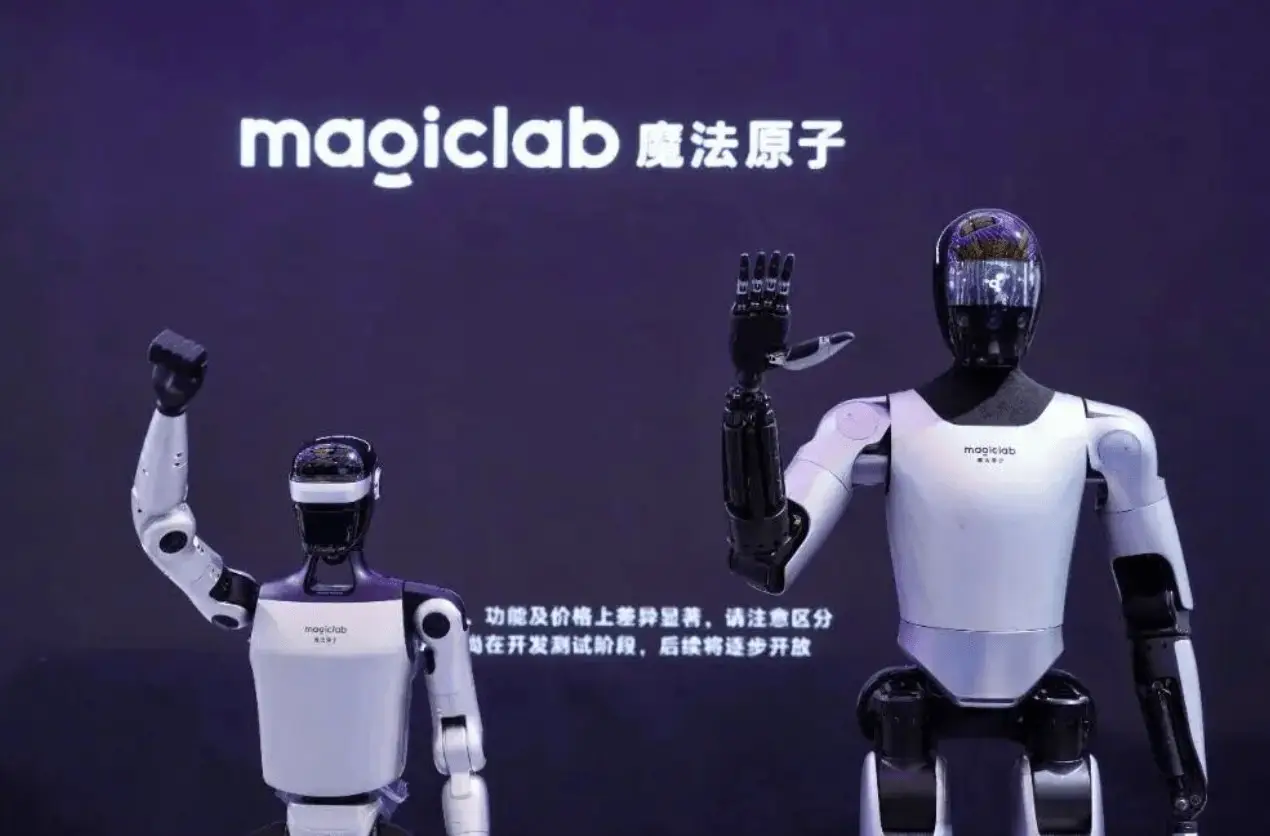
On March 9, a signal worth pondering came from the embodied intelligence track. Magic Atom announced the completion of a new round of financing of 500 million yuan. Among the investors, there are a number of industrial capitals with manufacturing foundation and scene resources such as Tuopu Group, Jiechuang Intelligent, and ASD. SkyWorks Venture Capital Fund, Jinyu Bogor, etc. also participated.
It is worth noting that there is also an industrial ecological fund with a scale of tens of billions, focusing on the key links in the upstream and downstream of the industrial chain, and the overall capital scale exceeds 10.5 billion yuan.
For a long time in the past, early financing in the embodied intelligence track was often characterized by a single-point breakthrough. Because the single-point route is more focused, it is easy for startups to label technology in the short term, thereby further gaining favor from the capital market.
Now, the wind direction is shifting. Public data shows that global humanoid robot shipments have reached 18,000 units in 2025, and their technical capabilities are moving from "prototype verification" to "scale availability."
Capital is also paying more and more attention to whether a company is an all-rounder and whether it can continue to build system capabilities among ontology, models, data, and scenarios along a complete path. Magic Atom’s capital dynamics of exceeding 10 billion this time just reflect this logical evolution.
Behind the battle between software and hardware, the industry begins to bid farewell to the "partial science competition"
The current embodied intelligence track has shown clear path divisions.
Some companies choose to start with models and "brains", trying to take the lead in breakthroughs in understanding, planning, and generalization capabilities; others start with the ontology and hardware, giving priority to establishing motion performance, structural capabilities, and engineering thresholds. Behind the different paths are different judgments by enterprises on the key bottlenecks of the industry, which also correspond to different aspects of the embodied intelligence industry.
The discussion within the industry on the battle between software and hardware has never stopped. Musk has admitted that the team is still struggling with the final design of Optimus hardware, but he is confident in achieving natural human-computer interaction based on large language models. Wang Xingxing, the founder of Yushu Technology, has the complete opposite view of somatosensory. He believes that the existing hardware is sufficient in a sense. The real desert lies in the difficulty of AI in accurately controlling the complex mechanical components of the robot.
The completely different somatosensory does not represent opposing views, but reveals the current dilemma of robots – the lack of deep integration of software and hardware.
As the industry enters the implementation verification period, a consensus has become increasingly clear. Embodied intelligence is not a track that can be won by relying on a single point. The real real competition is turning to "whether software and hardware can form a closed-loop system."
The integrated strategy of software and hardware has once again become the way to break the situation.
IDC pointed out that China's embodied intelligence market has entered a critical inflection point in 2026. Breakthroughs in single-point technology are no longer scarce resources. In the next two to three years, the differences in hardware parameters will gradually narrow, components such as body structure, computing power, and sensors will become standardized, and manufacturers' software and hardware system capabilities will become a watershed.
In this context, Magic Atom takes "embodied intelligence + The "1" on the bottom represents a capability base that integrates software and hardware and continues to evolve. The "2" represents the two core product lines of humanoid and four-legged. It is extended by N ecological touch points. Starting from modular products, it gradually grows into a collaborative, multi-form intelligent ecological space.
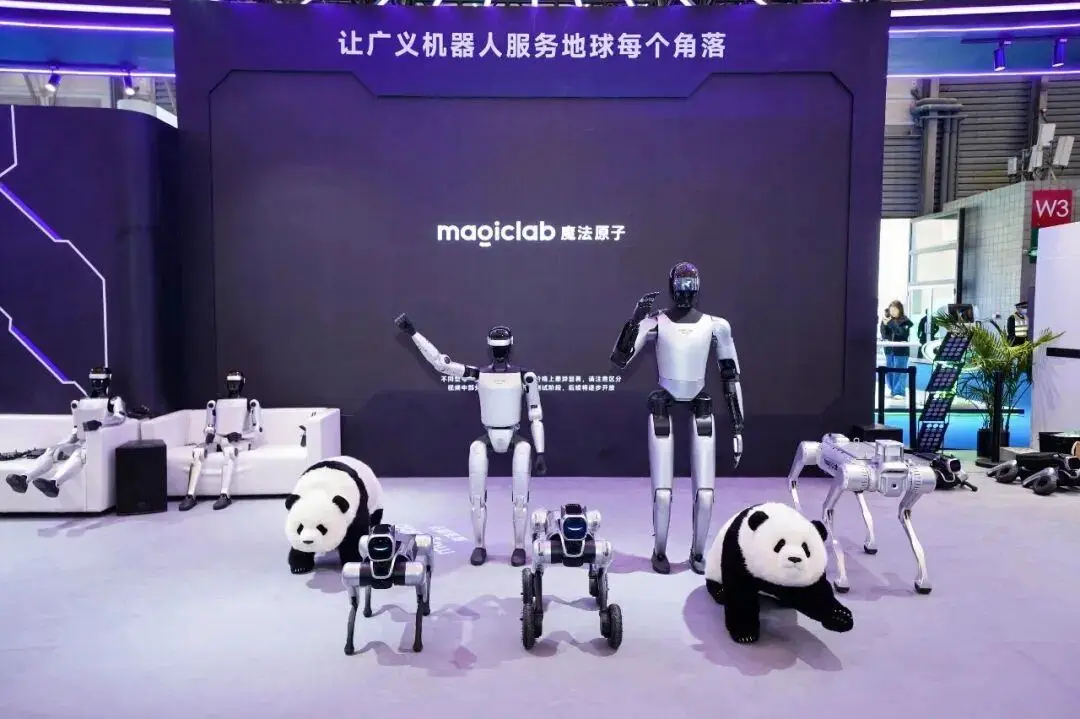
The significance of this strategic structure lies not in the enrichment of product lines, but in the fact that different products and different scenarios are not separated from each other, but share a technical chassis.
Because in the real world, without ontology, the model has no execution carrier; without the model, the ontology is difficult to generalize across tasks; without data, the model and control cannot be continuously iterated; without scenarios, it is difficult for data to form a closed loop; without productization and engineering capabilities, it is difficult to achieve stable delivery.
The real barrier is not a certain ability itself, but whether a stable and difficult-to-dismantle interlocking relationship can be formed between these abilities. Optimize the model through data feedback from the real environment, and then use the iterated model to improve the generalization ability of the hardware. This advantage that relies on time, scale, and task density is extremely difficult for latecomers to directly eliminate through short-term capital investment.
The moat of embodied intelligence is shifting from parameters to systems
What kind of robot can be considered as a large-scale application?
A robot that lifts a 20-kilogram weight in a stable environment only completes primary engineering indicators; but a robot that can stably pick up metal castings with an offset center of gravity for 24 hours in a factory environment with slight ground vibrations can be called a commercial product.
This is the difference between heavy parameters and heavy systems. Commercial competition has never been about showing off parameter "muscle", but testing systematization capabilities.
Therefore, Magic Atom chose to self-develop key components and independently developed joint modules covering a variety of actuators such as planetary deceleration, harmonic deceleration and linear actuators, with a maximum explosive force of 525N·m. The accompanying dexterous hand MagicHand S01, while providing 11 degrees of freedom, can lift the maximum load for specific tasks to more than 20 kilograms. This heavy investment in core components and overall machine structure has an extremely long cycle, but it is deeply bound to subsequent model training and task execution.
In terms of model technology, Magic Atom has self-developed large-scale embodied intelligent models that integrate visual language understanding, task planning and motion control capabilities to promote the evolution of robots from single task execution to cross-scenario task capabilities. From life service scenarios where robots "catch noodles" during the Spring Festival Gala to industrial manufacturing scenarios, the capabilities of the Magic Atomic Model have been verified in real industrial scenarios, with a loading and unloading accuracy rate of up to over 90%.

But if robots want to truly enter large-scale applications, only ontology and models are not enough. Data training based on real scenarios is also required. This is a prerequisite for the system to traverse complex environments and improve robustness.
The data of the robot naturally depends on the body shape, control method, task process and scene feedback. Although laboratory simulation data can help the model converge quickly, it can also easily push the system to "overfitting": it performs well in an ideal environment, but frequently fails once it arrives on site. The real world is far more complex than the laboratory. The position of parts on the assembly line may only shift by a few millimeters. The light in the workshop will alternate between light and dark as the time changes, disrupting the original spatial coordinates.
This is also the reason why more and more head manufacturers are beginning to pay attention to real scene data. For example, in order for Tesla's Optimus to achieve stable sorting in the factory, the amount of measured data required reaches millions of hours.
In this regard, Magic Atom built its own data mining factory to open up a complete link from data collection, model training, simulation evaluation, model deployment, and application feedback. And it is deployed in the production front-line scenarios of a group of the most demanding head KAs (key customers) as a "whetstone" for product iterations. Every time the robot enters a more complex scene, it gets not only orders, but also higher-quality data and more realistic problem sets.
From the perspective of scenario distribution, this system capability is also tested in different types of environments.
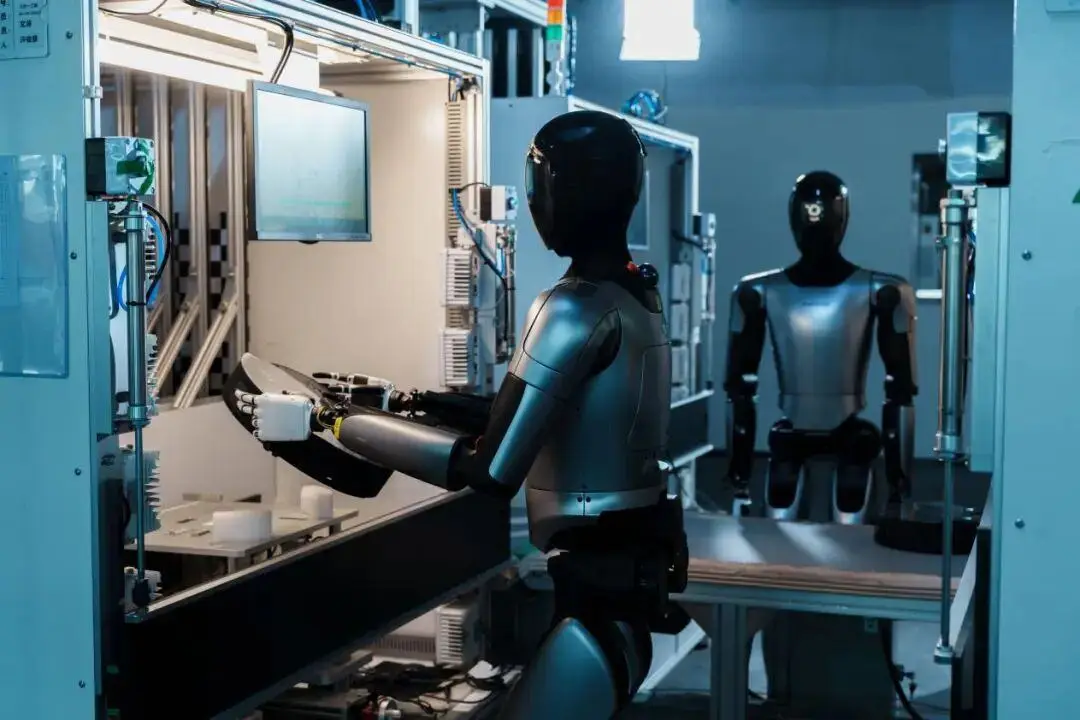
Industrial scenarios are relatively structured scenarios in reality, and the first thing to verify is execution capabilities. In the factory, Magic Atom's Magic Bot Gen1 is no longer just a demonstration prototype, but has begun to be used in specific tasks such as loading and unloading on the production line, precision inspection of parts, cargo sorting, handling and palletizing.
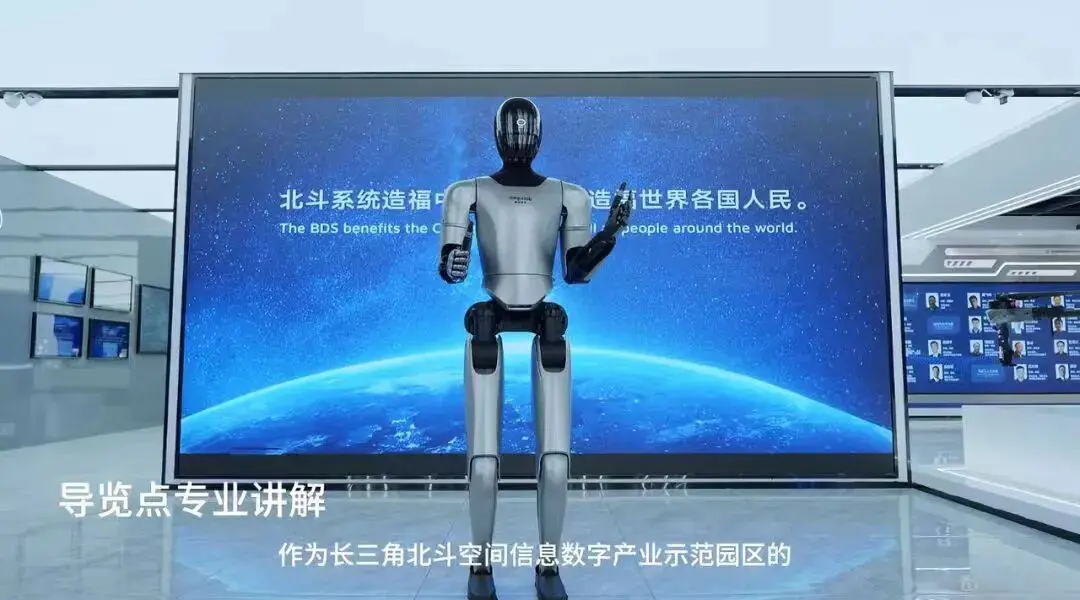
Commercial service scenarios are semi-structured scenarios that require human-computer interaction, environmental adaptation, and long-term stable operation in scenarios such as tour guides and shopping guides. Magic Atom's tour and shopping guide solutions have been implemented in many projects such as the Wuxi Yangtze River Delta Beidou Space Information Digital Industry Demonstration Park and the Wuxi Low-altitude Economic Operation Exhibition Center; the unmanned store solution has also been implemented on a regular basis in Wuxi Airport, Plaza 66, Huishan Ancient Town, and Shenzhen Gankeng Ancient Town.
Special scenarios further push the system capabilities to the limit and are its ultimate tests. High-risk environments such as mining prospecting, power inspection, and chemical monitoring put forward more stringent requirements for all-terrain adaptation, high load capacity, and stable operation capabilities in dangerous environments. Here, any shortcomings between ontology, control, perception and execution are magnified. The quadruped robot Magic Dog Y1 can replace humans to complete data collection in dangerous environments, freeing humans from high-risk operations.
Industrial, commercial, special and other scenarios use seemingly scattered scenarios, but ultimately serve the same thing: increasing scene density, accumulating real data, and improving system reusability.
Why is Magic Atom revalued by capital?
Observing the current industry climate of China's embodied intelligence is more like revisiting the early development of the autonomous driving track from 2015 to 2019. Initially, capital was keen on the grand narrative of the industry. Just as concepts such as L4 and Robotaxi were pursued back then, hot money initially also flocked to single-point technological breakthroughs. Because a single technological breakthrough can amplify industry optimism.
However, as it truly advances towards commercialization, industry rules emerge: the path of autonomous driving that has been fully experienced by "algorithm breakthroughs igniting expectations – parallel competition among multiple routes – hot money chasing head narratives – commercialization forcing technological convergence", embodied intelligence is going through again.
The investment logic quickly moves from the conceptual level to the closed-loop scenario. Investors are no longer satisfied with demo code, but are beginning to ask about the cost of a single machine, the success rate of real deployment, and the number of complete machines delivered.
At the stage of commercialization, software and hardware collaboration, system integration, responsibility boundaries, supply chain cooperation and scenario closed loop have become new sticking points.
At this time, the tens of billions-level industrial ecological fund and 500 million yuan in financing settled by Magic Atom happened to be in line with the pace of industry revaluation.
If ontologies, models, data, and scenarios are scattered among different vendors, commercial delivery will face extremely high communication losses. A robot made a grasping error in the workshop, resulting in a decline in yield, and the customer was unable to identify the root cause. Enterprises cannot open the underlying interfaces without reservation, which directly locks the upper limit of system capabilities.
In order to break the fragmented state of the industry in its early stages, Magic Atomic chose capital links to integrate the industrial chain, and settled tens of billions of ecological funds in Wuxi. Through the "Venus Plan" of "investment + incubation", it clearly invested funds in upstream and downstream links such as algorithms, computing power, core components and end execution tools.
The financing promoted at the same time is essentially reserving strategic ammunition for the subsequent large-scale mass production. Looking at the list of Magic Atom’s investors in this round: SkyWorks Venture Capital Fund, Top Group, Golden Rain Bogor, Suda Tiangong, Jiechuang Intelligent, Aistar, Liang Venture Capital… it shows a clear demand for industrial synergy.
From this point of view, the next stage of competition in embodied intelligence is not necessarily about who can achieve the ultimate in a certain ability first, but who can first truly turn ontology, models, data, and scenarios into a self-reinforcing system.
A single breakthrough can bring a temporary lead, but it is the system's capabilities that determine long-term value. After the robots enter the real scene, the competition is not only parameters and demonstration effects, but also stability, collaboration and continuous iteration capabilities.
In this sense, Magic Atom’s dual-line financing and fundraising is not just a capital event, but more like the market’s early bet on the “complete path school”. This bet is not on the explosion of a single point of capability, but on the closed-loop capability of the system. This is a path that is heavier, slower, but also harder to copy.
The real watershed of embodied intelligence may begin here.