According to data predictions from the "2019 China Automotive Aftermarket Industry Research Report", the size of my country's auto aftermarket market in 2018 will reach 120 million yuan, which is about half the size of the U.S. aftermarket. However, the number of companies in my country's aftermarket has reached twice that of the United States, and the market share of 4S stores in China's market structure is as high as 77%, far exceeding the foreign level of about 30%.
Cluster Chebao, which 36Kr recently came into contact with, is an Internet empowerment platform for the automotive aftermarket industry. It helps auto service stores transform and upgrade through the S2B2C model to output standardization, digitization, informatization and intelligence, improve upstream and downstream efficiency of the industry chain, reduce costs, and improve user service experience. Its business areas include car beauty, repair, sheet metal painting, car modification, second-hand cars, car insurance inquiry, roadside assistance and other automotive aftermarket services.
There are a huge number of service providers in my country's automotive aftermarket, but the market share is still firmly occupied by a few brands such as 4S stores. Auto parts repair stores mainly exist in scattered forms such as mom-and-pop shops. Scattered B-end stores do not have symmetrical spare parts information and internal management capabilities, and customer retention rates are generally low. my country's current car ownership has increased year after year since 2010, reaching 250 million in 2019. However, because the warranty period of original parts is about 4 years, the growth of the automotive aftermarket will have a lagging effect. If individual stores want to seize the growth points of the automotive aftermarket in recent years, they urgently need stronger supply chain integration capabilities and corporate management capabilities to improve service quality. According to data from the "2019 China Auto Users Online Maintenance Report" compiled and released by Tencent, the market penetration rate of online car maintenance outside the 4S store system has reached 16% in 2018, far exceeding the 5% in 2015. The overall online channel in the auto maintenance market has shown a significant upward trend.
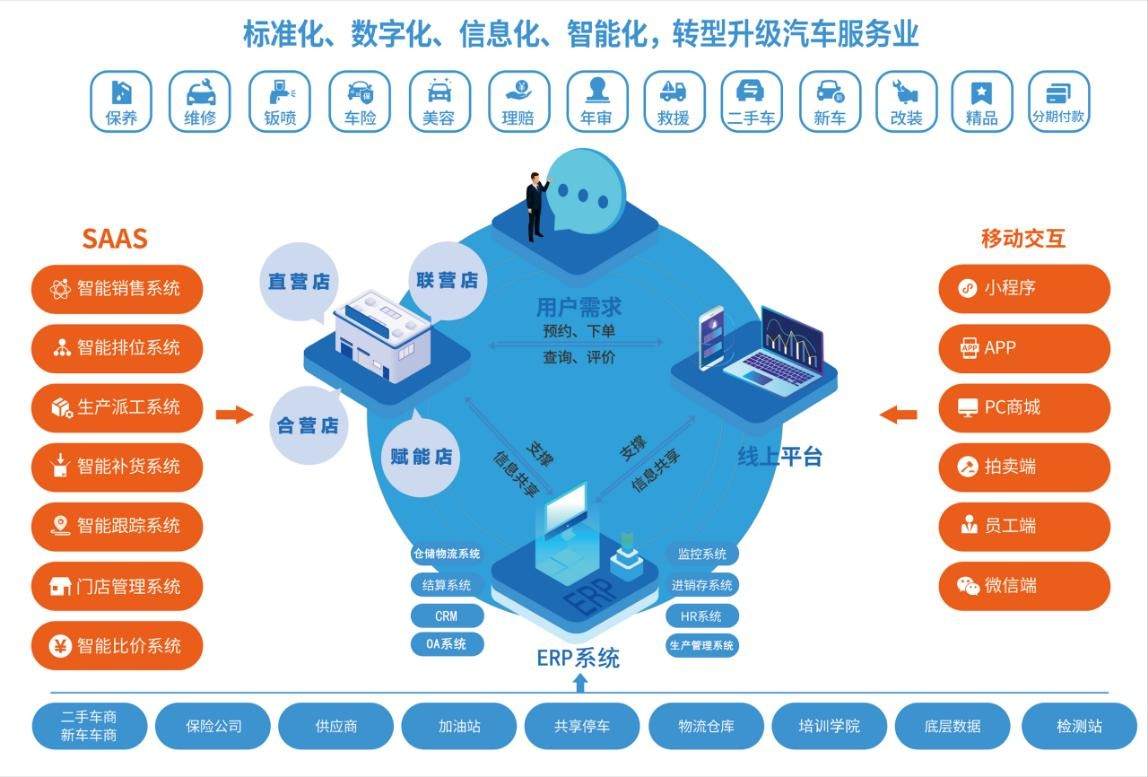
Cluster Chebao integrated system architecture diagram
Auto parts maintenance is an asset-heavy and highly regional industry. If an enterprise wants to expand and replicate quickly, it will face higher direct operating costs and restrictions on cross-regional expansion. Therefore, we have noticed that many after-market service companies expand their markets through franchises and joint ventures and export their production and operation models. Since its establishment in 2013, Cluster Chebao has mainly been engaged in self-operated store business and has been intensively deployed in Guangzhou. After integrating the supply chain and management system, Cluster Chebao focuses on the output expansion of the model. Due to the asset-heavy nature of after-market services, self-operated expansion is no longer the fastest way to implement it. It has begun to implement through franchise and joint venture platform expansion.
Cluster Chebao currently has 135 stores, 86 of which are directly operated stores. Combined with the agglomeration of the automobile manufacturing industry in Guangzhou, the initial cluster Chebao conducted self-operated store business through self-built intelligent warehouse distribution, logistics and direct sales supply chain models. At the same time, it developed an independent ERP system to link stores and headquarters, and independently developed an enterprise SaaS system for auto repair and auto parts. 36Kr once conducted an exclusive interview with Cluster Chebao after it completed its Series A financing in 2016 (for more information, please click here). At this time, the Cluster Chebao development center focused on the integration of the automotive aftermarket supply chain and the expansion of the direct operation model, and established a service platform for vehicle model data and accessories data.
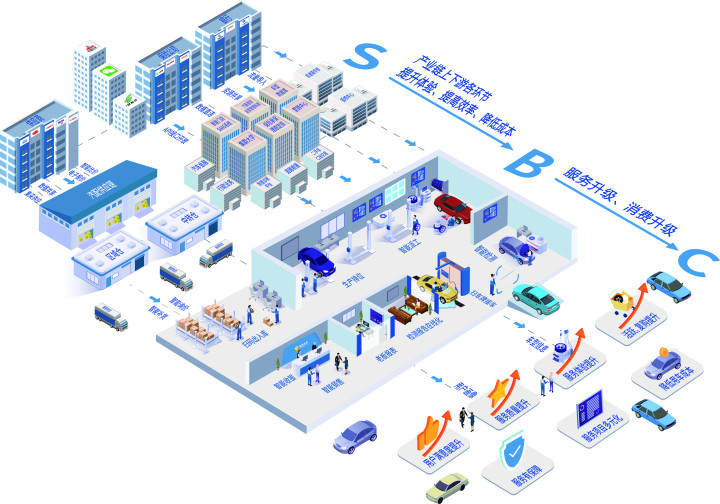
Cluster Chebao S2B2C model diagram
In 2019, Cluster Chebao is already replicating the model and exporting the supply chain and management platform built by its 7 years of data accumulation. The average output value of a single store of its direct-operated stores is about 280,000 yuan. Currently, franchisees are concentrated in individual auto repair stores in Foshan, Guangzhou. Cluster Chebao is also gradually exporting its model through urban partners in Hunan and Guangdong provinces. Franchisees can obtain corresponding maintenance standards, supply chain, information systems, training, logistics and warehousing through the platform. After traditional small and medium-sized stores join the cluster car insurance platform, they still maintain their original brands and stores for operations.
Gao Qunqun, founder and CEO of Cluster Chebao, told 36Kr that Cluster Chebao’s empowered franchise model is the transformation and upgrading of existing stores. Franchisees will use its supply system, ERP system, SAAS system, training system, insurance platform, and second-hand car platform. The S2BSC model is different from the B2C platform. The B2C platform mainly obtains profits from selling auto parts, while the S2B2C model integrates upstream suppliers and downstream terminal auto service stores, and then expands it with value-added services in the aftermarket. Franchisees do not simply obtain the upstream supplier information of Cluster Chebao. They do not need to directly purchase auto parts. Instead, they obtain the goods and sell them through the Cluster Chebao platform. This can reduce the franchisee's operating costs and alleviate the franchisee's capital turnover problem. In terms of maintenance services, Cluster Chebao has established a remote technical diagnosis center to solve technical service problems for some difficult and niche vehicles. Currently, China-Taiwan data includes 308 vehicle brands and electronic catalog information of 1.6 billion parts.
Different from the traditional platform profit model, which mainly focuses on franchise fees, Cluster Chebao's existing model does not charge franchise fees, but obtains benefits through later service fees. Gao Cluster believes that the franchise service fee is more similar to a one-time deal, which will increase the cost of opening a small and medium-sized store and is not conducive to the joint growth of the platform and the store. In addition, Cluster Chebao hopes to lower the entry threshold by waiving franchise fees and reduce the initial investment pressure on store owners. Gao Cluster told 36Kr that Cluster Auto Insurance has reached an agreement with the Bank of China for a total credit of RMB 100 million for franchise stores, and each store has a loan limit of RMB 300,000.
Cluster Chebao's aftermarket service model was first promoted in Guangzhou and Foshan. It plans to establish 20 stores in large districts and about 10 stores in small districts and counties. Currently, there are 49 franchised joint stores. Cluster Chebao has applied for the school license of the "Guangzhou Cluster Car Insurance Auto Training Institute" in 2019, and plans to deploy a school on the automotive service industry chain in 2020.
Cluster Chebao’s franchise stores obtain customers through the following three methods:
1. Regional traffic. The regional attributes of offline stores in aftermarket services are relatively strong, and Gao Cluster believes that on-demand traffic will still be the first source of traffic for stores.
2. Import traffic from B-side partners. Cluster Chebao cooperates with insurance companies (People's Insurance Company of China, Ping An, China Life, etc.), automobile service companies (Sinopec), and financial institutions (China Construction Bank, ICBC, Postal Savings Bank, etc.) to achieve the purpose of traffic exchange. Cluster Chebao will serve as a landing point for road rescue, repair and maintenance, financial derivative services for insurance companies, and value-added services for oil companies. It will also reverse traffic exchanges for partner companies to provide insurance services, financial value-added services, etc.
3. Platform traffic diversion for clustered auto insurance self-operated stores. 36Kr learned that compared with the general repurchase rate of about 20% on industry platforms, the repurchase rate of Cluster Chebao’s current self-operated stores has reached 45%, with 1.12 million registered members on the platform, of which 420,000 are members who spend 1,000 yuan per year.
The automotive aftermarket has the characteristics of focusing on services, many processes, long chains, and strong regional characteristics. Chinese consumers attach great importance to brands, and the automotive aftermarket will further see a cluster of leaders in the future. The existing market is largely occupied by 4S stores due to consumers' maintenance period and brand dependence. However, in fact, the existing vehicle sales, inventory, turnover, capital, maintenance and other businesses of 4S stores are already separated, and the bundled sales model is also well known to consumers. In addition, 4S stores cannot perform cross-brand maintenance due to brand attributes, which actually wastes a lot of production resources and customer flow. my country's automobile market has gradually seen the separation of sales and after-sales.
In the auto parts field in the United States, there are already several unicorn companies with a market value of over 10 billion, such as Auto Zone, and in the maintenance services field, there are also leading manufacturers such as Valvoline. Internet unicorns such as Alibaba and Tencent have plans in the automotive aftermarket, but they are currently in a bottleneck period with poor customer stickiness. This also reflects that what the aftermarket lacks is not traffic, but how to retain users. The core contradiction in the industry still focuses on supply chain and service efficiency issues.
In China's automobile maintenance market, the independent aftermarket system accounts for as much as 75%. However, the independent aftermarket often uses auto parts that are not authorized by the original OEM for maintenance. Quality issues have also been criticized in the past few years. In recent years, the regulatory standards related to auto parts have been continuously tightened. Most auto parts are processed by several OEMs. Therefore, the gap between original parts and non-original parts is reflected in the price, and the brand premium is very high. The emergence of clustered auto parts platforms will bring more unified standards and pricing systems to auto parts manufacturers that are not authorized by the OEM. Platform operators will have higher bargaining power, which is something that scattered independent aftermarket service stores do not have. However, through platform layout, they can enjoy this level of benefits.
According to 36Kr, Cluster Chebao completed an angel round financing of 10 million yuan in March 2014; in January 2016, Cluster Chebao received a 100 million yuan Series A financing led by Shangxin Capital, with personal participation from Zhu Jia, managing director of Bain Capital; in June 2017, it received a 50 million yuan A+ round of financing from Pansheng Capital. In 2018, Baidu and Tencent invested in Tuhu car maintenance, which has demonstrated the enthusiasm of capital for this track. However, pure Internet companies do not have the ability to compete independently. Tuhu entered the market with tire products in the early days of car maintenance. It gradually expanded based on the online transaction + offline installation model and already has a very strong traffic pool. However, Cluster Chebao, through self-operated stores, replicates the model from the perspective of its own car owner traffic, warehousing and logistics, finance, auto parts supply chain and services, and seems to have broader experience in auto parts maintenance categories and implementation experience.
On the relevant track, there are also simple cars with car sales in the sinking market as the core selling point, as well as the chain brand Shenqi Online. At the beginning of its establishment, Cluster Chebao did not directly expand its platform similar to existing Internet car after-sales service providers. Instead, after several years of development of self-operated stores, it built its own supply chain system and management system, breaking away from the services of third-party auto parts centers. As more and more cars leave the 4S store maintenance period, the independent after-car service market is about to enter the stage of platform integration. The self-operated accumulation of Cluster Chebao will be the moat between it and the pure Internet platform.