Boeing has been awarded a $289 million contract to supply up to 5,000 GBU-39/B Small Diameter Bombs (SDB I) to Israel through a Direct Commercial Sales (DCS) agreement. Under the contract, deliveries are expected to begin in about 36 months, reflecting the current production schedule for the precision-guided munition, Bloomberg News reported, citing people familiar with the deal.
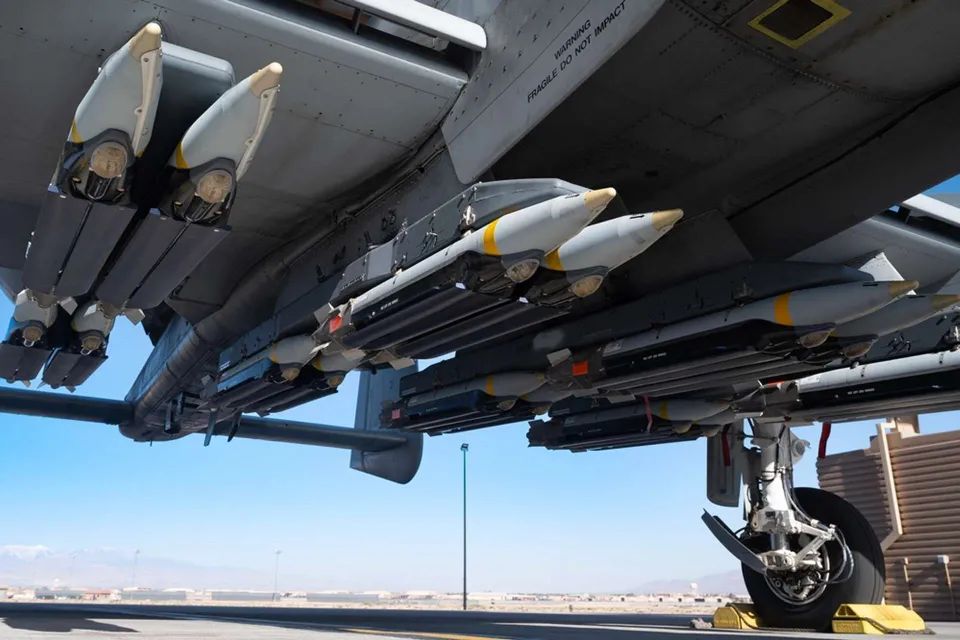
The agreement provides new insights into the current unit price, production capabilities and international demand for the GBU-39/B platform, a widely used precision glide bomb designed for high-precision strikes and reduced collateral damage.
Contract Structure and Pricing
Unlike traditional U.S. government Foreign Military Sales (FMS), the deal is executed as a direct commercial sale between Boeing and Israel, allowing the manufacturer to negotiate directly with the customer.
According to the agreement, the unit price negotiated by Israel was approximately US$57,800 per bomb, and the total order value for 5,000 weapons was approximately US$289 million. The negotiated price was lower than the Air Force's estimated acquisition cost of approximately $67,000, illustrating the potential pricing differences between domestic procurement programs and direct commercial agreements.
The 36-month lead time associated with the Israeli order is broadly consistent with the Air Force's current procurement timeline for the system.
GBU-39/B Small Diameter Bomb Overview
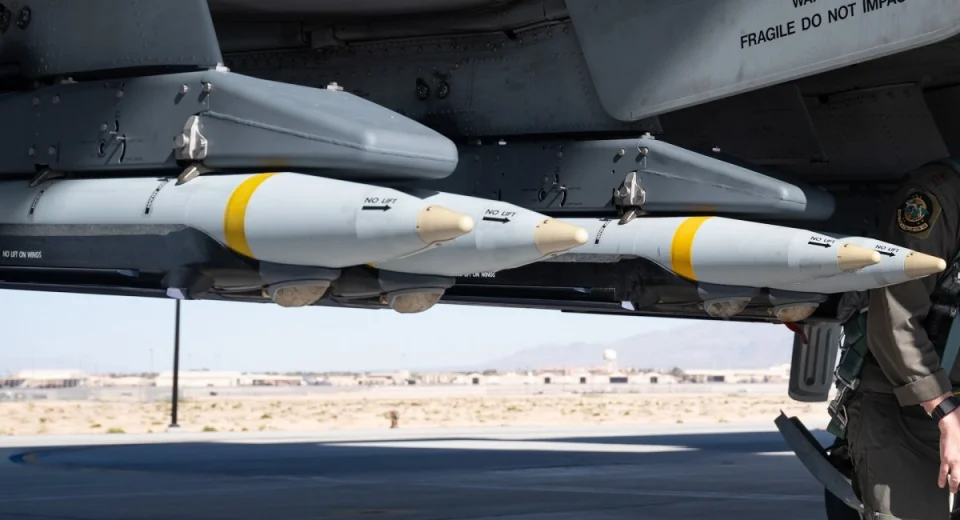
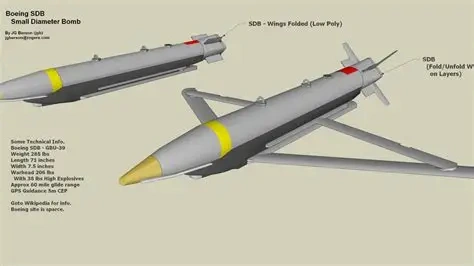
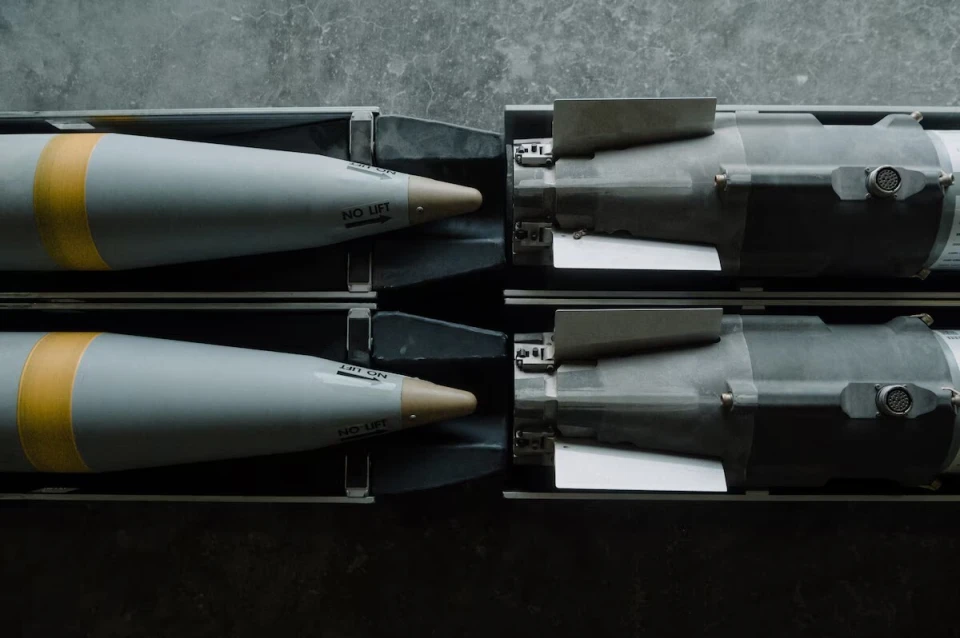
The GBU-39/B, also known as the Small Diameter Bomb Increment I (SDB I), is a 250-pound precision-guided glide bomb designed to provide long-range strike capabilities while enabling the aircraft to carry more munitions per sortie.
The weapon uses Global Positioning System (GPS) guidance combined with an Inertial Navigation System (INS) to maintain accuracy during flight. Its design enables the aircraft to engage targets at a distance of more than 70 kilometers, depending on the release altitude and speed.
One of the system's key features is compatibility with the BRU-61/A pylon, which allows four SDBs to be installed in the space originally occupied by a 2,000-pound bomb. This configuration significantly increases the number of targets the aircraft can attack on a single mission.
The munition is designed for day and night all-weather operations and uses a low-yield penetrating warhead designed to limit collateral damage compared to larger conventional bombs.
Integration with Israeli aircraft
Israel has previously integrated the GBU-39/B onto several aircraft in its inventory. The munition is known to be compatible with Israeli Air Force F-15I, F-16I and F-35I fighter jets and is capable of precision strike missions against a wide range of targets.
The purchase represents at least the third confirmed Israeli purchase of the weapons system. Foreign military sales approved in 2008 included 1,000, with additional quantities delivered through U.S. military assistance programs in subsequent years.
The newly reported contract is separate from other recent U.S. military assistance or foreign military sales notifications involving other munitions.
Production Capacity and Manufacturing Expansion
The GBU-39/B production line has historically been sustained by international orders and foreign military sales, which has helped maintain continued manufacturing even during periods of lower internal U.S. procurement.
Prior to the recent increase in demand, the production line operated at a minimum sustainment rate (MSR) of approximately 750 bombs per year.
Boeing is now increasing production to at least 2,500 bombs per year to meet growing orders from the United States and international partners.
Despite the increase, the production rate of 2,500 pieces represents only about 25% of the production line's total capacity, indicating that there is still room for significant further expansion if future demand requires it.
U.S. Air Force Procurement Project
The recent surge in demand for small-diameter bombs is closely tied to large U.S. Air Force procurement programs.
In September 2024, the Air Force awarded Lot 20, a 10-year indefinite-delivery/indefinite-quantity (IDIQ) contract worth $6.9 billion covering the production and maintenance of SDB munitions.
While the contract was initially structured to exclude foreign participation, subsequent delivery orders incorporated Foreign Military Sales quotas for Bulgaria, Japan and Ukraine.
The Lot 21 production award, expected to be finalized in March 2026, is expected to include a 12-month lead time for initial deliveries to U.S. forces.
Industry tracking suggests that Lot 21 may also include thousands of additional bombs for international customers, possibly including Canada, Norway and South Korea.
Global use and purchasing
The GBU-39/B has been adopted by an increasing number of allied air forces as part of precision strike modernization programs.
In addition to the United States and Israel, operating countries or procurement partners include Saudi Arabia, Australia, Italy, the Netherlands, Japan and several NATO countries.
According to USAF program documents, total U.S. procurement volume for the SDB I Series program has historically exceeded 24,000 units, with continued support, modernization and international sales supporting the program.
delivery schedule
Specific details regarding delivery schedules, integration support or additional equipment related to the Israeli procurement have not been publicly disclosed.
The agreement's 36-month lead time reflects current production backlogs as Boeing expands production to meet growing demand from U.S. military programs and international customers.
The contract is separate from ongoing military operations or other U.S. support programs, according to people familiar with the deal.