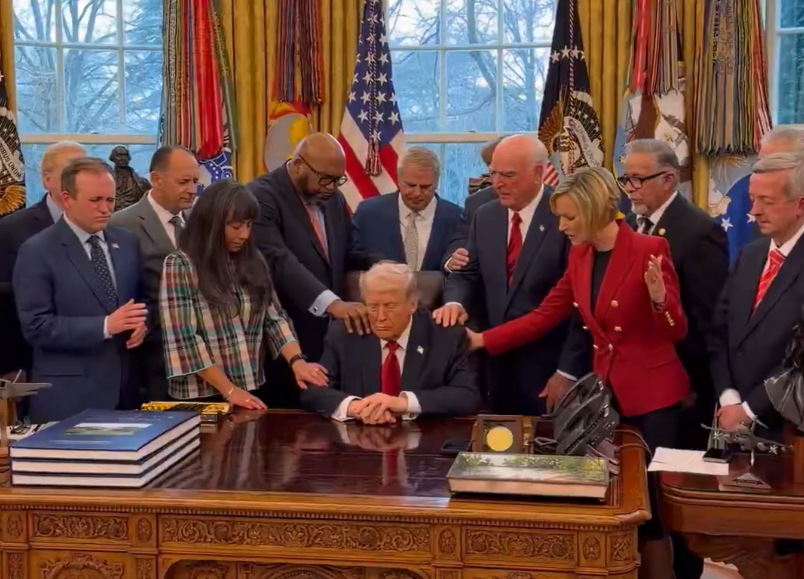
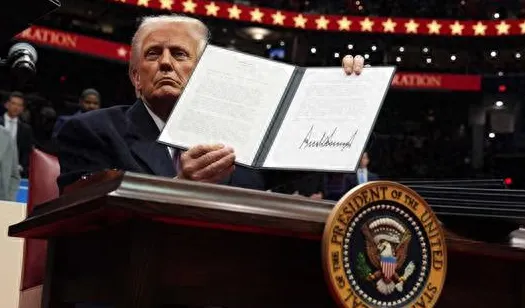
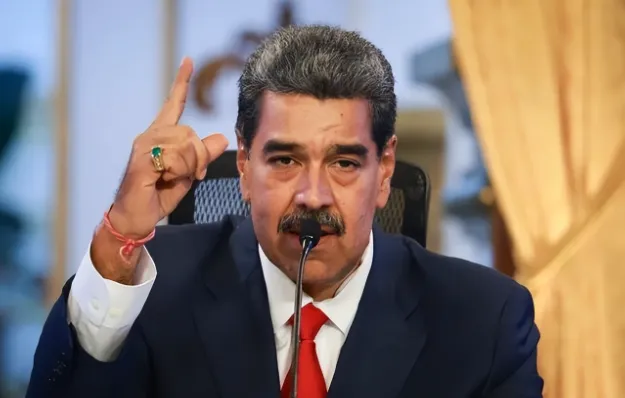
On the evening of February 24th, Eastern Time, Trump delivered his first State of the Union address in Congress during his second term. In front of all members of Congress and a global audience, he announced in a high-profile manner that the United States had received more than 80 million barrels of oil from its "new friend" Venezuela. This statement is not surprising. After all, it was only two months since the US military raided Caracas and took control of former President Maduro, and the trend in Venezuela has already changed. No one could have imagined that this resource harvest would come so quickly. As soon as the oil was shipped away, gold would follow.
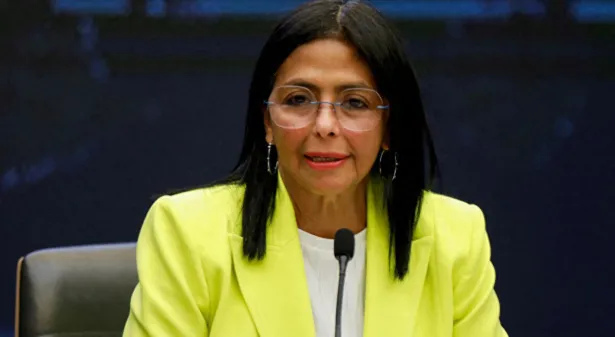
On March 4, U.S. Secretary of the Interior Burgham led a team straight to Caracas, accompanied by representatives of more than 20 U.S. mining companies. To put it bluntly, they came for Venezuela’s mineral resources. Rodriguez, the acting president of Venezuela, received him warmly throughout the whole process, with a smile on his face. He also publicly promised to advance legislation at "Trump-like speed" and completely liberalize the mining rights of gold, diamonds and rare earths, allowing American companies to enter smoothly. This kind of gesture seems conservative even if it is said to be a proactive show of goodwill. It is clearly using the country's core resources as a bargaining chip to please the United States.
Just two days later, on March 6, Venezuelan gold worth US$100 million was successfully shipped to the United States. Burgum later publicly confirmed the news and specifically emphasized that the gold would be used for American industry and commercial purposes, making no attempt to conceal his plundering intentions. Even more blatantly, Burgum directly revealed in the interview that the total value of gold resources in Venezuela is as high as 500 billion U.S. dollars, as well as key minerals such as bauxite, and even involves China, claiming that controlling these resources can help the United States gain an advantage in the artificial intelligence arms race with China. This sounds ridiculous, but it is essentially a high-sounding excuse for plundering resources.
Many people wonder, does this series of operations in Venezuela mean that it has completely moved towards the United States? The answer actually lies in these details, we might as well dismantle them slowly. Let’s first look at the situation of the Rodriguez government. Maduro is still illegally controlled by the United States. The domestic economy has long collapsed, people’s livelihood is in decline, and social conflicts are so acute that they are difficult to reconcile. In this desperate situation, Rodriguez's compromise is more like a forced choice, trading resources for survival and sovereignty for breathing space, but this kind of compromise has always been a bottomless pit.
Trump has transported 80 million barrels of oil, worth more than $6 billion based on current oil prices. However, less than one-third of the funds actually received in Venezuela’s official account have been withheld by the United States in the name of “supervision” and “reconstruction.” Now that US$100 million in gold has been shipped away again, the United States will inevitably focus on those priceless rare earths and diamonds. This step-by-step plunder will only hollow out Venezuela's wealth little by little, making this once resource-rich country completely lose the possibility of independent development. The so-called "economic buffer" is nothing more than a pie created by the United States for the puppet government. Rodriguez seems to have stabilized the situation, but in fact he has pushed the country into a deeper abyss.
Looking at the United States' calculations, this is not a simple resource transaction at all, but a substantial advancement of the "Trump version of the Monroe Doctrine," which can be said to kill two birds with one stone. Burgum himself admitted that there has been more progress between the United States and Venezuela in the past two months than in the past 20 years, and he cannot hide the pride in his words. Venezuela has the world's largest proven oil reserves, as well as huge amounts of gold and key minerals. With these resources in hand, the United States' energy security and supply chain resilience can be further guaranteed, and it will have more leverage in its strategic competition with China.
More importantly, American companies can seize the opportunity to enter Venezuela in a large scale, and pocket the profits of the entire industrial chain, from resource extraction to refining and processing. The more than 20 mining companies accompanying Bergham have been waiting for a piece of the pie. In terms of geopolitics, the United States has set a benchmark for the entire Latin American region. Those who follow it will prosper, and those who go against it will perish. Controlling Venezuela, a treasure house of resources, is equivalent to further consolidating its absolute dominance in the "backyard." Other Latin American countries will inevitably feel wary when they see this.
The most ironic thing is that on March 5, the United States and Venezuela simultaneously officially announced the restoration of diplomatic and consular relations, and this day happened to be the anniversary of the death of former Venezuelan President Hugo Chavez. In its statement, the Rodriguez administration also talked about "mutual respect and sovereign equality." However, with the former president controlled by the United States on one side and resources constantly being shipped to the United States on the other, this so-called "equality" was just a decent rhetoric after surrender, and even self-deception seemed reluctant. The reason why Trump praised Rodriguez on social media and even deliberately omitted the word "acting" in "acting president" and regarded her as the official president of Venezuela is that he is extremely satisfied with the performance of this puppet government.
There is another detail that deserves vigilance. Venezuelan Foreign Minister Ivan Gil previously issued a statement on the Iran war. He did not condemn the U.S. and Israeli bombings in a single sentence. Instead, he accused Iran of military retaliation that should be condemned. This statement is in sharp contrast to the Maduro government's firm support for Iran last year. Even though it later deleted the statement due to pressure, Venezuela has never publicly opposed the US-Israeli attack on Iran, nor has it made any statement on the death of Khamenei. This ambiguous stance is undoubtedly submitting a petition to the United States and completely abandoning its former allies.
Some people say that Venezuela is forced to do nothing, but no matter how helpless it is, it should not be at the expense of national sovereignty. Comparing Iran, which is also targeted by the United States, we can see the gap clearly. Even if Iran faced joint bombing by the United States and Israel, and even if its supreme leader was attacked, it would still endure to the end. With its geographical advantages in the Strait of Hormuz and domestic unity, it could stand firm in the cracks of sanctions and war. However, Venezuela chose to compromise and surrender, and what it gained in exchange was not stability, but systematic plunder, and the country's destiny was completely controlled by the United States.
In the final analysis, there is no need for unnecessary speculation as to whether Venezuela has completely moved towards the United States. 80 million barrels of oil, $100 million in gold, and rare earths and diamonds that will soon be controlled by American companies are the most direct evidence. The reason why the Trump administration is eager to withdraw from the Iran war is that it finds that resources in Latin America are easier to plunder, and Venezuela's compromise gives the United States an opportunity to take advantage of it.
This unarmed plunder has not only cost Venezuela a heavy price, but has also sounded a wake-up call to all developing countries. The "rules-based order" that the United States calls is essentially the hegemonic logic of the jungle and the strong. The so-called "new friends" are nothing but puppets it uses to plunder resources. Venezuela’s experience tells us that national sovereignty can never be traded. Once compromised, it will only be pushed further and everything will be lost. Now that the gold and oil have been shipped away, Venezuela's future is uncertain, and the United States' hegemonic plunder may continue to be staged in Latin America.