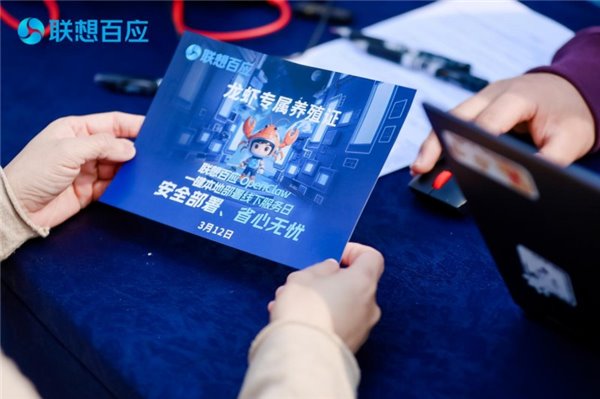
On March 12, a special AI experience event was held in the Zhongguancun Software Park in Beijing. Lenovo Baiying engineers completed the local deployment of OpenClaw for users on site, and the staff answered questions from the audience on technical issues and safe use in the "lobster farming" process.
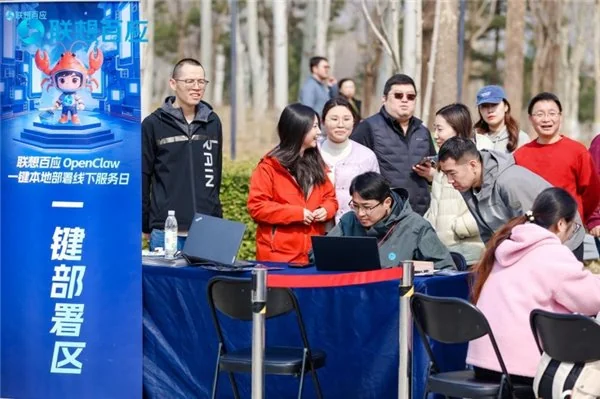
This offline experience event is another move by Lenovo Baiying to promote the large-scale implementation of the open source AI agent OpenClaw. Previously, Lenovo Baiying has joined hands with two major platforms, Meituan and JD.com, to launch remote one-click deployment services. Lenovo Baiying's in-store deployment and door-to-door deployment services have also been gradually launched, and will soon achieve full online and offline coverage of installation services. As an important part of Lenovo Baiying's × OpenClaw digital employee solution, Lenovo Baiying's NUC terminal, which is natively adapted to Windows and OpenClaw, has become a hard-to-find market. While OpenClaw continues to be popular, its security application issues have also attracted much attention. The National Internet Emergency Center recently issued relevant risk warnings, and Lenovo Baiying provides users with an effective solution to resolve security anxiety with its dual layout of "local deployment solution + exclusive AI hardware terminal".
As an open source agent that has recently detonated the AI market, OpenClaw is regarded by the industry as an important carrier of the agent-driven productivity revolution due to its ability to perform tasks autonomously and adapt to all scenes of office use. It is also affectionately called "crayfish" by users. However, industry pain points such as complex environment construction, high debugging threshold, and cumbersome deployment processes have deterred many ordinary users and small and medium-sized enterprises. In order to break the technical barriers to the implementation of AI applications, Lenovo Baiying took the lead in launching cross-border collaboration and reached an in-depth cooperation with Meituan to launch the exclusive OpenClaw remote deployment service. Users only need to search for "lobster installation" in the Meituan App, and they can place an order with one click and enjoy remote one-on-one operation by professional engineers. The entire process from configuration to debugging is taken care of, truly achieving "zero-threshold" access with no technical background.
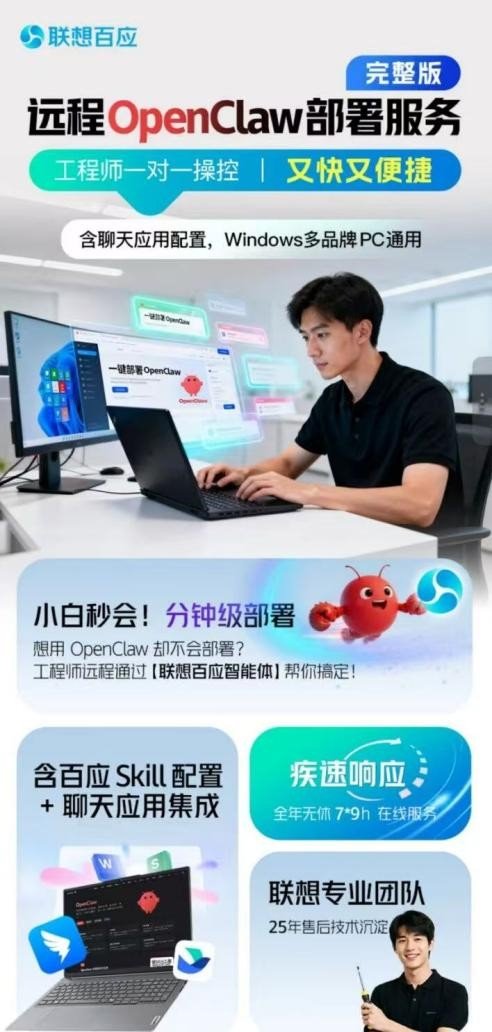
Immediately afterwards, Lenovo Baiying teamed up with JD.com to launch the OpenClaw remote deployment special service. Users can place orders by searching "Lobster farming on JD.com" on JD.com. Certified engineers can complete the configuration within 30 minutes. Exclusive AI office skills will also be pre-installed, allowing users to quickly unlock core capabilities such as code writing, document processing, and email organization. At present, Lenovo Baiying's OpenClaw deployment service has achieved nationwide coverage. Relying on the traffic and service networks of Meituan and JD.com, high-quality AI technology services can reach a wider user group, achieving precise connection between technical services and public needs. The offline deployment activities of Zhongguancun Software Park extend services from online to offline, allowing users to intuitively experience the implementation experience of OpenClaw, further lowering the threshold for using AI technology.

While deployment services continue to be implemented, Lenovo Baiying launched Baiying NUC, an AI terminal that is natively adapted to Windows and OpenClaw, and has become a popular product in the market, with a box being hard to find. This terminal adopts the trinity ecological model of "software (OpenClaw) + hardware (Baiying NUC) + AI service (Baiying Intelligent)", breaking the limitation of traditional hardware only serving as a computing power container, and achieving an upgrade of the out-of-the-box experience of the intelligent agent. Its core advantage is that it can achieve zero-threshold local deployment in a Windows environment in 3 minutes. Relying on OpenClaw's long-term memory capability, it can continuously accumulate user workflow and usage preferences, allowing the agent to "understand you" more and more with use. At the same time, it has built-in rich AI office skills, which can interactively optimize mainstream office tools such as DingTalk and Feishu, and convert complex analysis conclusions into structured documents such as Word, Excel, and PDF, greatly improving team collaboration efficiency.
The rapid popularity of OpenClaw has also brought its security issues to the surface. Because the agent is granted higher system permissions such as accessing local file systems and calling external APIs, and the default security configuration is relatively fragile, the National Internet Emergency Center recently issued a risk warning, pointing out that it has four major security risks: "prompt word injection", "misoperation", "plug-in poisoning" and "security vulnerabilities", which may lead to user privacy leaks, core data loss and even system control. Relevant experts also reminded that users need to take safety precautions when "raising lobsters" to avoid usage risks.
In response to this industry problem, the relevant person in charge of Lenovo Baiying said that "local deployment mode + Baiying NUC exclusive AI terminal" can effectively solve users' security anxiety. Lenovo Baiying × OpenClaw digital employee solution creates an enterprise-level data security fortress. Through physical isolation technology, the company's core data, personal documents and business processes are all retained on local hardware, achieving physical-level security isolation and avoiding the risk of leakage caused by data uploading to the cloud from the source. At the same time, the terminal has a built-in 7×24-hour daemon, which not only perfectly adapts to the long-term running requirements of OpenClaw, but also ensures the stability of remote control. During the deployment process, Lenovo Baiying engineers will also reasonably configure system permissions to avoid security loopholes in default settings, allowing users to use AI agents compliantly and worry-free.

Currently, AI agents are at a critical stage from "technical concept" to "large-scale application". The popularity of OpenClaw is an intuitive reflection of the market's demand for intelligent productivity. Through online and offline multi-terminal layout, Lenovo Baiying teamed up with Meituan and JD.com to create convenient deployment services. At the same time, it used Baiying NUC terminals to build an integrated "hardware and software" solution, which not only broke the technical barriers to the implementation of AI applications, but also solved the industry pain points of its safe use. In the future, Lenovo Baiying will continue to delve into user needs and launch advanced functions such as batch deployment and customized configuration. At the same time, it will continue to work with ecological partners to promote the popularization and safe implementation of AI agents, allowing more users to enjoy the productivity innovation brought by AI, and ushering in a new era of AI with active intelligent agent services and sustainable evolution.