Nowadays, when it comes to invasive alien species, people are familiar with them: "Scavenger", Brazilian turtle, alligator gar…
But it’s hard to imagine that a country in South America is being invaded by hippos. A large number of hippos are raging in Colombia, and their numbers continue to surge.
They wander the streets, bite people in villages, and produce huge amounts of feces in rivers. They make the lives of Colombia's native animals worse than death, and their numbers have dropped sharply, making the already bad situation worse.
Seeing this, most people will be confused: How did these guys who originally lived in Africa cross the ocean and come to Colombia? How did you end up wandering?
"Cocaine Hippopotamus"
The story begins with a Colombian man named Pablo Escobar.
Pablo was once a rich man and was once selected as one of the seven richest people in the world by Fortune magazine. The way he made his fortune is harder to imitate – selling drugs. He once maintained a private armed force of 40,000 people, with better equipment than the government army, including tanks, helicopters, and even small submarines. He established a drug empire called the "Medellin Cartel" in Colombia and beat the government to its knees.
If you are interested in his story, you can watch the American TV series "Narcos".
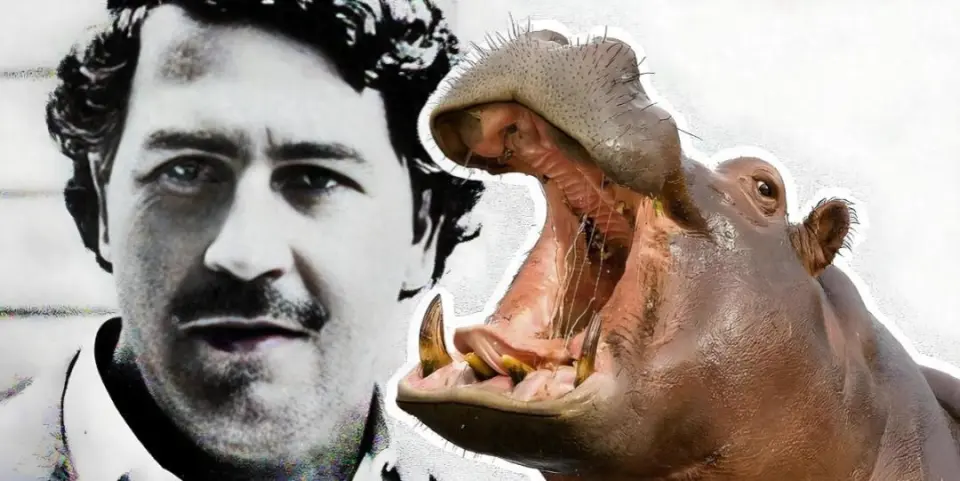
Drug lord Pablo and his hippopotamus pictures/video screenshots
After having too much money to spend, Pablo began to build schools, hospitals, churches, and even houses for the poor, becoming a well-known "good man" from all over the country.
In the 1980s, after Pablo became a "good man", he found that his 20 square kilometers of manor seemed a bit empty, so he decided to build a zoo at home.
Through illegal smuggling, Pablo obtained various animals including elephants, ostriches, rhinos, kangaroos, among which were four hippos, one male and three females.
China News Weekly learned that various versions of the story have described that these four hippos were smuggled from Africa by Pablo through personal connections. In fact, Pablo did smuggle a large number of animals, but these four hippos were imported from a wildlife breeding center in Dallas, USA.
In the American drama "Narcos", Pablo once kidnapped the Mexican drug lord Miguel to his estate and threatened to throw him into a hippopotamus pool. In the drama, Pablo once described the hippopotamus like this:
"They look gentle, like a baby, fat and bald, but it's very irritable. If you touch something it cares about, it'll bite you in two."
I have to say that Pablo understands hippos very well.
In 1993, Pablo was shot dead by the government after escaping from prison. The manor was confiscated, and most of the animals in the zoo were returned to the public zoo opened by the government, except for the four hippos.
They were adults and were inconvenient to move due to their huge size. The local zoo was unable to take them over. In the end, they were temporarily left in the empty manor and were called "cocaine hippos."
"My home, my paradise"
At first, the four hippos, "one king and three queens", were anxious due to lack of food, but this anxiety was soon dispelled.
Native to Africa, the hippopotamus' main habitat is south of the Sahara Desert. In the hippopotamus' hometown, there are distinct dry and rainy seasons. The rainy season is natural and comfortable, but in the dry season, hippos even have to face the test of dehydration due to various reasons such as lower water lines, rising temperatures, and direct sunlight.
But in Colombia it's a different story. Pablo Manor, located in the middle reaches of the Magdalena River, has abundant water resources, no dry season, and plenty of food around the river. More importantly, there are no competitors in nature that match the size of the hippos. For hippos, this is simply their "paradise". Even without Pablo's "care", the life of the four hippos is still very good.
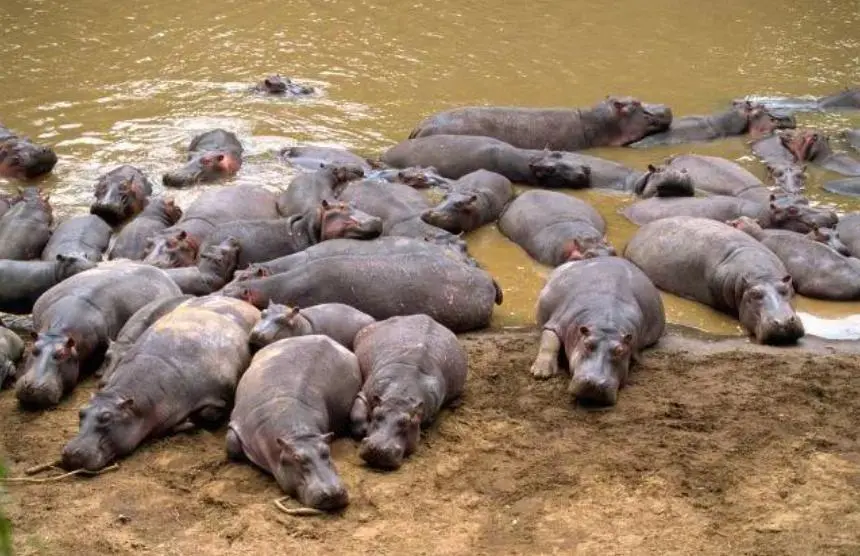
Hippopotamus pictures/video screenshots in Colombia
Thus, their unrestrained, carefree, and shameless life began. Slowly, they discovered that their scope of activities was no longer limited to the manor. The outside of the manor was also good, and their sphere of influence continued to expand.
By around 2006, the number of hippos near the manor had increased from the original 4 to 16. By 2019, this number had increased to 120. By the end of 2023, scientists analyzed that there were more than 200 hippos in Colombia. Hippo populations are increasing exponentially, and if left unchecked, there will be thousands of hippos in Colombia within a few decades.
The person in charge of a domestic zoo told China News Weekly that hippos in estrus appear to be very "casual". Compared with some animals that "sit calmly", hippos are of the type that "will not reject anyone who comes", which makes hippopotamus breeding easier. In an artificial environment, if you want to prevent it from reproducing, you need a lot of human intervention, and you even need to reduce its living space to prevent it from mating, but in the wild, none of this exists.
Unlike other invasive alien species that appear to be "harmless to humans and animals," hippos are, as Pablo said, very irritable.
According to incomplete statistics, after Pablo's death, there have been many incidents of hippos hurting people in Colombia, including: entering the elementary school playground for a walk and suddenly charging at elementary school students, suddenly attacking a man's buttocks on the roadside in the middle of the night, attacking a fishing guy by the river and throwing him into the air, biting a fishing boat and sinking it…
I can’t catch up, and I can’t find the “egg” if I catch up.
The increase in the number of hippos not only threatens the lives and property of surrounding people, but also causes great damage and impact on the ecology.
Eutrophication has occurred in the river channels along the Magdalena River where hippos gather. The ecological niche of semi-aquatic and herbivorous mammals in the Magdalena River Basin has been occupied. The living conditions of capybaras and manatees have declined sharply. There are also some endangered amphibians and reptiles that have become difficult to trace after the increase in the number of hippos.
In fact, the Colombian government has long been aware of the consequences of hippo population growth and has begun trying to change some of the status quo.
In 2009, the Colombian military once killed a hippopotamus, but it was dissatisfied by the people of the country. Some American environmentalists even came to Colombia across the border to demonstrate in protest. Domestic and foreign protesters have reached a high degree of unity in their attitude: "Hippopotamus are so cute, how can you kill them casually?"
Therefore, after 2010, the Colombian government began to seek to control the number of hippos through sterilization. But when this thing is done, people realize how laborious it is.
The prerequisite for sterilization is anesthesia, and hunting down a hippopotamus to anesthetize it usually requires the cooperation of multiple adult men. They have bad tempers, huge bodies, and unpredictable movements, so various difficulties often arise.
Difficulties include but are not limited to: not being able to find it, finding it but not being able to catch up, catching up but not being hit, being hit with not enough medicine but not being numb, being numb with too much medicine and not waking up…
But actually numbing the hippos is the first step in the task of sterilizing them. The testicles of the hippopotamus can be said to be a miracle of evolution in the biological world. The hippopotamus has no scrotum and the testicles are completely hidden in the body. The hippopotamus has a special tube to hide the testicles, which allows the testicles to move within the body.
The difficulty of sterilizing a hippopotamus can be said to be epic. It often takes a long time after anesthesia, and the doctor is still groping for the hippo's crotch to determine the location of its testicles.
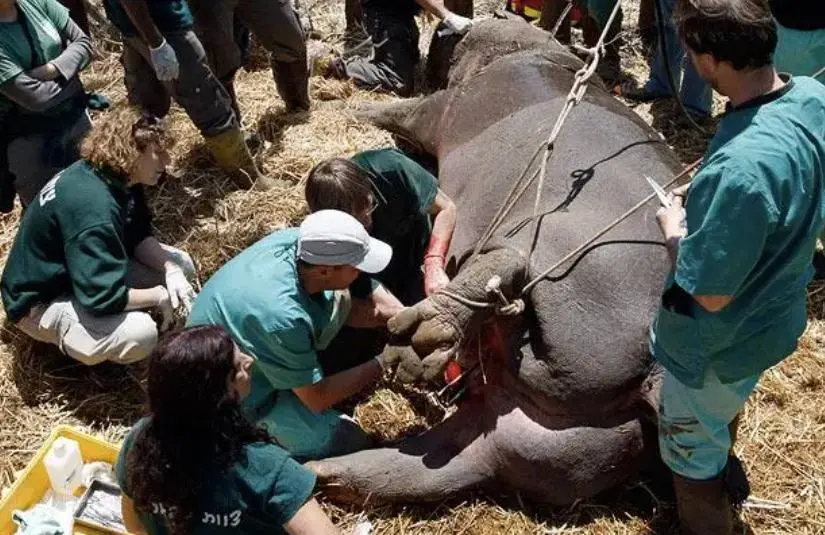
Pictures/video screenshots of hippopotamus sterilization surgery
The key is that the position of each hippopotamus' testicles is uncertain after being numbed, which means that this task is often done and there is no strategy to check. It was not until the veterinary team adopted ultrasound technology that the situation became slightly easier.
Subsequently, the Colombian government decided to abandon the once backward "egg-hunting sterilization" method and instead used contraceptive injections, injecting a contraceptive vaccine into the hippopotamus to achieve a short-term contraceptive effect. In 2021, 24 hippos received this kind of contraceptive injection, but for the growing number of hippos, this is still a drop in the bucket.
Some scientists predict that without effective intervention, the huge number of hippos will further harm Colombia's ecological environment by 2030, and the safety of local residents will also be greater threatened.
References
"Cocaine" hippopotamus: Hunt or protect? 》Chinese Science Journal